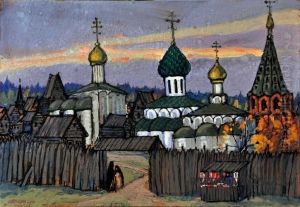
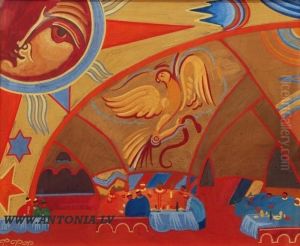
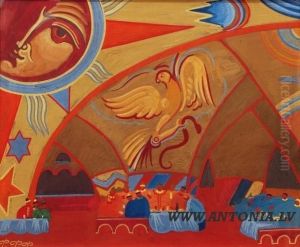
Fjodor Fjodorovsky was a prominent Russian and Soviet scenographer and theater artist, known for his work in opera and ballet. Born in 1883 in Moscow, Fedorovsky began his career in the field of theater design after studying at the Moscow School of Painting, Sculpture and Architecture. He was a student of renowned Russian artists such as Korovin and Serov, which helped him develop a nuanced understanding of visual arts that he would later apply to his stage designs.
Fedorovsky's career was closely linked with the Bolshoi Theatre, where he worked for many years, creating set designs for numerous productions. His work was characterized by its grandeur, attention to historical accuracy, and a strong sense of drama and spectacle. He often drew inspiration from Russian history and folklore, which he integrated into his designs to enhance the theatrical experience.
During the Soviet era, Fedorovsky's designs aligned with the aesthetic of Socialist Realism, which was the official art style promoted by the Communist Party. Despite the restrictions this style imposed, he managed to retain a sense of creativity and innovation in his work. Fedorovsky’s contributions to the world of theater extended beyond set design; he was also involved in costume design, and his efforts were instrumental in shaping the visual aspects of Soviet ballet and opera during the first half of the 20th century.
Fedorovsky's influence was not limited to Russia; his work was recognized internationally, and he was involved in theater productions abroad. His legacy includes not only the numerous sets and costumes he designed but also the generations of scenographers and designers he inspired through his teaching and mentorship.
Fedorovsky died in 1955, leaving behind a rich legacy of artistic achievement that continued to influence the world of theater design in Russia and beyond. His work remains a testament to the power of visual storytelling in the performing arts.