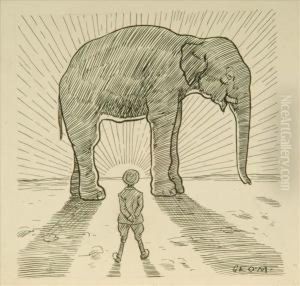
George Morrow was an Irish illustrator and cartoonist, born in 1869 in Dalkey, County Dublin. He came from an artistically inclined family; his brothers Jack, Albert, and Norman were also involved in the arts. Morrow developed his distinctive style early on, and during his career, he worked for various magazines and publications, showcasing his versatile ability to capture both the whimsy and the satire of the day.
He moved to London to further his career, where he became well-known for his contributions to publications such as Punch, The Tatler, and The Bystander. Morrow was particularly noted for his humorous illustrations and cartoons, which often commented on social and political issues of the time. In addition to magazines, Morrow also illustrated several books, including children's books and humorous works.
Beyond his work in print, George Morrow was involved in the world of advertising, creating memorable campaigns that were innovative for their use of humor and imagery. Despite his success in various domains, he is not as widely remembered today as some of his contemporaries, often overshadowed by the likes of more famous illustrators and cartoonists of the early 20th century.
George Morrow's work was characterized by a fluid and confident line, a keen eye for the absurd, and a gentle yet incisive wit. His ability to create engaging characters and scenarios was evident across his body of work. He was adept at both single-panel cartoons and sequential art, showing a narrative flair that endeared his work to both adults and children.
Morrow's influence extended beyond the page; he was a co-founder of the London Sketch Club, an organization that provided a social and professional hub for illustrators and cartoonists. Throughout his life, he continued to contribute to the art community and remained active in the industry.
George Morrow passed away in 1955, leaving behind a legacy of work that continues to be appreciated by those with an interest in the history of illustration and cartooning. His contributions to the field are remembered for their wit, artistic skill, and the unique perspective they provided on the culture and politics of his time.