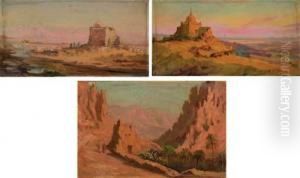
Jose Ortega was a prominent Spanish painter and printmaker associated with the abstract expressionism movement. Born in 1921 in Valencia, Spain, he grew up during a period of significant political unrest, which influenced his early works. Ortega began his artistic training at the Royal Academy of San Carlos in Valencia, where he was exposed to both traditional Spanish painting techniques and the emerging trends of the European avant-garde.
As a young artist, Ortega's style evolved from figurative work to a more abstract approach. He was deeply affected by the Spanish Civil War and the subsequent dictatorship under Francisco Franco, themes that often found their way into his art. In the late 1940s, Ortega moved to Paris, which was then the center of the art world. There, he was influenced by the works of Picasso and the existentialist philosophy that pervaded post-war Europe. Ortega's work from this period is characterized by a dynamic use of color and form, and often reflected his ongoing concern with the human condition and the complexities of modern life.
In the 1950s, Ortega traveled extensively, including visits to the United States, where he encountered the works of the Abstract Expressionists, such as Jackson Pollock and Willem de Kooning. These experiences informed his subsequent artworks, leading to a style that combined European abstraction with the energy and scale of American painting. Ortega's canvases from this period are noted for their expressive brushwork and bold experimentation with materials and techniques.
Throughout his career, Ortega also explored printmaking, particularly lithography, etching, and woodcut, which allowed him to reach a broader audience. His graphic works often served as a more accessible counterpart to his paintings, with similar thematic and stylistic concerns.
Ortega's contributions to art were recognized with numerous awards and exhibitions throughout Europe and the Americas. He continued to paint and exhibit his work until his death in 1990. Today, Jose Ortega's legacy is preserved through his artworks, which are held in private collections and museums around the world, and through critical studies that place him among the important figures of 20th-century Spanish art.