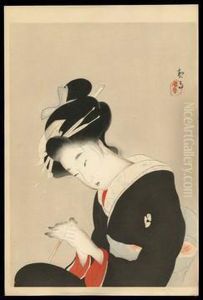
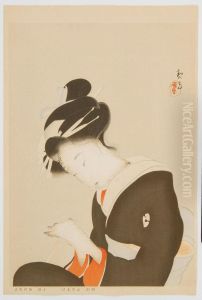
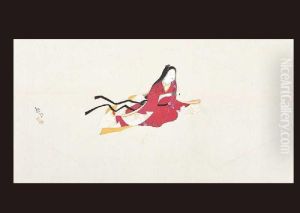
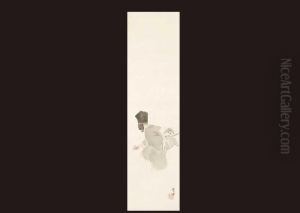
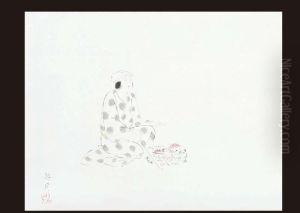
Kikuchi Keigetsu was a prominent Japanese painter, born in 1879 in Taketa, Oita Prefecture, Japan. His career spanned a significant period in Japanese art history, straddling the Meiji, Taisho, and Showa periods, during which Japan underwent substantial cultural and political changes. Keigetsu is best known for his contributions to Nihonga, a term referring to traditional Japanese painting techniques and subjects, which he adeptly combined with influences from Western art movements, thereby playing a crucial role in the modernization of Japanese painting.
Keigetsu initially studied with Kano Hogai, a master of the Kano school, which had been influential since the Muromachi period (1336–1573). This early training instilled in him a deep appreciation for traditional Japanese artistic principles and techniques. However, Keigetsu's artistic journey took a pivotal turn when he moved to Tokyo, where he was exposed to Western art forms. This exposure broadened his artistic vision and led him to incorporate Western techniques and perspectives into his work, without abandoning the essence of traditional Japanese painting.
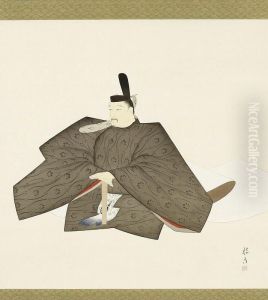
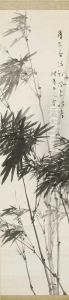
Throughout his career, Keigetsu achieved a harmonious blend of East and West in his art. He was particularly admired for his landscape paintings and his delicate depictions of historical and mythological themes, which were rendered with a refined sensibility and attention to detail. His work not only reflected the aesthetic values of his time but also contributed to the evolving narrative of Nihonga, as he explored new motifs and experimented with painting materials and techniques.
Keigetsu's contributions to the art world were recognized with several honors, including his appointment to the Imperial Art Academy (Teikoku Bijutsu-in) and the receipt of the Order of Culture (Bunka Kunsho) from the Japanese government, acknowledging his significant impact on the cultural heritage of Japan. His paintings are held in high esteem and can be found in prestigious collections both in Japan and internationally.
Kikuchi Keigetsu passed away in 1955, leaving behind a legacy that continues to influence Nihonga painters. His work is celebrated for its beauty, technical excellence, and the seamless integration of traditional and modern elements. Through his paintings, Keigetsu captured the spirit of his changing times and contributed to the broader discourse on the nature of Japanese identity and aesthetics in the modern era.