Abraham de Verwer: A Dutch Master of Marine and Urban Vistas
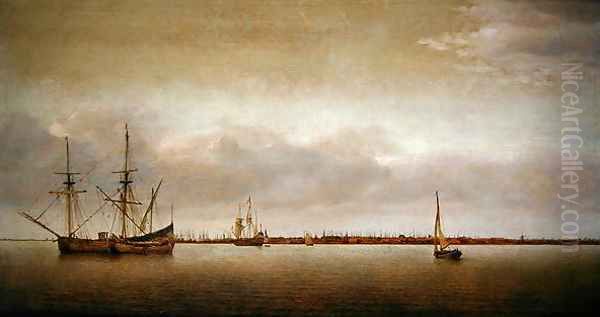
The Dutch Golden Age, spanning roughly the 17th century, was a period of extraordinary artistic efflorescence, witnessing the rise of masters who captured the multifaceted life of the newly independent Dutch Republic. Among these talents was Abraham de Verwer (circa 1585–1650), a painter whose contributions to marine art and cityscapes offer a vivid window into the maritime prowess and urban vitality of his time. Though perhaps not as universally recognized today as some of his contemporaries like Rembrandt van Rijn or Johannes Vermeer, De Verwer carved a distinct niche for himself, celebrated for his detailed renderings, atmospheric sensibility, and ability to convey both the grandeur of naval power and the quiet charm of daily life.
Early Life and Artistic Formation in Haarlem and Amsterdam
Abraham de Verwer is believed to have been born in Haarlem around 1585. Haarlem, at this time, was a significant artistic hub, particularly known for its landscape and marine painters. It was the birthplace of Dutch marine painting as a distinct genre, largely pioneered by artists like Hendrick Cornelisz Vroom (1566–1640). Vroom, often hailed as the father of Dutch marine painting, moved away from the bird's-eye views of earlier traditions to more naturalistic depictions of ships and sea, emphasizing realistic wave patterns and atmospheric conditions. His influence on subsequent generations of marine artists was profound.
While the provided information initially suggests Vroom as De Verwer's teacher, more specific accounts point towards Jochem de Vries as his primary instructor. It's plausible that De Verwer was exposed to Vroom's groundbreaking work and style, which permeated the artistic environment of Haarlem, even if his direct tutelage came from another. Jochem de Vries, himself a marine painter, may have been De Verwer's father, and their stylistic similarities suggest a close artistic relationship, typical of the master-apprentice system prevalent in that era. This system involved rigorous training within a master's workshop, where apprentices learned by copying, assisting, and eventually developing their own skills.
De Verwer later moved to Amsterdam, the burgeoning commercial and cultural heart of the Dutch Republic. This city, with its bustling harbors, intricate network of canals, and wealthy merchant class, provided ample inspiration and patronage for artists. It was in Amsterdam that De Verwer's career truly flourished, and he became known for his depictions of its waterways and naval engagements. His connection to the city is evident in his works and the commissions he received.
The Distinctive Style and Thematic Concerns of De Verwer
Abraham de Verwer's artistic style is characterized by a meticulous attention to detail, particularly in the rendering of ships, architecture, and human figures. His marine paintings, especially those depicting sea battles, are noted for their large scale, bright coloration, and rich detailing, capturing the drama and complexity of naval warfare. He possessed a keen ability to depict the intricate rigging of ships, the dynamic movement of water, and the atmospheric effects of light and weather, lending a sense of immediacy and realism to his scenes.
His thematic concerns were primarily focused on marine subjects and cityscapes. The sea was central to Dutch identity and prosperity, and marine painting became an immensely popular genre. De Verwer contributed significantly to this tradition, painting everything from tranquil harbor scenes to dramatic naval encounters. His works often celebrated Dutch maritime strength and commercial success. Artists like Jan Porcellis (c. 1584–1632) and Simon de Vlieger (c. 1601–1653) were also prominent marine painters of this era, each developing unique approaches to capturing the sea's moods, with Porcellis known for his tonal subtlety and De Vlieger for his luminous, atmospheric seascapes.
Beyond the open sea, De Verwer was adept at capturing the life of Dutch cities. His cityscapes are not merely topographical records but are imbued with a sense of place and daily life. He skillfully depicted the interplay of water, boats, and architecture that defined cities like Amsterdam. His eye for detail extended to the small human activities within these urban settings – merchants conducting business, sailors at work, citizens going about their day – which animate his compositions and provide a rich social tapestry. This focus on everyday life was a hallmark of much Dutch Golden Age painting, distinguishing it from the more grandiose themes often favored in other parts of Europe.
Masterpieces of the Sea and City
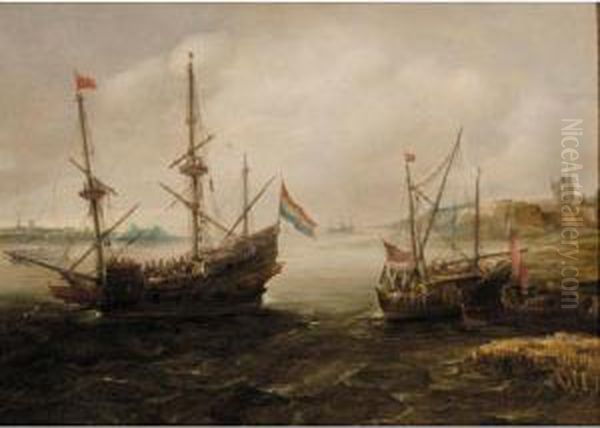
Several key works exemplify Abraham de Verwer's artistic prowess and thematic interests. His painting, often referred to as "Amsterdam's Inner Amstel" or "Schepen op de Amstel" (Ships on the Amstel), is considered one of his early significant works. This piece vividly portrays the bustling activity of Amsterdam's inner harbor, with various vessels moored or navigating the waters, and details such as a customs house. It showcases his ability to capture the specific character of a location and the minutiae of daily maritime commerce. This work is now housed in an Amsterdam museum, a testament to its local historical and artistic significance.
Another crucial work is "The Battle on the Zuiderzee," completed around 1621. This painting depicts a naval engagement, likely celebrating a Dutch victory, and is characterized by its dynamic composition, detailed rendering of warships in action, and dramatic use of smoke and light. Such paintings served not only as artistic achievements but also as patriotic statements, reinforcing the Republic's naval might. This painting is preserved in the prestigious Rijksmuseum in Amsterdam, alongside masterpieces by many of his most famous contemporaries.
His "View of Hoorn," created around 1650, towards the end of his life, is celebrated for its serene atmosphere and exquisite rendering of light. The painting depicts the port town of Hoorn, possibly at sunset, with calm waters reflecting the sky and the town's distinctive architecture, including its belfry, meticulously recorded. This work is considered a fine example of Dutch Golden Age cityscape painting, capturing a moment of tranquility and civic pride. Its pure light and peaceful mood are characteristic of a particular strand of Dutch landscape and cityscape painting that emphasized harmony and order. The National Gallery of Art in Washington D.C. is the current home for this evocative piece.
A further example of his marine art is "Seascape with Shipping," dated to around 1640. This work, now part of the UK Government Art Collection, likely showcases his skill in depicting various types of vessels navigating the open sea, highlighting his understanding of maritime life and the challenges of seafaring. Such scenes were popular among a populace whose fortunes were intrinsically linked to the sea.
A Sojourn in France: Parisian Views
De Verwer's artistic endeavors were not confined to the Netherlands. Evidence indicates that he traveled to France, specifically Paris, where he produced a number of significant paintings. Notably, he created views of the Louvre Palace. Interestingly, these Parisian scenes were not commissioned by French patrons, as one might expect, but by Prince Frederick Henry of Orange, a leading figure in the Dutch Republic and a significant patron of the arts. This commission suggests that De Verwer's reputation extended beyond Dutch borders and that his skills were sought after for prestigious projects.
His "A View of Paris," which includes iconic landmarks such as the Louvre and potentially views towards the Pont Neuf or Notre Dame, demonstrates his versatility in adapting his cityscape skills to a foreign urban environment. These paintings offer a valuable Dutch perspective on the French capital during the 17th century. The fact that the Louvre Museum itself now holds one of these Parisian views by De Verwer underscores their historical and artistic importance. His depiction of Paris can be seen in the context of other artists who portrayed the city, such as the Lorraine-born etcher Jacques Callot (1592–1635), who also spent time in Paris and captured its urban life, albeit in a different medium and style.
This period in France likely exposed De Verwer to different artistic currents and architectural styles, which may have subtly influenced his later work. The very act of a Dutch painter being commissioned to depict foreign landmarks for a Dutch prince speaks to the cosmopolitan outlook of the Dutch elite and the high regard in which their artists were held.
Patronage and Esteem in the Dutch Republic
The patrons of Abraham de Verwer reflect his standing within Dutch society. He received commissions from significant institutions such as the Amsterdam Admiralty, the naval authority of the city. This is hardly surprising given his specialization in marine subjects and sea battles, which would have been of direct interest to an organization responsible for the Dutch fleet. Such commissions often served to commemorate naval victories or to visually represent the power and reach of the Dutch navy.
He also found favor with the Amsterdam Municipal Orphanage and, as mentioned, the House of Orange, specifically Prince Frederick Henry. Patronage from the House of Orange was particularly prestigious, indicating a high level of artistic recognition. Prince Frederick Henry was a notable collector and commissioner of art, and his court at The Hague was a center of cultural activity. Artists like Gerrit van Honthorst (1592–1656) and Rembrandt also benefited from his patronage. For De Verwer to be included in this circle speaks volumes about the quality and appeal of his work.
The diverse range of patrons, from civic institutions to the highest levels of the aristocracy, indicates that De Verwer's art resonated across different segments of Dutch society. His ability to capture both the grandeur of state power and the subtleties of everyday life likely contributed to his broad appeal.
Contemporaries: A Network of Influence, Competition, and Collaboration
The art world of the Dutch Golden Age was a vibrant and often tightly-knit community. Artists frequently knew each other, belonged to the same guilds (like the Guild of Saint Luke), and influenced one another's work, even amidst competition. De Verwer's career unfolded within this dynamic environment.
His primary teacher, Jochem de Vries, as discussed, played a foundational role. If De Vries was indeed his father, this would represent a common familial pattern in artistic dynasties. De Verwer, in turn, is noted as the teacher of Justus de Verwey, who may have been his son, continuing this tradition. Justus de Verwer's work, like his presumed father's and grandfather's, also focused on marine themes.
Beyond his direct lineage, De Verwer's work can be situated alongside that of other prominent marine painters. Hendrick Vroom's pioneering efforts undoubtedly shaped the genre. Cornelis Claesz van Wieringen (c. 1576–1633), another Haarlem-based contemporary of Vroom, also specialized in dramatic sea battles and shipwrecks. Later figures like Willem van de Velde the Elder (1611–1693) and his son Willem van de Velde the Younger (1633–1707) would further elevate marine painting, with the Elder known for his highly accurate "pen paintings" (monochrome ink drawings on panel or canvas) of ships and naval events, and the Younger for his masterful, colorful, and atmospheric oil paintings.
In the realm of cityscapes, De Verwer's detailed urban views can be seen in the context of artists like Jan van der Heyden (1637–1712) and Gerrit Berckheyde (1638–1698), though they were slightly later. These artists brought an almost photographic precision to their depictions of Amsterdam and other Dutch cities, celebrating their orderliness and prosperity. De Verwer's earlier city views share this appreciation for urban detail and atmosphere.
The fact that De Verwer's works were collected alongside those of artists such as Renier Nooms, also known as Zeeman (c. 1623–c. 1667), Pieter Wouwerman (1623–1682, brother of the more famous Philips Wouwerman), and Hendrick Mommers (c. 1623–1693) indicates their shared presence in 17th-century collections and the art market. Zeeman, like De Verwer, was a skilled marine painter and etcher, known for his accurate ship portraits and views of Amsterdam's harbor. Wouwerman and Mommers were more associated with genre scenes and landscapes, but their inclusion alongside De Verwer in collections highlights the diverse tastes of Dutch art collectors.
Attribution Challenges and Art Historical Scrutiny
As with many artists from earlier centuries, the oeuvre of Abraham de Verwer has been subject to art historical scrutiny, including challenges related to attribution. Documentation from the 17th century is not always complete, and the similarity in styles among artists within the same workshop or specializing in the same genre can lead to confusion.
It has been noted that some of De Verwer's works may have been misattributed, occasionally to more famous names like Hendrick Vroom. This is a common phenomenon in art history, where works by lesser-known masters are sometimes ascribed to more prominent figures to enhance their market value or due to genuine stylistic similarities. Conversely, works by masters can also be misattributed to their pupils or followers. The meticulous work of art historians involves stylistic analysis, provenance research, and technical examination to establish more accurate attributions.
The ongoing study of De Verwer and his contemporaries helps to clarify his specific contributions and to distinguish his hand from that of others. This process is vital for understanding the nuances of artistic development and the individual achievements of painters within the broader context of the Dutch Golden Age.
Legacy and Enduring Significance
Abraham de Verwer's legacy lies in his skillful and evocative depictions of the maritime and urban landscapes of the Dutch Golden Age. His paintings serve as valuable historical documents, offering insights into Dutch shipbuilding, naval practices, urban architecture, and daily life in the 17th century. The accuracy of his renderings provides a visual record that complements written historical accounts.
His art reflects the pride and confidence of a nation at the zenith of its power and cultural influence. The detailed portrayal of bustling harbors and formidable warships speaks to the sources of Dutch prosperity and security. Simultaneously, his tranquil city views and attention to the human element within his scenes convey a sense of the ordered and vibrant society that flourished in the Dutch Republic.
While he may not have achieved the posthumous fame of a Rembrandt or Vermeer, Abraham de Verwer was a respected and accomplished artist in his own time, sought after by significant patrons. His works continue to be appreciated for their technical skill, their atmospheric quality, and their ability to transport viewers back to a pivotal era in Dutch and European history. His paintings in major museum collections around the world, from Amsterdam and Paris to Washington D.C., ensure that his contribution to the rich tapestry of Dutch Golden Age art remains accessible and recognized.
Conclusion: A Chronicler of an Age
Abraham de Verwer stands as a significant figure in the story of Dutch art. Born in the artistic crucible of Haarlem and flourishing in the dynamic metropolis of Amsterdam, he masterfully chronicled the defining aspects of his era: its reliance on the sea, its naval prowess, and the vibrant life of its cities. Through his detailed marine paintings and evocative cityscapes, De Verwer not only captured the visual reality of the 17th-century Netherlands but also conveyed the spirit of a nation confident in its achievements and its place in the world. His works, characterized by meticulous detail, atmospheric depth, and a keen observational eye, continue to engage and inform, securing his place as a noteworthy master of the Dutch Golden Age.