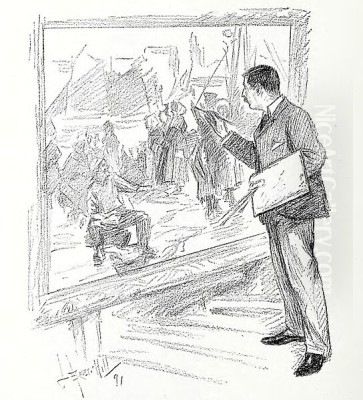
Albert Chevallier Tayler (1862-1925) stands as a significant, if sometimes understated, figure in the landscape of British art during the late Victorian and Edwardian periods. Primarily celebrated as a portrait painter, Tayler's oeuvre also encompassed genre scenes and occasional forays into landscape and thematic compositions. His artistic journey saw him engage with prominent art movements of his time, most notably the Newlyn School, and his work reflects both the academic traditions he was schooled in and the burgeoning interest in realism and plein air painting. This exploration seeks to illuminate the life, career, artistic contributions, and enduring, albeit quiet, legacy of a painter who skillfully captured the visages and vignettes of his era.
Early Life and Artistic Formation
Born in England in 1862, Albert Chevallier Tayler's early artistic inclinations led him to pursue formal training, a conventional path for aspiring artists of his generation. He commenced his studies at the Heatherley School of Fine Art in London, an institution known for its less rigid approach compared to the Royal Academy Schools, and one that had nurtured talents like Dante Gabriel Rossetti and Edward Burne-Jones in earlier decades. Heatherley's provided a foundational grounding in drawing and painting, emphasizing observation and technical proficiency.
Following his time at Heatherley's, Tayler's education continued, as noted in some accounts, at Bloxham School in Oxfordshire. While primarily a public school, its curriculum might have offered avenues for artistic development or it may represent a period of general education before a more intensive focus on art. More critically for his professional development, Tayler is recorded as having studied at the prestigious Royal Academy Schools. These schools, attached to the Royal Academy of Arts, were the pinnacle of art education in Britain, offering rigorous training in classical principles, anatomy, and composition. Here, students were immersed in a tradition that valued historical painting, portraiture, and meticulously finished works, under the tutelage of established Academicians.
It is also mentioned that Tayler spent time studying in Paris, a common practice for ambitious British artists seeking to broaden their horizons and expose themselves to continental trends. While the specific "Paris Royal Academy Schools" is an unusual phrasing (as Paris had the École des Beaux-Arts and numerous private ateliers like the Académie Julian), it signifies an engagement with the vibrant Parisian art scene. This period would have exposed him to the lingering influence of French academicism, the rise of Impressionism, and various forms of Realism, all of which were shaping European art. Artists like Jules Bastien-Lepage, with his sentimental rural realism, were particularly influential on many British painters who studied in France.
This comprehensive education, spanning both English institutions and likely Parisian ateliers, equipped Tayler with a strong technical foundation and a broad awareness of contemporary artistic currents. He emerged well-versed in academic methods but also open to the newer ideas that were challenging established norms, particularly the emphasis on capturing light and atmosphere directly from nature.
The Newlyn School and the Embrace of Plein Air
A pivotal phase in Albert Chevallier Tayler's career was his association with the Newlyn School. Located in the fishing village of Newlyn in Cornwall, this artists' colony became a magnet for painters in the 1880s and 1890s. Attracted by the dramatic coastal scenery, the quality of light, and the lives of the local fishing community, these artists sought to depict everyday life with honesty and naturalism. The Newlyn School was, in essence, Britain's response to the Barbizon School in France and other realist movements across Europe.
Tayler became an active participant in the Newlyn School, embracing their "Plein Air Method." This approach, derived from the French "en plein air" (in the open air), involved painting outdoors directly from the subject, rather than relying solely on studio sketches. This allowed artists to capture the fleeting effects of light and atmosphere with greater immediacy and accuracy. The Newlyn painters, including leading figures like Stanhope Forbes, often referred to as the "father of the Newlyn School," and his wife Elizabeth Forbes (née Armstrong), were deeply committed to this practice.
Other prominent artists associated with the Newlyn School during Tayler's time there, or whose work shared similar sensibilities, included Frank Bramley, known for his emotionally charged interior scenes like "A Hopeless Dawn"; Walter Langley, who often depicted the hardships and heroism of the fishing folk with a sympathetic eye; Henry Scott Tuke, famed for his sun-drenched paintings of nude boys and boats, often painted outdoors; and Norman Garstin, an intellectual figure within the group who also painted evocative local scenes. Tayler's involvement with this group undoubtedly shaped his artistic vision, encouraging a move towards greater naturalism and a focus on contemporary subjects, even within his portraiture. The camaraderie and shared artistic goals of the Newlyn community provided a stimulating environment for development.
The influence of French realist painters like Jules Bastien-Lepage and Pascal-Adolphe-Jean Dagnan-Bouveret was palpable among the Newlyn artists. Their square brush technique and muted palettes, often used to depict rural life with a degree of sentiment, found echoes in the work produced in Cornwall. Tayler, through his Newlyn experience, absorbed these influences, integrating them into his own developing style.
Artistic Style and Thematic Concerns
Albert Chevallier Tayler is primarily recognized as a portrait painter. His training at the Royal Academy Schools would have instilled in him the importance of capturing a sitter's likeness with accuracy and conveying their character and social standing. Victorian and Edwardian portraiture was a thriving genre, catering to a wealthy clientele eager to have their images preserved for posterity. Tayler's portraits were likely characterized by a solid academic technique, refined by the Newlyn emphasis on natural light and a less idealized representation. He would have aimed for a balance between formal dignity and a sense of the sitter's personality.
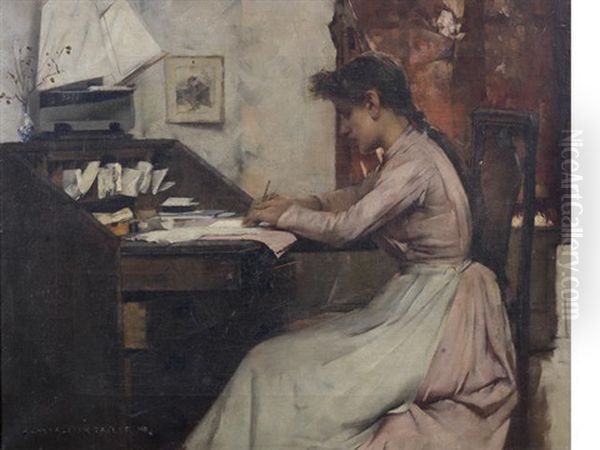
Beyond formal portraiture, Tayler also engaged with genre painting – scenes of everyday life, often with a narrative or anecdotal quality. This was a popular form of art in the Victorian era, appealing to a broad public. His Newlyn association would have naturally inclined him towards subjects drawn from contemporary life, perhaps depicting domestic interiors, social interactions, or moments of quiet contemplation. The painting "The Letter," one of his known works, falls squarely into this category, inviting viewers to speculate on the contents of the missive and the emotions of its recipient.
A particularly interesting aspect of his thematic concerns is highlighted by his painting "St. Francis of Assisi." This work, depicting the saint in a natural landscape, has been noted for its potential environmental undertones. St. Francis is widely regarded as a patron saint of animals and the environment, and a depiction of him in this manner during an era of increasing industrialization could suggest a sympathy for nature and a subtle commentary on the changing world. This aligns with a broader Victorian interest in nature, albeit often romanticized, and the burgeoning conservation movements.
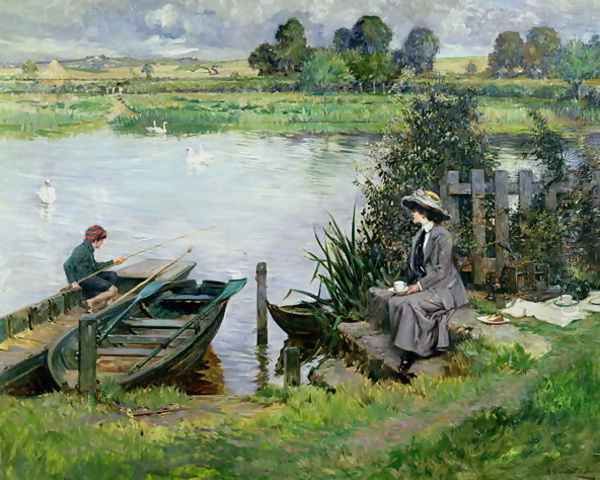
His landscapes, such as "The Thames at Benson," demonstrate his ability to capture the specific atmosphere of a location. This oil on canvas, noted as being popular with clients, suggests a facility with landscape painting that complemented his figurative work. The influence of plein air painting would have been crucial here, enabling him to render the nuances of light and color in the English countryside or along its waterways.
Tayler's style, therefore, can be seen as a blend of academic tradition and the naturalistic impulses of the Newlyn School. He was not an avant-garde radical in the vein of the Impressionists or Post-Impressionists who were beginning to make their mark, but rather a skilled practitioner working within established, yet evolving, conventions. His brushwork was likely controlled and descriptive, aiming for a convincing representation of form and texture, enlivened by an attention to the effects of natural light.
Notable Works and Contributions
Several works by Albert Chevallier Tayler are cited, providing insight into his artistic output and reception.
"The Letter": This painting is frequently mentioned as a representative example of his genre work. While specific visual details are not extensively available in common summaries, genre paintings of this title typically depict one or more figures engaged with a letter – reading it, writing it, or reacting to its contents. Such scenes were popular for their narrative potential, allowing artists to explore themes of love, news from afar, anticipation, or sorrow. Tayler's treatment would likely have focused on the psychological state of the figure(s) and the careful rendering of the domestic setting, imbued with the naturalistic light favored by the Newlyn painters.
Illustrations for "The Empire's Cricketers": This is a significant and somewhat unique contribution. Published in 1905, this book featured colored photogravures of leading cricketers of the day, based on original portraits by Tayler. The fact that these illustrations are considered "the highest achievement of book cricket portraiture" speaks volumes about Tayler's skill in capturing likenesses and his ability to work effectively for reproduction. Cricket held immense cultural importance in Britain and the Empire, and a project of this nature would have been prestigious. It placed Tayler at the intersection of art, sport, and popular culture, and his portraits would have been seen by a wide audience. This commission underscores his reputation as a capable portraitist.
"St. Francis of Assisi": As previously discussed, this work suggests a thematic depth beyond straightforward portraiture or genre. The choice of St. Francis, a figure associated with humility, nature, and spirituality, offered Tayler an opportunity to explore these themes. The painting's environmental resonance, whether consciously intended as a primary message or not, adds an interesting dimension to his oeuvre, reflecting a sensitivity to the natural world that was also a hallmark of many plein air painters.
"The Thames at Benson": This landscape painting indicates his engagement with the English countryside as a subject. Benson, a village on the River Thames in Oxfordshire, would have offered picturesque views. Such works were popular with patrons seeking pleasant, evocative scenes of familiar locales. Tayler's skill in rendering the specific light and atmosphere of the Thames Valley would have been key to the success of such paintings.
The fact that his art prints and reproductions of his works, particularly oil on canvas pieces like "The Thames at Benson," were well-received by clients and continue to find an audience suggests a lasting appeal in his imagery. This indicates a technical competence and an ability to create pleasing and engaging compositions that resonated with the tastes of his time and beyond.
Later Career, Influence, and Legacy
Information regarding Albert Chevallier Tayler's later career, after his main association with the Newlyn School, is less prominently detailed in general art historical summaries. However, it is likely he continued to work as a portrait and genre painter, exhibiting at venues such as the Royal Academy and other London galleries. The demand for portraiture remained strong into the Edwardian era, and skilled practitioners like Tayler would have found continued patronage.
His influence on subsequent generations of artists might be considered modest compared to more revolutionary figures. He was not a radical innovator who dramatically altered the course of British art. Instead, his contribution lies in his competent and sensitive practice within the evolving traditions of academic and realist painting. As a member of the Newlyn School, he participated in a movement that significantly revitalized British realist painting, bringing a fresh eye to contemporary subjects and a commitment to outdoor work. The Newlyn School as a whole had a lasting impact, demonstrating that compelling art could be found in the lives of ordinary people and the landscapes of Britain, rather than solely in classical or historical themes.
Tayler's legacy is that of a skilled and respected artist of his time. He navigated the art world of late Victorian and Edwardian Britain, contributing to its richness and diversity. His portraits captured the likenesses of his contemporaries, his genre scenes offered glimpses into their lives, and his illustrations for "The Empire's Cricketers" remain a notable achievement in sporting art. While perhaps not as widely known today as some of his more flamboyant contemporaries like John Singer Sargent, or a Royal Academy president like Sir Frederic Leighton or Sir Edward Poynter, Tayler's work holds its place as a fine example of British painting from a period of significant artistic activity.
The continued availability and appreciation of reproductions of his work suggest that his ability to create appealing and well-crafted images endures. He represents a strand of British art that valued technical skill, narrative clarity, and a sensitive observation of the world, qualities that retain their appeal even as artistic fashions change.
Tayler in the Context of His Contemporaries
To fully appreciate Albert Chevallier Tayler's position, it is useful to consider him alongside other artists active during his career. The British art scene in the late 19th and early 20th centuries was diverse and dynamic.
Within the Newlyn School, as mentioned, he worked alongside Stanhope Forbes, Elizabeth Forbes, Walter Langley, Frank Bramley, and Henry Scott Tuke. These artists shared a common purpose but each had individual strengths. For instance, Stanhope Forbes was known for his robust, almost heroic depictions of fishermen, while Langley often focused on more melancholic and domestic aspects of their lives.
Beyond Newlyn, the Royal Academy remained a dominant force, though its supremacy was being challenged. Figures like Lord Frederic Leighton, Sir Lawrence Alma-Tadema, and Sir Edward John Poynter represented the high Victorian classical tradition, producing large-scale, meticulously detailed paintings of historical and mythological subjects. Their work, often grand and idealized, stood in contrast to the gritty realism of the Newlyn painters. John Everett Millais, a founding member of the Pre-Raphaelite Brotherhood, had by this time become a pillar of the establishment and a highly successful portrait and subject painter.
Social Realism was another important current, with artists like Luke Fildes (e.g., "Applicants for Admission to a Casual Ward") and Hubert von Herkomer (e.g., "Hard Times") depicting the plight of the urban and rural poor. While Newlyn painters also focused on working-class subjects, their approach was often less overtly critical and more focused on the dignity and picturesqueness of rural labor.
The influence of James McNeill Whistler, an American expatriate, was significant in promoting "Art for Art's Sake" and aestheticism, challenging the Victorian emphasis on narrative and morality in art. His subtle tonal harmonies and decorative compositions offered a different path. Similarly, John Singer Sargent, another American who made his career in Britain, was the pre-eminent portrait painter of the era, dazzling society with his bravura brushwork and insightful characterizations. Tayler, as a portraitist, would have been working in a field dominated by Sargent's immense talent and reputation.
The stirrings of Impressionism and Post-Impressionism were also being felt in Britain, with artists like Philip Wilson Steer and Walter Sickert (a student of Whistler and influenced by Degas) championing these new approaches to light, color, and subject matter. Sickert, with his Camden Town Group, would later push British art in a more modern direction. George Clausen, initially influenced by French naturalism similar to the Newlyn artists, later adopted a more impressionistic style in his depictions of rural life and labor.
Tayler's work, therefore, existed within this complex tapestry. He was aligned with the realist and plein air tendencies of the Newlyn School, a movement that offered a vital alternative to academic classicism, yet he remained rooted in strong draughtsmanship and traditional genres like portraiture. He was not an avant-gardist pushing the boundaries of modernism, but a dedicated artist contributing to the strong current of figurative painting that continued to flourish in Britain even as new artistic languages were emerging. His contemporaries also included artists like John William Waterhouse, who continued the romantic, Pre-Raphaelite tradition with his depictions of mythological women, and Sir Frank Dicksee, known for his chivalric and sentimental subject pictures.
Conclusion: An Enduring Craft
Albert Chevallier Tayler (1862-1925) was a product of his time, an artist who honed his craft through rigorous academic training and enriched it through his engagement with the progressive Newlyn School. His primary identity as a portrait painter is well-established, evidenced by his skilled likenesses and his significant contribution to "The Empire's Cricketers." His genre scenes, such as "The Letter," captured the quiet narratives of everyday life, while works like "St. Francis of Assisi" hinted at deeper thematic interests.
Though perhaps not a household name in the grand sweep of art history, Tayler represents the many dedicated and talented artists who formed the backbone of the British art world during a period of transition and rich artistic production. He successfully navigated the demands of patronage, the influence of artistic movements, and the expectations of exhibiting institutions. His work, characterized by technical proficiency, a sensitivity to light and atmosphere fostered by his plein air experiences, and an honest engagement with his subjects, provides a valuable window into the artistic and social fabric of late Victorian and Edwardian Britain. His legacy endures in the paintings that have survived, offering a quiet testament to a life dedicated to the art of observation and representation.