Andrew Fisher Bunner: An American Vision of European Light and Landscape
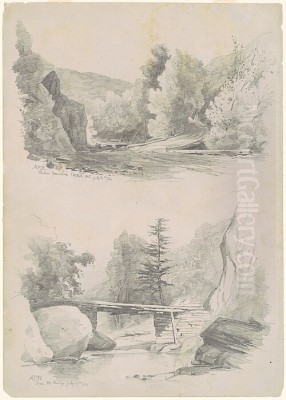
Andrew Fisher Bunner (1841-1897) stands as a notable, if sometimes overlooked, figure in nineteenth-century American art. A painter celebrated for his evocative landscapes and marine scenes, Bunner carved a distinct niche for himself, particularly through his sensitive portrayals of European, and especially Venetian, vistas. His work, characterized by a keen observation of light and atmosphere, offers a fascinating bridge between American artistic sensibilities and the enduring allure of the Old World. Though his name might not be as instantly recognizable as some of his contemporaries, his contributions to American art, his dedication to his craft, and the quiet beauty of his canvases merit closer examination.
Early Life and Artistic Awakening in America
Born in New York City in 1841, Andrew Fisher Bunner emerged during a period of significant growth and cultural development in the United States. The mid-nineteenth century saw American art, particularly landscape painting, come into its own with the rise of the Hudson River School. Artists like Asher B. Durand, Frederic Edwin Church, and Albert Bierstadt were capturing the majestic wilderness of the American continent, instilling a sense of national pride and wonder through their grand canvases. While Bunner's later focus would shift transatlantic, his formative years were undoubtedly shaped by this vibrant artistic environment.
Bunner resided in New York City between 1865 and 1868, a period during which he began to establish his presence in the art world. He exhibited several works at the prestigious National Academy of Design, a key institution for American artists seeking recognition. Among these early submissions were "Summer Afternoon in Pike County, Pennsylvania" (1865) and "The Potomac below Harper's Ferry" (1868). These titles suggest an early engagement with the American landscape, echoing the prevailing themes of his artistic milieu. His depiction of Pike County, known for its scenic beauty, and the historically significant Harper's Ferry area, indicates an artist exploring the diverse topographies and narratives of his homeland.
In 1869, Bunner briefly relocated to New Jersey before moving to Louisville, Kentucky, in 1870. Despite these moves, he maintained his connection with the New York art scene, exhibiting "A Study from Nature, West Virginia" at the National Academy of Design in 1870. This piece further underscores his early dedication to landscape painting, likely executed with the detailed observation that would become a hallmark of his style. These formative years in America provided Bunner with a solid foundation in the principles of landscape art, even as his artistic journey was about to take a significant turn towards Europe.
The European Sojourn: A Deepening Vision
The 1870s marked a pivotal chapter in Bunner's career as he embarked on an extended period of travel and study in Europe. This was a common trajectory for ambitious American artists of the era, who sought to immerse themselves in the rich artistic traditions and picturesque landscapes of the Old World. Figures like James McNeill Whistler, John Singer Sargent, and Mary Cassatt were among the many Americans who found inspiration and refined their skills abroad. Bunner's European sojourn primarily took him to Germany, France, and, most significantly, Italy.
He spent considerable time in Paris, the undisputed art capital of the Western world, and in Venice, a city that would captivate his artistic imagination for years to come. The experience of living and working in these diverse cultural settings profoundly influenced his artistic development. In Paris, he would have been exposed to a dynamic art scene, with academic traditions coexisting alongside emerging movements like Impressionism, championed by artists such as Claude Monet and Edgar Degas. While Bunner's style remained rooted in a more realistic tradition, the Parisian emphasis on light and contemporary life likely resonated with him.
His time in Venice was particularly fruitful. The city of canals, with its unique interplay of water, architecture, and light, offered endless subject matter. Bunner became deeply enamored with Venice, and it became a recurring theme in his oeuvre. He diligently submitted works from his European travels back to the National Academy of Design, keeping his American audience appraised of his evolving vision. This period of intense study and immersion in European art and culture was crucial in shaping the mature style for which he would become known.
Artistic Style: Realism, Light, and Atmosphere
Andrew Fisher Bunner's artistic style is best characterized as a form of lyrical realism, with a particular emphasis on the accurate yet poetic depiction of light, color, and atmosphere. He was a meticulous observer of nature, and his landscapes, especially his river and canal scenes, are rendered with a fine attention to detail. However, his work transcends mere topographical accuracy; it captures the mood and essence of a place, often imbuing his scenes with a sense of tranquility and quiet contemplation.
His handling of light and shadow was particularly adept. Whether depicting the luminous haze of a Venetian morning or the dappled sunlight on a forest floor, Bunner demonstrated a unique understanding of how light interacts with surfaces and defines form. This sensitivity to atmospheric effects aligns him with some aspects of the Barbizon School in France, where artists like Jean-Baptiste-Camille Corot and Charles-François Daubigny sought to capture the fleeting moments of nature with truthfulness and poetic feeling. While not an Impressionist in the French sense, Bunner shared their interest in capturing the visual sensations of a particular moment.
Bunner worked proficiently in both oil and watercolor. His oil paintings often possess a rich texture and depth of color, while his watercolors showcase a lighter touch and a fluidity well-suited to capturing the reflective qualities of water or the softness of a distant landscape. His compositions are generally well-balanced, drawing the viewer's eye into the scene through carefully constructed perspectives. The overall effect is one of harmonious realism, where the beauty of the natural world is presented with both fidelity and artistic grace. His focus on European scenery, particularly the canals of Venice and the landscapes of Long Island later in his career, provided him with ample opportunity to explore these stylistic concerns.
Notable Works and Their Significance
Several key works exemplify Andrew Fisher Bunner's artistic achievements and thematic preoccupations. His European period, especially his time in Venice, yielded numerous memorable paintings. "Rio in Venice" (1883) and "A Fisherman’s Cottage in the Tyrol" (1883), both exhibited at the National Academy, showcase his engagement with diverse European settings. The Venetian scenes, in particular, highlight his fascination with the city's unique waterways and architecture. One can imagine "Rio in Venice" capturing a quiet canal, with gondolas moored alongside weathered buildings, the scene bathed in the soft, diffused light for which Venice is famous.
Another significant work from this period is "Church in Parma" (1875). This painting, now held in the prestigious collection of the Musée d'Orsay in Paris, underscores the quality and recognition of his European output. The choice of an architectural subject in Parma suggests an interest in historical structures and the interplay of light on stone, a theme common among artists drawn to Italy's rich cultural heritage.
His painting "The Lagoon with San Giorgio, Della Salute, Entrance to Grand Canal" is a quintessential Venetian piece. The title itself evokes a panoramic view, likely capturing iconic landmarks such as the Church of San Giorgio Maggiore and the Basilica di Santa Maria della Salute, which guard the entrance to the Grand Canal. Such compositions allowed Bunner to explore complex perspectives and the expansive, reflective qualities of the Venetian lagoon. Artists like Canaletto and Francesco Guardi had, of course, famously depicted Venice in earlier centuries, and later, J.M.W. Turner and Whistler would also offer their own iconic interpretations. Bunner’s Venetian works fit within this long tradition, offering an American perspective on the city's timeless allure.
A painting titled "Picnic Party at Lake George" (New York) indicates that even with his European focus, Bunner occasionally returned to American subjects. Lake George, a popular scenic destination, was a favored subject for Hudson River School painters. This work suggests a continuity of interest in landscape, whether American or European. Another intriguing piece, "Cutting Ice, Rockland Lake, N.Y.," offers a glimpse into American genre scenes and local industry, documenting the historical practice of ice harvesting, which was crucial for industries like beer brewing in 19th-century New York. This painting demonstrates a versatility beyond pure landscape.
Exhibitions, Affiliations, and Contemporary Circles
Andrew Fisher Bunner was an active participant in the art world of his time, consistently exhibiting his work and maintaining memberships in several important artistic organizations. His most consistent venue was the National Academy of Design in New York, where he exhibited annually. The Academy was a cornerstone of the American art establishment, and regular inclusion in its exhibitions was a mark of professional standing.
Beyond the NAD, Bunner also frequently showed his work at the Boston Art Club and the Brooklyn Art Association, further expanding his visibility within American art circles. His participation in the Paris Salons during his time in Europe was also a significant achievement. The Paris Salon was the most prestigious art exhibition in the world, and acceptance into it conferred considerable international recognition. This indicates that Bunner's work was judged to be of high quality by the demanding Parisian art establishment.
He was a member of the American Watercolor Society, reflecting his proficiency and interest in this medium. His membership in the National Academy of Design (likely as an Associate or Academician, though specifics require deeper archival research) and the Salmagundi Club further cemented his place within the artistic community. The Salmagundi Club, still active today, was (and is) a prominent social and professional organization for artists in New York.
While detailed records of Bunner's direct personal interactions with many specific contemporaries are scarce, his active exhibition record and memberships place him firmly within the orbit of many leading artists of his day. He would have undoubtedly known, or been known by, many of the prominent figures exhibiting at the NAD, such as Eastman Johnson, Winslow Homer (though their styles differed greatly), and landscape painters like Sanford Robinson Gifford or John Frederick Kensett in his earlier years. In Europe, particularly in Venice and Paris, which were melting pots for international artists, he would have encountered a diverse array of talents. For instance, American artists like Frank Duveneck and William Merritt Chase were also active in Europe, particularly in Germany and Italy, around the same period, often leading groups of American students.
Legacy and Museum Collections
Andrew Fisher Bunner passed away in 1897, but his artistic contributions continued to be recognized. His works found their way into several significant public collections, a testament to their enduring appeal and historical importance. The Metropolitan Museum of Art in New York and the Corcoran Gallery of Art in Washington, D.C. (whose collection was later largely absorbed by the National Gallery of Art) are among the prominent institutions that acquired his paintings. The presence of his work in the Musée d'Orsay ("Church in Parma") is a particularly notable honor, placing him among esteemed international artists.
His paintings are also held by the National Gallery of Art in Washington, D.C., and the Pennsylvania Academy of the Fine Arts (PAFA) in Philadelphia, another of America's oldest and most respected art institutions. These institutional acquisitions ensure that Bunner's work remains accessible for study and appreciation by future generations.
While perhaps not achieving the household-name status of some of his peers, Bunner's legacy lies in his skillful and sensitive interpretations of landscape, particularly his European scenes. He brought an American eye to the Old World, capturing its beauty with a sincerity and technical proficiency that resonated with audiences on both sides of the Atlantic. His Venetian paintings, in particular, contribute to a rich artistic tradition of depicting that magical city, offering a perspective that is both personal and reflective of late nineteenth-century aesthetic values. His dedication to capturing the nuances of light and atmosphere places him among the accomplished landscape painters of his generation.
Conclusion: A Quiet Observer of Beauty
Andrew Fisher Bunner was an artist who, through dedication and a refined sensibility, created a body of work that speaks to the enduring human fascination with the beauty of the natural and man-made world. From the landscapes of his native America to the sun-drenched canals of Venice and the rustic charm of the Tyrol, Bunner approached his subjects with an honest eye and a skilled hand. His ability to convey not just the appearance of a place, but also its atmosphere and emotional resonance, is the hallmark of his art.
His paintings serve as a visual diary of his travels and his artistic explorations, reflecting a deep appreciation for the interplay of light, color, and form. While he operated within the broader currents of nineteenth-century realism, his work possesses a quiet individuality. As an American artist who found profound inspiration in Europe, Bunner contributed to the transatlantic dialogue that enriched American art during this period. His legacy, preserved in esteemed museum collections and in the quiet beauty of his canvases, is that of a talented and sincere painter who dedicated his life to capturing the world's varied landscapes with grace and fidelity. His work invites us to pause and appreciate the subtle poetry of place, a message that remains timeless.