Johann Anton Castell, a significant yet sometimes overlooked figure in 19th-century German art, carved a distinct niche for himself as a painter of evocative landscapes, particularly those bathed in the ethereal glow of moonlight or the warm hues of sunset. Born in the artistic heart of Dresden in 1810 and passing away in 1867, Castell's career unfolded during a period of rich artistic development in Germany, straddling the later phases of Romanticism and the rise of Realism. His dedication to capturing the atmospheric subtleties of nature, especially around his native Dresden, has left a legacy of works that continue to be appreciated for their technical skill and poetic sensibility.
Early Life and Artistic Formation in Dresden
Anton Castell's artistic journey began in Dresden, a city renowned for its vibrant cultural scene and its prestigious Academy of Fine Arts. In 1827, he enrolled at the Dresden Academy, an institution that had nurtured many prominent artists. However, his formal academic path was unconventional. Records indicate that he was "expelled" in 1828 due to irregular attendance. This early departure from the formal academic structure did not, however, curtail his artistic ambitions. Instead, it seems to have steered him towards a more direct and perhaps more influential mentorship.
Following his brief stint at the Academy, Castell became a student of Johan Christian Clausen Dahl (1788-1857). Dahl, a Norwegian-born painter who had settled in Dresden, was a towering figure in European landscape painting and a professor at the Dresden Academy himself. He was a close associate of Caspar David Friedrich (1774-1840), the leading figure of German Romanticism, and Dahl's own work masterfully blended Romantic sensibilities with a keen observation of natural phenomena. Studying under Dahl would have provided Castell with invaluable training in landscape techniques, an emphasis on direct observation of nature, and an appreciation for atmospheric effects – all hallmarks of Castell's later work.
The Influence of Johan Christian Clausen Dahl
The tutelage under J.C.C. Dahl was undoubtedly a formative experience for Anton Castell. Dahl was known for encouraging his students to paint en plein air (outdoors) to capture the immediate impressions of light and weather, a practice that was gaining traction during this period. Dahl's own landscapes, whether depicting the rugged mountains of Norway or the picturesque Elbe valley near Dresden, were celebrated for their dynamism, their realistic portrayal of clouds and water, and their ability to convey the raw power and beauty of nature.
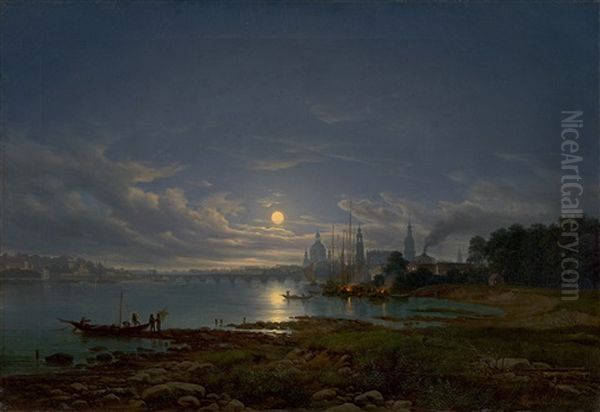
Castell absorbed these lessons, developing a keen eye for the nuances of light, particularly during transitional times of day like dawn, dusk, and under moonlight. While Friedrich, Dahl's contemporary, often imbued his landscapes with profound spiritual and symbolic meaning, Dahl, and subsequently Castell, leaned towards a more direct, though still deeply felt, engagement with the visible world. This is not to say Castell's work lacked emotion; rather, the emotion was conveyed through the faithful yet artistic rendering of atmosphere and specific locales. The choice of night scenes, or "Mondscheinbilder," became a signature for Castell, allowing him to explore dramatic chiaroscuro and a palette of cool, luminous tones.
The Artistic Milieu of Dresden
Dresden in the first half of the 19th century was a crucible of artistic innovation, particularly for Romantic landscape painting. Caspar David Friedrich was the dominant spiritual force, his allegorical landscapes shaping the perception of German nature. Alongside him, figures like Carl Gustav Carus (1789-1869), a physician, scientist, and painter, contributed to the intellectual and artistic ferment with his own atmospheric landscapes and writings on art theory. Ludwig Richter (1803-1884), another prominent Dresden artist, initially influenced by Romanticism, later developed a more idyllic, Biedermeier style, often depicting charming scenes of German life and landscape.
Ernst Ferdinand Oehme (1797-1855), like Castell, was a student of Dahl and also influenced by Friedrich. Oehme's works often featured Gothic architecture within moody landscapes, sharing some thematic concerns with Castell's interest in depicting specific, often historic, urban settings within a naturalistic, atmospheric context. While direct collaborative records between Castell and these luminaries are not extensively documented, he operated within this rich environment, absorbing its influences and contributing to its diverse artistic output. The emphasis on local scenery, particularly the Elbe Sandstone Mountains and the city of Dresden itself, was a common thread among many artists of this school.
Castell's Artistic Style: A Blend of Romanticism and Realism
Anton Castell's artistic style can be characterized as a nuanced blend of late Romantic sensibility and emerging Realist observation. His landscapes are not merely topographical records; they are imbued with a distinct mood, often melancholic or serene, which aligns with Romantic ideals of evoking emotional responses through nature. The preference for twilight, moonlight, and dramatic skies speaks to this Romantic inclination, emphasizing the sublime and the picturesque.
However, Castell's work also demonstrates a commitment to accurate depiction. His rendering of architectural details, the play of light on water, and the specific character of the Dresden townscape show a careful observation of reality. This grounding in observable fact distinguishes his work from the more overtly symbolic or idealized landscapes of earlier Romantics. He was adept at capturing the specific atmosphere of a place at a particular time, a skill honed by the practice of outdoor sketching encouraged by Dahl. His brushwork, while capable of conveying texture and detail, often aimed for a smooth finish that enhanced the luminous quality of his scenes, particularly in his nocturnes. This synthesis allowed him to create paintings that were both poetically evocative and convincingly real.
Masterpieces of Moonlight and Urban Views
Several works stand out in Anton Castell's oeuvre, showcasing his particular talents. Perhaps his most renowned painting is Ansicht auf Dresden, Mondschein (View of Dresden, Moonlight), created in 1846. This painting exemplifies his mastery of the nocturne. It depicts the familiar skyline of Dresden, including the Frauenkirche and the Hofkirche, under a serene, moonlit sky. The moonlight casts a silvery sheen on the Elbe River and throws the city's architecture into a play of light and shadow, creating an atmosphere of quiet grandeur and timelessness. The careful rendering of reflections on the water and the subtle gradations of the night sky demonstrate his technical prowess.
Another significant work is Dresden im Abendrot, hinter dem Schloss Albrechtsberg (Dresden at Sunset, behind Albrechtsberg Castle), painted in 1861. This piece captures a different mood, with the warm glow of the setting sun illuminating the scene. Albrechtsberg Castle, one of the three Elbe castles, provides a picturesque backdrop. Here, Castell explores a warmer palette, demonstrating his versatility in capturing different lighting conditions while maintaining his characteristic atmospheric depth.
Der Glockenturm in Dresden (The Bell Tower in Dresden), from 1859, offers a more focused architectural study. It depicts the ruined tower of the old town hall, which later became a bell tower. This painting not only showcases his skill in architectural rendering but also perhaps hints at a Romantic appreciation for the picturesque decay and historical resonance of such structures. These works, centered on his beloved Dresden, highlight his deep connection to the city and his ability to transform its familiar views into compelling artistic statements.
Technique and Media: Beyond Oil Paintings
While Anton Castell is primarily known for his oil paintings, his artistic output also included other media, notably prints and lithographs. The 19th century saw a rise in the popularity of printmaking as a means of disseminating images to a wider audience. Castell's landscape views, with their clear compositions and atmospheric appeal, lent themselves well to reproduction.
The creation of prints and lithographs based on his paintings would have helped to popularize his work and make his imagery accessible beyond the circles of original art collectors. Lithography, in particular, allowed for a nuanced range of tones and could effectively replicate the subtle gradations of light and shadow found in his paintings. This aspect of his practice underscores his engagement with the broader art market of his time and contributed to his reputation as a skilled landscape artist. The fact that his works were considered worthy of reproduction speaks to their contemporary appeal and artistic merit.
Reception, Legacy, and Place in Art History
During his lifetime and in the succeeding decades, Anton Castell's works were well-regarded, particularly for their skillful depiction of landscapes and atmospheric effects. His specialization in night scenes and views of Dresden found a ready audience appreciative of both the technical execution and the romantic mood of his paintings. The reproduction of his works as prints and lithographs further attests to their popularity.
In the broader context of German art history, Castell is recognized as a significant representative of the Dresden school of landscape painting in the mid-19th century. He successfully navigated the transition from the high Romanticism of figures like Friedrich to a more naturalistic, yet still evocative, approach to landscape. He may not have achieved the same level of international fame as Friedrich or even his teacher Dahl, but his contribution to the rich tapestry of German landscape art is undeniable. His paintings continue to appear at auctions, such as the 2021 sale at Grisebach in Berlin, indicating a sustained interest among collectors. His works are held in private collections and have been associated with institutions like the Albrechtsburg in Meissen, near Dresden, reflecting his regional importance.
Castell in the Wider Context of European Landscape Painting
To fully appreciate Anton Castell's position, it's useful to consider him within the broader currents of European landscape painting in the 19th century. While Dresden had its unique artistic character, it was not isolated. In France, the Barbizon School, with artists like Jean-Baptiste-Camille Corot (1796-1875) and Théodore Rousseau (1812-1867), was pioneering a move towards more direct, naturalistic landscape painting, often completed outdoors. Their emphasis on capturing the fleeting effects of light and atmosphere resonated with trends seen elsewhere in Europe.
In Germany itself, other schools of landscape painting flourished. The Düsseldorf School, for instance, with prominent figures like Andreas Achenbach (1815-1910) and his brother Oswald Achenbach (1827-1905), often produced dramatic, meticulously detailed landscapes that gained international acclaim. Carl Blechen (1798-1840), active in Berlin, was another important figure whose work showed a move towards a more realistic and sometimes starkly dramatic depiction of nature and industrial scenes, prefiguring later Realist tendencies.
While Castell's primary sphere was Dresden, his work shares with these broader movements a deep engagement with the natural world and a desire to capture its essence, whether through the romantic lens of moonlight or the detailed observation of specific locales. His teacher, J.C.C. Dahl, himself had connections across Europe, bringing influences from his native Norway and his travels in Italy to Dresden. This interconnectedness of the European art world meant that artists like Castell, even if focused on their regional environment, were part of a larger conversation about the role and representation of landscape in art. Other German contemporaries whose work provides context include Carl Spitzweg (1808-1885), known for his charming Biedermeier genre scenes often set in idyllic landscapes, and Moritz von Schwind (1804-1871), whose work often incorporated romantic and fairy-tale landscapes.
The Enduring Appeal of Castell's Vision
The enduring appeal of Anton Castell's art lies in his ability to capture a specific sense of place and time with both technical finesse and emotional resonance. His views of Dresden, particularly his moonlit scenes, transcend mere topography to become poetic meditations on the interplay of nature, architecture, and light. The "expulsion" from the Academy, rather than a setback, may have liberated him to pursue a more personal artistic path under the guidance of a master like Dahl, fostering a style that was both grounded in observation and elevated by a romantic sensibility.
His works serve as a valuable window into the artistic concerns of mid-19th century Dresden, a period of transition and rich artistic production. They reflect a deep love for his native city and its surrounding landscapes, rendered with a sensitivity that continues to captivate viewers. While perhaps not a radical innovator in the vein of some of his more famous contemporaries, Anton Castell was a dedicated and highly skilled artist who made a distinctive contribution to the tradition of German landscape painting. His mastery of atmosphere, his evocative depictions of light, and his intimate portrayals of Dresden secure his place as an important figure in the art of his time. His legacy is that of an artist who found profound beauty in the familiar, transforming it through his unique vision into enduring works of art.