Benjamin Barker (1776–1838), often distinguished as "Barker of Bath" to differentiate him from other artists of the same surname, including his own relatives, was a significant English landscape painter. Active during a transformative period in British art, he carved a niche for himself with his evocative depictions of rural scenery, primarily in oil and watercolour. His life and work offer a fascinating glimpse into the provincial art world of Georgian England, particularly in the thriving spa town of Bath, and his contributions, though sometimes overshadowed by his more famous brother, Thomas Barker, remain noteworthy.
Early Life and Artistic Genesis in Bath
Born in 1776 near Pontypool, Monmouthshire, Wales, Benjamin Barker Jr. was the son of Benjamin Barker Sr. (1729-1796), an artist known for decorating japanned ware, and the elder brother of the more widely acclaimed Thomas Barker (1769–1847). The family's artistic inclinations provided an early exposure to the world of art. Following a period where his father's fortunes declined, the family, including young Benjamin and Thomas, moved to Bath. This relocation proved pivotal for the artistic development of the Barker brothers.
Bath, in the late 18th and early 19th centuries, was not merely a health resort but a vibrant social and cultural hub, attracting artists, writers, and a wealthy clientele eager for portraits and picturesque landscapes. It was in this stimulating environment that Benjamin Barker's artistic talents began to flourish. While his elder brother Thomas quickly gained recognition, Benjamin also pursued his passion for painting. Early accounts suggest that, like his brother, he was largely self-taught, honing his skills through observation and practice. He received encouragement and some patronage, with one "Mr. Spackman," a wealthy coachbuilder in Bath, notably supporting Thomas, which likely had a beneficial effect on the entire artistic family. Another figure, a "Mr. Jones," is mentioned as having supported Benjamin after his father's death, enabling him to pursue art after a brief period working in stables.
The Barker Artistic Circle and the "Barker of Bath" Appellation
The name "Barker of Bath" became a collective identifier for the artistic members of the family, primarily Benjamin and Thomas, but also occasionally extending to their father and another brother, Joseph Barker, who also painted. This shared appellation, while indicative of their strong association with the city, sometimes led to confusion in attributions, particularly between Benjamin and Thomas, whose landscape subjects could overlap.
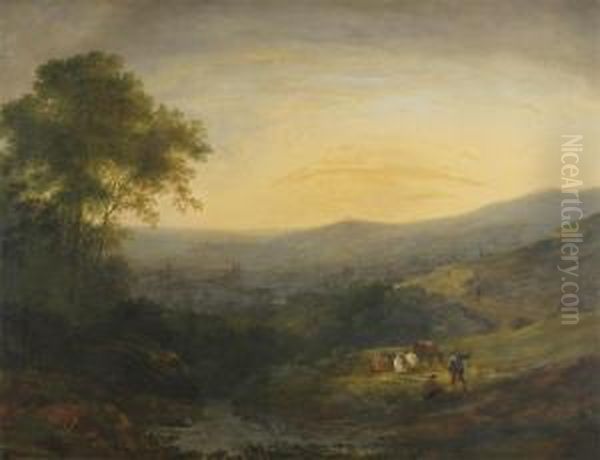
Thomas Barker achieved considerable fame for his rustic figures, sentimental genre scenes like "The Woodman," and ambitious historical paintings. He even established a gallery in Bath to showcase his works. Benjamin, while perhaps less flamboyant in his public persona and artistic scope, developed a distinct and respected voice as a landscape specialist. He focused intently on the nuances of the English countryside, its wooded valleys, tranquil rivers, and the atmospheric effects of light and weather. His relationship with Thomas appears to have been one of mutual artistic pursuit rather than rivalry, with both contributing to Bath's reputation as an artistic centre.
Artistic Style, Influences, and Mediums
Benjamin Barker's style is characterized by its gentle naturalism, a sensitivity to the picturesque qualities of the landscape, and a competent handling of both oil and watercolour. His works often convey a sense of peace and harmony, reflecting the prevailing taste for idyllic rural scenes.
A significant influence on many British landscape painters of this era, including those in Bath, was Thomas Gainsborough. Gainsborough had spent a formative part of his career in Bath (1759-1774) before moving to London, and his feathery brushwork, elegant compositions, and sympathetic portrayal of rustic life left an indelible mark. While Benjamin Barker developed his own approach, the legacy of Gainsborough's landscape style, with its blend of observation and poetic sensibility, can be discerned in his work. He was also likely aware of the Dutch landscape tradition, which was highly prized in Britain, with artists like Jacob van Ruisdael and Meindert Hobbema admired for their naturalism.
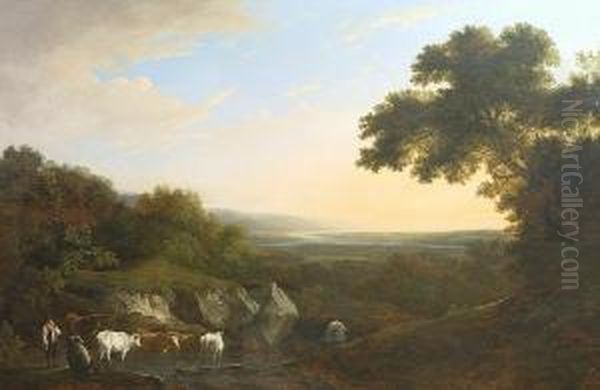
Barker was adept in both oil and watercolour. His oil paintings often feature rich, earthy palettes and a careful rendering of foliage and terrain. His watercolours demonstrate a skilled handling of washes and a keen eye for atmospheric effects, contributing to the growing prestige of watercolour as an independent art form during this period, championed by artists like Paul Sandby, Thomas Girtin, and the young J.M.W. Turner. Some contemporaries even bestowed upon Benjamin Barker the moniker "the English Poussin," suggesting an appreciation for the classical balance and harmonious composition in his landscapes, though his work generally lacked the overt classicism of Nicolas Poussin or British artists like Richard Wilson who directly emulated the Italianate tradition. This comparison likely pointed to a perceived order and serene dignity in his best compositions.
Major Works and Exhibitions
Benjamin Barker was a consistent exhibitor in London, showcasing his works at prestigious venues. He exhibited frequently at the Royal Academy of Arts between 1800 and 1821. He also sent pictures to the British Institution and, significantly, was a member of the Society of Painters in Water Colours (often known as the Old Watercolour Society), exhibiting there from 1807. His participation in these exhibitions placed his work before a national audience and alongside the leading artists of the day.
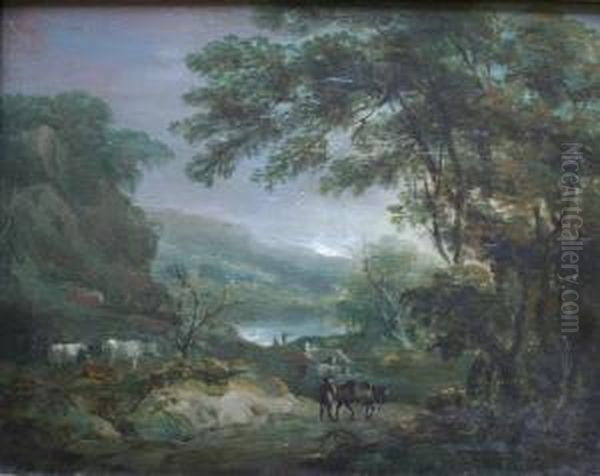
Among his representative works, titles such as "Wooded River Landscape with Wood Gatherers" capture the essence of his subject matter – tranquil, well-observed scenes of rural England, often populated with incidental figures that add a touch of human interest without dominating the landscape. A work titled "Barker of Bath, Benjamin Barker" dated 1815, suggests either a self-portrait or a portrait of him by another hand, indicating his established presence. Another notable piece is "View of a River with Rocks and Trees" (1815), praised for its poetic depiction of nature. His series of 48 views, engraved by Theodore Fielding and published in 1824 under the title "The Fine Arts: A Series of Engravings, from the Paintings of Benjamin Barker," further disseminated his imagery.
His landscapes often depicted scenes in Somerset, Wales, and other picturesque regions. Unlike the dramatic, sublime landscapes being pioneered by J.M.W. Turner or the intensely personal and naturalistic studies of John Constable (both younger contemporaries), Barker's work generally adhered to the established picturesque tradition, finding beauty in the cultivated and gently wild aspects of the British countryside. His approach was perhaps closer in spirit to contemporaries like George Morland, known for rustic scenes, or Julius Caesar Ibbetson, who also painted picturesque landscapes and figures, though Barker's focus remained more purely on landscape.
The Broader Context of British Landscape Painting
Benjamin Barker worked during a golden age for British landscape painting. The late 18th and early 19th centuries saw an unprecedented rise in the genre's popularity and status. The Napoleonic Wars restricted travel to the continent, compelling artists and patrons to discover the scenic beauties of their own country. This fostered a national school of landscape art.
Artists like Richard Wilson had earlier laid the groundwork for a native landscape tradition infused with classical ideals. The Cozens family, Alexander Cozens and his son John Robert Cozens, explored more atmospheric and romantic interpretations. The Norwich School, with figures like John Crome and John Sell Cotman, developed a distinct regional style characterized by its truth to nature and understated beauty.
In this diverse artistic milieu, Benjamin Barker represented a steady, competent talent. He may not have been a radical innovator like Turner or Constable, but he produced a substantial body of work that appealed to contemporary tastes for picturesque scenery. His dedication to landscape, his proficiency in both oil and watercolour, and his consistent presence in major exhibitions contributed to the richness and variety of British art during this period. He was part of a generation that included artists such as William Havell, another fine watercolourist, and David Cox, who also excelled in capturing the British weather and landscape.
Later Years, Financial Struggles, and Legacy
Despite a productive career and a degree of recognition, Benjamin Barker's later years were reportedly marked by financial difficulties. This was not uncommon for artists of the period, even those with considerable talent, as patronage could be fickle and the art market competitive. He continued to paint and exhibit, but the changing tastes and the rise of new artistic stars may have impacted his income.
Benjamin Barker died in Totnes, Devon, on March 2, 1838. He left behind a significant oeuvre that documents the British landscape with affection and skill. While his fame has been somewhat eclipsed by that of his brother Thomas, and by the towering figures of Turner and Constable, his work is valued by collectors and art historians for its genuine charm, technical competence, and its representation of a particular strand of British landscape painting.
His paintings can be found in various public collections, including the Victoria Art Gallery in Bath, which holds a good representation of the Barker family's work, and the British Museum. His art provides a valuable counterpoint to the more dramatic or revolutionary art of his time, reminding us of the enduring appeal of the serene and picturesque in British visual culture. He was a dedicated craftsman of the landscape, a true "Barker of Bath," whose contributions merit appreciation within the broader narrative of British art. His work stands as a testament to the quiet dedication of an artist who found his inspiration in the enduring beauty of the natural world.