Benno Adam (1812-1892) stands as a significant figure in the realm of 19th-century German art, particularly celebrated for his exceptional skill in animal painting. Born into a family deeply entrenched in artistic pursuits, he carved out a distinguished career, primarily in Munich, and became closely associated with the Chiemsee artists' colony. His work is characterized by a profound understanding of animal anatomy and behavior, rendered with a realistic yet sensitive touch that captured the spirit of his subjects.
Early Life and Artistic Heritage
Benno Rafael Adam was born in Munich, the capital of Bavaria, in 1812. His artistic journey was, in many ways, predestined. He was the eldest son of the highly respected Bavarian painter Albrecht Adam (1786-1862). Albrecht was a renowned artist in his own right, famous for his depictions of battle scenes, horses, and portraits. He had gained considerable fame as the official artist accompanying Napoleon Bonaparte during the 1812 Russian campaign, documenting the dramatic events with his brush and pencil. This familial environment undoubtedly provided Benno with an immersive and early education in the arts.
Growing up surrounded by his father's studio, sketches, and ongoing projects, Benno Adam was exposed to the rigors and rewards of an artistic life from a young age. It is documented that from the 1830s, Benno began to actively assist his father. This apprenticeship was crucial, allowing him to hone his skills under the direct tutelage of an established master. One of his early tasks involved creating lithographs based on his father's compositions, a practice that would have sharpened his eye for detail and understanding of form and tone. This collaborative work with Albrecht Adam was instrumental in Benno's development, gradually enabling him to emerge as an independent artist with his own distinct focus.
The Adam family was, in fact, an artistic dynasty. Benno's younger brothers, Franz Adam (1815-1886) and Eugen Adam (1817-1880), also became accomplished painters. Franz specialized in battle scenes and equestrian portraits, much like his father, while Eugen focused on genre scenes and military subjects. This collective artistic talent within one family created a vibrant and supportive, albeit potentially competitive, atmosphere that likely spurred each member to achieve excellence.
The Munich School and the Chiemsee Connection
Munich, during the 19th century, was a major European art center, rivaling Paris and Vienna. The Royal Academy of Fine Arts in Munich attracted students from across Germany and beyond. The prevailing artistic trend, particularly in the first half of the century, was influenced by Neoclassicism and Romanticism, gradually giving way to Realism and, later, Naturalism. Benno Adam's career unfolded within this dynamic environment.
While he was a product of the Munich art scene, Benno Adam also became associated with the Chiemsee artists' colony. Lake Chiemsee, the largest lake in Bavaria, with its picturesque islands (Herrenchiemsee, Frauenchiemsee) and surrounding alpine foothills, became a magnet for artists from the mid-19th century onwards. They were drawn to its natural beauty, tranquil atmosphere, and the rustic charm of its local communities. Artists like Karl Raupp (1837-1918), often dubbed "Chiemsee-Raupp," Josef Wopfner (1843-1927), and Wilhelm Marc (1839-1907), father of Franz Marc, were prominent figures in this informal group.
The Chiemsee artists typically focused on landscape painting, often in a plein air (open air) style, and genre scenes depicting the lives of local fishermen, farmers, and islanders. Their works often conveyed an idyllic and romanticized vision of rural life, emphasizing harmony between humans and nature. While Benno Adam was primarily an animal painter, his connection to the Chiemsee group suggests an affinity for these naturalistic and pastoral themes. His depictions of animals in their natural settings, or in harmonious interaction with humans in rural contexts, align with the broader spirit of the Chiemsee artists.
Artistic Style and Thematic Focus
Benno Adam distinguished himself as one of the foremost animal painters (Tiermaler) of his generation in Germany. His specialization was not merely a technical exercise but stemmed from a genuine empathy and keen observation of the animal world. He possessed an exceptional ability to capture the individual character and vitality of his subjects, whether they were domestic animals or creatures of the wild.
His oeuvre predominantly features depictions of hunting scenes, game animals (especially deer), domestic animals such as cattle and sheep, and, notably, dogs and horses. His portrayal of dogs, in particular, showcases his mastery. He rendered various breeds with an acute understanding of their specific anatomical features, postures, and expressions, often highlighting their loyalty, intelligence, or hunting prowess. These were not generic representations but true portraits of individual animals.
Adam's style can be characterized as realistic, with meticulous attention to detail. He rendered fur, feathers, and musculature with remarkable precision. His use of color was typically rich and naturalistic, and he demonstrated a sophisticated understanding of light and shadow to model forms and create atmospheric depth. While realism was paramount, his works often transcended mere anatomical accuracy, imbuing his subjects with a sense of dignity and presence. He frequently depicted animals in narrative contexts, such as a stag at bay, hounds on a scent, or a shepherd with his flock, adding a dynamic or anecdotal quality to his paintings.
He worked in various media, including oil on canvas and pen drawings. His drawings, often studies or finished works in their own right, reveal his confident draftsmanship and his ability to capture movement and form with economical lines.
Notable Works
Several works exemplify Benno Adam's skill and thematic preoccupations. While a comprehensive catalogue raisonné might be extensive, certain paintings are frequently cited:
_Hirschjagd_ (Deer Hunt): This theme was a recurring one for Adam, and various paintings depicting deer hunts showcase his ability to create dramatic and dynamic compositions. These works often feature stags in majestic poses, pursued by hounds, set against meticulously rendered forest landscapes. The tension and energy of the hunt are palpable, yet the animals themselves are portrayed with a sense of nobility. An example from around 1860 highlights his mature style in this genre.
_Shepherd with Flock of Sheep in the Evening Light_: This pen drawing, dated to the 19th century, captures a more tranquil and pastoral scene. It demonstrates his versatility across media and his ability to evoke a specific mood – in this case, the quietude of dusk in a rural setting. The interplay of light and the gentle grouping of the sheep would have been key elements.
Paintings of Dogs: Throughout his career, Adam produced numerous paintings focusing solely on dogs, often in pairs or small groups, sometimes in hunting contexts or as companion animals. These works were highly sought after by patrons who appreciated his ability to capture the unique personality of each animal.
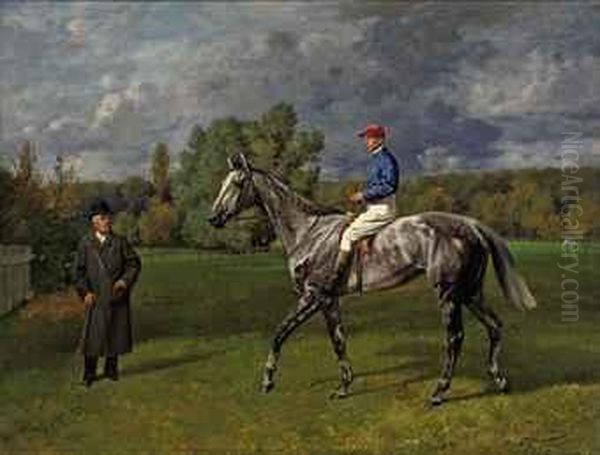
It is important to note that the Adam family's artistic legacy continued with Benno's son, Richard Benno Adam (1873-1937), who also became a painter, specializing in horses and portraits. Sometimes, works by Richard Benno Adam, such as Corelli II with Jockey and a Gentleman (1903) or Racetrack Berlin-Hoppegarten (1898), can be confused with those of his father due to the shared name and similar subject matter, but the dates clearly distinguish their authorship, as Benno Adam Sr. passed away in 1892.
The Adam Artistic Dynasty and Contemporaries
Benno Adam was not an isolated figure but part of a remarkable artistic family that significantly contributed to the Munich art scene. His father, Albrecht Adam, laid the foundation with his historical and animal paintings. Benno's brothers, Franz and Eugen, further diversified the family's output.
Franz Adam (1815-1886) was particularly known for his large-scale battle paintings and equestrian portraits, often depicting scenes from the Franco-Prussian War. His style was dynamic and detailed, reflecting the family's strong tradition in depicting horses.
Eugen Adam (1817-1880) focused more on genre scenes, often with military themes, but also produced landscapes and animal studies.
This familial concentration on related themes, especially involving animals and military subjects, created a distinct "Adam school" within Munich. Benno's son, Richard Benno Adam (1873-1937), carried this tradition into the 20th century, becoming known for his elegant portraits of horses and society figures.
Beyond his immediate family, Benno Adam worked within a rich artistic milieu. In Munich, other notable animal painters were his contemporaries.
Anton Braith (1836-1905) and his close associate Christian Mali (1832-1906) were highly successful painters of livestock, particularly cattle and sheep, often depicted in alpine pastures. Their works shared Adam's commitment to realism and sympathetic portrayal of animals.
Otto Gebler (1838-1917) was another Munich artist who gained acclaim for his charming and meticulously painted scenes of sheep.
Carl Steffeck (1818-1890), active in Berlin but influential, was renowned for his horse paintings and historical scenes.
The broader German art scene of the time included figures like:
Carl Spitzweg (1808-1885), a master of Biedermeier genre painting, whose charming and often humorous depictions of everyday life in small German towns were immensely popular.
Adolph Menzel (1815-1905), a leading figure of German Realism, known for his historical paintings, particularly scenes from the life of Frederick the Great, as well as his innovative depictions of modern industrial life.
Wilhelm von Kaulbach (1805-1874), a prominent history painter and director of the Munich Academy, known for his large-scale allegorical and historical murals.
Franz von Lenbach (1836-1904), who became one of Germany's most famous portrait painters, capturing the likenesses of prominent figures like Bismarck and Wagner.
Internationally, the field of animal painting was also vibrant.
In Britain, Sir Edwin Landseer (1802-1873) was the preeminent animal painter, whose sentimental yet anatomically precise depictions of dogs (like "The Old Shepherd's Chief Mourner"), stags ("The Monarch of the Glen"), and other animals achieved enormous popularity and influenced artists across Europe.
In France, Rosa Bonheur (1822-1899) was a celebrated animal painter and sculptor, famous for works like "The Horse Fair." Her meticulous realism and dedication to studying animal anatomy earned her international acclaim.
Austrian painter Friedrich Gauermann (1807-1862) was also a significant figure, known for his dramatic landscapes incorporating wildlife and rural scenes.
Benno Adam's work, therefore, should be seen within this wider context of a flourishing tradition of animal painting and a dynamic German art scene that was increasingly embracing realism and naturalism.
Influence and Legacy
Benno Adam's primary achievement lies in his contribution to the genre of animal painting in Germany. He elevated the depiction of animals beyond mere illustration, imbuing his subjects with individuality and a sense of inherent dignity. His technical skill, combined with his empathetic approach, resulted in works that were both aesthetically pleasing and emotionally resonant.
His association with the Chiemsee artists, though perhaps not as central to his identity as it was for dedicated landscape painters of that group, underscores his connection to the naturalistic trends of his time and his appreciation for the Bavarian countryside as a backdrop for his animal subjects.
The Adam family as a whole left an indelible mark on Munich's artistic landscape for nearly a century. Benno, as the eldest son of Albrecht and a mentor figure to his own son Richard, played a crucial role in perpetuating this artistic lineage. His dedication to animal painting provided a model for subsequent artists and contributed to the high regard in which this genre was held in 19th-century Germany.
His paintings continue to be appreciated by collectors and art enthusiasts for their technical finesse, their faithful representation of animals, and their evocation of a 19th-century world where the relationship between humans, animals, and the natural environment was a prominent theme in art and life. While perhaps not as revolutionary as some of his contemporaries who pushed the boundaries of modernism, Benno Adam excelled within his chosen specialization, creating a body of work that remains a testament to his skill and his deep affection for the animal kingdom. His works can be found in various German museums and private collections, preserving his contribution to the rich tapestry of 19th-century European art.
Conclusion
Benno Adam was a master of his craft, a German painter who dedicated his life to the art of animal depiction. Born into an artistic dynasty in Munich, he absorbed the lessons of his father, Albrecht Adam, and developed his own distinct voice, characterized by meticulous realism, anatomical accuracy, and a sensitive portrayal of his subjects. His hunting scenes, studies of deer, and especially his portraits of dogs and horses, stand as prime examples of 19th-century animal painting.
Connected to the Chiemsee artists' colony and working alongside notable contemporaries in Munich and beyond, Benno Adam contributed significantly to the artistic milieu of his time. He not only produced a substantial body of high-quality work but also played a part in the continuation of the Adam family's artistic legacy through his son, Richard Benno Adam. His paintings offer a window into the natural world as seen through the eyes of a skilled and empathetic observer, securing his place as an important figure in the history of German art.