Carl Joseph Alois Agricola: A Viennese Master of Portraiture and Myth
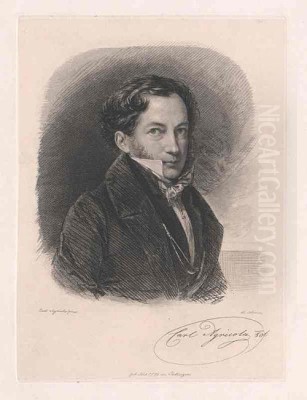
Carl Joseph Alois Agricola stands as a significant, if sometimes overlooked, figure in Austrian art history. Active during a transformative period that saw the twilight of Neoclassicism and the dawn of Romanticism and Biedermeier sensibilities, Agricola carved a niche for himself primarily as a painter of miniatures and historical scenes. His life and work offer a fascinating window into the artistic milieu of Vienna in the late 18th and early 19th centuries, a city then at the cultural heart of Europe.
Early Life and Artistic Awakening
Born on October 18, 1779, in Bad Säckingen, a town in the Margraviate of Baden, Carl Joseph Alois Agricola's artistic journey began not in the imperial capital, but with initial training in Karlsruhe. This early grounding provided him with the foundational skills that would later be honed in one of Europe's most vibrant artistic centers. Like many aspiring artists of his generation, Agricola was drawn to Vienna, the glittering capital of the Habsburg Empire, which promised greater opportunities for study, patronage, and recognition.
In 1798, Agricola made the pivotal move to Vienna. This was a city teeming with artistic talent and intellectual ferment. He enrolled in the prestigious Academy of Fine Arts Vienna (Akademie der bildenden Künste Wien), a venerable institution that had shaped generations of artists. It was here that he came under the tutelage of the renowned painter Heinrich Friedrich Füger (1751–1818). Füger, himself a dominant figure in Viennese Neoclassicism and a director of the Academy, exerted a considerable influence on his students, Agricola among them. Füger was celebrated for his historical paintings, mythological scenes, and portraits, often imbued with a dramatic flair and a meticulous attention to detail that echoed the tenets of Neoclassicism, yet sometimes hinted at emerging Romantic sensibilities.
The Influence of Heinrich Füger and the Viennese Academy
Under Füger's guidance, Agricola immersed himself in the academic tradition. This involved rigorous training in drawing from casts of ancient sculptures, life drawing, and the study of composition and color theory. Füger's own artistic leanings, which combined the clarity and idealism of Neoclassicism with a certain theatricality, undoubtedly shaped Agricola's approach. The master's emphasis on historical and mythological subjects would also resonate in Agricola's later oeuvre.
The environment at the Academy was competitive yet collaborative. Agricola would have studied alongside other promising talents who would also make their mark on Austrian art. Among those associated with Füger's studio or active at the Academy during this period were artists such as Johann Peter Krafft (1780–1856), who would become known for his historical and genre paintings, and Josef Abel (1764–1818), another prominent historical painter and portraitist. Other figures in the Viennese art scene whose paths Agricola might have crossed or whose work he would have known included the portraitist Johann Baptist von Lampi the Elder (1751–1830), whose elegant depictions of aristocracy were highly sought after. The broader artistic climate was also shaped by figures like Anton Raphael Mengs (1728-1779), whose Neoclassical theories and works had a profound impact across Europe, influencing teachers like Füger.
Specialization in Miniature Painting
While Agricola developed skills in various genres, he gained particular acclaim for his miniature portraits. In an era before photography, miniatures served a vital role. These small, intimately scaled portraits, often painted on ivory or vellum, were cherished as personal keepsakes, exchanged as tokens of affection, or carried during travel. They demanded exceptional precision, a delicate touch, and the ability to capture a likeness and personality within a confined space.
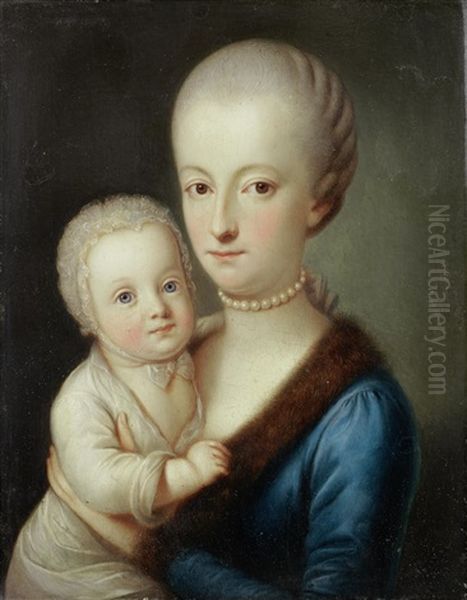
Agricola excelled in this demanding art form. His miniatures were praised for their fine execution, sensitive portrayal of sitters, and often, a charming intimacy. He was especially noted for his depictions of children, capturing their innocence and individual character with remarkable skill. These works found favor among the Viennese aristocracy and the burgeoning middle class, who sought to commemorate their loved ones. In this field, Agricola was a contemporary of other celebrated Viennese miniaturists, most notably Moritz Michael Daffinger (1790–1849), who became one of the most famous miniature painters of the Biedermeier period. While Daffinger's style often had a particular Viennese charm and elegance, Agricola's work maintained a high level of technical proficiency and psychological insight.
His success in miniature painting provided a steady source of income and helped establish his reputation. Several of these exquisite small works, including portraits of children, are now preserved in prestigious collections, such as the Austrian National Gallery (Belvedere) in Vienna, testifying to his mastery in this genre.
Historical and Mythological Compositions
Beyond miniatures, Carl Joseph Alois Agricola also dedicated himself to historical and mythological paintings, genres highly esteemed within the academic tradition. These larger-scale works, often executed in oil or watercolor, allowed him to explore grander themes and more complex compositions, reflecting the Neoclassical and early Romantic influences prevalent at the time.
Among his notable works in this vein are paintings depicting mythological subjects such as "Cupid and Psyche." This particular theme, drawn from Apuleius's "Metamorphoses," was a favorite among Neoclassical and Romantic artists, offering opportunities to explore themes of love, trial, and divine beauty. Agricola's interpretations would have aimed to capture the grace and idealism associated with classical antiquity, filtered through the artistic sensibilities of his era. Another mythological subject he tackled was "Pan," the Greek god of the wild, shepherds, and flocks, often associated with rustic music and nature.
These works demonstrate Agricola's ambition to engage with the "grand manner" of painting. His style in these compositions often reflected the late 18th-century aesthetic, characterized by clear lines, balanced compositions, and an idealized representation of the human form, though sometimes infused with a softer, more Romantic atmosphere. He was working in a tradition that included artists like Angelica Kauffman (1741-1807), whose graceful Neoclassical scenes were internationally renowned, and whose influence was felt in Vienna.
Engraving and the Study of Old Masters
Agricola was not only a painter but also a skilled engraver and etcher. This aspect of his artistic practice was twofold: it served as a means of disseminating his own compositions and, significantly, involved the reproduction of works by esteemed Old Masters. Creating engravings after famous paintings was a common practice, allowing for wider appreciation of masterpieces and serving as an important learning tool for the engraver.
He is known to have produced engravings and etchings after a diverse range of influential artists. These included the German painter Adam Elsheimer (1578–1610), known for his small, intensely atmospheric landscapes and biblical scenes. Agricola also engaged with the titans of the Baroque, such as Peter Paul Rubens (1577–1640), whose dynamic compositions and vibrant use of color set a high bar for subsequent generations. Italian masters also featured in his reproductive work, including Parmigianino (1503–1540), a key figure of Mannerism celebrated for his elegant and elongated figures, and Domenico Feti (c. 1589–1623, sometimes referred to as Finchi in older sources), known for his rich color and expressive biblical parables.
His teacher, Heinrich Füger, was also among those whose works Agricola reproduced, a testament to their close artistic relationship. Furthermore, he is documented as having imitated the works of High Renaissance master Raphael (1483–1520) and the classical Baroque painter Nicolas Poussin (1594–1665). This practice of copying and interpreting the works of past masters was crucial for an artist's development, allowing for a deep understanding of composition, form, and technique. It also placed Agricola within a long tradition of artists learning from and paying homage to their predecessors.
Patronage and Professional Life
Throughout his career in Vienna, Agricola served a distinguished clientele. His skill in portraiture, particularly miniatures, made him sought after by noble families. He is recorded as having worked for prominent Bohemian and Moravian aristocratic houses, who often maintained residences in Vienna or visited the capital. This network of patronage was essential for an artist's livelihood and reputation.
A significant appointment in his career was that of court painter to the princely Dietrichstein family, one of Austria's most influential noble lineages. Such a position would have provided him with a degree of financial security and prestige, as well as regular commissions. His role as a portraitist for these elite circles places him among the key figures documenting the faces of Viennese society in the early 19th century. His style, which blended the formality expected in aristocratic portraiture with a sensitive rendering of individual character, was well-suited to these patrons.
The Biedermeier period (roughly 1815-1848), which overlapped with a significant portion of Agricola's career, saw the rise of the middle class as art patrons. While Agricola had strong ties to the aristocracy, the general demand for portraits, including miniatures and larger formats, extended to this increasingly affluent bourgeois clientele. Artists like Peter Fendi (1796–1842), known for his genre scenes and watercolors, and Ferdinand Georg Waldmüller (1793–1865), a leading figure of Austrian Biedermeier painting, catered to and helped define the tastes of this era. Agricola, with his refined technique, operated within this evolving artistic landscape.
Contemporaries and the Viennese Art World
Agricola's career unfolded within a dynamic Viennese art world. Besides his teacher Füger and fellow students like Krafft and Abel, he was contemporary with a host of other artists who contributed to the city's cultural richness. The Academy of Fine Arts remained a central institution, with figures like Hubert Maurer (1738–1818) and Franz Caucig (1755–1828) also teaching and promoting Neoclassical ideals.
The transition towards Romanticism and Biedermeier brought new names and styles to the fore. While Agricola's primary style remained rooted in the late 18th-century and Neoclassical traditions, he would have been aware of these shifts. The Ender brothers, Johann Nepomuk Ender (1793–1854) and Thomas Ender (1793–1865), were active during this period, with Johann known for portraits and historical scenes, and Thomas for landscapes. Leopold Kupelwieser (1796–1862) was another contemporary who embraced Romanticism, particularly in his religious and historical paintings.
The demand for portraiture was high, and Agricola was one of many skilled practitioners. His ability to work across different scales, from intimate miniatures to more formal oil portraits, gave him versatility. His "Damenporträt" (Lady's Portrait) from 1835, once in the collection of Dr. Walther Kastner, and the "Portrait de la comtesse Desfours-Walderode" from 1839, are examples of his mature portrait work, showcasing his skill in capturing both likeness and the social standing of his sitters.
Personal Life: A Glimpse of Tragedy
Historical records offer few detailed insights into the personal lives of many artists from this period, but some anecdotes concerning Agricola have survived, painting a picture of a man who experienced profound personal loss. It is documented that he suffered the death of his son, an event that understandably caused him immense grief. Accounts suggest that, despite this deep sorrow, he bore his pain with a stoic demeanor, not outwardly displaying the extent of his suffering in the way some might have expected. This portrayal hints at a man of considerable inner fortitude, navigating personal tragedy while continuing his professional life.
Later Years, Death, and Legacy
Carl Joseph Alois Agricola passed away in Vienna on May 15, 1852. His death was reportedly met with considerable public attention and sympathy. There were even rumors, as sometimes occurred with public figures, suggesting he might have been poisoned, though such claims are often difficult to substantiate historically. The outpouring of public interest indicates that he was a respected and well-known figure in Viennese society.
Agricola's legacy lies in his contribution to Austrian art during a period of significant stylistic transition. He was a master of the miniature, a genre that, while declining with the advent of photography later in the 19th century, was of paramount importance during his lifetime. His historical and mythological paintings reflect the academic ideals of his training, while his portraiture provides a valuable record of the individuals who shaped Viennese society.
His works are represented in important Austrian collections, most notably the Belvedere in Vienna, which houses a significant collection of Austrian art spanning centuries. The presence of his works in such an institution underscores his place in the narrative of Austrian art history. While perhaps not as revolutionary as some of his contemporaries who more fully embraced Romanticism or Biedermeier realism, Agricola was a highly skilled and productive artist who upheld the traditions of fine craftsmanship and sensitive portrayal. He remains an important representative of the Viennese school of painting in the early 19th century, a bridge between the fading elegance of the Ancien Régime and the emerging sensibilities of a new era.
Conclusion: An Enduring Contribution
Carl Joseph Alois Agricola's career spanned several decades of dynamic change in European art and society. From his early training in Karlsruhe to his established career in Vienna under the influence of Heinrich Füger, he developed into a versatile artist proficient in miniature painting, historical scenes, and portraiture. His dedication to his craft, his ability to capture the essence of his sitters, and his engagement with the grand themes of mythology and history solidify his position as a noteworthy artist of his time.
His connections with prominent patrons like the Dietrichstein family, and his role in the broader Viennese art scene alongside contemporaries such as Daffinger, Krafft, and Abel, highlight his integration into the cultural fabric of the Habsburg capital. While the intimate art of the miniature, for which he was particularly famed, would eventually be superseded by new technologies, his surviving works continue to charm and impress with their delicacy and precision. Agricola's oeuvre provides valuable insight into the artistic tastes and social customs of early 19th-century Vienna, securing his place as a respected master in the annals of Austrian art.