Dirk Helmbreker, a notable figure of the Dutch Golden Age, carved a unique niche for himself through his evocative depictions of everyday life, particularly during his extended tenure in Italy. Born in Haarlem in 1633 and passing away in Rome in 1696, Helmbreker's artistic journey bridges the vibrant art scene of the Netherlands with the enduring allure of Italian landscapes and culture. His work, characterized by a keen observational skill and a distinctive, somewhat sketch-like yet precise technique, offers a fascinating window into the cross-cultural artistic currents of the 17th century.
Early Life and Artistic Formation in Haarlem
Dirk Helmbreker, baptized Theodorus Helmbreker, entered the world in the bustling artistic hub of Haarlem in 1633. His father, Cornelis Helmbreker, was an organist at the city's prominent Grote Kerk, or St. Bavo Church, a position that likely immersed the young Dirk in an environment rich with cultural and religious significance from an early age. Haarlem, during this period, was a crucible of artistic innovation, home to renowned masters and a thriving guild system that nurtured young talent.
It was within this stimulating milieu that Helmbreker received his foundational artistic training. His principal master was Pieter de Grebber (c. 1600–1652/53), a respected Haarlem painter known for his history paintings, portraits, and religious works. De Grebber himself was part of a family of artists and had a style that blended classicist tendencies with a typically Dutch realism. Under De Grebber's tutelage, Helmbreker would have learned the fundamentals of drawing, composition, and oil painting, likely working on religious scenes and portraits that were De Grebber's forte.
During his formative years in Haarlem, Helmbreker was also part of a close-knit circle of young artists. Among his contemporaries and fellow students were figures like Leendert van der Cooghen (1632–1681) and Cornelis Pietersz Bega (1631/32–1664). This group often studied and worked together, sometimes sharing materials and stylistic approaches, such as a preference for sanguine (red chalk) and black chalk in their drawings. The camaraderie and friendly rivalry within such groups were crucial for artistic development, fostering experimentation and mutual influence. Other prominent Haarlem artists of the era, whose presence would have contributed to the city's artistic vibrancy, included masters like Frans Hals (c. 1582/83–1666), Adriaen van Ostade (1610–1685), and Jacob van Ruisdael (c. 1628/29–1682), though direct tutelage under them is not recorded for Helmbreker. The influence of Salomon de Bray (1597–1664) and his talented son Jan de Bray (c. 1627–1697) also permeated the Haarlem art scene, emphasizing a more classical and refined style.
The Lure of Italy: Journey and Arrival in Rome
Around 1652 or 1653, like many Northern European artists of his generation, Dirk Helmbreker felt the irresistible pull of Italy, the cradle of classical antiquity and Renaissance art. The journey south was an established rite of passage for ambitious artists seeking to broaden their horizons, study ancient ruins, and absorb the masterpieces of Italian art. Helmbreker did not undertake this significant journey alone. He traveled with a group of fellow artists, most notably Cornelis Bega, his close associate from Haarlem, and Vincent van der Vinne (1628–1702). Their itinerary reportedly took them through Germany and Switzerland before they finally reached Italy.
Upon arriving in Rome, Helmbreker found himself in a city teeming with artists from all over Europe, all drawn by its rich artistic heritage and the opportunities for patronage. He quickly integrated into the community of Northern artists, known as the "Bentvueghels" (Dutch for "birds of a feather"). This informal brotherhood provided mutual support, networking opportunities, and a social outlet for expatriate painters, sculptors, and poets. Upon initiation, members were given a "bent" nickname; Helmbreker's is not definitively recorded, though he was sometimes referred to as "Monsù Teodoro" in Italy, a common Italianization of Dutch names. Within this circle, he would have encountered artists like Cornelis Visscher (though Visscher was primarily an engraver and spent less time in Rome) and Guillaume du Bois.
Rome offered a different artistic landscape than Haarlem. While Dutch art often focused on intimate genre scenes, portraits, and landscapes for a burgeoning middle-class market, Roman art was still heavily dominated by large-scale commissions from the Church and powerful noble families, often favoring grand historical, mythological, or religious themes in the Baroque style. However, a particular niche had been carved out by earlier Northern artists like Pieter van Laer (1599–c. 1642), nicknamed "Il Bamboccio" (the puppet or clumsy doll).
The Bamboccianti and Roman Genre Scenes
Pieter van Laer had pioneered a style of painting that focused on the everyday life of the common people in Rome and its surrounding countryside – scenes of peasants, street vendors, travelers, and artisans amidst Roman ruins or in rustic settings. His followers, known as the "Bamboccianti," embraced these themes, creating works that were highly popular with collectors, both Italian and foreign, for their lively and unidealized portrayal of Roman life. Dirk Helmbreker found a natural affinity with this genre.
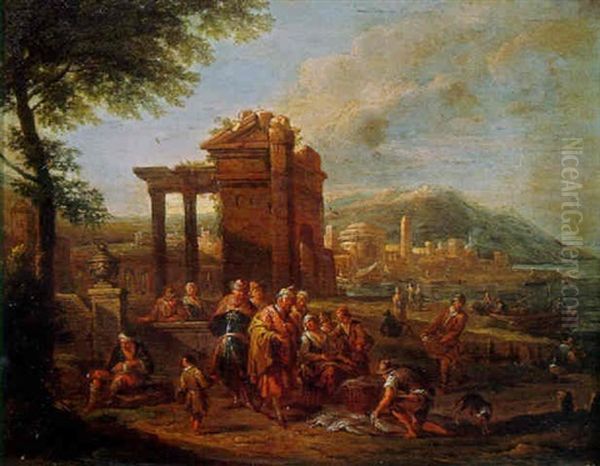
Helmbreker became a prominent figure among the later generation of Bamboccianti. His paintings often depict bustling outdoor scenes, markets, peasant gatherings, and, notably, "open kitchen" themes set in rustic environments or among ancient ruins. These works are characterized by their detailed observation, lively figures, and a careful rendering of textures and light. He shared this thematic focus with other Bamboccianti active in Rome during his time, such as Johannes Lingelbach (1622–1674), Thomas Wijck (c. 1616–1677), and Karel Dujardin (c. 1626–1678), though each artist brought their own stylistic nuances to the genre.
Helmbreker's approach was marked by a delicate, almost feathery brushwork and a keen eye for anecdotal detail. His compositions are often complex, filled with numerous figures engaged in various activities, creating a vibrant tapestry of daily existence. He was adept at capturing the play of light and shadow, often using it to highlight specific figures or create a sense of depth in his scenes. His palette, while sometimes subdued, could also incorporate lively touches of color, particularly in the clothing of his figures.
Masterpieces and Artistic Characteristics
Dirk Helmbreker's oeuvre, though not as vast as some of his contemporaries, includes several significant works that exemplify his style and thematic concerns. One of his most celebrated paintings is "Rustic Scene" (Scena campestre), currently housed in the collections of the Villa Medicea di Poggio a Caiano. This work is a quintessential example of his Bambocciante style. It depicts a lively scene set within a grotto-like structure, possibly an ancient ruin repurposed as a temporary dwelling or kitchen near Rome. Men are shown drinking and conversing, women are busy with food preparation and cleaning utensils, children play, and various animals, including dogs and donkeys, are integrated into the composition. The painting is a rich tableau of 17th-century Roman peasant life, rendered with Helmbreker's characteristic attention to detail and lively figural arrangement. The work was notably donated to Grand Prince Ferdinando de' Medici in 1705, indicating its high regard.
Another significant work often attributed to him, or at least in his style, is known by the title "Open Kitchen" (sometimes referred to by his Italian moniker, Monsù Teodoro). This painting, and others like it, showcases his fascination with scenes of food preparation in outdoor or rustic settings. These "open kitchens" often feature an array of figures engaged in cooking, butchering, or selling food, surrounded by an abundance of culinary implements, game, and produce. Such scenes allowed Helmbreker to display his skill in still-life elements within a larger narrative composition.
Helmbreker was also a skilled draftsman. His drawings, often executed in red or black chalk, reveal his working process. These studies frequently focus on individual figures or small groups, capturing their poses, gestures, and expressions with a fluid, sketch-like quality. Examples include drawings of smokers and drinkers, common motifs in Dutch and Bambocciante genre art. These sketches often employ parallel hatching for shading, a technique that translates into the subtle modeling seen in his paintings. His "Self-Portrait" (c. 1650), now in the National Gallery of Art, Washington, D.C., created relatively early in his career, shows a confident young artist, and another portrait, this one of his friend "Cornelis Bega, Rome" (c. 1650-1654), is in the Rijksmuseum, Amsterdam, capturing a moment from their shared Italian experience.
His artistic style is marked by several key characteristics:
1. Detailed Realism: While not photographic, Helmbreker's works show a commitment to depicting the textures of fabrics, the roughness of stone, and the varied physiognomies of his figures with considerable accuracy.
2. Lively Compositions: His scenes are rarely static. They are filled with movement and interaction between figures, creating a sense of dynamism.
3. Anecdotal Focus: Helmbreker excelled at incorporating small narrative details that enrich the scene and engage the viewer's curiosity.
4. Subtle Light and Shadow: He skillfully used chiaroscuro to model forms and create atmospheric effects, often bathing his scenes in a soft, diffused light.
5. Sketch-like Finish: Some of his paintings retain a certain immediacy, as if capturing a fleeting moment, with visible brushstrokes contributing to this effect. This was a departure from the highly polished finish favored by some academic painters.
Connections, Patronage, and Influence in Italy
During his long career in Rome, which spanned over four decades with only a brief interruption for a return to Holland, Helmbreker established himself as a respected artist. He maintained connections with fellow Dutch and Flemish artists in the Bentvueghels, but also likely interacted with Italian artists and patrons. The art critic Filippo Baldinucci (1625–1697), a contemporary, mentioned Helmbreker in his writings, which is a testament to his recognition within the Italian art world.
His patrons likely included Italian nobles and church officials, as well as foreign visitors on the Grand Tour who were keen to acquire scenes of Roman life as souvenirs. The aforementioned donation of "Rustic Scene" to Grand Prince Ferdinando de' Medici highlights his connection to one of the most powerful and discerning art-collecting families in Italy. Works by Helmbreker were also reportedly found in Roman churches, suggesting he undertook religious commissions, aligning with his initial training under De Grebber, although his fame rests primarily on his genre scenes. There are mentions of his works being appreciated by figures such as Pope Innocent X (Giovanni Battista Pamphilj, papacy 1644-1655, though this would be early in Helmbreker's Roman period) and later, Pope Innocent XII (Antonio Pignatelli, papacy 1691-1700), during Helmbreker's final years.
The Bamboccianti, including Helmbreker, played an interesting role in the Roman art scene. While some academic critics, who championed the "grand manner" of history painting, looked down upon their focus on "low-life" subjects, their works were immensely popular with a broad range of collectors. Their influence extended beyond their immediate circle, contributing to a broader European interest in genre painting and influencing later artists, including some Rococo painters who admired their lively and informal depictions of everyday life.
Later Years, Return to Holland, and Final Period in Rome
Sources suggest that Dirk Helmbreker made at least one trip back to the Netherlands after his initial move to Italy. This return is thought to have occurred sometime in the mid-to-late period of his career, possibly in the 1670s or 1680s. During this time, he would have reconnected with the Dutch art scene, which had continued to evolve. It's plausible he undertook commissions or re-established contacts in cities like Haarlem or Amsterdam. However, the allure of Italy proved strong, and he did not remain in his homeland permanently.
He eventually returned to Rome, the city that had become his adopted home and the primary stage for his artistic endeavors. He continued to paint, likely producing more of the genre scenes that had brought him success. His later works would have reflected his mature style, honed over decades of practice and observation. He remained in Rome until his death in 1696. He was buried in the city, a testament to his deep integration into its artistic and social fabric.
Legacy and Collections
Dirk Helmbreker's legacy lies in his contribution to the Bamboccianti tradition and his skillful portrayal of 17th-century Italian, particularly Roman, life through the eyes of a Northern European artist. His works offer a valuable glimpse into the social customs, attire, and daily activities of the common people of his time, rendered with a sympathetic and observant eye. He successfully blended Dutch traditions of genre painting with Italian settings and subjects.
His paintings and drawings are found in several prestigious museum collections today. As mentioned, the National Gallery of Art in Washington, D.C. holds his "Self-Portrait," and the Rijksmuseum in Amsterdam has his portrait of Cornelis Bega. The Villa Medicea di Poggio a Caiano (near Florence) is home to his significant "Rustic Scene." Other works can be found in various European and American museums and private collections, sometimes appearing in exhibitions dedicated to Dutch Golden Age painting or the art of the Bamboccianti. For instance, his "Self-Portrait" was featured in the major exhibition "The Glory of the Golden Age" held at the Rijksmuseum in 2000.
While perhaps not as universally famous as some of his Dutch contemporaries like Rembrandt van Rijn (1606–1669) or Johannes Vermeer (1632–1675), Dirk Helmbreker holds a significant place among the Dutch Italianates and the Bamboccianti. His dedication to capturing the vibrant, unvarnished life of Rome's streets and countryside, combined with his distinctive artistic style, ensures his enduring appeal and importance for art historians and enthusiasts alike. He remains a key figure for understanding the rich artistic exchange between the Netherlands and Italy during the Baroque period.