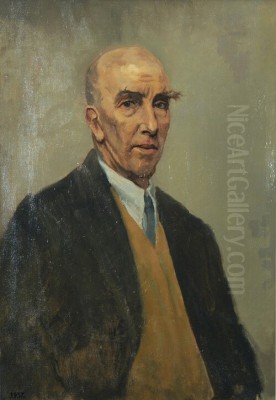
Fedor van Kregten (1871-1937) stands as a notable figure in the lineage of Dutch painters who found their deepest inspiration in the tranquil beauty of their native landscapes and the gentle presence of animals that inhabit them. Working primarily in oils, van Kregten dedicated his artistic career to capturing the serene atmosphere of the Dutch countryside, a subject that has captivated artists for centuries. His work, characterized by a realistic approach and a keen eye for detail, offers a window into the pastoral life of the Netherlands during the late 19th and early 20th centuries. While perhaps not as widely known internationally as some of his Golden Age predecessors or Hague School contemporaries, van Kregten's paintings are cherished for their honest depiction and evocative power, securing him a respected place among Dutch traditional painters.
The Enduring Tradition of Dutch Landscape Painting
The Netherlands boasts a rich and unparalleled tradition in landscape painting, reaching its zenith during the 17th-century Golden Age. Artists like Jacob van Ruisdael, with his dramatic skies and meticulously rendered trees, and Meindert Hobbema, known for his idyllic woodland scenes and watermills, established a visual vocabulary for the Dutch landscape. Aelbert Cuyp bathed his scenes, often featuring placid cattle, in a warm, golden light, while Paulus Potter became renowned for his incredibly lifelike depictions of farm animals, most famously The Young Bull. This profound connection to the land, its specific light, and its agrarian life, did not wane with the passing centuries. It continued to be a dominant theme, evolving with artistic currents but always retaining a core affection for the local environment. Fedor van Kregten emerged within this enduring legacy, inheriting a deep-seated cultural appreciation for scenes of rural life.
The Hague School and its Afterglow
In the latter half of the 19th century, the Hague School revitalized Dutch landscape and genre painting. Artists like Jozef Israëls, Hendrik Willem Mesdag, Anton Mauve, Willem Maris, Jacob Maris, Johannes Bosboom, Paul Gabriël, and Willem Roelofs sought to capture the atmospheric qualities of the Dutch landscape and the everyday lives of its people, often fishermen and farmers. They were influenced by the French Barbizon School, favoring realistic depictions, often imbued with a melancholic or contemplative mood, and a focus on the effects of light and weather. Anton Mauve, in particular, became famous for his depictions of sheep on the heath, a subject that resonated with van Kregten. Willem Maris excelled in painting cattle and ducks near water, capturing the moist, light-filled atmosphere of the polders.
While Fedor van Kregten's active period slightly post-dates the main flourishing of the Hague School, his work clearly shows an affinity with its principles. He continued the tradition of realistic landscape painting with a focus on rural subjects, particularly livestock, which were central to the Dutch agricultural identity and a beloved motif in its art. His approach can be seen as part of the "afterglow" of the Hague School, maintaining its commitment to verisimilitude and atmospheric representation before modernism began to take a firmer hold in Dutch art with figures like Piet Mondrian or the artists of De Stijl.
Fedor van Kregten: A Life Immersed in Nature
Specific biographical details about Fedor van Kregten's early life, formal artistic training, or the precise locations of his birth and death are not extensively documented in readily available sources. However, his body of work speaks volumes about his life's focus. Born in 1871 and passing away in 1937, his artistic output firmly places him in a period of transition in European art. Yet, van Kregten remained steadfastly committed to the pastoral genre. His paintings suggest an artist who spent considerable time observing the Dutch countryside, its changing seasons, its particular light, and the behavior of its animal inhabitants.
This dedication to a specific genre, while perhaps limiting his appeal to those seeking avant-garde innovation, allowed him to develop a profound understanding and mastery of his chosen subjects. His consistent focus on cows, sheep, and the meadows and waterways they frequented, indicates a deep personal connection to these scenes. He was not merely painting generic animals in a landscape; he was capturing a way of life, a specific environment that was quintessentially Dutch. His signature, often found in the lower right corner of his canvases, became a mark of this dedicated vision.
Artistic Style and Thematic Focus
Fedor van Kregten's artistic style is rooted in realism. He meticulously rendered the anatomy of his animals, the textures of their coats, and the play of light on their forms. His landscapes, whether expansive meadows, quiet watersides, or heathlands, are depicted with a similar attention to detail. He had a fine understanding of perspective and composition, often arranging his animal subjects naturally within the landscape to create harmonious and believable scenes.
His palette typically reflects the often-subdued, earthy tones of the Dutch landscape, but he was also adept at capturing the subtle shifts in light – the soft glow of morning, the hazy light of a summer afternoon, or the cool tones of an overcast day. This sensitivity to atmospheric conditions is a hallmark of the Dutch landscape tradition he inherited. The recurring themes in his work are:
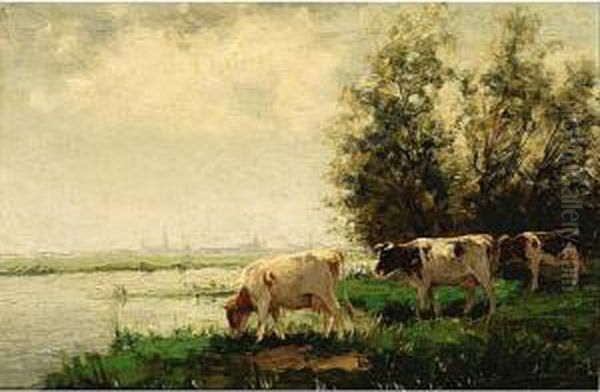
Cattle in Meadows: Perhaps his most frequent subject, van Kregten depicted cows grazing, resting, or wading in the polders. These scenes evoke a sense of peace and the timeless rhythm of rural life.
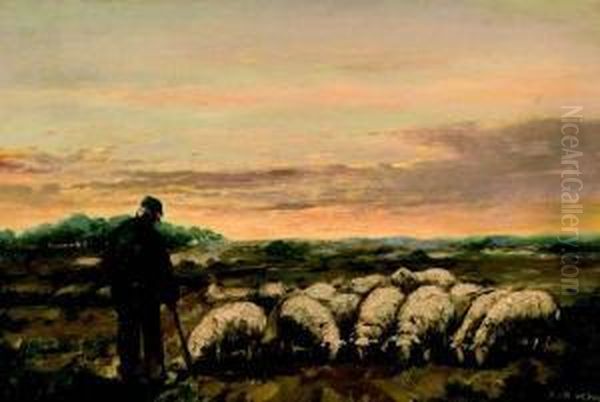
Sheep on the Heath: Following in the footsteps of artists like Mauve, van Kregten also painted sheep, often in the more rugged terrain of heathlands, capturing their woolly texture and herd behavior.
Waterside Scenes: Reflecting the water-rich environment of the Netherlands, many of his paintings feature canals, ditches, or ponds, with animals interacting with these water elements.
Individual Animal Portraits: While often part of a larger scene, his animals are rendered with enough individuality to sometimes feel like portraits, showcasing his keen observation.
His commitment to oil on canvas allowed for a richness of color and texture that suited his realistic approach. The varying dimensions of his works suggest he produced paintings for different contexts, from smaller, more intimate pieces to larger compositions suitable for more prominent display.
Representative Works of Fedor van Kregten
Several titles of Fedor van Kregten's works have been recorded, giving us insight into his typical subject matter and artistic concerns.
One of his well-documented pieces is Cows in the meadow . A specific version of this painting, measuring 66.6 x 88.2 cm, exemplifies his focus. Such a scene would typically depict several cows, perhaps Holstein Friesians, grazing or resting in a lush, green Dutch polder, possibly under a wide, cloud-strewn sky. The dimensions suggest a moderately sized painting, suitable for domestic display, allowing the viewer to appreciate the details of the animals and the surrounding landscape. This work was noted to have an auction estimate of €800-€1200 and reportedly sold in a range of €1000-€2000, indicating a consistent level of collector interest.
Another work, titled Two calves at rest , points to his interest in the younger members of the herd. Calves, with their slightly more delicate forms and often curious nature, would offer a different dynamic to his compositions. Such a painting would likely emphasize the innocence and tranquility of these young animals, perhaps nestled in tall grass or close to their mothers.
Landschaft aan water is a broader title that could encompass a variety of scenes. Given the Netherlands' geography, this could depict cows drinking from a canal, ducks on a pond, or simply a landscape where water is a dominant feature, reflecting the interplay of light on the water's surface and the surrounding vegetation.
Schapen op de heide , with recorded dimensions of 61 x 101 cm, indicates a more panoramic format. This subject would allow van Kregten to explore a different type of landscape – the heathlands, often characterized by heather, sandy patches, and a more open, sometimes starker, beauty compared to the lush polders. The depiction of a flock of sheep would involve capturing their collective movement and the textures of their fleece.
The painting Herder met schapen introduces a human element, albeit one intrinsically linked to the pastoral theme. The shepherd, a timeless figure in rural landscapes, adds a narrative dimension, suggesting the symbiotic relationship between humans and their livestock.
Finally, a work titled Dutch polder landscape with pollard willows and ducks further specifies the quintessential elements of many Dutch landscapes. Pollard willows, with their distinctive gnarled shapes, are iconic features of the Dutch countryside, often lining canals and ditches. The inclusion of ducks adds another layer of life and movement to the scene.
These titles, while not exhaustive, paint a clear picture of Fedor van Kregten's artistic preoccupations. He was an artist deeply attuned to the nuances of the Dutch rural environment and its animal inhabitants, capturing them with skill and affection.
The Pastoral Ideal in Dutch Art and Van Kregten's Contribution
The pastoral ideal – the romanticized vision of rural life, emphasizing its simplicity, tranquility, and harmony with nature – has a long history in Western art. In the Netherlands, this ideal took on a particular character, deeply intertwined with national pride in the reclaimed land and the productivity of its agriculture. Paintings of well-fed cattle and sheep in lush pastures were not just charming scenes; they were also subtle affirmations of prosperity and a well-ordered society.
Fedor van Kregten's work fits comfortably within this tradition. His paintings rarely depict hardship or the more grueling aspects of farm labor. Instead, they focus on moments of calm and natural beauty: cows resting contentedly, sheep grazing peacefully, the gentle light illuminating a serene landscape. This focus on the idyllic aspects of rural life appealed to a broad audience, including urban dwellers who might have yearned for a connection to the countryside.
His contribution lies in his consistent and skilled portrayal of these themes during a period when art was undergoing significant transformations. While artists like Vincent van Gogh (in his earlier Dutch period) depicted the harsher realities of peasant life, and others like George Hendrik Breitner and Isaac Israëls (son of Jozef) were capturing the dynamism of Amsterdam city life (Amsterdam Impressionism), van Kregten remained a steadfast voice for the pastoral tradition. He provided a continuation of a beloved genre, reassuring viewers with familiar and comforting scenes executed with technical proficiency.
Contemporaries and the Broader Artistic Milieu
Fedor van Kregten worked during a vibrant period in Dutch art. Besides the lingering influence of the Hague School masters like Anton Mauve, Willem Maris, and Jozef Israëls, other notable artists were active. The aforementioned Breitner and Isaac Israëls were leading figures of Amsterdam Impressionism, capturing urban scenes with a dynamic, sketch-like style. Willem Witsen, another contemporary, was known for his atmospheric cityscapes and etchings.
In the realm of landscape and rural scenes, artists like Bernardus Johannes Blommers continued the Hague School tradition, often focusing on fisherfolk and peasant families. Théophile de Bock was another landscape painter associated with the Hague School, known for his moody depictions of Dutch scenery. While van Kregten's focus was more specifically on animals within the landscape, he shared with these artists a commitment to representing the visual character of the Netherlands.
Internationally, this period saw the rise of Post-Impressionism with figures like Paul Cézanne, Paul Gauguin, and Vincent van Gogh (though van Gogh's most famous works were produced outside the Netherlands). Symbolism was also a significant movement. While van Kregten's art did not directly engage with these more avant-garde currents, he was part of a broader artistic environment where traditional and modern approaches coexisted and sometimes overlapped. His adherence to a more established style catered to a segment of the art market that continued to appreciate well-executed, realistic depictions of familiar subjects. Other Dutch painters who maintained a more traditional, realistic approach to landscape and genre scenes around this time include figures like Louis Apol, known for his winter landscapes, and Cornelis Vreedenburgh, who also painted Dutch landscapes with cattle and water scenes.
Van Kregten's Place in Art History
Fedor van Kregten is best understood as a skilled and dedicated practitioner within the long tradition of Dutch pastoral painting. He may not have been an innovator who radically altered the course of art history, but his contribution is valuable for its consistent quality and its heartfelt depiction of a specific aspect of Dutch life and landscape. His work represents a continuation of the aesthetic values championed by the Hague School, emphasizing realism, atmospheric sensitivity, and a deep affection for the subject matter.
In an era that saw increasing industrialization and urbanization, van Kregten's paintings offered an escape into a seemingly timeless rural world. His art serves as a visual record of the Dutch countryside at the turn of the 20th century, rendered with an eye for detail and a genuine appreciation for its quiet beauty. For collectors and enthusiasts of traditional Dutch art, his works remain appealing for their technical skill, their evocative power, and their connection to a cherished artistic heritage. He is one of many talented artists who, while not achieving the global fame of a Rembrandt or a Vermeer, played an important role in sustaining and enriching their national artistic traditions. His name appears in catalogues such as "OLD Masters to Modernists," indicating his recognition within the art historical narrative of the period.
The Market for Fedor van Kregten's Work
The information available from auction records indicates that Fedor van Kregten's paintings have a consistent presence in the art market, particularly within the Netherlands and among collectors of traditional European art. The auction estimate of €800-€1200 for Cows in the meadow and its reported sale price in the €1000-€2000 range suggest a stable market value for his works of good quality and typical subject matter. Another piece, Herder met schapen, was noted with a starting bid of €400 in a 2024 auction.
His works have appeared at auction houses like Heritage Auctions Europe. The fact that his paintings were, and continue to be, collected privately and traded at auction demonstrates an enduring appreciation for his style and subject matter. While not commanding the prices of the most famous Old Masters or leading Impressionists, van Kregten's art holds its value and appeals to a dedicated group of collectors who appreciate the charm and skill of his pastoral scenes. The provenance of some works, such as being handled by dealers like Artworks Simonis & Buunk in Ede (Netherlands), further attests to his recognized place in the Dutch art market.
Conclusion: An Artist of Quiet Charm
Fedor van Kregten (1871-1937) was a Dutch painter who devoted his career to capturing the serene beauty of his homeland's rural landscapes and the animals that grazed its pastures. Working in a realistic style that echoed the legacy of the Hague School, he produced a body of work characterized by careful observation, technical skill, and a gentle, appreciative eye. His paintings of cows in meadows, sheep on heaths, and tranquil waterside scenes offer a peaceful window into the Dutch countryside of his time.
While not a revolutionary figure, van Kregten played a significant role in continuing a beloved tradition of Dutch art. His works, found in private collections and appearing regularly on the art market, attest to an enduring appeal. He remains a respected artist for those who cherish the quiet charm and honest depiction of pastoral life, a chronicler of the timeless interplay between the Dutch land, its animals, and its unique atmospheric light. His dedication to this specific niche has ensured his place as a noteworthy, if understated, contributor to the rich tapestry of Dutch painting.