Franz Xaver von Pausinger stands as a significant, if sometimes overlooked, figure in 19th-century Austrian art. A painter renowned for his detailed landscapes, evocative animal studies, and his role as an illustrator for the imperial court, Pausinger's life and work offer a fascinating window into the artistic, cultural, and even political currents of the Austro-Hungarian Empire during its later decades. His art, deeply rooted in the traditions of realism and naturalism, captured both the grandeur of the alpine wilderness and the exotic allure of distant lands, securing him a unique place among his contemporaries.
Early Life and Artistic Awakening in Salzburg
Born on February 10, 1839, in Salzburg, a city famed for its baroque architecture and stunning alpine surroundings, Franz Xaver von Pausinger was immersed in a rich cultural and natural environment from his earliest days. His childhood was spent at Schloss Frein, a setting that likely nurtured his appreciation for both the cultivated and the wild aspects of nature. His father's profession as a hunter and his role as a hunting companion meant that young Franz was frequently exposed to the forests, mountains, and wildlife of the Salzkammergut region. This early familiarity with the natural world would become a cornerstone of his artistic oeuvre.
Pausinger's formal education began at the local Volksschule (people's school) and subsequently the Realschule (a type of secondary school focusing on practical sciences and modern languages) in Salzburg. These institutions would have provided him with a solid general education, but his artistic inclinations soon led him to seek more specialized training. The mid-19th century was a period of burgeoning interest in academic art training across Europe, and Austria was no exception, with Vienna and Munich being major centers.
Formative Years: Academic Training and Early Career
To hone his artistic skills, Pausinger pursued academic painting training in Karlsbad (now Karlovy Vary in the Czech Republic) and Zurich, Switzerland. While perhaps not as central to the art world as Vienna or Munich, these cities offered instruction and exposure to prevailing artistic trends. During this period, the influence of German Romanticism was waning, giving way to a greater emphasis on realism and naturalism, particularly in landscape and genre painting. Artists like the Swiss Alexandre Calame, known for his dramatic Alpine scenes, or earlier German figures such as Caspar David Friedrich, though stylistically different, had established landscape as a significant genre. Pausinger's training would have emphasized meticulous observation, accurate rendering of form and light, and a deep understanding of anatomy, especially crucial for an aspiring animal painter.
Following his studies, Pausinger established himself as an illustrator, working for a time in both Vienna, the imperial capital, and Munich, a vibrant artistic hub in Bavaria. Illustration was a thriving field in the 19th century, fueled by the growth of illustrated magazines, books, and scientific publications. This work would have further refined his draughtsmanship and his ability to convey narrative and detail concisely. His skills as an illustrator laid the groundwork for one of the most significant commissions of his career.
The Oriental Journey with Crown Prince Rudolf
A pivotal moment in Pausinger's life and career arrived in 1881 when he was chosen to accompany Crown Prince Rudolf of Austria-Hungary on an extensive journey to the "Orient." This expedition took them through Egypt and the Holy Land. Crown Prince Rudolf, the only son of Emperor Franz Joseph I and Empress Elisabeth, was a figure of considerable intellectual curiosity, with interests in ornithology, natural sciences, and ethnography. He intended to document his travels, and Pausinger's role was to serve as the official artist of the expedition.
This was a prestigious appointment. The 19th century saw a surge in European fascination with the "Orient"—a term then used to describe regions of North Africa, the Middle East, and sometimes further afield. Artists like the French master Jean-Léon Gérôme had captivated audiences with their detailed, often romanticized, depictions of these lands. In the German-speaking world, painters like Gustav Bauernfeind were gaining renown for their Orientalist scenes, and the Austrian Leopold Carl Müller had already established a significant reputation with his vibrant portrayals of Egyptian life, often spending considerable time in Cairo.
Pausinger's task was to create a visual record of the landscapes, wildlife, local customs, and significant sites encountered during the journey. He produced numerous on-the-spot sketches, which he later developed into more finished, large-scale charcoal drawings. These drawings, in turn, served as the basis for wood engravings that would illustrate Crown Prince Rudolf's published travelogue, "Eine Orientreise vom Jahre 1881" (An Oriental Journey of the Year 1881). This publication, lavishly illustrated with Pausinger's work, brought him considerable fame and recognition, linking his name with the imperial family and the popular fascination with exotic travel. His depictions of desert landscapes, bustling marketplaces, ancient ruins, and encounters with local fauna were praised for their accuracy and artistic merit.
Artistic Style: Realism, Nature, and Animals
Franz Xaver von Pausinger's artistic style is firmly rooted in the realist and naturalist traditions that dominated much of 19th-century European art, particularly in Central Europe. He eschewed the grand historical or mythological themes favored by some academic painters, such as the influential Hans Makart in Vienna, focusing instead on the direct observation and faithful representation of the natural world.
His landscapes are characterized by a meticulous attention to detail, a keen understanding of atmospheric perspective, and a sensitive rendering of light and shadow. Whether depicting the rugged Austrian Alps or the sun-drenched plains of Egypt, Pausinger aimed for topographical accuracy combined with an ability to evoke the mood and character of the place. In this, he followed a strong tradition of Austrian landscape painting, which included earlier figures like Friedrich Gauermann, known for his dramatic alpine scenes often incorporating animals, and contemporaries such as Emil Jakob Schindler, who became a leading figure of Austrian "Stimmungsimpressionismus" (Mood Impressionism), though Pausinger's style remained more strictly realistic.
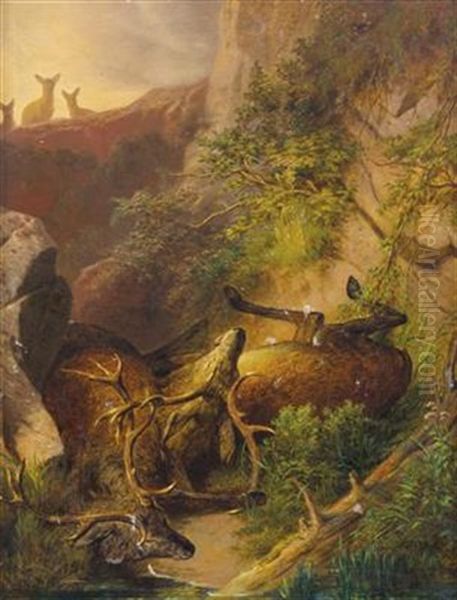
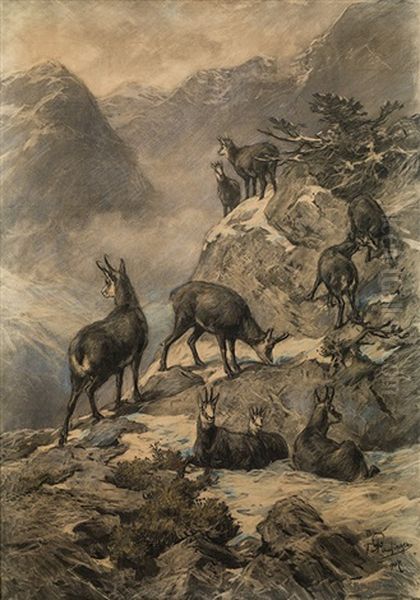
Animal painting, or "Tiermalerei," was Pausinger's other great strength. His early exposure to wildlife through his father's hunting activities provided him with an intimate knowledge of animal anatomy and behavior. His depictions of deer, chamois, foxes, birds, and other creatures are notable for their lifelike quality and the way they are integrated into their natural habitats. One of his noted works, Hirsch (Deer), recorded in a gallery catalogue in 1876, exemplifies his skill in this genre. Another significant piece, Wildhase im Winter (Wild Hare in Winter), showcases his ability to capture the subtle textures of fur and snow, and the animal's alert posture. His animal paintings can be seen in the context of a rich European tradition, with artists like the French Rosa Bonheur or the German Heinrich von Zügel (associated with the Munich School) also achieving fame for their animal subjects. Pausinger's animals are rarely sentimentalized; instead, they are portrayed with a dignity and authenticity that reflects his deep respect for nature.
His work as an illustrator, particularly for Crown Prince Rudolf's travelogue, also highlights his versatility. The ability to translate field sketches into compelling compositions suitable for reproduction required not only technical skill but also a strong narrative sense. These illustrations, often depicting hunting scenes or encounters with wildlife during the expedition, combined his talents as both a landscape and animal painter.
Later Life in Salzburg and Continued Artistic Production
After the fame garnered from the Oriental journey, Pausinger eventually settled back in his native Salzburg. He acquired a residence and studio at Schloss Schernstein, providing him with a tranquil environment conducive to his artistic pursuits. He continued to paint, focusing on the Austrian landscapes and wildlife that had always been central to his work. He also undertook commissions for hunting scenes and depictions of estates for aristocratic patrons, a common practice for artists specializing in landscape and animal subjects.
During this period, Pausinger also reportedly engaged in glass painting. While this medium had seen its heyday in earlier centuries, particularly in ecclesiastical art, it experienced periodic revivals. For Pausinger, it would have offered a different set of technical challenges and aesthetic possibilities, allowing him to explore the interplay of light and color in a unique way. His dedication to this craft, even as it might have been considered a declining art form by some, speaks to his broad artistic interests.
His personal life included his marriage to Rosalia Hinterhuber, who hailed from a family of pharmacists. The couple reportedly had no children. He maintained a close relationship with his brother, Hermann von Pausinger, who was also a painter, suggesting a shared artistic bond within the family.
Contemporaries and Artistic Milieu
To fully appreciate Franz Xaver von Pausinger's contributions, it is essential to view him within the broader artistic context of his time. The latter half of the 19th century was a period of dynamic change in the art world. In Vienna, Hans Makart was a dominant figure, known for his opulent historical paintings and his influence on the Ringstrasse era's aesthetic. While Pausinger's more subdued realism differed significantly from Makart's flamboyant style, both artists catered to the tastes of the imperial court and aristocracy in their own ways.
In Munich, where Pausinger also worked, the Munich School was highly influential, emphasizing realism and technical skill. Artists like Wilhelm Leibl and Wilhelm Trübner were key proponents of a more direct, unidealized approach to painting. The animal painter Heinrich von Zügel, also associated with Munich, shared Pausinger's dedication to depicting animals with anatomical accuracy and naturalism.
The field of landscape painting saw figures like Eduard Peithner von Lichtenfels, a professor at the Vienna Academy, who influenced a generation of landscape artists. While Pausinger's training was outside the main Vienna Academy, the prevailing trends towards naturalistic landscape depiction would have been pervasive. Later Austrian landscape painters like Tina Blau and Olga Wisinger-Florian, both associated with Stimmungsimpressionismus, pushed the boundaries further towards capturing fleeting atmospheric effects, a direction Pausinger did not fully embrace, remaining more committed to detailed realism.
As an illustrator, Pausinger was part of a tradition that included masters like the German Adolf Menzel, whose historical illustrations were renowned for their meticulous detail and dynamism. The demand for high-quality illustrations for books and periodicals provided a steady source of income and exposure for many artists.
The Orientalist genre, so crucial to Pausinger's fame, was populated by many distinguished artists. Beyond Gérôme, Müller, and Bauernfeind, figures like the British painter John Frederick Lewis or the French Eugène Fromentin also contributed significantly to Europe's visual understanding—or construction—of the "Orient." Pausinger's contribution, tied to an official imperial expedition, carried a particular cachet. His companion on the Egyptian trip, Karl von Rudolff, was another artist involved in documenting such journeys, highlighting the collaborative nature of these expeditions.
Legacy and Recognition
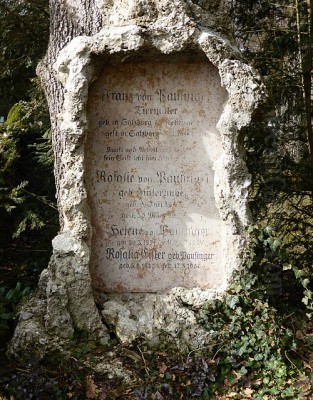
Franz Xaver von Pausinger passed away on April 7, 1915, in Salzburg and was interred in the Salzburg Municipal Cemetery (Salzburger Kommunalfriedhof). His contributions to Austrian art and culture have been recognized in various ways. In Salzburg, a street, Pausingerstraße, was named in his honor, and similarly, Pausingergasse in Penzing (a district of Vienna, though the provided text mentions "Pessen," which might be a typo or a smaller locality) commemorates his name.
His works are held in significant public collections, most notably the Salzburg Museum, which preserves a part of his regional artistic heritage, and the Austrian National Library in Vienna, which likely holds copies of the illustrated works he contributed to, including Crown Prince Rudolf's travelogue.
While Pausinger may not have been an avant-garde innovator who radically altered the course of art history in the way the Impressionists or later modernists did, his achievements are significant within his chosen fields. He was a master of realistic landscape and animal painting, creating works that were both aesthetically pleasing and scientifically accurate. His role as an expeditionary artist provided a valuable visual record of Crown Prince Rudolf's travels, contributing to the era's ethnographic and geographical interests.
After his death, like many artists of his generation whose work fell outside the main narratives of modernism, Pausinger's reputation may have experienced a period of relative obscurity. However, art historical scholarship often rediscovers and re-evaluates such figures, recognizing their importance within their specific historical and cultural contexts. Recent interest in 19th-century academic art, illustration, and Orientalism has helped to bring artists like Pausinger back into focus.
Conclusion: An Artist of His Time
Franz Xaver von Pausinger was, in many ways, an artist perfectly attuned to his time. His meticulous realism appealed to the 19th-century appreciation for detailed observation and technical skill. His subjects—the grandeur of nature, the intricacies of wildlife, and the allure of distant lands—resonated with popular interests and the patronage of the era. His association with Crown Prince Rudolf placed him at the nexus of art, science, and imperial representation.
His legacy endures through his paintings and illustrations, which continue to offer insights into the landscapes and cultures he depicted, as well as the artistic sensibilities of the late Austro-Hungarian Empire. As a skilled painter of alpine scenery, a sensitive portrayer of animals, and a diligent chronicler of royal expeditions, Franz Xaver von Pausinger carved out a distinctive niche in the rich tapestry of 19th-century European art, leaving behind a body of work that speaks to a deep engagement with the natural world and the spirit of exploration. His art remains a testament to a career dedicated to capturing the beauty and diversity of the world with an exacting eye and a skilled hand.