George Edward Horton (1859-1950) was a distinguished British artist whose life and career were deeply intertwined with the sea and the coastal communities of both Britain and the Netherlands. Primarily celebrated for his evocative watercolours and etchings, Horton carved a niche for himself as a painter of shipping, bustling harbours, and serene Dutch landscapes. His work, often imbued with an atmospheric quality that captured the interplay of light and water, provides a valuable visual record of maritime life at the turn of the 20th century. As a painter, printmaker, and teacher, Horton contributed to the rich tapestry of British art during a period of significant artistic evolution.
Early Life and Artistic Awakening in North Shields
Born in 1859 in North Shields, a historic seaport at the mouth of the River Tyne in Northeast England, George Edward Horton's formative years were steeped in the sights and sounds of a busy maritime environment. This early immersion in coastal life would profoundly shape his artistic vision. His family background was modest; his father was a butcher, and young Horton initially assisted in the family business. However, his artistic inclinations soon became apparent.
During his youth, Horton found solace and inspiration in the local Free Library. It was here that he diligently spent time copying the works of Old Masters, a traditional method of self-teaching that allowed aspiring artists to understand composition, form, and technique. This dedicated study, undertaken amidst his duties, laid the foundational skills for his future career. His burgeoning talent did not go unnoticed. Local art enthusiasts and patrons in North Shields recognized his potential and provided encouragement, which was crucial in his decision to pursue art professionally. This support enabled him to transition from an amateur enthusiast to a dedicated artist, determined to make his living through his passion.
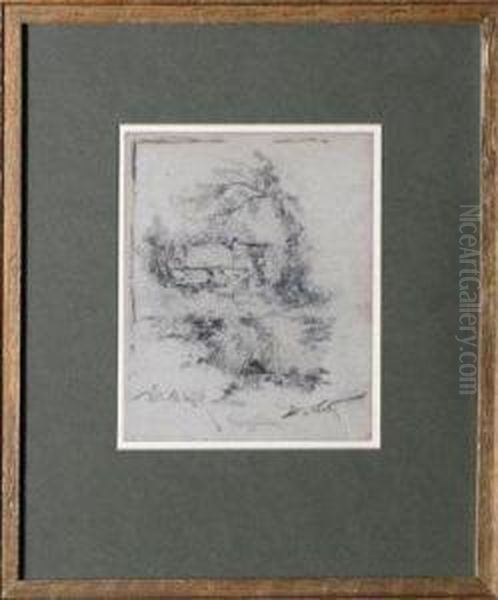
The environment of North Shields itself was a constant source of subject matter. The bustling fish quays, the myriad of vessels from fishing cobles to larger merchant ships, the ever-changing moods of the North Sea, and the distinctive character of the Tyneside community would all feature prominently in his later work. This direct, lived experience of a maritime town gave his art an authenticity and intimacy that resonated with viewers.
Forging an Artistic Career: London and Beyond
While his roots were firmly in the Northeast, Horton, like many ambitious artists of his time, recognized the need to establish himself in a larger artistic centre. He eventually left his hometown and, by 1918, had settled in London. The capital offered greater opportunities for exhibition, patronage, and engagement with the wider art world. In London, Horton worked to build his reputation, opening a studio where he not only created his own art but also offered art classes. Teaching provided a means of income and allowed him to share his knowledge and passion with aspiring artists.
A significant milestone in his career came in 1922 when he held his first solo exhibition at the prestigious Greatorex Gallery in London. Such an event was a crucial step for any artist seeking recognition, providing a platform to showcase a substantial body of work to critics, collectors, and the public. This exhibition marked his firm establishment within the London art scene and was a testament to the years of dedication and development of his craft.
Horton's artistic endeavours were not confined to London. He maintained strong ties with his native Northeast England, frequently visiting the region throughout his life. These visits allowed him to reconnect with the landscapes and maritime scenes that had first inspired him. His connection to the area became particularly poignant during the Second World War. When his London studio was bombed in 1940, a devastating event for any artist, Horton returned to the Northeast, taking up residence in Spital Tongues, Newcastle, where he lived and continued to work until 1945.
Artistic Style and Thematic Focus
George Edward Horton was primarily a watercolourist, a medium in which British artists have historically excelled. He also practiced as a printmaker, likely producing etchings that complemented his painted works in their thematic concerns. His style is often described as having Impressionistic tendencies, particularly in his treatment of light and atmosphere. While not a doctrinaire Impressionist in the French mould, he shared the Impressionists' interest in capturing fleeting moments, the effects of weather, and the play of light on water and land.
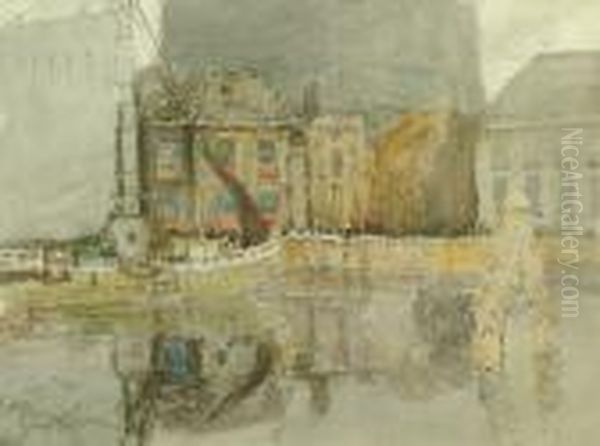
His subject matter was consistently drawn from the maritime world. He possessed a deep understanding of ships – their forms, rigging, and movement – which he depicted with accuracy and sensitivity. Harbour scenes, bustling with activity or quiet in the early morning light, were a recurring theme. He was particularly drawn to the coastal landscapes of the Netherlands, whose flat expanses, intricate waterways, and distinctive traditional vessels offered a rich vein of inspiration. These Dutch scenes, alongside his depictions of British ports, became a hallmark of his oeuvre.
Horton's watercolours are noted for their fluid handling, subtle colour palettes, and ability to evoke mood. He skillfully captured the reflective qualities of water, the vastness of the sky, and the tangible atmosphere of coastal environments, whether it be the crisp air of the North Sea or the softer light of a Dutch canal. His work often conveys a sense of realism grounded in careful observation, but elevated by an artistic sensibility that sought to capture the essence rather than merely a photographic representation of the scene.
Key Exhibitions and Recognition
Beyond his 1922 solo show at the Greatorex Gallery, George Edward Horton's work was exhibited widely and received considerable acclaim. He was a regular exhibitor at prominent institutions, a key indicator of an artist's standing. His paintings were shown at the Royal Academy of Arts (RA) in London, one of the most prestigious venues for contemporary art in Britain. An early notable exhibit was a landscape of the North Shields Fish Quay, reportedly shown at the RA as early as 1886, which would indicate a very early start to his exhibiting career and a consistent thematic interest.
He also exhibited at the Royal Scottish Academy (RSA) in Edinburgh, further broadening his exposure within the United Kingdom. In his native Northeast, the Laing Art Gallery in Newcastle frequently displayed his work, acknowledging his status as a significant regional artist with a national reputation. Horton's appeal was not limited to British shores; his paintings were also shown in Holland, a natural fit given his affinity for Dutch subjects, and in Paris, the epicentre of the art world at the time. This international exposure underscores the quality and appeal of his maritime scenes.
The consistent exhibition of his work across these varied and respected venues demonstrates the esteem in which he was held by his contemporaries and the art establishment. His ability to capture the maritime spirit in a manner that was both authentic and artistically compelling ensured his enduring popularity.
Representative Works
While a comprehensive catalogue of all his works is not readily available in summary form, several titles are noted as representative of his output, giving us insight into his typical subjects and approach.
Harbour Scenes: This is likely a generic title referring to a common theme in his work rather than a single specific piece. His harbour scenes would have depicted the daily life of ports, with ships at anchor or alongside quays, figures engaged in maritime tasks, and the architectural backdrop of the harbour towns. These would have showcased his skill in rendering complex compositions and capturing the atmosphere of these busy locales.
Towing in the Narrow Narrows, Tynemouth: This title is very specific and evocative. "The Narrows" likely refers to a constrained part of the River Tyne near its mouth at Tynemouth. A scene depicting a towing operation would involve tugboats, larger vessels under tow, and the dynamic interplay of water and machinery. Such a work would highlight his interest in the working aspects of maritime life and his ability to convey the power and movement of ships. The Tynemouth location firmly roots this piece in his native region.
Whittle Mill, Ovingham: This title suggests a departure from purely maritime themes, indicating an interest in the broader landscape of Northumberland. Ovingham is a village on the River Tyne, further inland than North Shields. Whittle Mill would likely be a watermill, offering a picturesque subject with potential for depicting rural industry and the interplay of architecture and nature. This demonstrates a versatility in his choice of landscape subjects, though still connected to the riverine environment.
These works, executed primarily in watercolour, would have exemplified his characteristic style: careful draughtsmanship combined with an atmospheric rendering of light and environment, bringing to life the scenes he observed and cherished.
The Artistic Milieu: Contemporaries and Influences
George Edward Horton's career spanned a dynamic period in British art, from the late Victorian era through the Edwardian period and into the mid-20th century. He worked alongside and was aware of many artistic currents and prominent figures.
In the realm of marine painting, Britain had a strong tradition. Horton would have been aware of the work of artists like William Lionel Wyllie (1851-1931), a prolific and highly regarded marine painter and etcher, whose detailed and atmospheric depictions of naval scenes and London's River Thames were immensely popular. Charles Napier Hemy (1841-1917), known for his vigorous and realistic portrayals of sea and coastal life, often painted in Falmouth, was another significant contemporary in this genre. The work of Thomas Somerscales (1842-1927), who specialized in dramatic open-ocean ship portraits, also contributed to the rich field of marine art. Later, Norman Wilkinson (1878-1971), also a marine painter, became famous for inventing Dazzle camouflage during World War I.
The watercolour medium itself was undergoing a renaissance. Artists like Albert Goodwin (1845-1932), known for his atmospheric landscapes and often complex, imaginative scenes inspired by Turner, were highly respected. While perhaps less directly comparable in style, the broader popularity and technical advancements in watercolour painting would have formed part of Horton's artistic environment. The legacy of earlier watercolourists like Myles Birket Foster (1825-1899), whose idyllic rural scenes were immensely popular, still lingered.
The influence of Impressionism and Post-Impressionism was strongly felt in Britain during Horton's active years. While Horton maintained a more representational style, the Impressionistic concern for light and atmosphere undoubtedly informed his approach. British artists who engaged more directly with Impressionism included Philip Wilson Steer (1860-1942), whose landscapes and coastal scenes (especially around Walberswick) show a clear debt to French Impressionism, and Walter Sickert (1860-1942), a key figure in the transition from Impressionism to modern British art, known for his urban scenes and music hall interiors. The American-born but London-based James McNeill Whistler (1834-1903) had, in the preceding decades, profoundly impacted British art with his aesthetic theories and atmospheric "Nocturnes," which emphasized tonal harmony over literal depiction.
The Royal Academy, where Horton exhibited, was home to many established figures. During his career, artists like Sir Edward Poynter (1836-1919), a classical painter and President of the RA, and Sir Lawrence Alma-Tadema (1836-1912), famous for his scenes of Roman antiquity, represented the academic tradition. However, the RA also exhibited a wide range of styles, including the dazzling society portraits of John Singer Sargent (1856-1925), another American who became a dominant figure in the British art world.
Furthermore, artists' colonies focusing on coastal and rural life, such as the Newlyn School in Cornwall (with figures like Stanhope Forbes (1857-1947) and Frank Bramley (1857-1915)) and the Staithes group in Yorkshire (including Laura Knight (1877-1970) and Harold Knight (1874-1961)), emphasized plein air painting and realistic depictions of fishing communities. While Horton may not have been a direct member of these groups, their focus on similar subject matter (coastal life, working people of the sea) was part of the broader artistic zeitgeist. His interest in Dutch coastal scenes also connects him to a long tradition of Dutch marine painting, historically exemplified by artists like Willem van de Velde the Younger (1633-1707), and more contemporaneously by figures such as Hendrik Willem Mesdag (1831-1915) of the Hague School, known for his seascapes.
Horton's career, therefore, unfolded within a rich and varied artistic landscape. He navigated these currents by focusing on his particular strengths: evocative watercolour depictions of maritime life, rendered with a keen eye for detail and atmosphere.
Later Years and Legacy
George Edward Horton continued to paint throughout his life. His return to Newcastle during World War II, following the destruction of his London studio, demonstrates his resilience and enduring connection to his roots. He passed away in 1950 at the age of 91 (or 86 if the 1945 death date from one of your sources is considered, though 1859-1950 is more consistently cited for the artist). His long career meant he witnessed significant changes in the art world and in the maritime world he so often depicted, as sail gave way to steam and traditional fishing practices evolved.
His legacy lies in his contribution to British marine art and watercolour painting. His works serve as valuable historical documents, capturing the essence of coastal and maritime life in Britain and Holland during his era. They are appreciated for their technical skill, their atmospheric beauty, and their honest portrayal of a world deeply connected to the sea. While perhaps not a radical innovator in the vein of some of his more avant-garde contemporaries, Horton excelled within his chosen genre, creating a body of work that continues to be admired by collectors and enthusiasts of maritime art.
A retrospective exhibition of his work was held at the Moss Gallery in Hexham in 1968, indicating a continued appreciation for his art nearly two decades after his death. His paintings can be found in public collections, particularly in the Northeast of England, and in private hands, a testament to his enduring appeal as a skilled and sensitive chronicler of the sea.
Conclusion
George Edward Horton stands as a notable figure in early 20th-century British art, particularly esteemed for his mastery of watercolour and his dedication to maritime themes. From his early artistic explorations in North Shields to his established career in London and his frequent sojourns to the Dutch coast, Horton's life and art were inextricably linked to the sea. His paintings, characterized by their atmospheric quality, careful observation, and sympathetic portrayal of shipping and coastal life, offer a window into a bygone era. As a painter, printmaker, and teacher, he made a quiet yet significant contribution, leaving behind a body of work that continues to evoke the enduring allure and importance of the maritime world. His art remains a cherished part of Britain's rich tradition of marine painting.