Gideon Jacques Denny stands as a notable figure in nineteenth-century American art, particularly celebrated for his evocative marine paintings. Born in an era of burgeoning national identity and westward expansion, Denny's life and art were intrinsically linked to the maritime world, from the bustling harbors of the East Coast to the dynamic shores of California. His canvases capture the power and allure of the ocean, the majesty of sailing vessels, and the burgeoning maritime commerce that shaped the American continent. This exploration delves into his life, his artistic journey, the cultural milieu in which he worked, and the legacy he left behind.
Early Life and Formative Experiences
Gideon Jacques Denny was born in Wilmington, Delaware, in 1830. His early years were spent in proximity to the water, an environment that would profoundly influence his artistic inclinations. As a young man, he gained firsthand experience of maritime life, working on vessels navigating the Chesapeake Bay. This period undoubtedly provided him with an intimate understanding of ships, the sea's myriad moods, and the daily lives of those who made their living upon it. These formative experiences would later translate into the authenticity and detail evident in his marine art.
The allure of gold and opportunity drew many to the West Coast during the mid-nineteenth century, and Denny was no exception. In 1849, he ventured to California, hoping to strike it rich in the Gold Rush. Like many aspiring prospectors, his quest for gold proved unsuccessful. However, this journey west was a pivotal moment, leading him to San Francisco, a city rapidly transforming from a small settlement into a bustling Pacific metropolis.
San Francisco: From Docks to Artistry
Upon his arrival in California and following his unsuccessful gold-seeking venture, Denny found work as a dockworker on the San Francisco wharves for approximately two years. This period, while perhaps arduous, kept him connected to the maritime world that would become his primary artistic subject. His time on the docks offered daily exposure to a diverse array of ships, from majestic clippers to humble workboats, and the vibrant, often chaotic, activity of a major port.
During this time in San Francisco, Denny also became a member of the San Francisco Committee of Vigilance. These citizen-led committees emerged in response to perceived lawlessness and inadequate official governance in the rapidly growing city. His involvement suggests a civic-mindedness and a willingness to engage with the pressing social issues of his community, adding another dimension to his character beyond his artistic pursuits.
Artistic Training and Development
Recognizing his passion for art, Denny made a significant decision to formally pursue his calling. He temporarily left California and traveled to Milwaukee, Wisconsin, around 1856. There, he sought out the tutelage of Samuel Marsden Brookes (1816-1892), an established artist known for his still lifes, portraits, and landscapes. Under Brookes's guidance, Denny honed his skills, focusing particularly on landscape painting, with a special emphasis on marine subjects. This period of dedicated study, lasting approximately six years, was crucial in developing his technical proficiency and artistic vision.
Brookes himself would later move to San Francisco in 1862, and the two artists, teacher and former pupil, would share a studio, indicating a lasting professional respect and friendship. This connection to Brookes placed Denny within a network of practicing artists and furthered his development in the burgeoning Californian art scene.
A Career Anchored in Marine Art
After completing his studies in Milwaukee, Gideon Jacques Denny returned to San Francisco, the city that would become the primary backdrop and inspiration for much of his mature work. He established his own studio on Bush Street, ready to embark on his professional career as an artist. His deep familiarity with ships and the sea, coupled with his formal training, positioned him perfectly to become one of California's preeminent marine painters.
Denny's artistic endeavors were not confined to the California coast. His desire for new subjects and experiences led him to travel. In 1868, he spent two months in the Hawaiian Islands, then known as the Sandwich Islands, visiting several islands and presumably sketching and painting the tropical landscapes and maritime scenes. He also undertook voyages to Canada and South America, further broadening his visual repertoire and exposing him to different maritime environments and cultures. These travels enriched his understanding of the sea in its global context.
Signature Works and Artistic Style
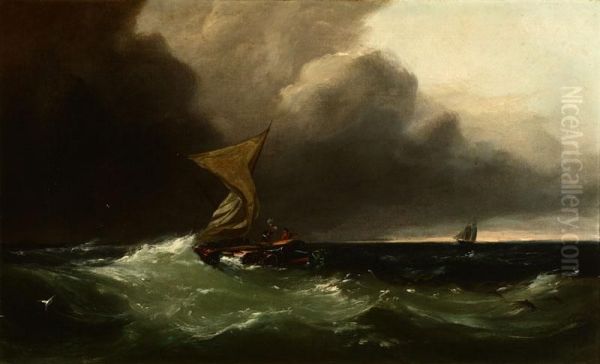
Gideon Jacques Denny is best known for his meticulously detailed and atmospherically rich depictions of ships and harbor scenes. His paintings often convey the grandeur of sail, the bustling activity of ports, and the dramatic interplay of light, water, and sky. He possessed a keen eye for nautical accuracy, rendering rigging, hulls, and sails with a precision that spoke to his early experiences at sea.
One of his most celebrated works is "Hay Scow on San Francisco Bay," painted in 1871. This oil on canvas, measuring 59.1 cm by 104.1 cm, captures a common sight in the bay – a flat-bottomed scow laden with hay, likely destined for the city's many horses. The painting is admired for its calm composition, the subtle rendering of light on the water, and the depiction of the distant San Francisco hills. It showcases Denny's ability to elevate a mundane subject into a work of quiet beauty and historical significance. This piece is now housed in the San Francisco Maritime National Historical Park, a testament to its importance in chronicling the region's maritime heritage.
Another notable work often attributed to him is "Shipwrecked figures signaling to a distant sailing ship," believed to have been painted between 1882 and 1885. This piece would highlight the more dramatic and perilous aspects of life at sea, a common theme in marine art that resonated with contemporary audiences familiar with the risks of ocean voyages.
Exploring Broader Artistic Horizons?
While Denny's reputation is firmly anchored in marine painting, some accounts and attributions suggest a broader, perhaps less consistently documented, artistic range. The provided information indicates that his oeuvre might have included works with Impressionistic tendencies, particularly visible in the handling of light and atmosphere in pieces like "Hay Scow on San Francisco Bay." This aligns with the evolving artistic currents of the later nineteenth century, where artists globally, including Americans like Childe Hassam and John Henry Twachtman, were exploring the effects of light and color.
More surprisingly, some sources link Denny to works with religious themes and stylistic influences far removed from typical American marine art of his period. For instance, a painting titled "Easter Morning" is described as incorporating influences from Japanese Ukiyo-e prints, characterized by strong color blocks, simplified and somewhat distorted figures, and a blend of realism with a dreamlike quality. Such a style would be more commonly associated with European Post-Impressionists or Symbolists like Paul Gauguin or Maurice Denis (whose work sometimes shares similar thematic and stylistic descriptions).
Further attributions mentioned include pieces like "Madonna of the Rose Garden" or "Madonna and Child with St John the Baptist," "Prince Bahram i Gor listens to the tale of the princess of Persia beneath the white pavilion," "Arab Stable," and "Landschaft mit Kuh" (Landscape with Cow), all purportedly from the 1882-1885 period. These titles suggest excursions into religious iconography, Orientalist themes (popularized by artists like Jean-Léon Gérôme), and pastoral European landscapes.
If these attributions are accurate, they would paint a picture of an artist with an unusually eclectic range, perhaps experimenting with styles and subjects beyond his primary specialization. It's possible these represent private studies, commissions, or a later phase of experimentation. However, without more extensive scholarly verification and visual evidence widely accepted within Denny's core body of work, these remain intriguing but less central aspects of his established artistic identity as a premier American marine painter. His primary legacy, and the bulk of his recognized output, remains firmly rooted in the depiction of the maritime world.
The San Francisco Art Scene and Contemporaries
Gideon Jacques Denny worked within a vibrant and growing artistic community in San Francisco. The city, fueled by the Gold Rush and its strategic position on the Pacific, was becoming a cultural center. Denny was a contemporary of several other important California artists. His teacher, Samuel Marsden Brookes, was renowned for his meticulous still lifes, particularly of fish and game.
Landscape painters like Albert Bierstadt (1830-1902) and Thomas Hill (1829-1908), though more famous for their grand depictions of Yosemite and the Sierra Nevada, were part of this artistic milieu, capturing the majestic scenery of the American West. William Keith (1838-1911), another prominent California landscape painter, transitioned from a more detailed style to a Tonalist approach, influenced by artists like George Inness.
In the realm of marine painting itself, Denny was not alone, though he was a leading practitioner. Artists like Norton Bush (1834-1894) also painted marine and tropical landscape scenes, often inspired by his travels to Central and South America. The broader American marine painting tradition, which Denny was part of, included East Coast luminaries such as Fitz Henry Lane (1804-1865) and Martin Johnson Heade (1819-1904), known for their serene and light-filled coastal scenes. The more dramatic, narrative marine works of artists like James E. Buttersworth (1817-1894), who specialized in yachting scenes, also formed part of this rich tradition.
The influence of earlier European masters of marine art, such as the Dutch Golden Age painters and the Romantic seascapes of J.M.W. Turner (1775-1851), provided a historical backdrop for all marine artists of the 19th century. While Denny's style was distinctly American and focused on the realities of his contemporary maritime world, the legacy of these European predecessors informed the genre as a whole. Even Winslow Homer (1836-1910), a towering figure in American art, would later become famous for his powerful depictions of the sea and humanity's relationship with it. The Hudson River School painters, such as Thomas Cole (1801-1848) and Asher B. Durand (1796-1886), had earlier established a strong tradition of American landscape painting, from which marine art, as a specialized form of landscape, also drew inspiration.
Later Life and Enduring Legacy
Gideon Jacques Denny continued to paint and contribute to the California art scene throughout his career. His life, however, was cut short. He passed away in 1886 in Cambria, California, at the age of 56, reportedly due to malaria.
Despite his relatively early death, Denny left behind a significant body of work that continues to be valued for its artistic merit and historical importance. His paintings serve as vital visual records of nineteenth-century maritime life, particularly on the West Coast. They capture an era of sail transitioning to steam, of burgeoning ports, and of America's growing presence on the world's oceans.
His works are held in the collections of several prestigious institutions, ensuring their preservation and accessibility for future generations. These include the Berkeley Art Museum and Pacific Film Archive, the Fine Arts Museums of San Francisco, the Crocker Art Museum in Sacramento, the Monterey Museum of Art, and the Oakland Museum of California. The inclusion of his work in the "Boston Museum (Hopkins branch)" likely refers to the Mark Hopkins Institute of Art, a predecessor to the San Francisco Art Institute, which played a crucial role in the city's artistic development. His paintings are also noted as being part of collections related to the San Francisco Museum of Modern Art (SFMOMA) and the California Academy of Fine Arts, further underscoring his significance.
Gideon Jacques Denny's contribution to American art lies in his dedicated and skillful portrayal of the maritime world. His paintings are more than just depictions of ships and water; they are windows into a pivotal period of American history, rendered with an artist's eye for beauty and a seaman's understanding of the subject. He remains an important figure for those interested in marine art, California history, and the broader narrative of nineteenth-century American painting. His life, from the Chesapeake Bay to the shores of the Pacific, and his art, which so vividly captured that world, continue to resonate.