Gotthardt Kuehl stands as a significant, if sometimes underappreciated, figure in the landscape of German art at the turn of the 20th century. Born on November 28, 1850, in Lübeck, and passing away on January 9, 1915, in Dresden, Kuehl was a pivotal painter who masterfully bridged the gap between 19th-century realism and the burgeoning Impressionist movement in Germany. His oeuvre, characterized by a profound sensitivity to light and atmosphere, primarily focused on urban landscapes, intimate interior scenes, and genre paintings, offering a unique window into the life and spirit of his time, particularly in Dresden, the city that became his artistic home.
Early Life and Artistic Formation
Gotthardt Kuehl's journey into the art world began in his Hanseatic hometown of Lübeck, a city whose historic architecture and maritime atmosphere likely provided early, albeit subconscious, visual stimuli. His formal artistic training commenced in 1867 at the Dresden Academy of Fine Arts, a venerable institution steeped in academic tradition. He studied there until 1870, absorbing the foundational skills of drawing and composition.
Seeking to broaden his artistic horizons, Kuehl then moved to the Munich Academy of Fine Arts. This was a crucial period, as Munich was then a vibrant center for artistic innovation in Germany, challenging the dominance of Düsseldorf and Berlin. In Munich, he studied under Wilhelm von Diez, a respected painter known for his genre scenes and historical subjects, who encouraged a more painterly approach. It was also during this period, specifically at the 1873 Weltausstellung (World's Fair) in Vienna, that Kuehl first encountered the radical works of the French Impressionists. This exposure was to have a lasting, though not immediate, impact on his artistic trajectory.
The Parisian Decade: Immersion in Impressionism
The allure of Paris, the undisputed capital of the art world in the late 19th century, proved irresistible. From 1878 to 1889, Kuehl lived and worked in the French metropolis. This decade was transformative. He immersed himself in the city's dynamic art scene, directly experiencing the revolutionary techniques and philosophies of Impressionism. He would have seen the works of masters like Claude Monet, with his shimmering depictions of light on water and landscapes; Pierre-Auguste Renoir, celebrated for his vibrant figures and joyful scenes; and Édouard Manet, whose bold compositions and modern subjects challenged academic conventions.
Kuehl was particularly drawn to the works of artists like Jules Bastien-Lepage, whose naturalistic yet subtly atmospheric paintings of rural life found favor, and the broader Barbizon School's emphasis on plein-air painting and capturing the nuances of natural light. While Kuehl never fully adopted the broken brushwork or high-keyed palette of the most radical French Impressionists, he absorbed their emphasis on capturing fleeting moments, the effects of light, and a more subjective response to the visible world. His time in Paris saw him achieve considerable recognition, with his works being accepted into the prestigious Paris Salons, where he won medals in 1884, 1888, and 1890, testament to his growing skill and international appeal.
Return to Germany: A Modernizing Force in Dresden
Around 1890, Gotthardt Kuehl returned to Germany, eventually settling in Dresden in 1893. His arrival was significant for the city's art scene, which, while possessing a rich artistic heritage, was somewhat conservative. Kuehl brought with him the fresh perspectives and modern sensibilities he had cultivated in Paris. In 1895, he was appointed a professor at the Dresden Academy of Fine Arts, the very institution where his formal training had begun.
As a professor, Kuehl became an influential figure, inspiring a new generation of artists. He advocated for a move away from rigid academicism towards a more direct engagement with contemporary life and a greater emphasis on individual expression. He was instrumental in founding "Die Elbier," an association of Dresden artists formed in 1902 by some of his students, which aimed to promote modern art in the city. His presence and teachings helped to invigorate the artistic climate of Dresden, paving the way for further modernist developments.
Artistic Style and Thematic Concerns
Gotthardt Kuehl is best described as a leading proponent of German Impressionism, a movement that, while indebted to its French counterpart, developed its own distinct characteristics. German Impressionists like Kuehl, Max Liebermann, Lovis Corinth, and Max Slevogt, often retained a stronger connection to drawing and a more subdued palette compared to the French, with a particular interest in capturing the atmosphere of urban life and interior spaces.
Kuehl's style is marked by his exceptional ability to render light and atmosphere. He was less concerned with the scientific deconstruction of light seen in some French Impressionists and more focused on its emotive and descriptive qualities. His interiors are often bathed in a soft, diffused light, creating a sense of intimacy and quiet contemplation. He masterfully captured the play of light filtering through windows, reflecting off polished surfaces, or illuminating figures within dimly lit rooms.
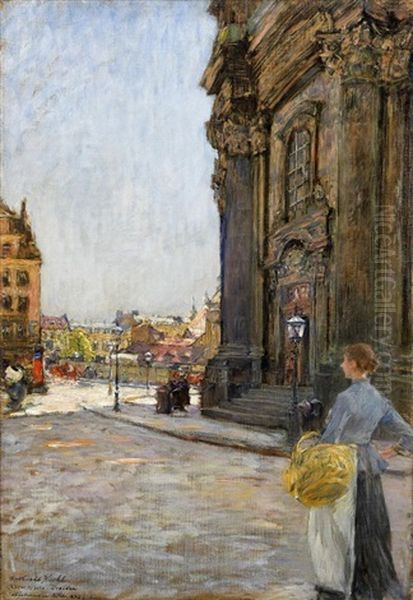
His subject matter was diverse. He painted numerous views of Dresden, capturing its baroque architecture, bustling marketplaces, and the bridges spanning the Elbe River. These cityscapes are not merely topographical records but atmospheric interpretations, imbued with the artist's personal response to the urban environment. He often chose unconventional viewpoints and focused on the everyday life unfolding within the city.
A significant portion of his work is dedicated to interior scenes. These range from depictions of elegant bourgeois parlors to more humble settings. He had a particular affinity for portraying life in institutions, most notably his series of paintings depicting the Lübeck Orphanage (Waisenhaus in Lübeck). These works, while aesthetically refined, also carry a subtle social commentary, observing the lives of the children with empathy and dignity. This interest in social themes, rendered with an impressionistic sensibility, distinguishes him from many of his contemporaries.
Over time, his palette, initially somewhat muted and influenced by the Dutch Old Masters he admired (like Johannes Vermeer, whose handling of interior light Kuehl's work sometimes echoes), gradually brightened, incorporating a richer range of colors, though always with a refined sense of harmony.
Representative Works
Several paintings stand out as emblematic of Kuehl's artistic achievements:
_In the Katharinenkirche, Hamburg_ (c. 1890-1900s): Kuehl painted several views inside the St. Catherine's Church in Hamburg and other churches. These works are remarkable for their depiction of vast, dimly lit Gothic or Baroque interiors, with light dramatically filtering through stained glass windows or illuminating specific architectural features. He masterfully captures the solemn atmosphere and the interplay of light and shadow in these sacred spaces, often including small figures of worshippers to give a sense of scale and human presence.
_The Card Reader_ (c. 1895): This painting, also known as _Die Kartenschlägerin_, is a fine example of his genre interiors. It depicts a woman, likely a fortune teller, laying out cards for a client in a subtly lit room. The focus is on the psychological interplay between the figures and the quiet intensity of the moment, all rendered with Kuehl's characteristic sensitivity to light and mood. The work showcases his ability to combine narrative interest with sophisticated painterly technique.
_Lübeck Orphanage Series_ (various dates, e.g., _Waisenhauskinder in Lübeck_): These paintings, created over several years, depict scenes from the daily life of children in the Lübeck orphanage. Whether showing them at meals, in classrooms, or at play, Kuehl approaches his subjects with a compassionate eye. The works are notable for their realistic yet atmospheric portrayal of the institution's interiors and the children's quiet existence, avoiding sentimentality while conveying a sense of their vulnerability.
_Augustus Bridge in Dresden_ (various versions, e.g., c. 1899, c. 1904): The Augustusbrücke, a prominent landmark in Dresden, was a recurring motif in Kuehl's work. He painted it from various angles and at different times of day, capturing the changing light and weather conditions. These cityscapes demonstrate his skill in rendering architectural detail while simultaneously conveying the bustling life of the city and the atmospheric effects of light on stone and water. His views often include the Hofkirche and other elements of Dresden's famous skyline.
_View of the Altmarkt in Dresden_ (various versions): Similar to his depictions of the Augustus Bridge, Kuehl frequently painted Dresden's Old Market Square, capturing its lively atmosphere, the architecture of the surrounding buildings, and the play of light across the open space. These works are vibrant testaments to his affection for the city.
_Budapest Painting_ (1897): This indicates his travels and his interest in capturing the essence of different urban environments, applying his impressionistic lens to new architectural and cultural settings.
These works, among many others, highlight Kuehl's ability to infuse everyday scenes and urban views with a poetic sensibility, achieved through his masterful control of light, color, and composition.
Contemporaries and Artistic Milieu
Gotthardt Kuehl operated within a rich and evolving German art scene. He is often grouped with the "triumvirate" of German Impressionism: Max Liebermann, Lovis Corinth, and Max Slevogt. While Liebermann was perhaps the most internationally recognized and a leading figure in the Berlin Secession, and Corinth and Slevogt pushed towards a more expressive, almost proto-Expressionistic style later in their careers, Kuehl carved out his own niche, particularly with his focus on Dresden and his atmospheric interiors.
His work can also be seen in relation to other German artists of the period. For instance, Adolph Menzel, though of an earlier generation and primarily a Realist, was renowned for his detailed and psychologically astute depictions of interiors and historical scenes, and his innovative use of light in some works might have been an influence. Wilhelm Leibl and his circle represented a powerful strain of German Realism, focusing on peasant life with uncompromising honesty. Kuehl, while sharing a commitment to observing reality, filtered it through a more subjective, light-focused lens.
In Dresden, he would have been aware of artists like Carl Bantzer, another professor at the Academy who also moved towards Impressionism, particularly in his landscapes of the Hessian countryside. The younger generation, who would soon form the Expressionist group Die Brücke in Dresden in 1905 (including Ernst Ludwig Kirchner, Erich Heckel, and Karl Schmidt-Rottluff), represented a radical departure from Impressionism, yet Kuehl's modernizing influence at the Academy helped create an environment where such avant-garde movements could emerge. Even if their artistic aims were vastly different, Kuehl's emphasis on personal vision over academic formula was a step towards the greater artistic freedoms embraced by the Expressionists.
His teacher, Wilhelm von Diez, remained an important figure in the Munich art scene, known for his genre and historical paintings. Kuehl's student, Max Ackermann, would later move towards abstract art, demonstrating the diverse paths taken by artists who passed through Kuehl's studio. Another student, Robert Sterl, who was also a close friend, became a notable Impressionist painter in his own right and took over Kuehl's studio and teaching position after his death. The anonymous student "B." who received an excellent certificate from Kuehl further attests to his dedicated teaching.
Teaching, Legacy, and Posthumous Reception
As a professor at the Dresden Academy from 1895 until his death in 1915, Gotthardt Kuehl exerted a significant influence on a generation of young artists. He was known for encouraging his students to develop their own individual styles and to observe the world around them with a fresh eye. His role in founding "Die Elbier" further underscores his commitment to fostering a modern art scene in Dresden.
Despite his contemporary renown and his important contributions, Kuehl's work, like that of many German Impressionists, was somewhat overshadowed by the more radical avant-garde movements of the early 20th century, such as Expressionism. Furthermore, during the Nazi era, the cultural authorities promoted a narrow, nationalistic vision of art. In 1937, some of Kuehl's works, along with those of many other modern artists (including Liebermann, Corinth, Slevogt, and even earlier figures like Emil Nolde who was ironically a Nazi party member), were declared "degenerate art" (Entartete Kunst) and removed from German museums. This undoubtedly contributed to a period where his work was less visible.
However, in recent decades, there has been a renewed appreciation for German Impressionism and for Gotthardt Kuehl's specific contributions. Art historians and curators have re-evaluated his oeuvre, recognizing his unique synthesis of German artistic traditions with French Impressionist innovations. His sensitive portrayals of Dresden offer invaluable historical and artistic insights into the city before its devastating destruction in World War II.
Collections and Market Presence
Gotthardt Kuehl's paintings are held in numerous prestigious public collections, primarily in Germany. These include:
The Nationalgalerie, Berlin
The Hamburger Kunsthalle, Hamburg
The Städtische Galerie im Lenbachhaus, Munich (though some sources say Munich Stadtmuseum or Neue Pinakothek for broader Munich holdings)
The Gemäldegalerie Neue Meister, Dresden
The Stadtmuseum Dresden (Dresden City Museum)
The Museum der bildenden Künste, Leipzig
The Museum Kunstpalast, Düsseldorf
The Behnhaus Drägerhaus, Lübeck (which holds a significant collection related to his Lübeck origins)
The Kunsthalle St. Annen, Lübeck
The Hungarian National Gallery, Budapest, also holds examples of his work, reflecting his international connections.
His works also appear on the art market, with auction records showing consistent interest. For example, a depiction of the Augustus Bridge in Dresden was sold in March 2020. Another Dresden scene, Strandszene (likely a scene along the Elbe), was sold at Schaefer Georg Schweinfurt. A view of the Dresden Kreuzkirche (Church of the Holy Cross) was auctioned in 2014, and a portrait of a young woman in 2016. His painting The Card Reader reportedly fetched ,000 at a Beijing Rongbao auction in 2022, indicating a continued international market for his work.
Academic and Critical Reception
Contemporary critics and art historians like Alfred Lichtwark, the influential director of the Hamburger Kunsthalle and a champion of modern German art, recognized Kuehl's significance. Lichtwark particularly praised Kuehl's innovative approach to depicting Dresden's architectural landscapes, highlighting his ability to capture the city's unique atmosphere.
Modern scholarship continues to affirm Kuehl's importance. He is acknowledged as a key figure who helped to introduce and adapt Impressionist principles within a German context. His focus on interior scenes, imbued with a subtle psychological depth and a masterful handling of light, is seen as a distinctive contribution. His paintings of the Lübeck orphanage are noted for their blend of social observation and aesthetic refinement. Exhibitions and research projects continue to explore his work, solidifying his place in the narrative of German art history. He is seen not just as an imitator of French styles, but as an artist who forged a personal vision, deeply rooted in his German heritage yet open to international currents.
Conclusion: The Enduring Light of Gotthardt Kuehl
Gotthardt Kuehl was more than just a painter of pleasant scenes; he was a thoughtful observer of his environment and a subtle innovator. His artistic journey from the academic halls of Dresden and Munich, through the vibrant crucible of Parisian Impressionism, and back to a professorship in Dresden, reflects a deep engagement with the artistic currents of his time. He successfully translated the lessons of French Impressionism into a distinctly German idiom, characterized by a nuanced understanding of light, a profound sense of atmosphere, and a quiet introspection.
His depictions of Dresden's cityscapes, his intimate interiors, and his empathetic genre scenes, particularly those from the Lübeck orphanage, reveal an artist of great sensitivity and skill. As a teacher, he played a crucial role in modernizing art education in Dresden, influencing a new generation. Though his fame may have been eclipsed at times by more radical movements or political upheavals, Gotthardt Kuehl's legacy endures. His paintings continue to charm and engage viewers with their luminous beauty and their quiet chronicling of a bygone era, securing his position as a distinguished master of German Impressionism.