Gustav Vermehren: A Danish Chronicler of Domesticity and Rural Life
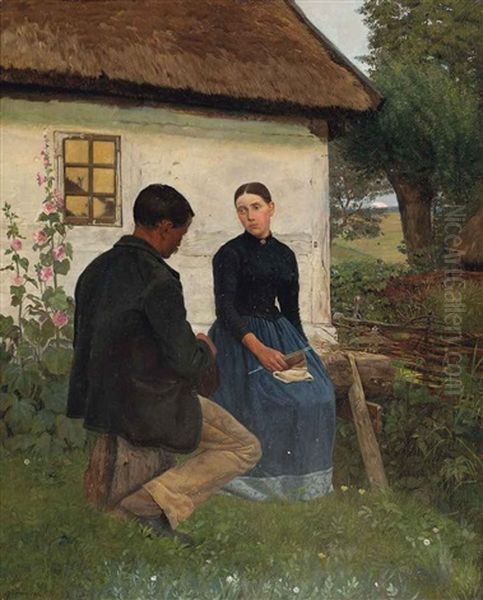
Gustav Vermehren (1863–1931) stands as a significant, if sometimes understated, figure in the landscape of Danish art during the late 19th and early 20th centuries. A painter deeply rooted in the traditions of Realism and National Romanticism, Vermehren dedicated his career to capturing the nuances of Danish life, from the quiet interiors of middle-class homes to the sun-dappled labours of rural folk. His work, characterized by meticulous detail, a subtle understanding of light, and a gentle empathy for his subjects, offers a valuable window into the social and cultural fabric of Denmark during a period of transition. He was part of an artistic dynasty, with both his father and brother also making notable contributions to Danish art, creating a rich familial context for his own artistic development.
Early Life and Artistic Lineage
Born in Copenhagen in 1863, Gustav Vermehren was immersed in art from his earliest years. He was the son of the highly respected painter Frederik Vermehren (1823–1910), a prominent figure associated with the later Danish Golden Age and a key proponent of National Romantic genre painting. The elder Vermehren was known for his depictions of Danish peasant life, imbued with a sense of national pride and moral integrity. This artistic environment undoubtedly shaped Gustav's own inclinations. His brother, Sophus Vermehren (1866–1950), also pursued a career as a painter, focusing on genre scenes and portraits, often with a similar attention to domestic realism.
Gustav Vermehren naturally gravitated towards formal artistic training, enrolling at the prestigious Royal Danish Academy of Fine Arts in Copenhagen. This institution was the crucible for generations of Danish artists, and under the tutelage of established masters, he would have honed his technical skills in drawing and painting. While his father, Frederik, had been a long-serving and influential professor at this very Academy from 1873 to 1901, shaping artists like P.S. Krøyer and Vilhelm Hammershøi, Gustav's own path as a student would have been within this established academic framework, emphasizing classical principles and observational accuracy. He became a member of the Academy in due course, a testament to his recognized skill and standing within the Danish art community.
Artistic Style: Realism and National Romanticism
Gustav Vermehren’s artistic style is best understood as a blend of Realism and the lingering currents of National Romanticism. Unlike the more avant-garde movements emerging elsewhere in Europe, Danish art of this period often retained a strong connection to narrative, meticulous representation, and themes rooted in national identity. Vermehren excelled in genre painting, depicting scenes of everyday life with an honest and unembellished approach. His subjects were often ordinary people engaged in commonplace activities: a woman sewing by a window, a family gathered in a simple interior, or workers in the field.
His realism was not the stark social critique seen in some French Realists like Gustave Courbet or Jean-François Millet, but rather a gentler, more observational form. He possessed a keen eye for detail, rendering textures, fabrics, and the play of light with considerable skill. His interiors are often suffused with a soft, natural light, creating a tranquil and contemplative atmosphere. This focus on light and its effects aligns him with a long tradition in Danish painting, stretching back to the Golden Age masters like Christen Købke and Wilhelm Marstrand, who were renowned for their sensitive handling of illumination.
The National Romantic aspect of his work is evident in his choice of subject matter – the Danish people, their homes, and their landscapes. There's an inherent appreciation for the local and the familiar, a quiet celebration of Danish cultural identity. This was a sentiment shared by many artists of his generation and the preceding one, including his father Frederik, and contemporaries like L.A. Ring, who also depicted Danish rural life with profound empathy, though often with a more pronounced symbolist undercurrent.
Notable Works and Thematic Concerns
Several works exemplify Gustav Vermehren's artistic concerns and stylistic strengths. One of his often-cited pieces is "Sweethearts at Dusk" (1891). This painting likely captures an intimate moment, imbued with the soft, fading light of evening, a time of day that often lends itself to romantic or contemplative moods. Such a work would showcase his ability to convey emotion subtly and to master the challenging effects of twilight on color and form. The depiction of personal relationships and quiet moments was a recurring theme in his oeuvre.
Another significant work mentioned is "Old Man Pushing a Wheelbarrow" (1913). This piece points to his interest in rural life and the dignity of labor, themes also explored by his father. The portrayal of an elderly worker suggests an empathy for the common man and an appreciation for the enduring rhythms of agricultural life. The composition and execution would likely emphasize the figure's connection to the land and the simple, honest nature of his toil.
A painting titled "A Young Girl Peeling Fruit" further illustrates his focus on domestic interiors and the quiet activities within them. Such scenes allowed Vermehren to explore the interplay of light on surfaces, the textures of everyday objects, and the absorbed concentration of his subjects. These are not grand historical narratives but intimate glimpses into the fabric of daily existence, rendered with care and precision. His early success with the portrait "Adolph Kittendorff" (1893) also indicates his proficiency in capturing likeness and character, a foundational skill for any realist painter.
His works often convey a sense of order, contentment, and the quiet virtues of domesticity and hard work. While not shying away from the realities of life, his paintings generally possess a serene and harmonious quality, reflecting a more conservative, perhaps idealized, view of Danish society compared to some of his more socially critical contemporaries.
The Vermehren Artistic Family: A Shared Legacy
The Vermehren family holds a distinct place in Danish art history. Frederik Vermehren, Gustav's father, was a towering figure. His career spanned a significant portion of the 19th century, and he was a staunch defender of academic tradition and national themes. His paintings, such as "A Jutland Shepherd on the Moors" (1855) or "Sædemaaleren" (The Sower, 1859), are iconic examples of Danish National Romanticism. As a professor at the Royal Danish Academy of Fine Arts for nearly three decades (1873-1901), Frederik Vermehren taught and influenced a generation of artists who would go on to define Danish art at the turn of the century. His students included some of the most celebrated names in Danish art:
P.S. Krøyer (1851-1909): A leading figure of the Skagen Painters, known for his luminous depictions of artists and fishermen.
Michael Ancher (1849-1927): Another central Skagen Painter, celebrated for his heroic portrayals of fishermen.
Vilhelm Hammershøi (1864-1916): Renowned for his enigmatic, muted interiors and portraits, a contemporary of Gustav.
Kristian Zahrtmann (1843-1917): Known for his historical paintings and vibrant use of color, and later an influential teacher himself at the Kunstnernes Frie Studieskoler (Artists' Free Study Schools), an alternative to the Academy.
Theodor Philipsen (1840-1920): A pioneer of Danish Impressionism, particularly known for his animal paintings and landscapes.
Frederik Vermehren's conservative teaching methods, while foundational for many, also led to some friction with students eager to explore newer artistic currents emanating from Paris. This tension contributed to the establishment of alternative art schools like Zahrtmann's.
Sophus Vermehren (1866-1950), Gustav's younger brother, continued the family tradition of genre painting. His style was closely aligned with Gustav's, focusing on intimate domestic scenes, portraits, and depictions of middle-class life. Sophus and Gustav reportedly collaborated in running their own art school for a time, distinct from the Royal Academy, likely offering a more traditional approach to art education. This endeavor highlights their shared commitment to the craft of painting and the transmission of artistic skills. The Vermehren brothers, therefore, represented a continuation of their father's artistic values, emphasizing skilled representation and themes rooted in Danish life, even as modernism began to take hold elsewhere.
Teaching and Broader Artistic Context
While Frederik Vermehren was the more prominent educator through his long tenure at the Royal Academy, Gustav Vermehren also contributed to art education. He taught at the Technical College in Copenhagen and, as mentioned, co-founded an art school with his brother Sophus. This indicates a dedication to nurturing artistic talent, likely emphasizing the solid, traditional skills that were the hallmark of their own work.
Gustav Vermehren's career unfolded during a dynamic period in Danish art. The late 19th century saw the flourishing of the Skagen Painters (including Anna Ancher, Michael's wife and a formidable artist in her own right, and Viggo Johansen), who brought a brighter palette and a more naturalistic, plein-air approach to their depictions of life in the remote fishing village of Skagen. Simultaneously, artists like L.A. Ring were developing a powerful form of Social Realism and Symbolism, often depicting the harsher realities of rural life and the psychological states of his subjects. Vilhelm Hammershøi, a near-contemporary, was forging a unique path with his spare, melancholic interiors, which, while realist in technique, possessed a profound modernist sensibility.
Compared to these figures, Gustav Vermehren's art might appear more conservative, less overtly innovative. However, his work holds its own value in its consistent dedication to a particular vision of Danish life. He was not an artist driven by the desire to radically break with tradition, but rather to refine and perpetuate a mode of painting that celebrated the familiar and the everyday. His contemporaries also included artists like Carl Bloch (1834-1890), known for his historical and religious paintings as well as genre scenes, and Julius Exner (1825-1910), another prominent genre painter whose depictions of folk life shared thematic similarities with Frederik Vermehren's work. The broader European context saw the rise of Impressionism, Post-Impressionism, and early Modernism, but Denmark, while not immune to these influences (as seen in the work of Philipsen or the later developments of Krøyer), often maintained a stronger adherence to its national artistic traditions.
International Exposure and Recognition
While primarily focused on the Danish art scene, Gustav Vermehren's work, and Danish art in general, did receive some international attention. The provided information mentions participation in the 1878 Paris World's Fair. Given Gustav's age at the time (15), it is highly probable that this refers to his father, Frederik Vermehren, who was an established artist by then and would have been a likely candidate to represent Danish art at such a prestigious international event. World's Fairs were crucial venues for artists to gain international exposure and for nations to showcase their cultural achievements. Frederik Vermehren's participation would have brought his particular vision of Danish National Romanticism to a wider audience.
Gustav's own career would have seen him exhibit regularly within Denmark, at venues like the Charlottenborg Spring Exhibition, the main annual showcase for Danish artists. His works were acquired by collectors and found their way into significant public collections, including the Statens Museum for Kunst (the National Gallery of Denmark) in Copenhagen. This indicates a consistent level of recognition and appreciation for his artistic contributions throughout his career.
Legacy and Lasting Significance
Gustav Vermehren passed away in 1931. His legacy is that of a skilled and dedicated painter who contributed to the rich tapestry of Danish Realism and genre painting. While perhaps not as revolutionary as some of his contemporaries, his work provides an invaluable and authentic record of Danish middle-class and rural life during his era. His paintings are characterized by their technical proficiency, their quiet charm, and their empathetic portrayal of human subjects.
He represents a continuation of a strong Danish tradition that valued craftsmanship, observation, and themes rooted in national identity. In an art world increasingly drawn to abstraction and radical experimentation in the 20th century, Vermehren remained committed to a representational art that found beauty and meaning in the everyday. His paintings offer a sense of calm, order, and timelessness, capturing moments of domestic tranquility and the enduring connection between people and their environment.
His influence can be seen in the perpetuation of realist traditions in Danish art and in the appreciation for genre scenes that capture the essence of a particular time and place. Along with his father Frederik and brother Sophus, Gustav Vermehren ensured that the artistic values of careful observation, skilled execution, and a focus on Danish life remained a vital part of the nation's cultural heritage. His works continue to be appreciated for their artistic merit and as historical documents, offering insights into the social and aesthetic sensibilities of Denmark at the turn of the 20th century. The presence of his art in national collections ensures that his contribution to Danish art history remains accessible to future generations. Other artists from the broader Danish Golden Age tradition, like Christen Købke, Constantin Hansen, and J.Th. Lundbye, had laid the groundwork for the national focus that the Vermehren family continued, each in their own way, contributing to a distinctly Danish artistic voice.
Conclusion
Gustav Vermehren was an artist who found his niche in the careful and loving depiction of his native Denmark. Born into an artistic family, he absorbed the principles of Realism and National Romanticism, applying them with skill and sensitivity throughout his career. His paintings of domestic interiors, rural scenes, and everyday people are more than mere representations; they are imbued with a quiet dignity and a deep appreciation for the simple moments that constitute a life. While the art world around him underwent significant transformations, Vermehren remained true to his artistic vision, creating a body of work that stands as a testament to his craftsmanship and his affection for his subjects. As a chronicler of Danish life, a skilled painter, and part of a notable artistic family, Gustav Vermehren holds a secure and respected place in the annals of Danish art. His work, alongside that of his father Frederik and brother Sophus, and in dialogue with contemporaries like P.S. Krøyer, L.A. Ring, and Vilhelm Hammershøi, contributes to a fuller understanding of the diverse artistic landscape of Denmark during a pivotal era.