Hans Eworth, a name that resonates with the opulent and often turbulent era of Tudor England, stands as a significant figure in the history of British art. A painter of Flemish origin, Eworth brought the refined techniques and keen observational skills of the Netherlandish tradition to the English court, leaving behind a legacy of striking portraits that capture the likenesses and aspirations of a transformative period. His career, spanning the reigns of several Tudor monarchs, offers a fascinating window into the artistic, political, and social currents of mid-16th century England.
From Antwerp to London: An Artist's Journey
Born around 1520, likely in the bustling artistic hub of Antwerp in the Duchy of Brabant (then part of the Habsburg Netherlands), Hans Eworth's early life and training are somewhat shrouded in the mists of time. What is known is that an artist named "Jan Euwouts" (a variant of Eworths or Eworth) was registered as a freemaster in the Guild of Saint Luke in Antwerp in 1540. Historical consensus strongly suggests that this Jan Euwouts is indeed the same individual who would later be known in England as Hans Eworth.
The mid-16th century was a period of religious upheaval across Europe. It is believed that Eworth, possibly due to Protestant sympathies or connections, found it prudent to leave Antwerp. Records indicate a Jan Euwents was banished from Antwerp in 1544 for "heresy." By approximately 1545, Eworth had made his way to London, a city that, while not yet the global metropolis it would become, was a significant center of power and patronage, particularly attractive to skilled artisans from the continent. He would remain in England for the rest of his life, dying around 1574.
His arrival in England placed him in an artistic environment still feeling the profound impact of Hans Holbein the Younger, who had died in 1543. Holbein had set an incredibly high standard for portraiture, and foreign-born artists continued to play a crucial role in the development of English painting. Eworth was one such artist, ready to fill the void and cater to the demands of a court and aristocracy eager for sophisticated representations of themselves.
Artistic Style and Influences
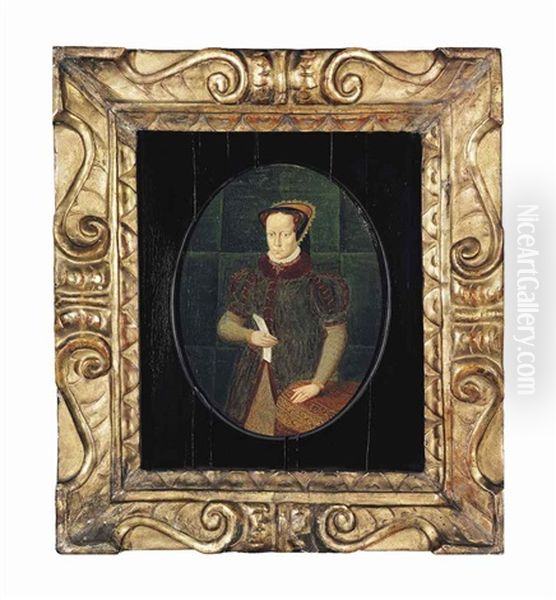
Hans Eworth's artistic style is deeply rooted in the Netherlandish tradition, characterized by meticulous attention to detail, a rich rendering of textures, and a generally realistic approach to likeness. His work clearly shows the influence of his Flemish predecessors and contemporaries, such as Joos van Cleve and Quentin Matsys, who were masters of capturing the material world with astonishing precision.
The towering figure of Hans Holbein the Younger, who had dominated English court portraiture until his death, inevitably cast a long shadow. Eworth's work, particularly in its careful delineation of features and the emphasis on the symbolic power of costume and accoutrements, shows an awareness of Holbein's achievements. However, Eworth developed his own distinct manner. While Holbein often imbued his sitters with a profound psychological presence and a sense of vibrant life, Eworth's portraits can sometimes appear more formal, even iconic, with a focus on the sitter's status and the opulence of their attire. His figures often possess a certain stillness and a more enamel-like surface quality compared to Holbein's softer, more blended modeling.
Eworth's palette was typically rich, though sometimes employing softer, more muted tones that contributed to the dignified and somewhat reserved character of his portraits. He excelled in the depiction of fabrics – silks, velvets, furs – and the intricate details of jewelry, embroidery, and weaponry. These elements were not mere decoration; they were crucial signifiers of wealth, lineage, and social standing in the hierarchical Tudor society. His compositions, while often conventional bust-length or three-quarter-length formats, could also be complex, incorporating allegorical elements or detailed backgrounds that added layers of meaning to the portrayal. Artists like William Scrots (or Guillim Stretes), another Netherlandish painter active in England around the same time, also contributed to this evolving style of Tudor portraiture, often characterized by elongated figures and a certain courtly elegance.
Royal Patronage: Painting Mary I
Hans Eworth's career in England flourished, particularly during the reign of Queen Mary I (1553-1558). He became one of the leading portrait painters to the Queen and her court. His most famous and securely attributed portrait of the monarch is the Portrait of Mary I, dated circa 1554, now in the collection of the Society of Antiquaries of London. This iconic image depicts the Queen in rich attire, holding a rose, a symbol of the Tudor dynasty, and a pair of gloves. Her expression is somber and determined, reflecting the challenges of her reign.
Eworth's portrayal of Mary I is a masterful example of his ability to convey majesty and authority through meticulous detail and symbolic attributes. The richness of her gown, the glint of her jewels, and the careful rendering of her features all contribute to a powerful image of queenship. During Mary's reign, other prominent artists were also active, including the Netherlandish painter Antonis Mor (Anthonis Mor van Dashorst), who also painted a renowned portrait of Mary I, offering an interesting comparison in style and interpretation. Eworth's version, however, remains a key image of the Queen, capturing her devout and somewhat austere persona.
His services were clearly valued, and he produced several versions and copies of royal portraits, a common practice at the time to disseminate the monarch's image. The demand for such images was high, not only from the court itself but also from nobles and gentry wishing to display their loyalty.
Navigating the Elizabethan Era
With the accession of Queen Elizabeth I in 1558, the artistic landscape at court began to shift. While Eworth continued to work and receive commissions, his prominence perhaps lessened slightly as new tastes and new artists emerged. Elizabeth I cultivated a highly symbolic and elaborate visual persona, and artists like Nicholas Hilliard, who excelled in the intimate art of the portrait miniature, and later George Gower, who became Serjeant Painter to the Queen, came to the fore.
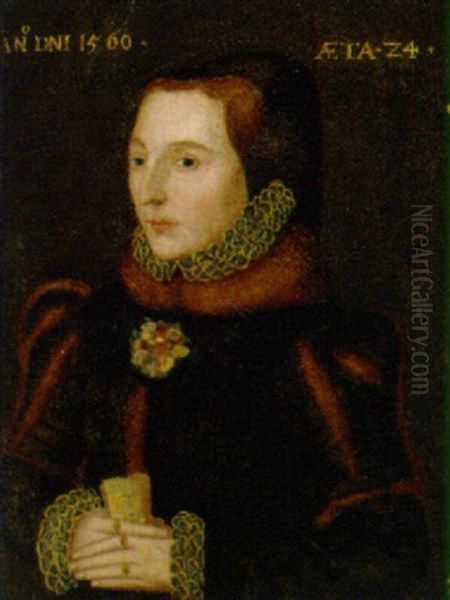
Despite this, Eworth did produce portraits during Elizabeth's reign. There is a version of a portrait of Henry VIII, dated between 1560-1573, attributed to Eworth, though this would have been a posthumous depiction, likely based on earlier prototypes by Holbein or his workshop. Such historical portraits were important for reinforcing dynastic legitimacy. Eworth also painted members of the nobility and gentry during this period.
The style of Elizabethan portraiture gradually evolved, often emphasizing elaborate costume, intricate symbolism, and a more flattened, decorative aesthetic, sometimes referred to as the "cult of Elizabeth." While Eworth's work retained its Netherlandish realism, he adapted to some extent to the prevailing tastes. His portraits from this later period continue to display his skill in rendering detail and conveying status, even if he was not the principal image-maker for Elizabeth I in the way Hilliard or Gower became. Other painters from the Low Countries, such as Steven van der Meulen and Marcus Gheeraerts the Younger (though Gheeraerts' main impact was slightly later), also contributed to the rich tapestry of Elizabethan art.
The "HE" Monogram and Questions of Attribution
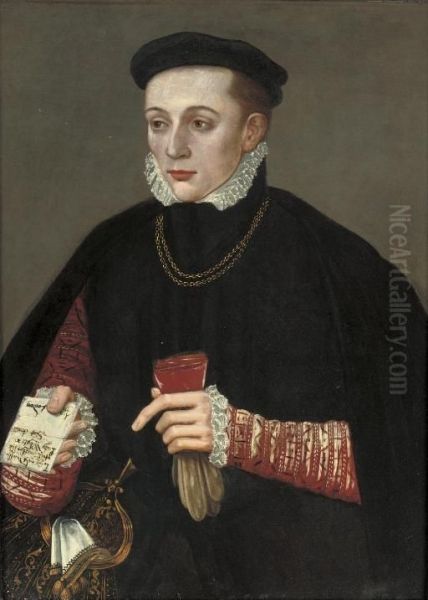
One of the distinctive features of Hans Eworth's oeuvre is his use of a monogram, typically "HE," often conjoined, to sign his works. This practice of signing, while not unique, was not universally adopted by painters of the period and marks Eworth as an artist conscious of his authorship and reputation. The presence of this monogram has been crucial for art historians in identifying and attributing works to him.
However, as with many artists of this era, questions of attribution are not always straightforward. The output of a successful workshop often involved assistants, and copies of popular portraits were common. Some works are securely signed and dated, while others are attributed to Eworth based on stylistic analysis or historical documentation. For instance, the "Phoenix Portrait" of Elizabeth I, a highly symbolic image, has been variously attributed, sometimes linked to Nicholas Hilliard, but its style also shows affinities with the panel painting tradition in which Eworth worked. The debate around such attributions highlights the complexities of art historical research and the collaborative nature of artistic production in the 16th century.
The study of Eworth's work has benefited greatly from the meticulous research of scholars who have pieced together his career from scattered records and the careful examination of his paintings. His consistent monogram has been a key, though not infallible, guide in this process.
Allegorical Portraits and Noble Connections: The Luttrell Example
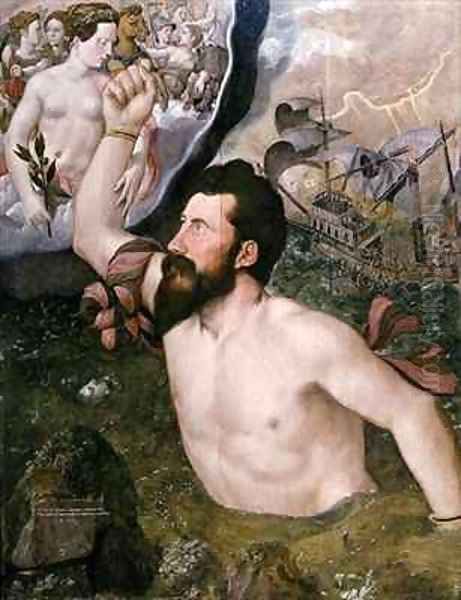
Beyond straightforward likenesses, Hans Eworth also demonstrated a capacity for more complex, allegorical compositions. A prime example is the Sir John Luttrell with the Allegorical Figure of Peace, dated 1550 (Courtauld Gallery, London). This highly unusual and fascinating painting depicts Sir John Luttrell, a soldier and courtier, semi-nude, wading through a stormy sea towards a figure of Peace, while a shipwreck and drowning figures are visible in the background. His arm is raised, and a female figure, possibly representing Peace or Divine Providence, reaches out to him.
This painting is rich in symbolism, likely alluding to Luttrell's military exploits, his survival through perilous times, and perhaps a yearning for peace after conflict. The allegorical nature of the work, its classical allusions (the nude hero), and its complex iconography set it apart from typical Tudor portraiture. It demonstrates Eworth's intellectual engagement with his subjects and his ability to translate complex ideas into visual form, drawing perhaps on emblem book traditions or humanist thought prevalent at the time. Such works indicate that Eworth was not merely a face-painter but an artist capable of sophisticated conceptualizations, similar to what one might find in the works of Italian Renaissance artists like Bronzino or the allegorical works of earlier Netherlandish masters like Jan Gossaert (Mabuse).
His connections with noble families like the Luttrells were vital for his career, providing him with commissions that allowed him to showcase the full range of his talents. These patrons valued not only a faithful likeness but also an image that conveyed their learning, virtues, and social standing.
Comparisons with Contemporaries
To fully appreciate Hans Eworth's contribution, it is useful to consider him in the context of his contemporaries. As mentioned, Hans Holbein the Younger set the benchmark. Eworth, along with William Scrots, filled the gap left by Holbein's death. Scrots, who was King's Painter to Henry VIII and Edward VI, produced elegant, somewhat mannered portraits, often featuring elongated figures, such as his famous anamorphic portrait of Edward VI.
Antonis Mor, active internationally and also patronized by Mary I, brought a more robust, psychologically penetrating style, influenced by Italian painters like Titian. Mor's portraits often have a gravitas and a sense of volume that differs from Eworth's more detailed and sometimes flatter surfaces. Levina Teerlinc, another Fleming, was highly regarded as a miniaturist at the English court, serving Henry VIII, Edward VI, Mary I, and Elizabeth I. While working on a different scale, her career highlights the continued importance of Netherlandish artists in England.
Later in Elizabeth's reign, Nicholas Hilliard became the dominant figure in portrait miniatures, developing a distinctly English style characterized by exquisite linearity and jewel-like colours. For larger scale portraits, George Gower, Serjeant Painter to Elizabeth I, produced iconic images of the Queen and her courtiers, often emphasizing pattern and rich surface decoration. Other artists from the continent, such as the Italian Federico Zuccaro, made brief but influential visits to England, while painters like Cornelis Ketel from the Netherlands also worked in London for a period. Gerlach Flicke, a German portrait painter, was active in London in the years just before and overlapping with Eworth's arrival, providing another point of comparison for the style of portraiture prevalent among immigrant artists. Eworth's work sits within this dynamic environment, maintaining a distinct Netherlandish character while adapting to English tastes.
Social Standing and Economic Fortunes
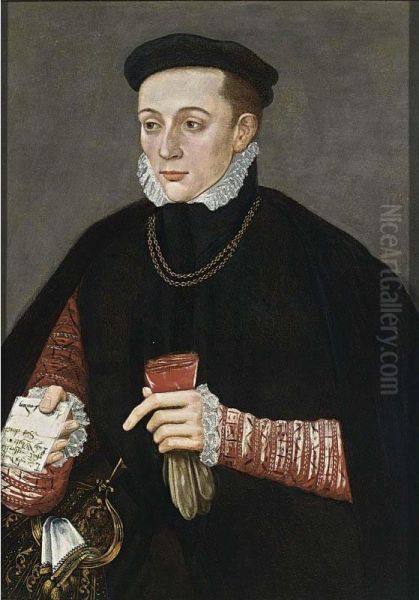
As a respected painter with royal and noble patronage, Hans Eworth would have enjoyed a relatively high social standing for an artisan of his time. Court appointments, even if not as formally defined as "King's Painter" for his entire career, provided prestige and access to influential circles. His ability to secure commissions from figures as prominent as Queen Mary I indicates a significant reputation.
Economically, such patronage would have provided a stable, if not extravagant, income. Portrait painting was a lucrative profession for skilled practitioners. The cost of materials, the time involved, and the status of the sitter all factored into the price of a portrait. Eworth's move from Antwerp to London was likely motivated by the prospect of better opportunities, and his sustained career suggests he found them.
However, the fortunes of court artists could be subject to the vicissitudes of political change. His prominence during Mary I's reign was clear. Under Elizabeth I, while he continued to work, the rise of other favored artists and evolving tastes may have shifted the primary flow of high-level commissions. Nevertheless, his surviving body of work, now housed in major museums and private collections, attests to a successful and productive career. He was part of a community of foreign artists and craftsmen in London who contributed significantly to the cultural life of the city.
Later Years and Enduring Legacy
Details about Hans Eworth's later years, leading up to his death around 1574, are sparse. He appears to have remained in London, continuing his artistic practice. The artistic climate of the 1560s and early 1570s in England was vibrant, with a growing demand for portraits from an expanding class of patrons beyond the immediate royal circle.
Hans Eworth's legacy lies in his contribution to the development of portraiture in England during a crucial transitional period. He helped to sustain the high standards of the Netherlandish tradition after Holbein, while also adapting to the specific demands and tastes of the English market. His portraits are invaluable historical documents, providing vivid likenesses of key figures from the Tudor era. They are also works of art in their own right, admired for their technical skill, meticulous detail, and the dignified presence of his sitters.
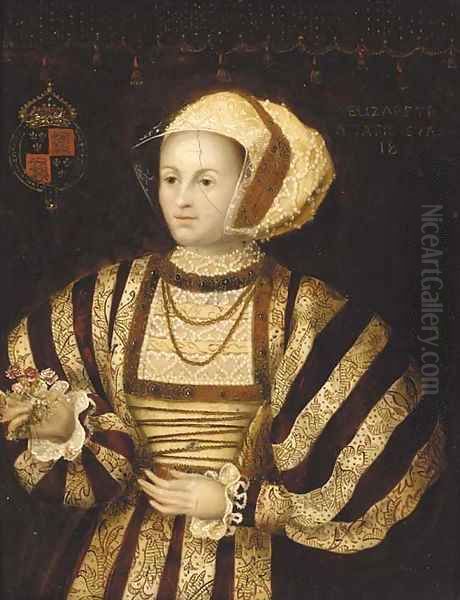
His influence can be seen in the work of subsequent painters in England, and his signed and monogrammed works provided an important benchmark for the study of Tudor art. He stands as a testament to the vital role that immigrant artists played in shaping the course of British art history, bringing skills and perspectives that enriched the cultural landscape of their adopted country. His paintings continue to engage viewers today, offering a glimpse into the world of power, piety, and personality that defined Tudor England.
Conclusion: A Master of Tudor Likeness
Hans Eworth was more than just a skilled craftsman; he was an artist who navigated the complex social and religious currents of his time, establishing a successful career in a foreign land. From his origins in Antwerp to his prominent position in the English court, he consistently produced portraits of high quality, characterized by their detailed realism and dignified composure. His depictions of Mary I, Sir John Luttrell, and other notables of the age remain iconic.
While perhaps not possessing the sheer innovative genius of a Holbein or the international fame of an Antonis Mor, Eworth carved out a significant niche for himself. He was a key figure in the story of English portraiture, bridging the gap between the Holbein era and the flourishing of Elizabethan painting. His meticulous technique, his ability to capture the richness of Tudor costume, and his occasional forays into complex allegory ensure his enduring importance. Hans Eworth's paintings are a vital part of England's visual heritage, offering a compelling window onto the faces and fashions of a fascinating past.