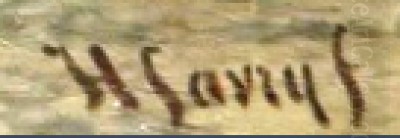
The annals of art history are replete with figures whose contributions, while significant, may sometimes be overshadowed or conflated with those of similarly named contemporaries or relatives. Such complexities often surround artists from prolific families or those active during particularly vibrant artistic periods. This exploration delves into the life and work of Hendrik Savry, a Dutch painter of the 19th century, while also navigating the frequent and understandable confusion with the earlier, highly influential Flemish-born Dutch Golden Age master, Roelant Savery. Understanding Hendrik Savry requires acknowledging the limited specific information available about him, and concurrently appreciating the rich legacy of the Savery name, predominantly shaped by Roelant.
Hendrik Savry (1823-1907): A Glimpse into a 19th-Century Dutch Artist
Hendrik Savry, born in 1823 and passing away in 1907, was a Dutch painter active during a period of significant evolution in European art. Information available from auction records and art historical databases consistently provides these life dates, sometimes associating him with Haarlem, a city with a profound artistic heritage in the Netherlands. Unlike his more famous namesake, Roelant Savery, detailed biographical accounts, records of extensive training, or a large catalog of widely recognized works for Hendrik Savry are not as readily accessible in mainstream art historical discourse.
His Dutch nationality places him within a rich tradition of painting, though the 19th century saw Dutch art diversify from its Golden Age zenith, embracing Romanticism, Realism, and eventually Impressionism, often reflecting a deep connection to the local landscape and everyday life.
Known Oeuvre: "Kühe auf der Weide"
The most frequently cited work attributed to Hendrik Savry (1823-1907) is "Kühe auf der Weide," which translates to "Cows in the Pasture." This title itself suggests a pastoral scene, a popular genre in 19th-century Dutch painting, which often celebrated the agrarian landscape and rural life. Such paintings typically emphasized a realistic depiction of animals within their natural environment, often imbued with a sense of tranquility and connection to the land.

Without widespread reproductions or detailed analyses of "Kühe auf der Weide," one can surmise its style likely aligned with the prevailing realist or Hague School tendencies of the era in the Netherlands, which favored atmospheric landscapes and depictions of peasant or fishing life. The Hague School, in particular, was known for its muted palettes and evocative portrayal of Dutch scenery. If Hendrik Savry's work followed this vein, it would feature careful observation of animal anatomy and behavior, set against a backdrop rendered with attention to light and atmosphere.
Another title, "Fanzende Bauern" (Dancing Peasants), has also been associated with an "H. Savry" in auction contexts, suggesting a broader interest in genre scenes depicting rural festivities, a theme with deep roots in Netherlandish art, harking back to artists like Pieter Bruegel the Elder.
Artistic Identity and Context
The relative obscurity of Hendrik Savry in broader art historical narratives means that details about his specific artistic training, his circle of contemporaries, or his influence are not extensively documented. He operated in a century that saw the legacy of the Dutch Golden Age painters being reinterpreted and built upon. Artists like Anton Mauve, Jozef Israëls, and the Maris brothers (Jacob, Matthijs, and Willem Maris) were leading figures of the Hague School, shaping the direction of Dutch art. It is plausible that Hendrik Savry's work shared thematic or stylistic affinities with these artists, focusing on the Dutch landscape and its inhabitants.
The challenge in constructing a detailed profile for Hendrik Savry underscores a common reality in art history: not every competent and active artist achieves lasting, widespread fame or leaves behind a comprehensive documentary trail. His work, appearing in auction catalogs, indicates a professional practice and a market for his paintings during his lifetime or subsequently.
The Savery Name: The Prominence of Roelant Savery (1576-1639)
Much of the detailed artistic information, including specific styles, extensive lists of works, notable patrons, and a clear lineage of teachers and pupils, often becomes associated with the Savery name through Roelant Savery. This earlier artist, born in Kortrijk, Flanders, in 1576, and who died in Utrecht in 1639, was a pivotal figure of the late Mannerist and early Baroque periods, straddling the Flemish and Dutch traditions. The similarity in names and the shared profession of painting can easily lead to a conflation of identities, especially when information is fragmented.
Roelant Savery's life and career are well-documented, offering a stark contrast to the sparser record for Hendrik. Understanding Roelant is essential not only for his own significant contributions but also to clearly delineate him from the 19th-century Hendrik Savry.
Roelant Savery: Early Life, Training, and Influences
Roelant Savery belonged to an Anabaptist family that fled the Spanish-controlled Southern Netherlands (Flanders) due to religious persecution, eventually settling in Haarlem around 1585. His initial artistic training is believed to have been under his elder brother, Jacob Savery the Elder (c. 1566–1603), a painter of landscapes, animals, and genre scenes. Some sources also suggest a period of study with Hans Bol in Amsterdam, or possibly Jacques de Jodt. Jacob Savery's style, influenced by artists like Pieter Bruegel the Elder and Gillis van Coninxloo III, would have provided Roelant with a strong foundation in detailed landscape and animal depiction.
The artistic environment of Haarlem and later Amsterdam was vibrant. Haarlem, in particular, was a center for landscape painting, with artists like Karel van Mander, who was also a significant art theorist, contributing to its dynamism. Gillis van Coninxloo III, known for his innovative forest landscapes, was another key influence on the development of landscape painting in this period, and his style resonated in the work of the Savery brothers.
Imperial Patronage: The Prague Period
A defining phase in Roelant Savery's career was his service to the Holy Roman Emperor Rudolf II in Prague, from approximately 1603/04 until the emperor's death in 1612. Rudolf II's court was a renowned center of arts, sciences, and curiosities. He maintained an extensive menagerie of exotic animals and a botanical garden, which provided Savery with unparalleled opportunities to study and sketch a wide variety of creatures and plants firsthand. This experience profoundly shaped his thematic repertoire.
During his time in Prague, Savery traveled to the Tyrol (1606-1607) to sketch mountain landscapes, waterfalls, and alpine flora. These studies informed many of his later paintings, which often feature dramatic, rocky terrains and lush, detailed vegetation, elements not typical of the Dutch landscape. Other artists at Rudolf II's court included Bartholomeus Spranger, Hans von Aachen, and Joseph Heintz the Elder, who were key proponents of late Mannerism. The intellectual and artistic ferment of Prague, with its blend of scientific inquiry and artistic creation, undoubtedly enriched Savery's vision.
Return to the Netherlands and Utrecht School
After Rudolf II's death, Savery briefly worked for his successor, Emperor Matthias. By 1613 or 1614, he returned to the Netherlands, initially to Amsterdam, and by 1619, he had settled in Utrecht, where he remained for the rest of his life. In Utrecht, he joined the Guild of St. Luke in 1619 and became a respected figure. Utrecht was another important artistic center, home to the Utrecht Caravaggisti like Hendrick ter Brugghen, Gerard van Honthorst, and Dirck van Baburen, who brought the dramatic chiaroscuro of Caravaggio to the North.
While Savery's style differed significantly from the Caravaggisti, his presence contributed to the city's artistic diversity. He continued to paint his characteristic landscapes filled with animals, flower still lifes, and mythological scenes. His workshop in Utrecht likely included pupils, further disseminating his style. Among those believed to have studied with him or been significantly influenced by him are Allart van Everdingen, known for his Scandinavian landscapes, Gillis d'Hondecoeter, and possibly his nephew, Hans Savery II (or Jan Savery).
Roelant Savery’s Artistic Style and Thematic Concerns
Roelant Savery's style is characterized by meticulous detail, vibrant (though sometimes cool) colors, and a blend of naturalistic observation with imaginative, often fantastical, compositions. His Mannerist roots are evident in the elongated forms of some figures, the crowded compositions, and the slightly artificial arrangement of elements.
Landscapes: His landscapes are often densely wooded, rocky, and mountainous, inspired by his Tyrolean travels. They are frequently populated with a multitude of animals, both domestic and exotic. Works like "Forest Scene with Hunters" or "Mountain Landscape with Castle" exemplify this aspect of his oeuvre. He was a pioneer in depicting waterfalls and wild, untamed nature.
Animal Paintings: Savery is perhaps best known for his depictions of animals. He painted numerous "Paradise" scenes (Adam and Eve in the Garden of Eden) and representations of "Orpheus Charming the Animals," which allowed him to showcase his skill in rendering diverse species. Lions, tigers, elephants, camels, ostriches, parrots, and even the dodo (which he was one of the last artists to depict from life or near-life studies) feature prominently. His animals are rendered with an almost scientific precision, reflecting his studies in Rudolf II's menagerie. "Two Horses and a Groom by a Ruin" and "Animals Entering Noah's Ark" are other examples.
Flower Still Lifes: Savery was also a significant contributor to the genre of flower still life painting. His bouquets are typically abundant, featuring a wide variety of flowers that would not bloom simultaneously, often arranged in simple glass roemers or Wanli porcelain vases. These still lifes are characterized by their bright colors, intricate detail, and the inclusion of insects, lizards, or shells, adding to the sense of vanitas or celebrating the diversity of nature. "Flower Still Life with Lizard and Insects" (1603, Centraal Museum, Utrecht) is an early and important example. His flower pieces are often compared to those of Ambrosius Bosschaert the Elder and Jan Brueghel the Elder, who were also pioneers of this genre.
Mythological and Biblical Scenes: Beyond Paradise and Orpheus, Savery depicted other mythological and biblical narratives, always integrating them into richly detailed natural settings.
Key Works of Roelant Savery
A comprehensive list of Roelant Savery's works is extensive, but some notable examples include:
"Paradise" (c. 1626, Gemäldegalerie, Berlin): A quintessential example of his ability to depict a multitude of animals in a lush, Edenic landscape.
"Orpheus Charming the Animals" (versions in various museums, e.g., Mauritshuis, The Hague; National Gallery, London): Showcasing his encyclopedic knowledge of fauna.
"Flowers in a Glass" (1603, Centraal Museum, Utrecht): An early masterpiece of flower painting, demonstrating his delicate touch and observational skill.
"Landscape with Birds" (c. 1628, Royal Museums of Fine Arts of Belgium, Brussels): Highlighting his specialization in avian subjects.
"The Dodo" (several studies and paintings, e.g., Natural History Museum, London): Historically significant depictions of the extinct bird.
"Struggle between Eagle and Ostrich" (Museum Mayer van den Bergh, Antwerp): A dynamic and dramatic animal scene.
"Tyrolean Landscape with Waterfall and Castle" (various versions): Reflecting his alpine travels.
Roelant Savery's Contemporaries and Influence
Roelant Savery's career spanned a period of immense artistic innovation. He was a contemporary of Flemish masters like Peter Paul Rubens and Jan Brueghel the Elder. His detailed style, particularly in rendering animals and foliage, shows affinities with Jan Brueghel the Elder, often called "Velvet" Brueghel for his smooth, refined technique. Both artists shared an interest in encyclopedic depictions of nature.
His influence extended to later generations of artists. Allart van Everdingen, who is said to have been his pupil, became famous for his rugged Scandinavian landscapes, which echo Savery's interest in wild, mountainous scenery. Other animal painters, such as Gillis d'Hondecoeter and his son Gijsbert d'Hondecoeter, and grandson Melchior d'Hondecoeter (renowned for his depictions of birds), continued the tradition of detailed animal painting in the Netherlands, a lineage to which Savery contributed significantly. The work of Abraham Govaerts also shows Savery's influence in forest landscapes.
The Savery Family of Artists
The Savery family was indeed an artistic dynasty. Besides Roelant and his brother/teacher Jacob Savery the Elder, other family members were active as artists:
Jacob Savery the Younger (c. 1593–after 1627): Son of Jacob the Elder, thus Roelant's nephew. He painted landscapes and genre scenes.
Hans Savery II (or Jan Savery) (1589–1654): Another nephew of Roelant (son of Jacob the Elder), who worked in Roelant's style and is known to have made prints after his uncle's designs. He inherited Roelant's studio effects.
Salomon Savery (1594–c. 1678): Also a nephew, son of Jacob the Elder, primarily known as an engraver and publisher in Amsterdam.
Pieter Savery (active c. 1618): Possibly another relative, details are scarce.
This familial network of artists contributed to the dissemination and continuation of certain stylistic traits and thematic preferences within Netherlandish art.
Roelant Savery's Later Life, Legacy, and Collections
Despite his success and international reputation, Roelant Savery reportedly faced financial difficulties in his later years. Some accounts suggest issues with alcohol and perhaps mental decline. He was declared bankrupt in 1638, a year before his death in Utrecht in 1639. He never married and left his property to his nephew, Hans (Jan) Savery.
His legacy, however, was secure. Roelant Savery was one of the most individualistic and imaginative artists of his time. His unique synthesis of Flemish detail, Mannerist elegance, and direct observation of nature, particularly exotic fauna and rugged landscapes, set him apart. He was instrumental in popularizing new themes in Dutch art, such as paradisiacal landscapes and flower still lifes.
Works by Roelant Savery are held in numerous prestigious museums worldwide, including:
The Rijksmuseum, Amsterdam
The Mauritshuis, The Hague
Centraal Museum, Utrecht (which holds a significant collection)
The Louvre, Paris
The National Gallery, London
The Kunsthistorisches Museum, Vienna
The Gemäldegalerie Alte Meister, Dresden
The J. Paul Getty Museum, Los Angeles
The Metropolitan Museum of Art, New York
Wallraf-Richartz-Museum, Cologne
His paintings continue to be admired for their intricate detail, imaginative compositions, and the window they offer into the early modern fascination with the natural world. Art critics and historians generally praise his technical skill, his innovative approach to landscape, and his unique contribution to animal and flower painting. While his style might have appeared somewhat retardataire by the 1630s as Dutch art moved towards greater naturalism and tonal unity (as seen in the works of Jan van Goyen or Salomon van Ruysdael), its appeal and distinctiveness remain undeniable.
Distinguishing Hendrik Savry from Roelant Savery: A Summary
To reiterate, the primary distinctions are:
Hendrik Savry (1823-1907): A 19th-century Dutch painter. Known for pastoral scenes like "Kühe auf der Weide." Detailed biographical information and a large body of work are less prominent in art historical records.
Roelant Savery (1576-1639): A highly influential Flemish-born Dutch Golden Age painter. Known for detailed landscapes with animals, flower still lifes, mythological scenes, and his service to Emperor Rudolf II. His life and work are extensively documented.
The confusion often arises from the shared surname and profession. However, their active periods, artistic styles, and the scope of their recognized contributions are vastly different.
Conclusion: Appreciating Diverse Artistic Contributions
Hendrik Savry represents a painter from a later era, contributing to the Dutch artistic tradition of the 19th century, likely focusing on themes close to his native land. While less information is readily available about him compared to his earlier namesake, his work "Kühe auf der Weide" points to an engagement with pastoral and animal painting, a genre with enduring appeal.
Roelant Savery, on the other hand, stands as a major figure of the late 16th and early 17th centuries, an artist whose imaginative and meticulously detailed works captured the wonders of the natural world as it was being newly discovered and cataloged by Europeans. His legacy is significant, influencing landscape and animal painting for generations.
Acknowledging both artists, and carefully distinguishing between them, allows for a more nuanced appreciation of the diverse talents that have enriched the history of art. While Hendrik Savry's profile may be more modest, his existence and work are part of the rich tapestry of Dutch painting. The extensive and well-documented career of Roelant Savery provides a fascinating insight into a pivotal period of artistic and intellectual change, and his name remains synonymous with a unique and captivating vision of nature. Further research into regional archives or specialized studies of 19th-century Dutch painting might yet uncover more details about Hendrik Savry, allowing for a fuller understanding of his individual contribution.