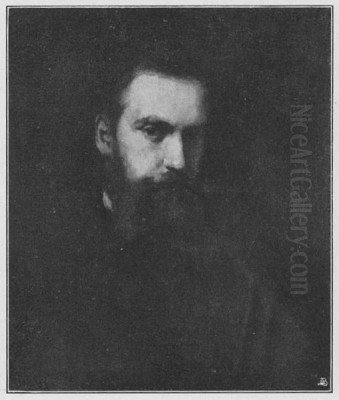
Horst Bernhard Hacker (1842-1906) was a German artist who dedicated his career to the genre of landscape painting. Active primarily in Munich during the latter half of the 19th century, Hacker's work is representative of the Munich School's detailed and atmospheric approach to depicting the natural world. Though perhaps not as widely known internationally as some of his contemporaries, his contributions form part of the rich tapestry of German art in an era of significant artistic development and national identity formation.
Early Life and Artistic Formation
Horst Bernhard Hacker was born on August 4, 1842, in Leipzig, a city with a strong cultural and artistic heritage in Germany. While some sources occasionally mention Hamburg as his birthplace, the more detailed records point to Leipzig. His formative years coincided with a period of burgeoning interest in realism and naturalism in German art, moving away from the more overtly Romantic or Neoclassical traditions of earlier decades.
Drawn to the arts, Hacker eventually made his way to Munich, which by the mid-19th century had become a major art center in Europe, rivaling Paris and Düsseldorf. It was in Munich that he would hone his skills and establish his artistic career. He became a student of Adolf Loehr (often cited, possibly interchangeably or through minor variations in records, as Adolf Lods), a notable figure within the Munich art scene. Under Loehr's tutelage, Hacker would have been immersed in the prevailing aesthetics of the Munich School, which emphasized careful observation of nature, often combined with studio-based refinement to achieve a harmonious and evocative composition. The training likely involved extensive sketching outdoors, followed by the meticulous execution of oil paintings in the studio.
The Munich School and Hacker's Artistic Milieu
The Munich School of painting, particularly prominent in the second half of the 19th century, was characterized by its realistic depiction of subject matter, often with a dark, rich palette and an emphasis on painterly technique. In landscape painting, artists of this school, such as the influential Eduard Schleich the Elder and Adolf Lier (who was also a teacher and a significant influence on many, including potentially Hacker indirectly through the general artistic climate), sought to capture the specific moods and atmospheres of the Bavarian countryside, the Alps, and other scenic locales. They were heirs to a tradition that valued both direct observation and the creation of an idealized, yet believable, natural world.
Hacker's development as an artist occurred within this vibrant environment. He would have been surrounded by artists like Carl Spitzweg, known for his charming genre scenes often set in idyllic landscapes, and animal painters like Friedrich Voltz, who frequently incorporated detailed landscapes as backdrops for his cattle scenes. The emphasis was on verisimilitude, but also on conveying an emotional response to nature. Figures like Josef Wenglein and Karl Raupp were also his contemporaries, contributing to the distinctive character of Munich landscape painting, often depicting scenes of Bavarian rural life and the picturesque qualities of the local environment. The legacy of earlier German Romantic painters, such as Caspar David Friedrich, though distinct in its spiritual intensity, had laid a foundation for the profound German appreciation of landscape as a subject worthy of serious artistic exploration.
Artistic Style and Thematic Focus
Horst Hacker's primary artistic style was firmly rooted in landscape painting. He worked predominantly in oils on canvas, a traditional medium that allowed for rich color and detailed rendering. His oeuvre encompassed a variety of natural scenes, with a particular fondness for the majestic beauty of the Alps. These Alpine landscapes, a popular subject among Munich painters, allowed artists to explore themes of grandeur, solitude, and the sublime power of nature.
His work also included depictions of forest interiors, tranquil lake scenes, and varied seasonal representations. Winter landscapes, featuring snow-covered terrains, frozen lakes, and figures engaged in winter activities like sledding, appear in his body of work, showcasing his ability to capture the crisp light and specific atmosphere of the colder months. Conversely, he also painted summer landscapes, evoking the warmth and vibrancy of the season. Beyond purely natural settings, Hacker is also noted for having created some cityscapes, capturing the bustling life of urban streets, which would have offered a different set of challenges in terms of perspective, light, and human activity. This thematic diversity, while centered on landscape, demonstrates a versatile engagement with his environment. The influence of the Barbizon School from France, with artists like Jean-Baptiste-Camille Corot and Théodore Rousseau championing plein-air sketching and a more direct, unidealized approach to nature, was also felt across Europe, including in Munich, encouraging a greater naturalism.
Representative Works
While a comprehensive catalogue raisonné of Horst Hacker's works may be elusive, several paintings are noted in art historical records and auction archives, giving us insight into his artistic output.
One such painting is titled Auf dem Waldlichtung (In the Forest Clearing), completed in 1869. This oil on canvas, measuring 62x48 cm, likely depicted a scene of dappled sunlight filtering through trees into a secluded clearing. Such subjects were popular for their play of light and shadow, and the sense of intimacy and tranquility they could evoke. Munich School painters excelled at rendering the textures of foliage, bark, and earth, and Hacker's work would likely reflect this attention to detail.
Another significant work is Bei Pallanza am Lago Maggiore (Near Pallanza on Lake Maggiore), dated to 1890. This painting, measuring 45x37 cm, was exhibited in Munich. Lake Maggiore, on the border of Italy and Switzerland, has long been a favored subject for artists due to its stunning scenery, clear light, and picturesque towns. Hacker's interpretation would likely have captured the serene beauty of the lake, possibly with the dramatic backdrop of the Alps, rendered with the characteristic clarity and atmospheric depth of his school.
A winter scene, described as Winterlandschaft mit Schlittelehren und Rodern auf dem eisigen See (Winter Landscape with Sledges and Toboggans on the Icy Lake), further illustrates his thematic range. This work, measuring 32x49 cm and created in Munich, would have showcased his skill in depicting the reflective qualities of ice and snow, the stark silhouettes of trees, and the lively presence of figures enjoying winter pastimes. Such scenes were popular for their evocation of seasonal charm and communal activity.
These examples, though limited, point to an artist skilled in capturing diverse natural environments and their specific atmospheric conditions, consistent with the aims of the Munich School. His works would have appealed to the tastes of the burgeoning middle-class collectors of the time, who appreciated recognizable and skillfully rendered depictions of their homeland and picturesque travel destinations.
Exhibitions and Recognition
Horst Hacker's works were exhibited in several prominent art centers during his lifetime, indicating a degree of recognition within the contemporary art world. He participated in exhibitions in Dresden, Munich, Berlin, and Vienna, which were all major hubs for art and culture in German-speaking Europe. The Munich Glaspalast (Glass Palace) was a particularly important venue for artists of the Munich School to showcase their work to a wide audience.
Specific records indicate his participation in the Swiss Art Exhibition in Basel in 1889, where his painting Bei Pallanza am Lago Maggiore was displayed. This suggests an outreach beyond purely German venues. Furthermore, his works have appeared in German auction catalogs, particularly from Munich, in the period spanning 1901-1929, indicating a continued market presence even after his death. Some sources also suggest his works were displayed in institutions such as the Pinakothek der Moderne in Munich and other museums in Berlin and Dresden, though specific acquisition details would require further archival research. Such exhibitions and market activity underscore his status as a professional artist contributing to the artistic landscape of his time.
Contemporaries and Broader Artistic Context
To fully appreciate Horst Hacker's position, it's useful to consider him alongside other artists active during the same period. In Munich, besides those already mentioned like Schleich the Elder, Lier, and Spitzweg, there were figures like Anton Zwengauer, known for his evocative sunset and twilight scenes, often set in the Bavarian uplands. The Düsseldorf School of painting, with artists like Andreas Achenbach and Oswald Achenbach, also had a profound impact on German landscape painting, known for their dramatic and meticulously detailed canvases. While distinct from the Munich School in some aspects, there was considerable exchange and mutual influence between these major German art centers.
The broader German art scene also included artists like Hans Thoma, whose work, while often imbued with a more symbolic or idyllic quality, shared a deep connection to the German landscape. Figure painters like Wilhelm Leibl, a leading proponent of Realism in Germany and a central figure in the Munich art scene, emphasized truth to nature in a way that paralleled the landscape painters' endeavors. Even portraitists like Franz von Lenbach, a dominant figure in Munich society, were part of this rich artistic milieu. Internationally, the aforementioned Barbizon School painters like Corot, Charles-François Daubigny, and Jean-François Millet (though more focused on peasant figures in landscapes) had already shifted European landscape art towards greater naturalism and plein-air practice, influences that resonated in Munich. Hacker's work, therefore, developed within a complex web of local traditions, national artistic trends, and international currents.
Later Years and Legacy
Horst Bernhard Hacker continued to live and work in Munich, the city that had become the center of his artistic life. He passed away in Munich on December 18, 1906, at the age of 64. His life spanned a period of immense change in Germany, from the disparate states of the German Confederation to the unified German Empire, and witnessed significant shifts in artistic styles, from late Romanticism and Biedermeier to Realism, Naturalism, and the stirrings of Impressionism and Jugendstil towards the end of his life.
Hacker's legacy is that of a dedicated and skilled landscape painter, a representative of the Munich School's particular approach to capturing the natural world. While he may not have achieved the revolutionary status of some of his contemporaries who broke more radically with tradition, his work contributed to the high standard of landscape painting prevalent in Germany during the 19th century. His paintings offered viewers meticulously rendered and atmospherically rich depictions of familiar and cherished landscapes, from the Bavarian Alps to the Italian lakes.
His art reflects the aesthetic values of his time and place: a deep appreciation for nature, a commitment to skilled craftsmanship, and a desire to create harmonious and evocative images. Artists like Horst Hacker played an important role in satisfying the public's growing appetite for landscape art, which adorned the homes of an increasingly prosperous bourgeoisie. His works can be found in various collections, and they continue to appear in the art market, valued for their competent execution and their representation of a significant school of 19th-century German painting.
Conclusion
Horst Bernhard Hacker stands as a noteworthy figure among the many talented artists who constituted the Munich School of landscape painting in the latter half of the 19th century. Born in Leipzig and primarily active in Munich, he absorbed the prevailing artistic currents of his time, dedicating his career to the depiction of nature in its varied forms and moods. From the majestic Alps to serene forest clearings and picturesque lake views, his oil paintings captured the essence of these scenes with a detailed realism and atmospheric sensitivity characteristic of his school.
Through his participation in exhibitions across Germany and beyond, and the enduring presence of his works, Hacker contributed to the rich tradition of German landscape art. While navigating an art world that included such luminaries as Eduard Schleich the Elder, Adolf Lier, and the Achenbach brothers, Hacker carved out his own niche, producing works that were appreciated for their beauty and skill. His paintings serve as a window into the 19th-century appreciation of the natural world and the artistic conventions used to represent it, securing his place within the annals of German art history.