Jakob Bogdany, a name that resonates with connoisseurs of Baroque art, stands as a significant figure whose vibrant depictions of exotic birds and opulent still lifes captured the imagination of his contemporaries and continue to fascinate art lovers today. Born in the historic town of Eperjes, then part of the Kingdom of Hungary, Bogdany's journey took him from Central Europe to the bustling art centers of Amsterdam and London, where he established himself as a sought-after artist, particularly favored by the British aristocracy and royalty. His work is a testament to the era's burgeoning interest in the natural world, the allure of the exotic, and the enduring appeal of meticulously rendered beauty.
Early Life and Artistic Awakening in Hungary
Jakob Bogdany was born on May 6, 1658, in Eperjes, which is now Prešov in modern-day Slovakia. His family belonged to the Hungarian Catholic nobility, a background that likely afforded him a certain level of education and exposure to the arts, though detailed records of his earliest training remain somewhat scarce. The region of Upper Hungary, where Eperjes was located, was a culturally rich area, albeit one often caught in the political and religious turmoil of the 17th century, situated at the crossroads of Habsburg, Ottoman, and Transylvanian influences.
It is believed that Bogdany's initial artistic inclinations were nurtured locally, though the specific masters under whom he might have studied in Hungary are not definitively known. The artistic environment in Hungary at the time, while perhaps not as internationally prominent as that of Italy or the Netherlands, still possessed a tradition of craftsmanship and an appreciation for decorative arts. This early grounding would have provided him with foundational skills before he sought further development in more established artistic hubs.
The Amsterdam Sojourn: Immersion in the Dutch Golden Age
In 1684, seeking to refine his talents and immerse himself in a more dynamic artistic milieu, Jakob Bogdany made the pivotal decision to travel to Amsterdam. The city, at that time, was a global center of commerce, culture, and, crucially for Bogdany, art. The Dutch Golden Age was still casting its brilliant light, and Amsterdam was home to a thriving community of painters specializing in various genres, including the still life and animal paintings that would become Bogdany's forte.
During his time in Amsterdam, which lasted approximately four years, Bogdany would have been exposed to the works of leading Dutch masters. Artists like Melchior d'Hondecoeter, renowned for his lively and often monumental paintings of domestic and exotic birds in park-like settings, would have been a particularly strong influence. Hondecoeter's ability to capture the varied textures of feathers, the characteristic poses of different species, and to arrange them in dynamic, almost narrative compositions, set a high standard. Similarly, the opulent still lifes of painters such as Willem Kalf, Abraham Mignon, and Jan Davidsz. de Heem, with their rich displays of fruit, flowers, and precious objects, would have offered invaluable lessons in composition, color, and the rendering of textures.
It was also in Amsterdam that Bogdany encountered a fellow Hungarian, Miklós Tótfalusi Kis, a renowned typographer and punch-cutter. This connection highlights the presence of a small expatriate Hungarian community and suggests a network of support and intellectual exchange. Bogdany's period in Amsterdam was undoubtedly formative, allowing him to absorb the technical mastery and thematic preoccupations of Dutch art, which he would later synthesize with his own unique vision.
A New Canvas: Establishing a Career in London
Around 1688, a year marked by significant political change in England with the Glorious Revolution, Jakob Bogdany relocated to London. This move proved to be a masterstroke for his career. While London's art scene was perhaps not as deeply established in still life and animal painting as Amsterdam's, there was a growing appetite among the English aristocracy and the burgeoning merchant class for decorative and status-enhancing artworks. Foreign artists often found fertile ground in England, and Bogdany, with his specialized skills, was well-positioned to cater to this demand.
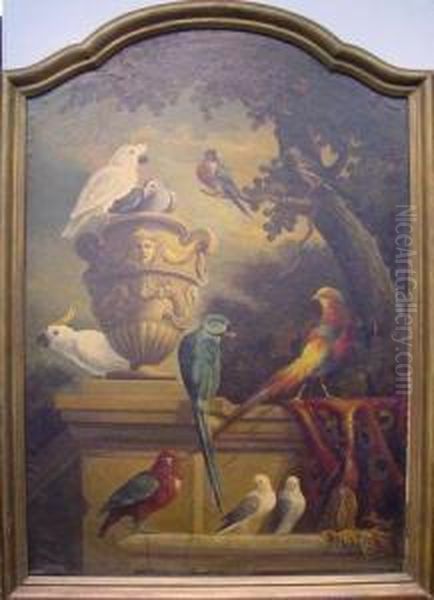
He quickly gained recognition for his vibrant and detailed paintings of birds, often exotic species that were becoming increasingly known in Europe due to global trade and exploration. His ability to depict these creatures with lifelike accuracy, combined with a flair for dramatic composition, appealed to patrons who wished to adorn their homes with images of nature's wonders. Bogdany's arrival coincided with a period where scientific curiosity about the natural world was growing, and collections of exotic flora and fauna, or "menageries," were becoming fashionable among the wealthy. His paintings served as a permanent, artistic record of these prized possessions.
His success in London was significant, leading to commissions from prominent figures, including members of the royal court. He became a favored painter of Queen Anne, for whom he produced several works. Admiral George Churchill, brother of the Duke of Marlborough, was another key patron, commissioning Bogdany to paint birds from his aviary at Windsor Park. This royal and aristocratic patronage cemented Bogdany's reputation and provided him with a steady stream of prestigious work.
Artistic Style: Baroque Splendor and Naturalistic Detail
Jakob Bogdany's artistic style is firmly rooted in the Baroque tradition, characterized by its dynamism, rich color palettes, and often dramatic use of light and shadow. However, within this broader framework, his work exhibits a particular dedication to naturalistic detail, especially in his depiction of avian subjects. He possessed a keen observational skill, capturing the unique plumage, posture, and character of each bird he painted.
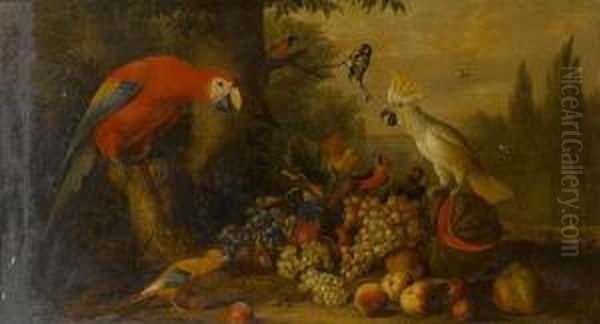
His compositions are often complex and animated, featuring a variety of birds interacting within a landscape or against a backdrop of lush foliage and fruit. He skillfully balanced the need for accurate representation with artistic license, creating scenes that were both believable and aesthetically pleasing. The textures in his paintings are particularly noteworthy – the softness of feathers, the sheen of fruit, the rough bark of trees, and the cool surface of stone are all rendered with a convincing tactility.
Bogdany's palette was typically vibrant, with a fondness for strong contrasts. He often highlighted birds with brightly colored plumage, such as parrots, macaws, and cockatoos, setting them against darker backgrounds or interspersing them with more subtly hued European species like great tits, blue tits, or robins. This juxtaposition of the familiar and the exotic was a hallmark of his work, reflecting the era's fascination with discoveries from distant lands. While primarily known for his bird paintings, his still lifes of fruit and flowers also demonstrate a high level of skill, echoing the traditions of Dutch and Flemish masters like Jan van Huysum or Rachel Ruysch, though Bogdany's focus remained more consistently on avian subjects.
Masterpieces and Signature Compositions
Several works stand out in Jakob Bogdany's oeuvre, exemplifying his skill and characteristic themes. One of his most celebrated paintings is often titled "Exotic Birds and Fruits" or a similar variation, depicting a lively assembly of various bird species, including colorful macaws, cockatoos, and other exotic birds, often accompanied by domestic fowl, set within a landscape or alongside a bounty of fruit. Such compositions were highly sought after and allowed Bogdany to showcase his virtuosity in rendering diverse forms and textures. A version of such a painting famously graced the cover of Procol Harum's 1974 album "Exotic Birds and Fruit," introducing his work to a new generation, albeit in a different context.
Another significant work is "Two Icelandic Owls" (sometimes referred to as "Two Snowy Owls"), currently housed in the Nottingham Castle Museum and Art Gallery. This painting is striking for its depiction of these majestic white birds, their plumage rendered with exquisite detail against a more subdued, atmospheric background. The choice of subject, the snowy owl, native to Arctic regions, again highlights the interest in rare and exotic fauna.
Many of his paintings feature a characteristic compositional device: a gathering of birds around a central focal point, perhaps a piece of fruit, an architectural element, or a particularly prominent bird. He often included a mix of ground-dwelling birds, perching birds, and sometimes birds in flight, creating a sense of depth and activity. His works for royal patrons, such as those depicting birds from Queen Anne's aviaries, were not just decorative pieces but also served as records of valuable collections, akin to an ornithological inventory rendered with artistic flair. The influence of earlier masters of animal painting, such as the Flemish artist Frans Snyders, known for his dynamic hunting scenes and market stalls teeming with game and animals, can be discerned in the energy and richness of Bogdany's compositions, though Bogdany's focus was less on the hunt and more on the peaceful, if animated, congregation of species.
The Allure of the Exotic: Birds as Symbols and Status Objects
The prevalence of exotic birds in Jakob Bogdany's work speaks volumes about the cultural and intellectual currents of the late 17th and early 18th centuries. This was an age of exploration and expanding global trade networks, which brought not only new commodities but also unfamiliar flora and fauna to Europe. Exotic birds, with their vibrant colors and unusual forms, became highly prized status symbols, collected by royalty, aristocracy, and wealthy merchants in private menageries and aviaries.
Bogdany's paintings catered directly to this fascination. His depictions of macaws from South America, cockatoos from Australasia, and other brightly plumaged birds from Africa and Asia transformed these living treasures into permanent artistic statements. These paintings did more than just decorate walls; they signified the owner's wealth, worldliness, and connection to the expanding horizons of the known world. The birds themselves often carried symbolic meanings, though in Bogdany's work, the primary emphasis seems to have been on their visual splendor and novelty.
The meticulous detail with which Bogdany rendered these creatures also aligned with the burgeoning scientific interest in the natural world. While not strictly scientific illustrations, his paintings offered a degree of accuracy that would have appealed to those with an interest in ornithology. He often depicted specific, identifiable species, suggesting careful observation, either from live specimens in menageries or possibly from preserved skins or detailed descriptions. This blend of artistic beauty and naturalistic representation was key to his appeal.
Bogdany and His Contemporaries: A European Network
While Bogdany carved a distinct niche for himself, he operated within a broader European art world populated by numerous talented individuals. In Amsterdam, beyond the direct influence of bird painters like Melchior d'Hondecoeter, he would have been aware of the broader trends in Dutch art. The meticulous realism of the "fijnschilders" (fine painters) like Gerrit Dou or Frans van Mieris the Elder, though primarily figure painters, set a standard for detailed execution that permeated many genres.
In London, Bogdany joined a diverse community of native-born and immigrant artists. Portraiture was the dominant genre, with figures like Sir Godfrey Kneller (German-born) and, earlier, Sir Peter Lely (Dutch-born) setting the tone. While Bogdany's specialization differed, the general artistic climate and patronage systems would have been shared. Other specialist painters were also active, such as the Dutch marine painters Willem van de Velde the Elder and the Younger, who also found success in England.
Bogdany's focus on bird painting places him in a lineage that includes earlier Flemish masters like Jan Brueghel the Elder, whose "paradise landscapes" often featured a rich array of animals and birds. While direct connections are speculative, the thematic concerns were shared. His work can also be seen as a precursor to later developments in animal and bird art, such as the work of George Stubbs in England, who brought a new level of anatomical accuracy to animal painting, or later, the ornithological illustrations of John James Audubon.
It is important to note that artists of this period often collaborated or had studios with assistants. While specific collaborations involving Bogdany are not extensively documented, it was common practice for still life or animal specialists to sometimes contribute elements to larger compositions by other artists, or for assistants to help with backgrounds or less critical parts of a painting. His son, William Bogdany, also became a painter, following in his father's thematic footsteps, though perhaps not achieving the same level of prominence.
Patronage and Royal Connections: A Seal of Approval
The success of an artist in the 17th and 18th centuries was often heavily reliant on securing influential patrons, and Jakob Bogdany excelled in this regard, particularly after his move to London. His most notable patron was undoubtedly Queen Anne (reigned 1702-1714). Several of Bogdany's paintings are recorded in the Royal Collection, and it is known that he was commissioned to paint birds from the Queen's own aviaries. This royal endorsement would have significantly enhanced his reputation and attractiveness to other members of the aristocracy.
Admiral George Churchill (1654-1710), a prominent naval commander and brother of the powerful John Churchill, 1st Duke of Marlborough, was another key supporter. Admiral Churchill maintained an extensive aviary at his lodge in Windsor Great Park, and Bogdany was employed to create a visual record of its diverse inhabitants. These paintings were not merely decorative; they were a source of pride for the Admiral, showcasing his collection of rare and exotic species. Some of Bogdany's most impressive and large-scale bird compositions are believed to have originated from this commission.
Such high-level patronage provided Bogdany with financial stability and access to a wider circle of potential clients. His works became desirable additions to the country houses and London residences of the English elite. The demand for his paintings underscores the cultural value placed on such subjects, reflecting a taste for the ornate, the natural, and the exotic that was characteristic of the late Baroque and early Georgian periods in England.
Later Years, Death, and Enduring Legacy
Jakob Bogdany continued to paint actively throughout the early 18th century, maintaining his distinctive style and thematic focus. He resided in the parish of St Margaret's, Westminster, and later moved to Finchley, then a rural area north of London, where he spent his final years. He passed away on February 11, 1724, at the age of 65 or 66, and was buried in Finchley.
His artistic legacy was carried on to some extent by his son, William Bogdany, who also specialized in bird and still life painting, though his work is generally considered to be less dynamic than his father's. Jakob Bogdany's paintings, however, continued to be prized. Many remained in the collections of the families who originally commissioned them, while others found their way into public collections over time.
Today, Jakob Bogdany's works are held in numerous prestigious museums and galleries worldwide, including the Hungarian National Gallery in Budapest (which holds a significant collection, reflecting his Hungarian origins), the Museum of Fine Arts, Budapest, the Royal Collection Trust in the United Kingdom, the Fitzwilliam Museum in Cambridge, Nottingham Castle Museum, and various other public and private collections.
His posthumous evaluation has remained consistently positive, particularly for his skill in bird painting. He is recognized as one ofthe leading practitioners of this genre in England during his lifetime. Art historians appreciate his ability to combine decorative appeal with a high degree of naturalistic observation, creating works that are both visually sumptuous and informative about the species he depicted. The enduring appeal of his paintings lies in their vibrant energy, meticulous detail, and the window they offer into the early modern fascination with the diversity of the natural world. His name, sometimes spelled Jacob Bogdany or even "Jacob and Bogdany" in older records, is firmly established in the annals of Baroque art.
The Continued Fascination: Bogdany in the Modern Eye
More than three centuries after his death, Jakob Bogdany's art continues to captivate. The vibrancy of his colors, the lifelike portrayal of his avian subjects, and the sheer decorative exuberance of his compositions retain their power to delight the eye. His work serves as an important bridge between the earlier traditions of Dutch and Flemish animal painting and later developments in ornithological art.
The use of his painting on the Procol Harum album cover, while perhaps an unexpected modern afterlife, demonstrates the timeless visual appeal of his work, capable of transcending its original context to resonate with contemporary audiences. Exhibitions that include his paintings often draw attention for their beauty and the fascinating glimpse they provide into the tastes and interests of a bygone era.
In an age where biodiversity is a pressing concern, Bogdany's depictions of exotic birds, many of which were then novelties in Europe, take on an added layer of significance. They remind us of the historical human fascination with the natural world and the rich variety of life on our planet. As an artist who so skillfully captured the beauty and wonder of these creatures, Jakob Bogdany's contribution to art history remains both significant and deeply enjoyable. His paintings are more than just images; they are vibrant, feathered testaments to a world where art and nature converged in spectacular fashion.