Jan Frans van Bredael the Elder: A Master of Flemish Tradition and Pastiche
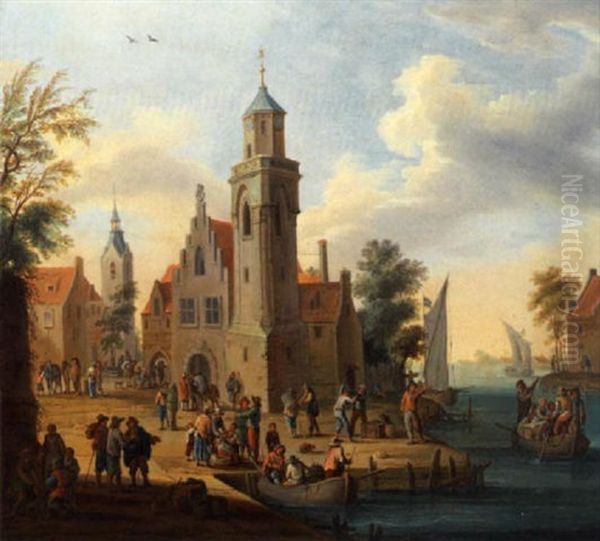
Jan Frans van Bredael the Elder (1683–1750) stands as a notable figure in the landscape of Flemish art during the late 17th and early 18th centuries. Born into an era where the towering achievements of 17th-century Flemish masters still cast a long shadow, Van Bredael carved out a distinct niche for himself. He was an artist celebrated not only for his original compositions but also for his extraordinary ability to emulate the styles of revered predecessors, particularly Philips Wouwerman and the illustrious Brueghel dynasty. His works, characterized by their delicate execution, vibrant narratives, and meticulous detail, found favor among discerning collectors and dealers, securing his place within the rich tapestry of European art history.
An Artistic Heritage: The Bredael Family
Jan Frans van Bredael was born in Antwerp, a city that had long been a vibrant hub of artistic innovation and production in Europe. His immersion in the world of art was almost preordained, as he hailed from a prolific family of painters. His father was Alexander van Bredael (1663–1720), himself an artist known for his market scenes, village feasts, and landscapes, often populated with numerous figures in the tradition of earlier Flemish masters. Alexander, in turn, was the son of Peeter van Bredael (1629–1719), a painter specializing in Italianate landscapes and market scenes, who had reportedly studied with David Ryckaert III.
This familial environment undoubtedly provided Jan Frans with his initial exposure to artistic techniques and the business of art. Growing up surrounded by painters, studios, and discussions of art would have been a formative experience, instilling in him a deep understanding of the craft from a young age. The Bredael family, including Jan Frans’s brothers Jan Peeter van Bredael the Younger and Joris van Bredael, and his cousin Joseph van Bredael, contributed significantly to the continuation of established Flemish painting genres well into the 18th century.
Early Training and Emergence as a Copyist
Jan Frans van Bredael's formal artistic training commenced under his father, Alexander. However, his career took a significant turn when, around 1705-1706, he entered the workshop or employ of the Antwerp art dealer Jacob de Witte (often recorded as J. de Jode or De Gitte in some sources). It was here that Van Bredael honed his remarkable talent for creating copies and pastiches – works executed in the style of other, more famous artists.
During his tenure with De Witte, which reportedly lasted about four years, Van Bredael was specifically commissioned to produce small-scale cabinet paintings that replicated or imitated the works of highly sought-after masters. This practice was common in the art market of the time, catering to collectors who desired the aesthetic of renowned artists but perhaps could not afford originals, or who appreciated the skill involved in such accomplished imitations. His primary models during this period were Philips Wouwerman, the celebrated Dutch painter of battle scenes, equestrian subjects, and landscapes, and various members of the Brueghel family, whose detailed and lively peasant scenes and landscapes had been popular for generations.
Van Bredael’s skill in this domain was exceptional. His copies were not mere slavish reproductions but captured the spirit, technique, and palette of the originals with such fidelity that they were, and sometimes still are, mistaken for the works of the masters he emulated. This ability to absorb and replicate diverse artistic idioms speaks volumes about his technical versatility and keen observational skills.
Artistic Style: A Delicate Hand and Keen Observation
Jan Frans van Bredael the Elder developed a style characterized by its refinement, delicate brushwork, and harmonious color palettes. While he was a master of imitation, his own artistic personality is discernible in the softness of his touch and the gentle atmosphere that often pervades his scenes.
When emulating Philips Wouwerman (1619–1668), Van Bredael adeptly captured the Dutch master’s lively compositions, his elegant depiction of horses and figures, and his characteristic silvery-blue tones. Wouwerman’s scenes of cavalry skirmishes, hunting parties, and travelers resting at inns were immensely popular, and Van Bredael’s versions successfully catered to this enduring taste. Some critics noted that while his imitations were masterful, his handling of shadows could occasionally be less nuanced than Wouwerman's own.
His engagement with the Brueghelian tradition was equally profound. He drew inspiration from Jan Brueghel the Elder (1568–1625), known as "Velvet Brueghel" for his smooth, detailed finish, and Pieter Brueghel the Younger (1564–1638), who popularized his father Pieter Bruegel the Elder's compositions. Van Bredael’s village scenes, bustling with peasants, market stalls, and festive activities, echo the vibrancy and narrative richness of the Brueghels. He often incorporated 17th-century costume and architectural styles, lending his works a timeless, nostalgic quality. His palette in these works could be brighter and more varied, reflecting the Brueghelian aesthetic.
Beyond these specific influences, Van Bredael’s works generally exhibit a meticulous attention to detail, whether in the rendering of foliage, the textures of clothing, or the expressions of his many small figures. His landscapes are often bathed in a soft, diffused light, creating a sense of depth and tranquility.
Thematic Focus: Rural Life, Battles, and Encounters
The subject matter of Jan Frans van Bredael’s paintings is diverse, yet consistently rooted in established Flemish and Dutch genres. His oeuvre predominantly features:
Village and Country Scenes: These are perhaps his most characteristic works. He depicted lively kermesses (village fairs), markets, travelers halting at country inns, peasants at work and leisure, and picturesque landscapes dotted with windmills, cottages, and meandering rivers. These scenes are often populated with numerous figures, each engaged in a specific activity, creating a rich tapestry of rural life. These compositions often recall the work of David Teniers the Younger (1610-1690), another master of Flemish genre scenes, though Bredael's touch is often softer.
Equestrian and Battle Scenes: Following the model of Philips Wouwerman, Van Bredael produced numerous paintings featuring cavalry skirmishes, hunting parties, and military encampments. These works are dynamic and filled with action, showcasing his skill in depicting horses in various poses and the drama of conflict. His "Battle between Turkish and European Cavalry" is a prime example, demonstrating his command of complex compositions, light, and color to convey the intensity of battle.
Landscapes with Travelers: A recurring theme in his work is that of travelers – elegantly dressed ladies and gentlemen on horseback, merchants with their wagons, or humble folk on foot – journeying through idyllic landscapes or pausing in village settings. These scenes often blend pastoral beauty with anecdotal detail.
While less emphasized in historical accounts, it is plausible that, like many Flemish artists of his time who specialized in landscapes and genre scenes, he might have occasionally collaborated with other artists who specialized in figures or still life elements, though specific documented collaborations beyond his family are scarce. The influence of artists like François de la Tour and Walter van Gissel has also been noted by some scholars, suggesting a broader awareness of contemporary artistic trends.
Representative Works
Several paintings exemplify Jan Frans van Bredael the Elder’s style and thematic concerns:
"Village Scene" (or "A Village Scene with Travellers by a Windmill"): This type of composition is central to his output. Such works typically depict a bustling village square or a country road near a windmill, with numerous figures engaged in various activities – conversing, trading, resting, or traveling. The landscapes are rendered with a gentle, often bluish hue, and the figures, though small, are delineated with care. These scenes capture a romanticized vision of rural life, blending observation with an idealized harmony.
"Battle between Turkish and European Cavalry": This painting showcases his proficiency in the genre popularized by Wouwerman. It features a dynamic clash of horsemen, with swirling smoke, rearing horses, and intense hand-to-hand combat. Van Bredael masterfully handles the complex arrangement of figures and the dramatic interplay of light and shadow, creating a vivid and engaging spectacle. The subject of battles against Ottoman forces was a popular one, reflecting historical conflicts and a taste for the exotic.
Copies and Pastiches after Wouwerman and Brueghel: While specific titles of copies can be hard to track as they were often not distinguished from originals or were attributed to the master, numerous works in museum collections and on the art market bear testament to his skill in this area. These works are crucial to understanding his career and reputation. For instance, paintings titled "A Halt of Travellers" or "Winter Landscape with Skaters" in the style of Brueghel or Wouwerman are frequently attributed to him or his circle.
His works are held in various museums and private collections worldwide, including the Prado Museum in Madrid, the Hermitage Museum in St. Petersburg, and numerous regional museums across Europe. The sheer number of works attributed to him and his workshop attests to his productivity and popularity.
Navigating the Art Market: Patrons and International Connections
Jan Frans van Bredael was a commercially successful artist. His ability to produce high-quality works in popular styles ensured a steady demand. After his initial period working for the dealer Jacob de Witte, he continued to supply the art market.
He is known to have worked for prominent patrons. For instance, he reportedly painted small cabinet pictures for the Earl of Devonshire, an English nobleman, indicating an international clientele. Furthermore, he spent time in Paris, where he is said to have had connections with Jean-François Le Fevre, who was an agent for the renowned French landscape painter Claude Lorrain (1600–1682). While Lorrain was of an earlier generation, his enduring fame meant that his works, and those associated with his circle, were highly valued. Van Bredael's presence in Paris suggests an ambition to tap into one of Europe's most important art markets.
His cousin, Joseph van Bredael (1688–1739), was also an artist who worked in a similar vein, often imitating Jan Brueghel the Elder and Philips Wouwerman. There was likely a degree of competition, but also potentially collaboration or shared workshop practices within the extended Bredael family, all catering to a similar market demand for these established Flemish and Dutch styles. Other contemporaries in Antwerp producing genre scenes included artists like Balthasar van den Bossche (1681–1715), who specialized in depicting artist studios and elegant interiors.
The Art of Imitation in the 18th Century
To a modern observer, the emphasis on copying and pastiche might seem to diminish an artist's originality. However, in the 17th and 18th centuries, the practice was viewed differently. The ability to masterfully replicate the style of a renowned artist was considered a testament to technical skill and artistic understanding. It was a way for artists to learn, to demonstrate their virtuosity, and to meet market demands.
Connoisseurs and collectors often appreciated these works for their intrinsic quality and the skill they represented. For many patrons, owning a fine "Brueghel" or "Wouwerman" by a skilled follower like Van Bredael was a desirable acquisition, especially if originals were unobtainable or prohibitively expensive. Van Bredael’s success lay in his ability to transcend mere mechanical reproduction; he imbued his imitations with a life and delicacy that made them appealing works of art in their own right. His contemporary, Théobald Michau (1676-1765), born in Tournai but active in Brussels and Antwerp, also worked in a style reminiscent of Jan Brueghel the Elder and David Teniers the Younger, highlighting the prevalence of this trend. Similarly, Matijs Schoevaerdts (active c. 1683 – c. 1703) was another Flemish painter known for his Brueghelian landscapes and market scenes.
Later Career, Legacy, and Art Historical Standing
Jan Frans van Bredael remained active as a painter throughout his life, dying in Antwerp in 1750. His artistic output was considerable, and his works continued to be appreciated by collectors. He successfully maintained the vitality of traditional Flemish genres at a time when artistic tastes in other parts of Europe were shifting towards the Rococo and, later, Neoclassicism.
His legacy is twofold. Firstly, he was a talented painter in his own right, creating charming and meticulously executed scenes that capture the idyllic aspects of rural life and the drama of equestrian encounters. His delicate touch and harmonious compositions have an enduring appeal. Secondly, he played a crucial role as a conduit for the styles of earlier masters, helping to perpetuate their popularity and making their aesthetic accessible to a wider audience. His imitations, far from being detrimental to his reputation, were a cornerstone of his success and a testament to his remarkable versatility.
In art historical evaluations, Jan Frans van Bredael the Elder is recognized as a skilled and important representative of the later Flemish school. While he may not have been an innovator on the scale of giants like Peter Paul Rubens (1577–1640) or Anthony van Dyck (1599–1641) from Antwerp's "Golden Age," he was a master craftsman who excelled within his chosen genres. His ability to work in the manner of Wouwerman and the Brueghels with such conviction places him among the foremost pasticheurs of his time.
The "mystery" surrounding some aspects of his life, such as the precise details of his training or the full extent of his international dealings, adds an intriguing layer to his biography. However, the primary "enigma" often cited is the sheer quality of his imitations – how he managed to capture the essence of other artists so convincingly remains a subject of admiration. There are no major "unsolved puzzles" in the dramatic sense, but rather the ongoing scholarly work of attribution, distinguishing his hand from that of his models, his family members (like his son Jan Frans van Bredael the Younger), and other followers.
Conclusion: An Enduring Flemish Master
Jan Frans van Bredael the Elder was more than just a copyist; he was a highly skilled artist who understood the nuances of style and composition, and who possessed a refined technique that allowed him to create works of considerable charm and quality. His paintings of bustling village festivals, serene landscapes with travelers, and spirited battle scenes continue to delight viewers and are valued contributions to the Flemish artistic tradition.
He successfully navigated the art market of his time, leveraging his talent for emulation while also developing a recognizable personal touch. In an era of transition, he upheld the enduring appeal of genres established by 17th-century masters, ensuring their continued appreciation. As an art historian, I see Jan Frans van Bredael the Elder as a significant figure who exemplifies the continuity and adaptation within the rich artistic heritage of Flanders, a testament to both the enduring power of tradition and the remarkable skill of its practitioners. His work invites us to appreciate the intricate ecosystem of the art world, where originality and skillful emulation could coexist and thrive.