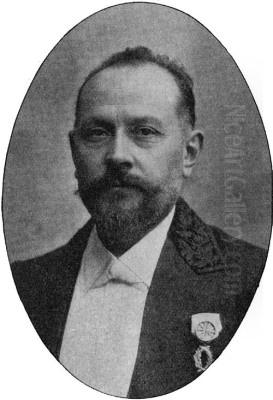
Johan Tirén stands as a significant, if sometimes overlooked, figure in Swedish art history, a painter whose dedication to realism and profound connection to the landscapes and people of northern Sweden, particularly the Sámi culture, defined his artistic legacy. Active during a transformative period in European art, Tirén carved a distinct path, prioritizing authentic representation and narrative depth over the prevailing avant-garde movements of his time. His work offers a vital window into the life, traditions, and stark beauty of a region often at the periphery of mainstream artistic focus, earning him a lasting place not only in galleries but also in the cultural memory of the communities he depicted.
Early Life and Artistic Awakening
Born on October 12, 1853, in Själevad, Västernorrland County, Johan Tirén's early life was steeped in an environment that likely fostered an appreciation for both nature and heritage. His father, Karl Tirén, was an artist himself, though he later became a vicar. When Johan was seven years old, in 1860, the family relocated to Oviken in Jämtland, a region that would become central to his artistic vision. This move to a more remote and culturally distinct part of Sweden undoubtedly exposed young Johan to the landscapes and the Sámi way of life that would later dominate his canvases.
The artistic inclinations of his father surely played a role in nurturing Johan's own talents. Growing up in the rugged, picturesque environment of Jämtland, with its vast forests, mountains, and lakes, provided an endless source of inspiration. This early immersion in the northern wilderness shaped his eye for detail and his deep empathy for the people who inhabited these challenging yet beautiful lands. It was a foundation built on direct experience, a characteristic that would remain a hallmark of his mature artistic practice.
Formal Training and Academic Recognition
To hone his burgeoning talent, Johan Tirén pursued formal artistic education. He initially studied at the Tekniska skolan (Technical School) in Stockholm, a common preparatory step for aspiring artists and craftsmen. This institution would have provided him with a solid grounding in drawing and foundational artistic techniques. His ambition, however, led him to the prestigious Kungliga Akademien för de fria konsterna (Royal Swedish Academy of Fine Arts) in Stockholm, where he enrolled in 1877 and studied until 1880.
The Academy at this time was a bastion of traditional art education, emphasizing classical principles, anatomical accuracy, and historical subjects. Figures like Georg von Rosen, a prominent historical painter and later director of the Academy, would have been influential. During his academic years, Tirén demonstrated considerable skill. A testament to his early promise was the Royal Medal he received in 1880 for his painting "Loke fängslas av asarna" (Loki Imprisoned by Æsir). This work, drawing from Norse mythology, showcased his ability to handle complex compositions and dramatic narratives, themes popular within academic circles.
It was also during his time at the Academy, or shortly thereafter, that he created another significant early work, "En Jämtlandssägen" (A Jämtland Legend). This painting, depicting the Näcken (a male water spirit from Scandinavian folklore), famously featured his fellow student and future internationally renowned artist, Anders Zorn, as the model for the Näcken. The painting garnered considerable attention when exhibited, highlighting Tirén's early interest in local folklore and his ability to imbue mythical subjects with a tangible, almost unsettling, realism.
Parisian Sojourn and Personal Life
Like many ambitious Scandinavian artists of his generation, Tirén sought further exposure and training in Paris, the undisputed art capital of the world in the late 19th century. While the exact dates of his Parisian stay are not always precisely documented, it was a common trajectory for artists after completing their studies at the Royal Academy. In Paris, artists could immerse themselves in a vibrant artistic milieu, visit the Louvre, and attend independent ateliers like the Académie Julian or Académie Colarossi, which offered alternatives to the more rigid École des Beaux-Arts.
It was in Paris that Johan Tirén met Gerda Rydberg (1858–1928), a fellow Swedish artist and illustrator who was also pursuing her studies there. Gerda had also studied at the Tekniska skolan and the Royal Swedish Academy of Fine Arts in Stockholm before venturing to Paris. Their shared artistic pursuits and Swedish heritage likely drew them together. They married in 1884, forming a personal and artistic partnership. Gerda Tirén (née Rydberg) would go on to have her own successful career, particularly as an illustrator of children's books and postcards, often with charming depictions of traditional Swedish life. Their life together would see them eventually settle in Penningby, Länna parish, Uppland, though Jämtland and the North remained Johan's primary artistic focus.
The Parisian experience, while perhaps not radically altering his fundamental realist approach, would have exposed Tirén to a wider range of artistic currents, from the lingering influence of French Realism (Courbet, Millet) to the rising tide of Impressionism. However, Tirén's artistic compass remained firmly pointed towards the narrative and descriptive potential of realism, which he would adapt to his unique Swedish subjects.
The Call of the North: Jämtland and the Sámi
Despite his academic training and experiences abroad, Johan Tirén's artistic heart belonged to the northern regions of Sweden, particularly Jämtland and the Sámi territories (often referred to as Sápmi). He became one of the foremost visual chroniclers of Sámi life and the dramatic landscapes they inhabited. His depictions were characterized by an ethnographic accuracy and a deep sense of empathy, setting his work apart from more romanticized or exoticized portrayals of indigenous cultures common in the 19th century.
Tirén spent considerable time in these northern areas, observing, sketching, and immersing himself in the environment and the daily lives of the Sámi people. He painted their reindeer herds, their traditional clothing (gákti), their camps (lávvu and goahti), and their interactions with the often harsh but breathtakingly beautiful natural world. His works captured the changing seasons, from the vibrant hues of autumn to the stark, snow-covered expanses of winter, with a keen eye for the specific quality of northern light.
His brother, Karl Tirén (1869–1955), also played a significant role in the preservation and understanding of Sámi culture, albeit through different means. Karl became a dedicated collector of Sámi traditional music (yoiks) and a passionate advocate for Sámi rights. This familial connection and shared interest in Sámi culture undoubtedly deepened Johan's own engagement with the subject.
Artistic Style: A Commitment to Realism
Johan Tirén's style was predominantly one of meticulous realism. He possessed a remarkable ability to render detail, whether it was the texture of reindeer fur, the intricate patterns of Sámi handicrafts, or the subtle gradations of color in a winter sky. This dedication to verisimilitude was not merely for descriptive purposes; it was a way of conveying the authenticity and dignity of his subjects.
During the late 19th century, the Swedish art scene was experiencing a period of ferment. A group of artists, including Anders Zorn, Carl Larsson, Karl Nordström, Richard Bergh, and Bruno Liljefors, formed the "Opponenterna" (The Opponents) in 1885, later establishing the Konstnärsförbundet (Artists' Association) in 1886. They rebelled against the conservative standards of the Royal Academy, advocating for greater artistic freedom, plein-air painting, and styles often influenced by French Impressionism and Naturalism.
Interestingly, Johan Tirén did not join the Konstnärsförbundet. While his realism shared some common ground with the Naturalist tendencies of some Opponents, his approach was perhaps more rooted in the detailed, narrative tradition of academic painting, albeit applied to contemporary, regional subjects. His connection to the Academy, where he had won accolades, and his unwavering commitment to a highly detailed form of realism may have set him on a more independent path. His focus was less on capturing fleeting atmospheric effects in the Impressionist vein and more on creating enduring, almost documentary, portrayals of life in the North.
Masterpieces and Their Enduring Impact
Several of Johan Tirén's paintings stand out as iconic representations of his artistic concerns and have had a lasting cultural impact.
"Loke fängslas av asarna" (Loki Imprisoned by Æsir, 1880), his prize-winning Academy piece, demonstrated his early mastery of academic conventions and mythological themes. It was a strong foundation upon which he built his career.
"En Jämtlandssägen" (A Jämtland Legend, c. 1882-1884), featuring Zorn as the Näcken, captured the public imagination and showcased his ability to bring folklore to life with a compelling, almost tangible presence. The dark, brooding atmosphere and the intense gaze of the water spirit made it a memorable work.
Perhaps his most socially significant and widely recognized works are those depicting Sámi life. "Lappar tillvaratagande skjuten ren" (Sámi Taking Care of a Shot Reindeer), painted in 1892, is a prime example. This large canvas depicts a Sámi family processing a reindeer in a snowy landscape. The painting is rendered with incredible detail, from the expressions on the faces to the textures of clothing and the surrounding environment. More than just a genre scene, this painting reportedly played a role in public and parliamentary discussions concerning Sámi land and hunting rights. It brought a human face and a sense of lived reality to debates that were often abstract or based on prejudice. The painting was seen as a powerful statement, highlighting the Sámi's connection to the land and their traditional way of life.
Other works, such as those depicting reindeer migrations, winter landscapes with Sámi figures, and scenes of daily life in Sámi camps, further solidified his reputation as a sensitive and accurate portrayer of this unique culture. His paintings were valued by the Sámi community themselves for their truthfulness and respectful approach, often being seen as "living images" that affirmed their identity and heritage.
Contemporaries and the Wider Art Scene
Johan Tirén operated within a vibrant Swedish art scene that included many notable figures. His direct contemporary and Academy classmate, Anders Zorn (1860-1920), achieved international fame for his virtuoso portraits, nudes, and depictions of Swedish rural life, often rendered with a dazzling, impressionistic brushwork. While their styles diverged, their shared Jämtland connection (Zorn was from Mora in nearby Dalarna, but the regions share cultural similarities) and early association are noteworthy.
Carl Larsson (1853-1919), another leading figure of the Konstnärsförbundet, became beloved for his idyllic watercolors of his family life in Sundborn, Dalarna, creating an iconic image of Swedish domesticity. Bruno Liljefors (1860-1939) was renowned for his dynamic and unsentimental depictions of wildlife, particularly birds and mammals in their natural habitats, sharing Tirén's deep connection to the Swedish landscape.
Richard Bergh (1858-1919) was a key theorist and portraitist within the Konstnärsförbundet, later becoming head of the Swedish National Museum. Karl Nordström (1855-1923) was a leading landscape painter, known for his evocative depictions of the Swedish west coast.
While Tirén did not align himself with the Konstnärsförbundet, his work can be seen in dialogue with the broader National Romantic movement prevalent in Scandinavia at the turn of the century. This movement sought to define national identity through art, music, and literature, often drawing inspiration from folklore, history, and the unique character of the Nordic landscape. Artists like the Norwegian Erik Werenskiold and Theodor Kittelsen, known for their illustrations of Norwegian folk tales, or the Finnish Akseli Gallen-Kallela, famous for his depictions of the Kalevala epic, were part of this wider cultural current.
In Sweden, painters like Prins Eugen (1865-1947), himself a royal and a talented landscape artist, also contributed to this National Romantic ethos. Even earlier figures like Marcus Larson (1825-1864), with his dramatic Romantic landscapes, had paved the way for a focus on Swedish nature. Tirén's contemporary, Hugo Fredrik Salmson (1843-1894), who spent much of his career in France, was known for his genre scenes, often with a more sentimental touch than Tirén's stark realism.
Later Years and Continued Dedication
Johan Tirén continued to paint and advocate for the subjects close to his heart throughout his life. He and Gerda established their home in Penningby, but his artistic focus remained largely on the North. He exhibited his works regularly, and they found their way into important collections. His dedication to depicting the Sámi people and their environment was unwavering, even as Sweden was undergoing rapid industrialization and societal change.
His work provided an important counter-narrative to the often-romanticized or, conversely, denigrating views of Sámi culture prevalent at the time. By presenting their lives with dignity and realism, he contributed to a greater understanding and appreciation of their unique place within the Swedish nation. His paintings became historical documents in their own right, preserving a visual record of a way of life that was increasingly under pressure.
The Tirén family's artistic legacy continued with their children. Their son, Nils Tirén (1885–1935), also became a painter, often depicting animals and nature in a style influenced by his father and Bruno Liljefors. Their daughter, Stina Tirén (1886–1951), also pursued an artistic career.
Johan Tirén passed away on August 24, 1911, in Penningby, Länna. He left behind a significant body of work that continues to resonate for its artistic quality, its historical importance, and its empathetic portrayal of a unique cultural heritage.
Legacy and Historical Significance
Johan Tirén's influence extends beyond the purely aesthetic. His paintings are vital historical documents, offering invaluable insights into Sámi life and the northern Swedish landscape at the turn of the 20th century. For the Sámi community, his works are often cherished as authentic and respectful representations, a contrast to many other contemporary depictions. His art has been cited in discussions about cultural heritage and indigenous rights, demonstrating the power of visual representation to shape understanding and influence societal attitudes.
His works are held in major Swedish museum collections, including the Nationalmuseum in Stockholm and Jamtli, the regional museum of Jämtland Härjedalen in Östersund, which has a significant collection reflecting his deep connection to that region. While he may not have achieved the same international superstar status as his contemporary Anders Zorn, Tirén's contribution to Swedish art and cultural history is undeniable and profound.
He is remembered as an artist of great integrity and skill, who chose to focus his considerable talents on subjects that were often marginalized. His meticulous realism, combined with a deep empathy for his subjects, created a body of work that is both visually compelling and culturally significant. In an era of artistic experimentation, Johan Tirén remained steadfast in his commitment to portraying the world he knew with honesty and respect, ensuring his place as a key chronicler of the Swedish North. His art continues to speak to audiences today, inviting them to explore the rich cultural tapestry and breathtaking landscapes of a unique part of the world.