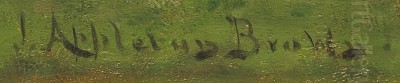
John Appleton Brown, an artist whose name became synonymous with the ephemeral beauty of New England's spring, carved a distinct niche for himself in the landscape of American art during the latter half of the nineteenth century. Born in Newburyport, Massachusetts, on July 12, 1844, Brown's artistic journey would see him traverse the Atlantic, absorb the revolutionary currents of French painting, and return to immortalize the gentle pastorals of his native region. His particular fondness for depicting apple orchards in full, radiant bloom earned him the affectionate moniker "Apple Blossom Brown," a testament to his ability to capture the delicate, joyous spirit of springtime. While often associated with American Impressionism, Brown's work retained a unique lyrical quality, deeply influenced by the Barbizon School, resulting in canvases that were both observant of nature and imbued with a poetic sensibility.
Early Life and Artistic Awakenings in Boston
John Appleton Brown's formative years were spent in the historic coastal town of Newburyport, a setting that likely instilled in him an early appreciation for the natural beauty of New England. The region, with its rolling hills, meandering rivers, and distinct seasonal changes, would become the enduring wellspring of his artistic inspiration. By 1865, driven by a burgeoning passion for art, Brown made the pivotal move to Boston. The city, a burgeoning cultural and intellectual hub, offered aspiring artists opportunities for study and exposure to a more established artistic community.
In Boston, Brown sought instruction under Benjamin Champney, a notable White Mountain School painter, and later, more significantly, with Benjamin Curtis Porter. Porter, a respected portrait and figure painter, would have provided Brown with a foundational understanding of academic drawing and painting techniques. This early training in Boston was crucial, equipping Brown with the essential skills before he embarked on the almost requisite pilgrimage for ambitious American artists of his generation: further study in Europe. The artistic atmosphere in Boston at the time was one of transition, with established traditions coexisting with a growing awareness of new European movements, setting the stage for Brown's own stylistic evolution.
The Parisian Sojourn: Immersion in the Barbizon Spirit
In 1866, John Appleton Brown, like many of his aspiring American contemporaries such as William Morris Hunt and Winslow Homer before him, traveled to Paris, the undisputed epicenter of the art world. It was here that his artistic vision would be profoundly shaped. Rather than enrolling in the highly structured École des Beaux-Arts, Brown sought out masters associated with the Barbizon School, a group of painters who had reacted against the idealized landscapes of Neoclassicism and the dramatic narratives of Romanticism. They advocated for a more direct, truthful depiction of nature, often painting en plein air (outdoors) in the Forest of Fontainebleau near the village of Barbizon.
Brown studied under two luminaries of this movement: Jean-Baptiste-Camille Corot and Charles-François Daubigny. Corot, celebrated for his poetic, silvery-toned landscapes, instilled in Brown an appreciation for atmospheric effects, subtle tonal harmonies, and the lyrical interpretation of nature. Daubigny, known for his tranquil river scenes and more direct, less idealized approach to landscape, further encouraged Brown's commitment to capturing the authentic character of the natural world. The influence of these masters, and the Barbizon ethos in general—which also included artists like Jean-François Millet, Théodore Rousseau, and Narcisse Virgilio Díaz de la Peña—was transformative. Brown absorbed their emphasis on capturing mood, light, and the quiet poetry of rural life, principles that would become hallmarks of his own work. He also spent time in the studio of Émile Lambinet, another landscape painter connected to the Barbizon tradition.
Return to America and the Development of a Personal Style
After his initial period of study in France, Brown returned to Boston in 1868, his artistic sensibilities enriched and his technique refined. He married Agnes Augusta Bartlett, a painter herself, in the same year. The artistic landscape in America was evolving, with a growing appreciation for styles that moved beyond the detailed realism of the Hudson River School. Brown's European training, particularly his Barbizon leanings, positioned him well within this changing milieu.
He established a studio in Boston and began to apply the lessons learned in France to the familiar scenery of New England. His early works from this period reflect a strong Barbizon influence, characterized by muted palettes, soft atmospheric effects, and a focus on the pastoral and the tranquil. He often sought out subjects that resonated with the Barbizon preference for the unassuming beauty of the countryside. It was during these years that he began to cultivate his reputation as a sensitive interpreter of the New England landscape. He became associated with other American artists who had also absorbed Barbizon principles, sometimes referred to as the American Barbizon School, including figures like William Morris Hunt, who had been one of the earliest American champions of the French movement, George Inness, and Joseph Foxcroft Cole.
In 1874, Brown and his wife returned to France, spending a significant period living in Ville d'Avray, a locale famously associated with his mentor, Corot. This extended stay allowed him to further immerse himself in the French artistic environment and solidify his connection to the Barbizon aesthetic. However, his subject matter increasingly drew from his American roots, even when painting abroad, or upon his return.
"Apple Blossom Brown": The Signature Theme
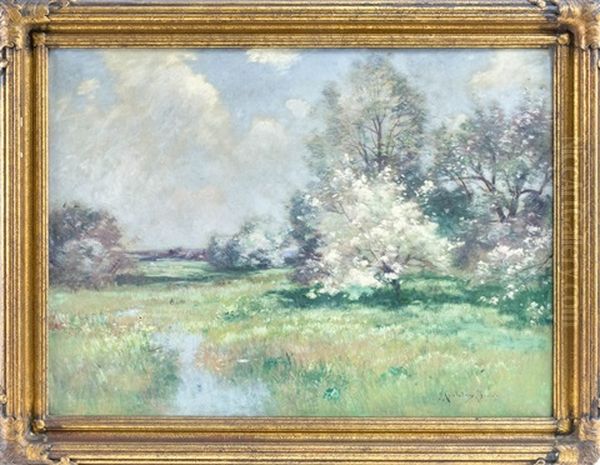
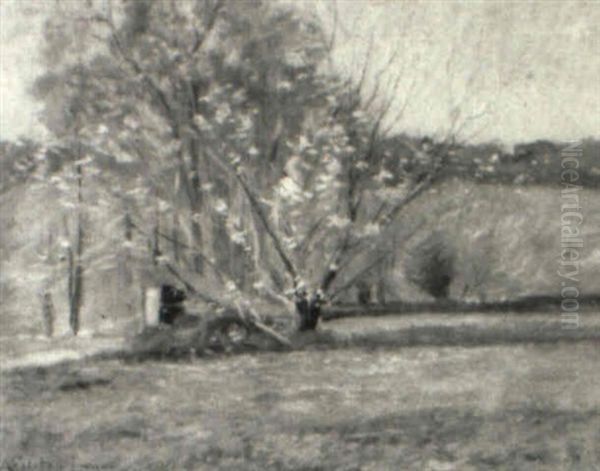
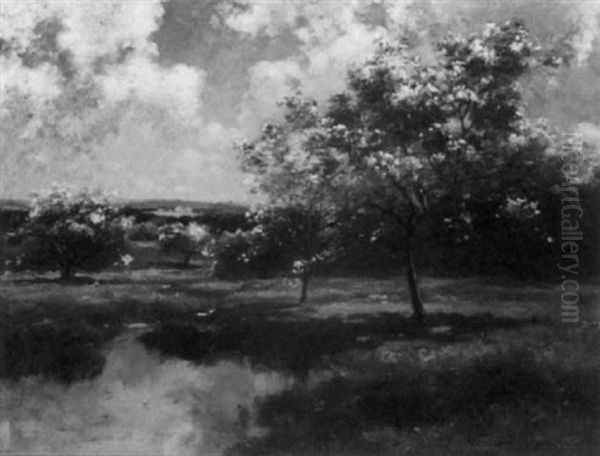
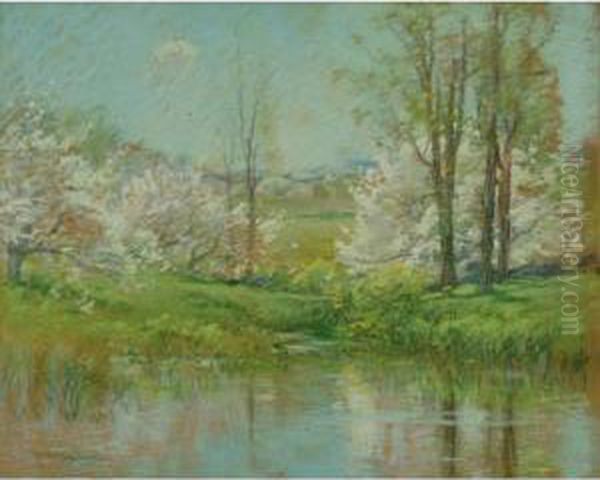
While Brown painted a variety of New England landscapes, it was his depictions of apple orchards in springtime that truly captured the public imagination and cemented his artistic identity. These works, brimming with the delicate pinks and whites of apple blossoms set against fresh green foliage and often under a soft, diffused light, earned him the affectionate nickname "Apple Blossom Brown." Paintings such as "Apple Blossoms," "Springtime," and "Old Apple Trees at Medfield" exemplify this cherished theme.
These paintings were more than mere botanical studies; they were lyrical evocations of renewal, beauty, and the gentle charm of rural New England. Brown's approach was not one of sharp, photographic realism. Instead, he employed a softer focus, with blended brushstrokes and a keen sensitivity to the interplay of light and color, creating a dreamlike, poetic atmosphere. The gnarled, characterful trunks of old apple trees often provided a structural counterpoint to the ephemeral delicacy of the blossoms. His ability to convey the specific light and atmosphere of a New England spring resonated deeply with audiences, offering an idyllic vision of a familiar and beloved landscape. This focus on a specific, recurring motif, rendered with such personal feeling, became a defining characteristic of his oeuvre.
The Allure of Appledore Island and Artistic Camaraderie
A significant aspect of Brown's artistic life involved his summers spent on Appledore Island, one of the Isles of Shoals off the coast of Maine and New Hampshire. The island was home to the renowned salon of poet and writer Celia Thaxter. Thaxter's cottage and her famous garden became a vibrant gathering place for prominent artists, writers, and musicians of the day. From the 1870s until Thaxter's death in 1894, Brown was a regular visitor and a cherished member of this artistic circle.
On Appledore, Brown found not only inspiring coastal scenery but also stimulating companionship. He interacted with fellow artists such as Childe Hassam, who would become one of America's foremost Impressionists and who also famously painted Thaxter's garden and the island's landscapes. Other visitors included William Morris Hunt, J. Appleton Brown's wife Agnes Bartlett Brown (also a painter), and the writer William Dean Howells. This environment fostered a rich exchange of ideas and undoubtedly influenced the artists present. Brown painted numerous views of Appledore, capturing its rugged coastline, Thaxter's vibrant garden, and the unique maritime light. His works from this period often show a brighter palette and a looser handling of paint, perhaps reflecting the influence of the burgeoning Impressionist movement and the stimulating artistic exchanges on the island.
Artistic Techniques: Bridging Barbizon and Impressionism
John Appleton Brown's artistic technique evolved throughout his career, but it consistently demonstrated a delicate balance between the tonalism of the Barbizon School and the brighter palette and broken brushwork associated with Impressionism. His early works, heavily influenced by Corot, feature soft, diffused light, subtle gradations of tone, and a poetic, often melancholic mood. He was a master of capturing atmospheric conditions, whether the hazy light of early morning or the gentle glow of twilight.
As Impressionism gained traction, Brown's palette brightened, and his brushwork became somewhat looser and more visible, particularly in his depictions of sun-dappled foliage and blossoms. However, he rarely adopted the fully broken color and optical mixing characteristic of French Impressionists like Claude Monet or Camille Pissarro. Instead, his Impressionism was more tempered, retaining a strong sense of underlying form and a focus on lyrical expression. He shared this nuanced approach with other American Impressionists such as John Henry Twachtman and J. Alden Weir, who also adapted French Impressionist techniques to an American sensibility.
Brown's landscapes, especially those featuring apple blossoms or sunsets, showcase his skill in rendering light. He was adept at capturing the fleeting effects of light as it filtered through leaves, shimmered on water, or suffused the sky with color. His compositions were typically well-balanced, often featuring a strong foreground element leading the eye into a receding landscape, creating a sense of depth and tranquility.
Exhibitions, Recognition, and Critical Reception
John Appleton Brown achieved considerable recognition during his lifetime, exhibiting his work widely both in the United States and abroad. He was a regular contributor to major American exhibitions, including those at the Boston Art Club, where he was a prominent member, the National Academy of Design in New York, and the Pennsylvania Academy of the Fine Arts in Philadelphia. His participation in these venues placed his work alongside that of leading American artists of the era, such as Winslow Homer, George Inness, and Eastman Johnson.
His work also found an audience in Europe. He exhibited at the prestigious Paris Salon on several occasions, a significant mark of achievement for an American artist. A notable honor came at the 1893 World's Columbian Exposition in Chicago, a landmark event that showcased international art and industry. Brown's paintings were included in the American art display, and he received a medal for his contributions, further solidifying his national reputation. His last painting was reportedly exhibited at the National Academy of Design in 1902, the year of his death.
Critics of the time generally praised Brown for the poetic charm and sincerity of his landscapes. His ability to capture the quintessential beauty of New England, particularly its springtimes, resonated with a public that valued art reflecting national scenery and sentiment. While perhaps not as radical an innovator as some of his contemporaries, Brown was respected for his consistent quality, his refined technique, and the genuine feeling he brought to his subjects.
Brown and His Contemporaries: A Network of Influences
John Appleton Brown operated within a vibrant network of artists, both in America and Europe. His primary mentors, Corot and Daubigny, connected him directly to the Barbizon School, a movement that also influenced many other American artists, including William Morris Hunt, George Inness, Alexander Helwig Wyant, and Homer Dodge Martin. Brown's friendship with Hunt, a key figure in introducing French art to Boston, was particularly significant.
In the realm of American Impressionism, Brown's path intersected with figures like Childe Hassam, particularly during their time at Celia Thaxter's salon on Appledore Island. While Hassam's Impressionism became more overtly high-keyed and broken in touch, their shared experiences and mutual respect are evident. Brown can be seen as part of a generation of American artists, including Theodore Robinson (who had direct contact with Monet), Willard Metcalf, and Frank Weston Benson, who adapted Impressionist principles to American subjects and sensibilities.
His competitors in exhibitions would have included a wide range of landscape and genre painters active in the late 19th century. In Boston, artists like Charles Herbert Woodbury (known for his marine paintings) and Edmund C. Tarbell (a leading figure of the Boston School) were prominent contemporaries. Nationally, he exhibited alongside artists from various schools, from the lingering influence of the Hudson River School to the emerging Tonalists and Impressionists. The art world was a place of both camaraderie and competition, and Brown navigated it successfully, carving out his distinctive niche. He also knew artists like Edwin Austin Abbey, a celebrated illustrator and muralist, and Frank Miller and Charles Parsons, who were active in similar exhibition circles.
Later Years and Enduring Legacy
John Appleton Brown continued to paint and exhibit actively into the early twentieth century. He maintained studios in Boston and New York, and his connection to New England, particularly the landscapes around Newburyport and the broader Merrimack Valley, remained central to his art. He passed away in New York City on January 18, 1902, leaving behind a significant body of work that celebrated the gentle beauty of the American landscape.
Today, John Appleton Brown's paintings are held in the collections of numerous prestigious American museums, including the Museum of Fine Arts, Boston; the Isabella Stewart Gardner Museum in Boston (Gardner was a personal patron); the Philadelphia Museum of Art; the Yale University Art Gallery; the Addison Gallery of American Art in Andover, Massachusetts; and the Colby College Museum of Art. His work is valued for its lyrical charm, its skillful rendering of light and atmosphere, and its quintessential depiction of New England scenery.
While he may not be as widely known as some of the leading figures of French Impressionism or the more radical American modernists who followed, John Appleton Brown holds an important place in the story of American art. He represents a significant bridge between the Barbizon tradition and American Impressionism, forging a personal style that was both informed by European innovations and deeply rooted in American soil. His "apple blossom" paintings, in particular, remain beloved icons of New England's vernal beauty, securing his legacy as an artist who captured the poetic heart of his native land. His dedication to his craft and his sensitive interpretation of nature ensure his continued appreciation by art lovers and historians alike.
Conclusion: The Poetic Naturalism of "Apple Blossom Brown"
John Appleton Brown's artistic journey was one of dedicated observation and lyrical interpretation. From his early studies in Boston to his transformative experiences with the Barbizon masters in France, and his subsequent career capturing the soul of New England, Brown developed a distinctive voice. His nickname, "Apple Blossom Brown," speaks volumes about his most cherished subject matter and the affection with which his work was, and continues to be, regarded. He masterfully blended the tonal subtleties and atmospheric concerns of the Barbizon school with the brighter palette and light-filled canvases of Impressionism, creating landscapes that were both true to nature and imbued with a gentle, poetic spirit. His participation in Celia Thaxter's vibrant artistic circle on Appledore Island further enriched his work and connected him with key figures of his time. Through his numerous exhibitions and the acquisition of his works by major museums, John Appleton Brown secured his place as a significant American landscape painter of the late nineteenth century, an artist whose canvases continue to evoke the timeless beauty and tranquil charm of the New England countryside.