John Bates Noel (1870-1927) was a distinguished British landscape painter who carved a niche for himself through his evocative depictions of the British countryside, particularly the rugged and picturesque terrains of the West Midlands, Worcestershire, and North Wales. Active during the late Victorian and Edwardian eras, Noel's work is characterized by its fluid brushwork, atmospheric depth, and a keen sensitivity to the natural world. Though perhaps not as widely known as some of his contemporaries, his contributions to British landscape art offer a valuable insight into the artistic currents and regional focuses of his time.
Early Life and Formative Influences
Born in Worcester in 1870, John Bates Noel was immersed in an artistic environment from a young age. He was the son of David Bates (1840-1921), himself a respected landscape painter known for his scenes of Wales and Scotland. This familial connection undoubtedly played a crucial role in shaping Noel's early artistic inclinations and providing him with foundational training. It is widely believed that David Bates was his son's primary, if not sole, formal instructor in the arts.
An interesting aspect of his early career was his decision to adopt the surname "Noel." This was reportedly done to avoid confusion with his already established father, David Bates, allowing the younger artist to forge his own distinct identity in the competitive art world of late 19th-century Britain. This practical step indicates a thoughtful approach to his professional life, even as he followed in his father's artistic footsteps. Growing up in Worcestershire, a county rich in natural beauty, provided him with ample inspiration and subject matter, which he would explore throughout his career. He later resided in Malvern, where he also engaged in teaching art, further contributing to the artistic community.
Artistic Style and Technique
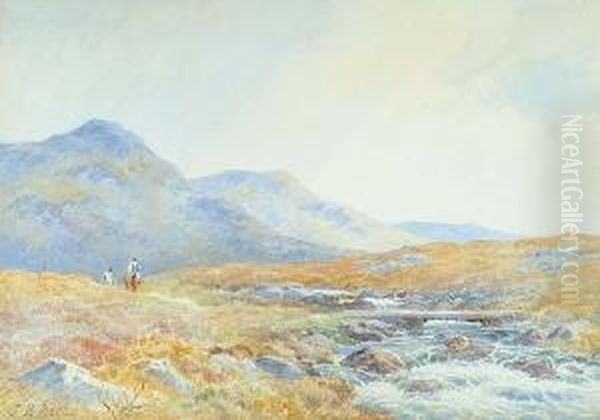
John Bates Noel developed a style that, while sharing some thematic similarities with his father's work, possessed its own unique characteristics. His paintings are often described as having a more fluid, free, and dynamic quality compared to the sometimes more detailed and structured approach of David Bates. Noel's brushwork was notably loose and expressive, lending an informal realism to his canvases. He excelled at capturing the transient effects of light and atmosphere, imbuing his landscapes with a palpable sense of place and mood.
His technique focused on conveying the essence and spirit of the landscape rather than a meticulous, photographic reproduction. This approach aligns him with a broader trend in British landscape painting that moved beyond the highly detailed Pre-Raphaelite influence towards a more personal and evocative interpretation of nature. Artists like John Constable and J.M.W. Turner, though from earlier generations, had laid the groundwork for such expressive freedom in landscape art. Noel's work can be seen as part of this continuing tradition, adapted to the specific scenery he favored. He was particularly adept at rendering the textures of the land – the roughness of stone, the foliage of trees, and the movement of water and clouds.
Thematic Focus: The British Countryside
The core of John Bates Noel's oeuvre lies in his depictions of the British countryside. He was particularly drawn to the "rugged" landscapes, suggesting a preference for scenes with a certain wildness or untamed character. His favored locales included the West Midlands, his native Worcestershire, and the dramatic scenery of North Wales, areas also popular with other landscape painters of the period.
His works often feature rolling hills, winding rivers, ancient woodlands, and rustic cottages nestled within the landscape. These elements were common in Victorian and Edwardian landscape painting, appealing to a public that often romanticized rural life, even as industrialization transformed much of the country. Noel's paintings, however, often managed to convey a sense of authenticity and direct observation. He was a keen observer of the changing seasons and the varying moods of nature, which he translated effectively onto canvas.
Among his representative works, titles such as "The Avon River," "A Rural Landscape," and the pair of oils "The Avon River and the Berwyn Valley" (sometimes referred to as "Afon Afon, Berwyn Valley") highlight his focus on specific geographical areas and the interplay of water and land. Another notable piece is "Country Landscape" (1910). These works showcase his ability to capture the distinctive character of these regions, from the gentler pastoral scenes of Worcestershire to the more dramatic vistas of the Welsh mountains and valleys.
Affiliations and the Birmingham School Context
While John Bates Noel was not formally a member of a tightly-knit "school" in the way some artists were, his work shows affinities with the broader trends of the Birmingham School of Artists. This was not a formal institution but rather a loose collective of artists working in and around Birmingham, many of whom shared an interest in landscape and rural subjects. His father, David Bates, was associated with this group.
Artists like Joseph Thors (c.1835-1920) and William Henry Mander (fl.1880-1920), who were also followers or associates of the Birmingham artistic circle, painted in a style that shared some common ground with Noel's. They, too, often depicted rustic scenes, farmsteads, and woodland interiors with a focus on naturalism and atmospheric effects. The influence of earlier figures associated with the Birmingham tradition, such as David Cox (1783-1859), who was renowned for his vigorous and atmospheric watercolors and oils of Welsh and English landscapes, can also be seen as a foundational element for later generations of Midland artists. Other artists from this regional sphere included Samuel Lines (1778-1863), a key figure in Birmingham's early art scene, and Joseph Barber (1757-1811), who taught many aspiring artists. Later, figures like Frederick Henry Henshaw (1807-1891) continued the landscape tradition in the region.
Noel's engagement with these artistic currents was primarily through shared subject matter and a similar approach to capturing the character of the local landscape, rather than adherence to a strict stylistic dogma. His individual talent lay in his ability to synthesize these influences into a personal and expressive visual language.
Exhibitions and Professional Recognition
John Bates Noel achieved a notable degree of professional recognition during his lifetime, primarily through his participation in significant art exhibitions. He regularly exhibited his works at prestigious venues, which was crucial for an artist's career progression and reputation in that era.
He showed his paintings at the Royal Academy of Arts in London, one of the most important art institutions in Britain. His exhibition record at the Royal Academy spanned from 1893 to 1909, indicating a consistent level of acceptance and quality in his work. To be hung at the RA was a mark of distinction and provided artists with national exposure.
Closer to his home region, Noel was a frequent exhibitor at the Royal Birmingham Society of Artists (RBSA). He showcased his work there from 1892 to 1919. The RBSA was, and remains, a vital hub for artists in the Midlands, and his long association with it underscores his standing within that regional art community.
Furthermore, his paintings were displayed in other major provincial galleries, including the Manchester City Art Gallery and the Walker Art Gallery in Liverpool. The inclusion of his work in these public collections and exhibitions helped to solidify his reputation as a competent and respected landscape painter. These institutions played a significant role in promoting British art outside of London, and their acquisition or exhibition of an artist's work was a testament to its perceived quality and appeal.
Interactions with Contemporaries
Beyond his father, David Bates, and the general influence of the Birmingham School artists like Joseph Thors and William Henry Mander, specific records of John Bates Noel's direct collaborations or close personal friendships with other named artists are not extensively documented in easily accessible sources. However, the art world of the late 19th and early 20th centuries, particularly within exhibiting societies like the RA and RBSA, was one of considerable interaction. Artists would meet at private views, serve on committees, and inevitably discuss and critique each other's work.
It is reasonable to assume that Noel would have been acquainted with many of the landscape painters active during his exhibiting years. Popular landscape artists of the broader Victorian and Edwardian period whose works would have been seen alongside Noel's at major exhibitions included figures like Benjamin Williams Leader (1831-1923), known for his highly popular and often idyllic Worcestershire scenes, and Alfred de Bréanski Sr. (1852-1928), who specialized in dramatic depictions of the Scottish Highlands and Welsh mountains. The works of the Williams family of painters, such as Sidney Richard Percy (1821-1886), who painted pastoral British landscapes, were also part of this rich tapestry of landscape art. While direct influence or interaction is speculative, Noel operated within this milieu, contributing his own distinct vision of the British countryside. Even artists working in different but related genres, such as Walter Langley (1852-1922) of the Newlyn School, who focused more on figurative scenes often set in coastal environments, were part of the broader artistic landscape of the time, showcasing the diversity of British art.
Publications and Academic Evaluation
As is common for many competent artists who were not at the very forefront of avant-garde movements or did not achieve superstar status like Turner or Constable, dedicated monographs or extensive academic publications solely focused on John Bates Noel are scarce. His recognition primarily comes through exhibition records, auction catalogues, and mentions in broader surveys of British landscape painting or dictionaries of British artists.
Academic evaluation, where it exists, generally positions him as a talented and skilled painter of the British landscape tradition. He is noted for his ability to capture the specific atmosphere of the regions he painted, his fluid and expressive style, and his connection to the artistic lineage of his father and the Birmingham School. Art historians acknowledge his contribution to the rich and diverse field of British landscape art during a period when it remained a highly popular genre. His works are appreciated for their aesthetic qualities and as visual records of the British countryside at the turn of the 20th century. While he may not have radically altered the course of art history, his consistent output and the quality of his paintings ensure his place as a respected figure within his specific domain.
Legacy and Conclusion
John Bates Noel passed away in 1927. His legacy resides in the body of work he left behind – paintings that continue to be appreciated for their beauty, their skillful execution, and their affectionate portrayal of the British landscape. He successfully navigated the art world of his time, building on the tradition inherited from his father while developing his own recognizable style.
His paintings serve as more than just picturesque views; they are imbued with a sense of the artist's personal connection to the land. They capture a specific period in British art when landscape painting, though evolving, still held a deep resonance with both artists and the public. Noel's focus on the rugged beauty of areas like North Wales and the more pastoral charm of the West Midlands contributed to the ongoing visual narrative of Britain's diverse natural heritage.
In conclusion, John Bates Noel was a dedicated and proficient British landscape painter whose work reflects a deep appreciation for the natural world. Influenced by his artist father, David Bates, and connected to the broader currents of the Birmingham School, he developed a free and fluid style well-suited to capturing the atmosphere and character of the English and Welsh countryside. Through his regular exhibitions at prestigious institutions like the Royal Academy and the Royal Birmingham Society of Artists, he gained recognition for his sensitive and evocative portrayals of landscapes that continue to charm and engage viewers today. His art remains a testament to the enduring appeal of the British landscape and the skill of an artist who dedicated his life to its depiction.