John Frederick Herring Snr.: Chronicler of the British Horse and Rural Life
Introduction: An Artist of Enduring Popularity
John Frederick Herring Snr. (1795-1865) stands as one of the most significant and popular British artists of the 19th century, particularly celebrated for his mastery in depicting animals, above all, the horse. Operating during the vibrant Victorian era, Herring carved a unique niche for himself, transitioning from the practical world of a coach driver to becoming a highly sought-after painter patronized by aristocracy and royalty. His work not only captures the beauty and spirit of the animals he portrayed but also serves as a valuable visual record of British sporting and rural life during a period of considerable social and cultural change. His enduring appeal lies in his technical skill, his ability to convey emotion and narrative, and the sheer breadth of his subject matter, ranging from high-stakes horse racing to tranquil farmyard scenes.
From London Roots to the Doncaster Road
Born in London in 1795, John Frederick Herring was the son of a London merchant of Dutch ancestry. His father, interestingly, had been born in America but later settled in England. Growing up in the bustling capital, the young Herring developed a profound fascination with two things that would define his life: drawing and horses. This passion was not initially encouraged as a viable career path. Indeed, family friction regarding his future, specifically concerning an arranged marriage, led to a dramatic turn of events. At the age of just 18, Herring defied his father's wishes and eloped with his intended bride, Ann Harris, seeking independence and a life of his own choosing.
This quest for autonomy led him north. By 1814, Herring had relocated to Doncaster in South Yorkshire (not Northumberland as sometimes mistakenly cited), a town renowned for its prestigious racecourse, home to the St. Leger Stakes, one of England's classic horse races. It was here that Herring's life took a practical, yet formative, turn. He found employment as a coachman, driving the "York and London Highflyer" coach. This profession immersed him daily in the world of horses, providing invaluable, firsthand knowledge of their anatomy, movement, and temperament – observations that would deeply inform his later artistic practice.
The 'Artist Coachman' Emerges
During his years driving coaches, Herring did not abandon his artistic inclinations. Quite the opposite, he began to utilize his talents in his spare time. Initially, this involved painting signs for inns and decorating the panels of coaches, skills that honed his draughtsmanship and handling of paint. His reputation began to grow, not just as a reliable coachman, but as one with remarkable artistic ability. He became known locally and affectionately as the "artist coachman." This period was crucial; it allowed him to develop his craft organically, grounded in the practical reality of his daily life rather than formal academic training, although he did receive some instruction from established artists like Abraham Cooper.
His presence in Doncaster, a hub of the racing world, proved serendipitous. Herring spent considerable time at the racecourse, sketching the magnificent thoroughbreds. His burgeoning talent did not go unnoticed. Wealthy patrons, including local landowners and racing enthusiasts, began commissioning him to paint portraits of their prized horses. This marked the beginning of his transition from a tradesman who painted to a professional artist. The intimate knowledge gained from working with horses daily gave his paintings an authenticity and vitality that resonated with those who knew the animals best.
Chronicler of the Turf: The St. Leger Winners
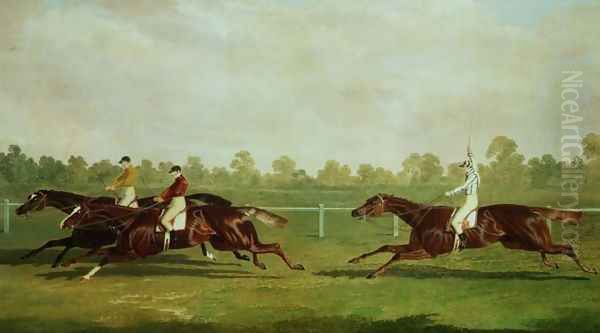
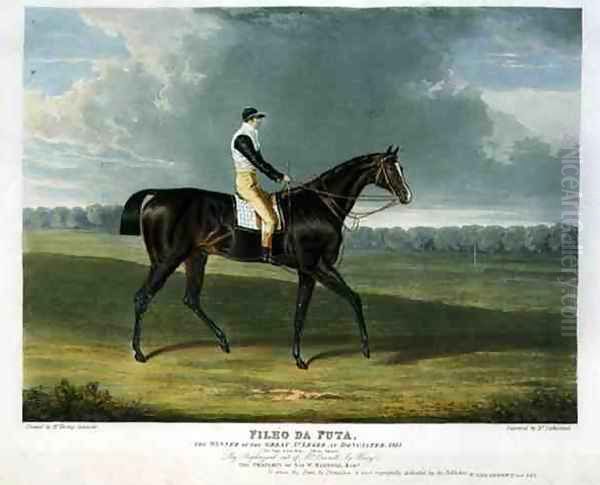
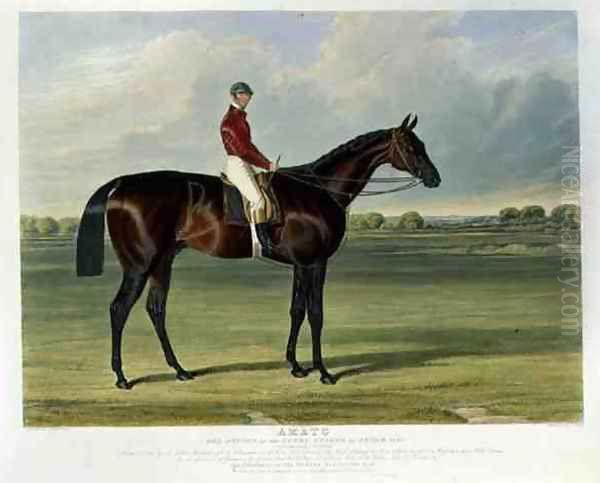
Herring's association with the Doncaster St. Leger Stakes became a cornerstone of his career and fame. For an astonishing period of 33 consecutive years, from 1815 onwards, he was commissioned to paint the portrait of each year's winner of this prestigious race. This consistent, high-profile commission cemented his reputation as the pre-eminent painter of racehorses in Britain. These portraits were not mere anatomical studies; they captured the unique character and triumphant spirit of each champion, often depicted with their jockeys or owners against the backdrop of the famous racecourse.
This series of paintings provides an invaluable historical record of thoroughbred breeding and racing during a key period of its development. His ability to capture the sleek musculature, the sheen of the coat, and the fiery spirit of these elite animals was unparalleled. His work in this field built upon the legacy of earlier British sporting artists like George Stubbs, renowned for his scientific approach to equine anatomy, and Benjamin Marshall, who brought a vigorous, less formal style to sporting art. Herring managed to combine anatomical accuracy with a sense of immediacy and drama that appealed greatly to his patrons.
Artistic Style: A Blend of Precision and Feeling
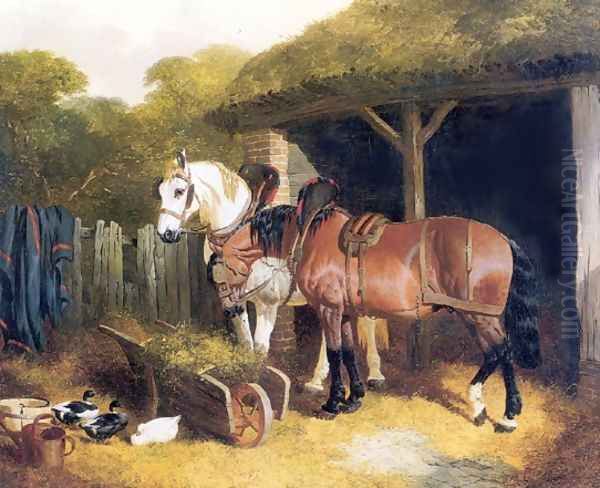
John Frederick Herring Snr.'s style is often characterized as a successful fusion of Realism and Romanticism. His commitment to accuracy is evident in the meticulous detail he rendered, particularly in the anatomy and tack of his horses. He possessed a keen eye for observation, honed during his years as a coachman, allowing him to depict horses with convincing naturalism. The textures of coats, the play of light on muscle, the intricate details of bridles and saddles – all were rendered with remarkable precision.
However, his work transcends mere technical accuracy. There is often a palpable sense of atmosphere and emotion, hallmarks of the Romantic sensibility prevalent in the early 19th century. Whether depicting the tension before a race, the exhilaration of the hunt, or the quiet dignity of farm animals, Herring imbued his subjects with a sense of life and feeling. He was particularly adept at capturing the expressive nature of animal eyes and postures, conveying fear, gentleness, or pride. This ability to capture the 'inner life' of animals contributed significantly to his popularity, setting him apart from artists who focused solely on anatomical representation, such as the Swiss-born painter Jacques-Laurent Agasse, who also worked in England.
Expanding Canvases: Farmyards, Hunting, and Rural Life
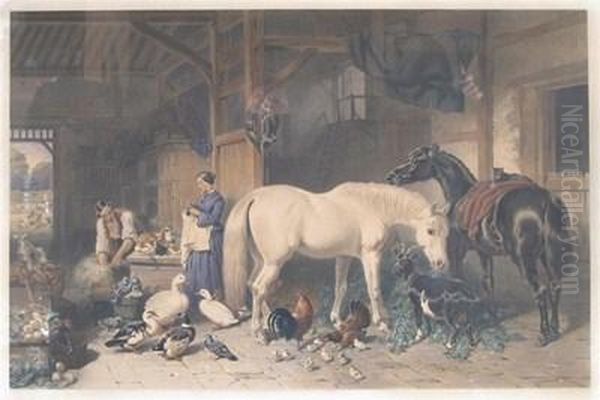
While Herring built his initial fame on racehorses, his artistic interests were broader. He became increasingly known for his depictions of farmyard scenes, hunting subjects, and general rural life. These works often featured a wider array of animals, including cattle, sheep, pigs, ducks, and dogs, frequently interacting within detailed barn or landscape settings. These paintings resonated deeply with the Victorian appreciation for the countryside and traditional ways of life, offering often idyllic, yet keenly observed, glimpses into the agricultural world.
Works like The Frugal Meal, depicting horses sharing feed in a stable, showcase his ability to find charm and narrative in everyday moments. His hunting scenes captured the energy and social dynamics of the chase, a popular pastime among the landed gentry who formed a significant part of his clientele. These rural themes placed him within a strong British tradition of genre and landscape painting, echoing the rustic charm found in the works of artists like George Morland, though Herring brought his own distinct focus on animal life. The detailed observation in his rural settings also shares some affinity with the naturalism seen in the landscapes of John Constable, albeit applied to different subject matter.
Notable Works and Signature Pieces
Throughout his prolific career, Herring produced numerous paintings that are now considered iconic representations of his style and subject matter. Pharaoh's Chariot Horses (1848) is a particularly dramatic and famous work, showcasing his ability to handle complex compositions and imbue his equine subjects with power and nobility, drawing on historical or biblical themes which became popular during the Victorian era.
His depictions of racehorses, beyond the St. Leger winners, were numerous and highly prized. Farmyard scenes like A Glimpse of an English Homestead and Two Harnessed Cart Horses (1853) exemplify his skill in portraying working animals and the textures of rural environments. A Soldier with an Officer's Charger (1853) combines his equine expertise with a touch of military genre. These specific works, alongside countless others, demonstrate the range and consistency of his output, solidifying his reputation.
Patronage by the Elite: Royalty and Aristocracy
Herring's talent attracted attention from the highest echelons of society. His list of patrons reads like a 'who's who' of 19th-century British and European nobility. He received commissions from King George IV and continued to enjoy royal favour under King William IV and, significantly, Queen Victoria. The Queen herself commissioned several works, including portraits of her favourite pets, demonstrating the widespread appeal of his animal painting.
Beyond the British monarchy, he also painted for influential figures like the Duke of Orléans in France. This elite patronage not only provided financial security but also significantly boosted his prestige. His works were regularly exhibited at prestigious venues, including the Royal Academy of Arts (RA), the British Institution (BI), and the Society of British Artists (SBA) at Suffolk Street, ensuring his visibility within the established art world. His success rivaled that of Sir Edwin Landseer, another Victorian favourite famed for his animal paintings, particularly those with sentimental or anthropomorphic qualities. While Landseer perhaps achieved greater critical acclaim within the Academy, Herring enjoyed immense popular appeal and commercial success.
A Scottish Turn: Exploring Highland Themes
Interestingly, from the mid-19th century onwards, Herring began to incorporate Scottish subjects into his repertoire. Works like Highland Scene (1834) appeared earlier, but there was a noticeable increase in such themes from the late 1840s into the 1850s. This coincided with a broader Victorian fascination with Scotland, fueled in part by the historical novels of Sir Walter Scott and Queen Victoria's own love for the Highlands (Balmoral Castle became her Scottish retreat).
Herring's Scottish paintings often depicted Highland cattle, ponies, and dramatic landscapes, capturing a different kind of rugged beauty compared to his English rural scenes. There is speculation and some evidence suggesting he may have collaborated on certain works with the Scottish genre painter Thomas Faed, known for his depictions of Scottish life and character. Paintings like Barnie Leavey and Gamekeeper’s Shack are sometimes cited in this context. Whether collaborations or simply reflecting a popular trend, these works added another dimension to Herring's oeuvre, aligning him with contemporary Scottish landscape artists like Horatio McCulloch.
The Herring Dynasty: Artistry Across Generations
John Frederick Herring Snr. was not the only artist in his family. He fathered several children, and three of his sons followed him into the profession: John Frederick Herring Jr. (1820-1907), Charles Herring (fl. 1852-1866), and Benjamin Herring Jr. (1830-1871). John Frederick Jr., in particular, became a successful artist in his own right, painting in a style very similar to his father's, focusing on comparable subjects like horses, farmyards, and hunting scenes.
This familial artistic activity led to some confusion in attribution, both then and now. Around 1836, the elder Herring began adding "Snr" or "SR" (Senior) to his signature, likely to distinguish his work from that of his increasingly active son. There are accounts suggesting occasional collaborations, where perhaps the father might paint the main animals and a son might contribute to the background or minor figures, though concrete details are often scarce. This situation mirrors other artistic families where styles and subjects were shared, such as the Nasmyth family of landscape painters in Scotland. Regardless of the complexities, the Herring name became synonymous with high-quality animal and sporting painting for much of the 19th century.
Later Life in Rural Kent
In his later years, Herring Snr. moved south from London and eventually settled at Meopham Park Farm near Tonbridge in Kent. This move seemed to coincide with a subtle shift in his artistic focus. While he continued to paint, his output perhaps featured fewer pure horse portraits and race scenes. Instead, he increasingly concentrated on agricultural subjects, detailed farmyard narratives, and compositions that told a story, often featuring a variety of animals within a carefully constructed setting.
This later phase might reflect a desire to explore different aspects of rural life, perhaps influenced by his own surroundings in the Kent countryside. It could also represent a natural evolution in his artistic interests as he aged. The precise reasons for this shift remain somewhat speculative, but it demonstrates his continued engagement with his craft until his death in 1865. He passed away in Kent, leaving behind a vast body of work and a secure place in British art history.
Anecdotes and Unanswered Questions
Herring's life wasn't without its share of interesting episodes and lingering questions. His youthful elopement provides a glimpse of a determined, perhaps rebellious, character beneath the successful Victorian artist. The exact nature and extent of his collaborations, both with his sons and potentially with other artists like Thomas Faed, remain areas of discussion for art historians. Why did he turn to Scottish themes when he did? Was it purely commercial opportunism, personal interest, or a combination? Similarly, the definitive reasons behind the thematic emphasis in his final years in Kent are not fully documented. These small mysteries add layers to the biography of a man primarily known through his canvases.
Herring's Position in the Victorian Art World
John Frederick Herring Snr. occupied a significant position within the bustling art world of Victorian Britain. He was undoubtedly one of the foremost animal painters of his generation, his name often mentioned alongside Sir Edwin Landseer. While Landseer may have courted academic favour more assiduously, Herring achieved enormous popularity with the public and patrons alike. His work was widely disseminated through engravings, making his images accessible to a broader audience beyond the wealthy collectors who bought his original canvases. Engravers like Charles George Lewis, who famously reproduced Landseer's work, performed similar services for Herring, amplifying his fame.
His detailed, realistic yet often sentimental style perfectly suited Victorian tastes. He operated somewhat outside the major artistic upheavals of the time, such as the rise of the Pre-Raphaelite Brotherhood with figures like Dante Gabriel Rossetti and John Everett Millais, who pursued very different aesthetic and moral goals. Herring remained steadfastly focused on his chosen subjects, perfecting his representation of the animal world and rural England. Internationally, his dedication to animal painting could be compared to that of the French artist Rosa Bonheur, another highly successful female painter celebrated for her realistic depictions of animals.
Conclusion: An Enduring Legacy
John Frederick Herring Snr. died in 1865, but his artistic legacy endures. Through thousands of paintings, sketches, and the numerous prints made after his work, he provided an unparalleled visual chronicle of British life in the 19th century, particularly its obsession with horses, racing, hunting, and the idealized countryside. His journey from coachman to celebrated artist is remarkable in itself. His technical proficiency, his keen observational skills, his ability to capture both the form and spirit of animals, and his knack for creating engaging narrative scenes secured his fame during his lifetime and ensure his continued appreciation today. He remains a key figure for anyone interested in sporting art, animal painting, or the broader cultural landscape of Victorian Britain. His work is held in numerous public and private collections worldwide, a testament to his skill and enduring appeal.