Lammert van der Tonge: A Glimpse into Dutch Genre Painting at the Turn of the Century
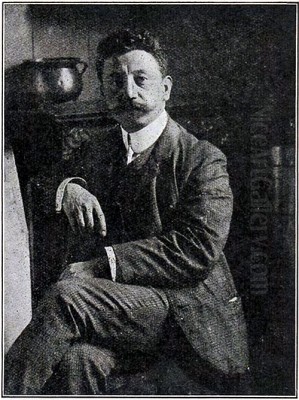
Lammert van der Tonge (1871-1937) was a Dutch painter whose life and work offer a window into the artistic currents of the Netherlands during a period of significant cultural and stylistic transition. While detailed biographical information about Van der Tonge remains somewhat elusive in mainstream art historical narratives, his participation in significant international exhibitions, such as the Panama-Pacific International Exposition of 1915, provides a crucial anchor for understanding his place within the Dutch art scene of his time. Born in Lisse, Netherlands, Van der Tonge navigated an era where the echoes of the Hague School’s atmospheric realism blended with the burgeoning vibrancy of Amsterdam Impressionism and the introspective currents of Symbolism.
The Dutch Artistic Landscape in Van der Tonge's Era
The late nineteenth and early twentieth centuries in the Netherlands were a period of rich artistic diversity. The Hague School, with luminaries like Jozef Israëls, Jacob Maris, Willem Maris, Anton Mauve, and Hendrik Willem Mesdag, had established a powerful tradition of landscape and genre painting characterized by its moody atmospheres and depiction of rural life and coastal scenes. Their influence was profound, shaping a national artistic identity centered on realistic portrayals of Dutch light and land.
As the century turned, Amsterdam emerged as a vibrant artistic hub, fostering a more urban and dynamic form of Impressionism. Artists like George Hendrik Breitner and Isaac Israëls captured the bustling energy of city life, its cafes, streets, and working people, with a bolder palette and more vigorous brushwork than their Hague School predecessors. Concurrently, Symbolism found expression in the works of artists such as Jan Toorop and Johan Thorn Prikker, who explored more spiritual, mythological, and psychological themes, often with innovative stylistic approaches. This complex milieu formed the backdrop against which Lammert van der Tonge developed his artistic practice.
The Panama-Pacific International Exposition of 1915: A Global Stage
The Panama-Pacific International Exposition (PPIE), held in San Francisco in 1915 to celebrate the completion of the Panama Canal, was a monumental event. It served as a global showcase for achievements in industry, science, and, significantly, the arts. Nations from around the world participated, constructing elaborate pavilions and sending their finest artistic creations to represent their cultural prowess. For artists, inclusion in such an exposition was a mark of recognition and an opportunity to present their work to an international audience.
The Netherlands was among the participating nations, and its art exhibition provided a snapshot of contemporary Dutch painting and sculpture. The selection typically aimed to balance established masters with promising contemporary talents, reflecting both tradition and innovation within the national school. It was in this prestigious context that Lammert van der Tonge's work was presented.
Lammert van der Tonge's "Riches" at the PPIE
Among the Dutch artworks exhibited at the PPIE was a piece by Lammert van der Tonge titled "Riches." While the specific visual details of this painting are not widely documented in readily accessible sources today, the title itself offers intriguing possibilities for interpretation within the context of Dutch genre painting. The theme of "riches" could have been explored in various ways: perhaps a depiction of a prosperous bourgeois interior, a common subject in Dutch art that allowed for the meticulous rendering of textures, fabrics, and objects of value. Such scenes often carried subtle moral or social commentaries.
Alternatively, "Riches" might have offered a more allegorical or symbolic interpretation, contrasting material wealth with spiritual or emotional richness, or perhaps even depicting the lives of those who possessed material comforts. Given the prevalence of genre scenes in Dutch art, it is likely that "Riches" fell within this tradition, focusing on aspects of daily life, character study, or interior settings. Van der Tonge's style, generally understood to be rooted in realism with impressionistic touches, would have lent itself well to capturing the nuances of such a subject. The inclusion of "Riches" at the PPIE suggests that it was considered a representative example of his talent and of contemporary Dutch art.
Fellow Dutch Exhibitors: A Tapestry of Styles
The Dutch section at the PPIE featured a diverse group of artists, painting a broader picture of the artistic concerns of the Netherlands at the time. Understanding Van der Tonge's context is enriched by looking at some of his contemporaries who also exhibited.
Willem Bastiaan Tholen (1860-1931) was a prominent figure whose work bridged the Hague School and later, more impressionistic tendencies. He was known for his tranquil landscapes, cityscapes, and particularly his depictions of Dutch waterways and boats. At the PPIE, Tholen exhibited works such as "Church Near Leiderdorp." His paintings are celebrated for their subtle color harmonies and serene compositions, capturing the unique atmosphere of the Dutch environment. Tholen's dedication to observing and rendering the specific qualities of light and water placed him firmly within a beloved Dutch tradition, even as his brushwork could be quite free.
Nicolaas van der Waay (1855-1936) was an artist closely associated with Amsterdam Impressionism. He was a professor at the Rijksakademie van beeldende kunsten in Amsterdam and was known for his portraits, genre scenes, and allegorical works. Van der Waay gained particular recognition for his sensitive portrayals of the young women of the Amsterdam Burgerweeshuis (City Orphanage). At the PPIE, he exhibited pieces like "Slum in the City of Hattem" and "A Dutch Orphan House." These titles suggest a focus on social realism and genre scenes, capturing aspects of everyday life, including its less glamorous sides, a characteristic of some Amsterdam Impressionists who, like Breitner, did not shy away from urban realities.
Johannes Vlaanderen (1868-1949), another Dutch artist present at the exposition, contributed a work titled "Autumn." While less universally known today than Tholen or Van der Waay, his participation indicates his standing at the time. A painting titled "Autumn" would likely have been a landscape, a favored subject in Dutch art, allowing for the exploration of seasonal color and light. It might have reflected the lingering influence of the Hague School's atmospheric concerns or perhaps a more personal, expressive interpretation of nature.
Cornelis Vreedenburgh (1880-1946), often listed as C. Vreden in some catalogues, was known for his impressionistic landscapes and cityscapes, particularly those featuring water. His work "Country Road in the County of Overysel," exhibited at the PPIE, points to his engagement with the Dutch landscape. Vreedenburgh's style was characterized by a fluid brushstroke and a keen eye for the effects of light, often depicting scenes of pastoral tranquility or the bustling life along canals and rivers. He was a younger contemporary who carried the impressionistic tradition forward.
M. Schotel, who exhibited "Unloading Peat on the Canal Edge," likely refers to a member of the Schotel family of painters, renowned for their marine art. If it was Petrus Johannes Schotel (1808-1865), it would have been a posthumous inclusion of an established master, or more likely a descendant carrying on the tradition. The subject itself – unloading peat – is a classic Dutch genre and labor scene, deeply rooted in the country's economic and cultural history, often depicted by artists from the 17th century onwards and revisited by 19th-century realists.
These artists, alongside Lammert van der Tonge, represented a spectrum of Dutch art. From the established, atmospheric landscapes of figures like Tholen to the urban and social observations of Van der Waay, and the continued tradition of genre and landscape by others, the Dutch contribution to the PPIE highlighted a national school that was both rooted in its rich heritage and responsive to contemporary artistic developments. Other notable Dutch artists active during Van der Tonge's lifetime, though not necessarily all exhibiting at this specific event, include figures like Floris Verster, known for his still lifes and sensitive use of color; Suze Robertson, a powerful female artist with an expressive style; Willem Witsen, with his melancholic cityscapes and etchings; and the internationally renowned Vincent van Gogh, whose most impactful period predated this but whose influence was beginning to permeate. Furthermore, younger artists like Piet Mondrian (in his earlier, pre-abstract phases) and Jan Sluyters were pushing Dutch art towards modernism.
Van der Tonge's Artistic Milieu and Potential Style
Given that Lammert van der Tonge's work "Riches" was exhibited alongside these contemporaries, it is reasonable to infer that his artistic approach likely aligned with the prevailing realist and impressionist tendencies in Dutch genre painting. His focus was often on interiors and scenes of everyday Dutch life, rendered with attention to detail and character. Such subjects were popular, appealing to a sense of national identity and the enduring charm of traditional Dutch culture.
The meticulous rendering of interiors, a hallmark of Dutch art since the Golden Age with masters like Johannes Vermeer and Pieter de Hooch, continued to be a significant genre. Van der Tonge's work would have likely participated in this tradition, capturing the play of light in domestic spaces, the textures of fabrics and furnishings, and the quiet activities of their inhabitants. This focus on intimate, everyday scenes provided a counterpoint to the grand historical or mythological subjects favored in other European academies, underscoring a particular Dutch sensibility.
His contemporaries, such as Bernardus Johannes Blommers or Albert Neuhuys, also specialized in similar themes, often depicting peasant interiors or fishing communities with a warmth and empathy that resonated with the public. While Van der Tonge's "Riches" might suggest a more affluent setting, the underlying principles of careful observation and sympathetic portrayal of human life would likely have been consistent.
Legacy and Concluding Thoughts
Lammert van der Tonge, while perhaps not achieving the widespread international fame of some of his Dutch contemporaries like Van Gogh or Mondrian (who would take radically different paths), was nonetheless a participant in the vibrant tapestry of Dutch art at the turn of the twentieth century. His work, as exemplified by "Riches" and his general focus on genre scenes and interiors, contributed to a tradition that celebrated the nuances of Dutch life and culture.
The scarcity of extensive monographic studies on Van der Tonge means that a full appreciation of his oeuvre and artistic development requires further research, likely involving delving into Dutch archival records, exhibition catalogues beyond the PPIE, and collections that may hold his works. However, his inclusion in the Panama-Pacific International Exposition of 1915 is a significant marker, placing him on an international stage and acknowledging his contribution to the Dutch school of painting during his lifetime.
Artists like Lammert van der Tonge are crucial for a comprehensive understanding of any art historical period. They represent the steady, skilled practitioners who sustain and evolve artistic traditions, forming the rich context against which more revolutionary figures emerge. His paintings offer a glimpse into the homes, lives, and values of the Netherlands during his era, rendered with a skill and sensitivity that merits appreciation. The study of such artists helps to illuminate the breadth and depth of a national artistic identity and its representation to the wider world.