Ludwig Müller-Cornelius (1864-1946) was a German artist who carved a niche for himself depicting the everyday life, landscapes, and market scenes of his native Bavaria. Active during a period of significant artistic transition in Europe, Müller-Cornelius largely remained committed to a realistic, observational style, capturing the charm and character of rural existence. While perhaps not a revolutionary figure in the grand narrative of art history, his work offers valuable insights into the popular tastes and artistic currents of late 19th and early 20th-century Germany, particularly within the influential Munich art scene.
Birth in an Artistic Hub: Munich
Born in Munich in 1864, Ludwig Müller-Cornelius entered a city that was a vibrant and crucial center for the arts in the German-speaking world. The Bavarian capital was home to the prestigious Royal Academy of Fine Arts (Königliche Akademie der Bildenden Künste), which had, throughout the 19th century, attracted students and artists from across Germany and Europe. By the time Müller-Cornelius was embarking on his artistic journey, Munich was a melting pot of established academic traditions and emerging modernist impulses.
The artistic environment was rich and varied. Figures like Franz von Lenbach, known for his powerful portraits of contemporary luminaries, and Friedrich August von Kaulbach, another celebrated portraitist and historical painter, represented the more established, academic side of Munich art. However, the city was also a place where new ideas were taking root, eventually leading to the formation of the Munich Secession in 1892, a movement that sought to break away from the perceived conservatism of the official Salon exhibitions.
Thematic Focus: Chronicler of the Countryside
Müller-Cornelius distinguished himself through his dedication to genre painting, focusing on scenes of rural life, bustling market days, and tranquil landscapes. This thematic choice placed him within a long and respected tradition in German art. His paintings often feature peasants at work or rest, villagers congregating in town squares, and the picturesque settings of the Bavarian countryside. Titles such as Resting on the Roadside before a Village and A Market Scene are indicative of his preferred subject matter.
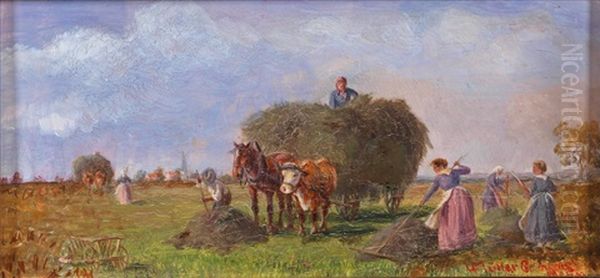
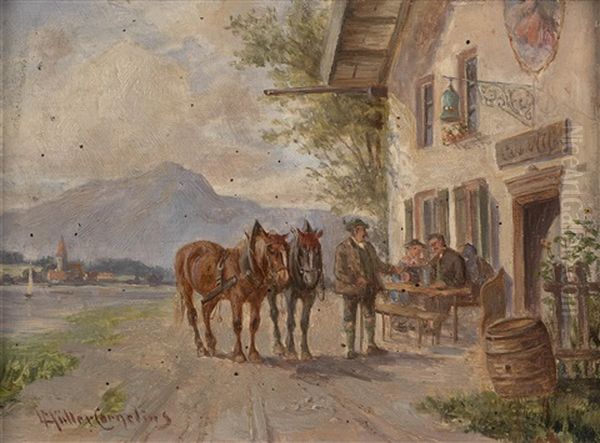
His work Heuernte (Hay Harvest) likely depicted the communal activity of haymaking, a common theme for artists wishing to portray rural labor and the connection between people and the land. Similarly, Rast vor dem Wirtshaus (Rest in Front of the Inn) would have captured a moment of social interaction and leisure, a typical scene in village life. These subjects resonated with a public that often romanticized rural simplicity in an era of increasing industrialization and urbanization.
Another mentioned work, Landsknechte zu Pferden in Winterlandschaft (Mercenary Knights on Horseback in a Winter Landscape), suggests an interest in historical genre scenes as well. This type of painting, often imbued with a sense of historical romanticism or adventure, was also popular during this period. It allowed artists to explore costume, narrative, and a more dramatic atmosphere than purely observational rural scenes.
Artistic Style and Influences
The available information suggests that Müller-Cornelius was, to some extent, a self-taught artist, though he was active in the circle of the "Diez school" in Munich. This refers to the influence of Wilhelm von Diez (1839-1907), a highly respected professor at the Munich Academy and a prominent painter of genre, animal, and historical scenes. Diez was known for his painterly technique, his use of color, and his ability to capture character and atmosphere. If Müller-Cornelius moved within this circle, he would have been exposed to these stylistic tendencies.
The Munich School, in general, was characterized by its strong emphasis on draftsmanship, a often somber or tonal palette (at least until the influence of French Impressionism became more widespread), and a narrative or anecdotal quality in its genre paintings. Artists like Franz von Defregger, famous for his scenes from Tyrolean peasant life and historical events, and Eduard von Grützner, known for his humorous depictions of monastic life, were leading exponents of Munich genre painting and would have been significant contemporaries.
Müller-Cornelius's style is described as having "exquisite details" and "realism." This points towards a meticulous approach to observation and rendering, aiming to create a believable and engaging depiction of his chosen subjects. His oil paintings, often on a modest scale, such as A Market Scene (19.5 x 10.5 cm or 10 x 20 cm, according to different sources), suggest an intimacy and a focus on capturing the essence of a scene rather than grand, monumental statements.
The Broader Artistic Context in Germany
To fully appreciate Müller-Cornelius's position, it's important to consider the wider German art landscape. The late 19th century saw the dominance of Realism, with artists like Adolph Menzel in Berlin setting a high standard for observational accuracy and the depiction of contemporary life and historical scenes. Wilhelm Leibl, who also worked in Bavaria, was a key figure in German Realism, known for his unvarnished portrayals of peasant life, influenced by Gustave Courbet.
As the century drew to a close, German Impressionism began to emerge, championed by artists such as Max Liebermann, Lovis Corinth, and Max Slevogt. These artists, often associated with the Secession movements in Munich and Berlin, embraced a lighter palette, looser brushwork, and a focus on capturing fleeting moments of light and atmosphere. While Müller-Cornelius's work seems to have remained more aligned with the established traditions of Munich genre painting, he would have been aware of these newer trends.
The turn of the century also saw the rise of Jugendstil (Art Nouveau) in Germany, with Munich being one of its key centers. Artists like Franz von Stuck, a co-founder of the Munich Secession, incorporated Symbolist and Jugendstil elements into their work, moving away from straightforward realism. This period was thus one of immense artistic diversity and debate, with traditional approaches coexisting and sometimes clashing with avant-garde movements.
Müller-Cornelius's Contemporaries and the Munich Scene
Beyond the towering figures of the Munich School and the Secession, there were many other artists contributing to the city's artistic fabric. For instance, Carl Spitzweg, though from an earlier generation (d. 1885), had left a lasting legacy with his charming and often humorous depictions of everyday life, which found continued appreciation. The tradition of landscape painting was also strong, with artists capturing the beauty of the Bavarian Alps and the surrounding countryside.
Painters like Otto Dill, known for his animal paintings and dynamic scenes, or Heinrich von Zügel, a prominent impressionistic animal painter and professor at the Munich Academy, represented different facets of the Munich art world. The city's numerous galleries, art societies, and the annual exhibitions at the Glaspalast (until it burned down in 1931) provided platforms for a wide range of artistic expressions.
Müller-Cornelius, by focusing on accessible and relatable themes like market scenes and rural idylls, catered to a segment of the art market that appreciated well-crafted, traditional paintings. His works, such as the small oil painting (11 x 15 cm) on wood mentioned as being handled by DAWO auction house, would have found homes in bourgeois collections.
Specific Works and Their Significance
Let's revisit some of the specific works attributed to Ludwig Müller-Cornelius:
Resting on the Roadside before a Village: This title evokes a tranquil scene, perhaps featuring travelers or local peasants taking a break. Such paintings often emphasized the harmony between humans and their environment, a common trope in 19th-century landscape and genre art. The dimensions (19 x 15 cm) suggest a cabinet-sized piece, intended for intimate viewing.
A Market Scene: Market scenes were a popular subgenre, offering artists the opportunity to depict a lively array of figures, goods, and social interactions. Müller-Cornelius produced several works with this theme, varying in size (e.g., 19.5 x 10.5 cm; another 10 x 20 cm). These paintings would have captured the vibrancy of local commerce and community life. The reported auction price of 700-900 Euros for one such piece indicates a continued, albeit modest, collector interest.
Landsknechte zu Pferden in Winterlandschaft: This title points to a more historical or romantic subject. Landsknechte were German mercenary soldiers from the late 15th to the early 17th centuries, known for their colorful attire. Depicting them in a winter landscape would have allowed for a dramatic and atmospheric composition. This work shows a broader thematic range than purely contemporary rural scenes.
Heuernte (Hay Harvest): A classic rural genre scene, the hay harvest symbolized summer, agricultural labor, and the bounty of the land. Artists like Jean-François Millet in France had famously depicted such themes, and similar subjects were popular across Europe.
Rast vor dem Wirtshaus (Rest in Front of the Inn): Inns and taverns were central social hubs in villages and towns. Scenes set in or around them provided opportunities to depict various characters, social dynamics, and moments of everyday life.
These works, taken together, paint a picture of an artist deeply engaged with the visual culture of his region, choosing subjects that were both picturesque and reflective of the local character. His commitment to detail and realism would have made these scenes relatable and appealing to his audience.
The Legacy of Ludwig Müller-Cornelius
Ludwig Müller-Cornelius operated within a well-established artistic tradition. He was not an avant-garde innovator who radically altered the course of art history, but rather a skilled practitioner who contributed to the rich tapestry of German genre painting. His works serve as valuable documents of rural and village life in Bavaria during a period of significant social and cultural change.
The fact that his paintings continue to appear at auctions, as noted with DAWO auction house and others, demonstrates that there is an ongoing appreciation for his art among collectors who value traditional German painting from this era. His name is associated with a particular type of intimate, carefully rendered genre scene that holds a specific appeal.
While the information provided in the initial query contained some potentially confusing elements, particularly regarding artistic style that might better describe a figure like Peter von Cornelius (1783-1867) – a leading Nazarene painter known for monumental frescoes and a profound influence on German art education with grand, idealistic, and nationalistic themes – the core attributes of Ludwig Müller-Cornelius point to a painter of more modest, though no less sincere, ambitions. His focus was on the observable world around him, rendered with skill and an eye for the characteristic details of Bavarian life.
Other notable German painters of the broader period whose work provides context for Müller-Cornelius include landscape artists like Hans Thoma, who combined realism with a more idyllic, almost fairy-tale quality, or the Worpswede school artists like Fritz Mackensen and Otto Modersohn, who focused on the stark landscapes and peasant life of northern Germany. In Munich itself, the Luitpold Group, formed after the Secession, also provided another avenue for artists.
In conclusion, Ludwig Müller-Cornelius was a German painter who dedicated his career to capturing the landscapes, market scenes, and rural life of his time. Working primarily in Munich, he contributed to the city's vibrant art scene through his realistic and detailed genre paintings. While he may not have achieved the fame of some of his more revolutionary contemporaries, his work remains a testament to the enduring appeal of traditional representational art and offers a charming window into a bygone era of German life. His paintings are part of a broader European tradition of genre art that sought to find beauty, character, and narrative in the everyday.