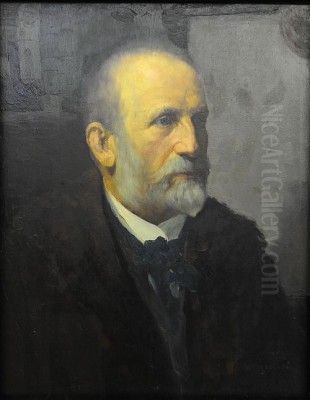
Ludwig Willroider stands as a significant figure in Austrian art history, primarily celebrated for his evocative landscape paintings and etchings. Born in Villach, Carinthia, in 1845, and passing away in 1910, his life spanned a period of rich artistic development in Europe. His work, deeply rooted in the observation of nature, captures the beauty and atmosphere of the Austrian and Bavarian Alps, leaving behind a legacy of luminous and detailed depictions of the natural world.
Early Life and Artistic Formation
Born into the family of a master carpenter in the picturesque town of Villach, Ludwig Willroider's initial training was not in the fine arts but in the practical craft of woodworking, following his father's trade. However, the artistic inclination was strong within the family. His elder brother, Josef Willroider, who would also become a respected landscape painter, provided Ludwig with his first formal instruction in drawing and painting. This early exposure laid the groundwork for his future career.
Seeking broader horizons and more advanced training, Willroider made a pivotal move in 1866. He relocated to Munich, then a major European art center bustling with creative energy and home to the prestigious Royal Academy of Fine Arts. This move marked the beginning of his dedicated pursuit of painting as a profession, immersing him in an environment that would profoundly shape his artistic vision.
Munich Influences and Mentorship
While in Munich, Willroider sought guidance from established artists. Although sources suggest his connection with the Academy might have been more through informal mentorship than formal enrollment, the influence of key figures was undeniable. He studied under the guidance of Eduard Schleich the Elder, a prominent landscape painter associated with the Munich School, known for his atmospheric depictions often inspired by 17th-century Dutch masters and the Barbizon School's emphasis on open-air painting. Schleich's approach likely encouraged Willroider's own focus on mood and light.
Another significant influence was Adolf Lier, also a professor at the Academy and a landscape painter deeply influenced by the French Barbizon School, particularly artists like Jules Dupré. Lier was known for emphasizing Stimmung, or mood, in landscape painting, often achieved through subtle tonal harmonies and a focus on the atmospheric effects of light. Willroider received crucial artistic advice from Lier, further refining his sensitivity to the nuances of the natural world.
Artistic Circle and Collaborations
Willroider did not develop his art in isolation. He cultivated important relationships within the Munich art scene. A close artistic friendship developed with Carl Ebert, another landscape painter active in Munich. Ebert himself was connected to notable figures like Christian Friedrich Mali and Anton Braith, painters known for their realistic depictions of animals and rural life, often associated with the later phase of the Munich School's realism. These connections placed Willroider within a network of artists dedicated to capturing the essence of the Bavarian landscape and its inhabitants.
His circle extended beyond Munich. Evidence suggests collaborative artistic activities in the Vikting area, where Willroider worked alongside fellow artist Anton Gregoritsch and the talented Moro sisters, Johanna Moro and Sophie Moro. These interactions highlight a communal aspect of art creation during the period and demonstrate Willroider's engagement with regional artistic communities. He also maintained contact with the painter Matthias Anton Braint, further embedding him within the contemporary artistic discourse.
Style Evolution: From Naturalism to Impressionistic Light
Willroider's artistic style evolved throughout his career, though it remained consistently focused on landscape. His early training and the influence of the Munich School grounded him in Naturalism – a commitment to depicting the world accurately based on direct observation. His works are characterized by careful attention to detail, capturing the specific textures of rock, foliage, and water.
However, his style was not merely photographic. Influenced perhaps by Schleich, Lier, and the broader European interest in light and atmosphere, particularly stemming from the French Barbizon and Impressionist movements, Willroider developed a keen sensitivity to the effects of light and weather. While not strictly an Impressionist in the French sense (focused on capturing fleeting moments with broken color), his work increasingly incorporated impressionistic qualities: a brighter palette, a focus on the interplay of light and shadow, and an ability to convey the distinct mood (Stimmung) of a scene at a particular time of day.
He achieved this through meticulous observation during his frequent sketching trips, combined with studio work where he refined his compositions. His brushwork, while often detailed, could also be fluid and suggestive, particularly in rendering skies and water, contributing to the overall atmospheric effect. He became a master at capturing the clear light of the Alps and the tranquil beauty of Bavarian lakes.
Favored Subjects and Locations
Willroider's heart remained deeply connected to the landscapes of his youth and his adopted home. He frequently returned to his native Carinthia, particularly the area around Villach, for sketching expeditions. The dramatic scenery of South Tyrol and Northern Italy also became recurring subjects in his later work, offering new motifs and light conditions to explore.
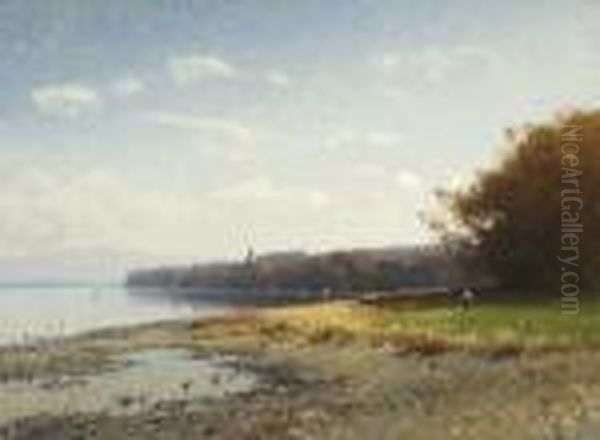
However, he is perhaps most strongly associated with the landscapes of Upper Bavaria. The region around Munich, especially the picturesque Lake Starnberg (Starnberger See) and the Isar River Valley (Isartal), provided him with endless inspiration. He spent considerable time living and working near Lake Starnberg, capturing its shores, waters, and surrounding countryside in numerous paintings. These works often depict tranquil scenes, emphasizing the harmony between nature and, occasionally, subtle human presence.
Representative Works and Etchings
While many of Willroider's works reside in private collections, several notable examples highlight his artistic achievements. "Am Starnberger See" (On Lake Starnberg) is a title representative of his many depictions of this beloved location, showcasing his ability to render water, light, and the distant Alpine foothills.
An earlier significant work, "Viehweide bei Morgenstimmung" (Pasture in Morning Mood), dating from 1872, exemplifies his skill in capturing specific atmospheric conditions and the tranquil beauty of a rural scene at dawn. Other works, such as "Bachlandschaft" (Stream Landscape) and "Landschaft mit Ochsen" (Landscape with Oxen), further demonstrate his commitment to detailed yet atmospheric landscape painting. Beyond oil painting, Willroider was also a proficient etcher, translating his landscape visions into the linear medium of printmaking.
Career Recognition and Professional Success
Willroider's dedication and talent did not go unnoticed. He achieved significant recognition during his lifetime. His paintings were regularly exhibited at the prestigious annual exhibitions held in the Munich Glaspalast, where they received critical acclaim and several awards. His reputation extended internationally, with participation in major events like the Paris World Exposition.
This success was formalized through academic honors. In 1883, he was appointed an honorary member of the Royal Academy of Fine Arts in Munich, a significant acknowledgment of his standing in the artistic community. This was followed in 1886 by the conferral of the title of Professor, further cementing his status. His achievements were noted by contemporary critics, such as Friedrich Pecht, who documented his rise within the Munich art world.
Architectural Interests
Interestingly, Willroider's connection to his father's profession as a builder or carpenter seems to have resurfaced later in life. He is credited with designing and building a residence known as the "Villa del Fabbro." This structure, reportedly influenced by Italian architectural styles, became a local landmark, suggesting a multifaceted creative talent extending beyond the canvas.
Later Life and Enduring Legacy
Ludwig Willroider spent much of his later life dividing his time between his Munich base and his residence near Lake Starnberg, continuing to paint the landscapes he loved. He passed away in 1910, leaving behind a substantial body of work.
His legacy lies in his contribution to late 19th and early 20th-century landscape painting within the German-speaking world. As a prominent member of the Munich School's later generation, he successfully blended detailed naturalistic observation with a profound sensitivity to light and atmosphere, bordering on Impressionism. He captured the specific character of the Alpine and Bavarian landscapes with both accuracy and poetic feeling.
Today, his works are held in various public collections, including the Georg Schäfer Museum in Schweinfurt, the Städtisches Museum in Weißenhorn, and the Frye Art Museum in Seattle, ensuring that his vision of nature continues to be appreciated. Ludwig Willroider remains an important figure for understanding the transition in landscape painting towards more modern sensibilities, admired for his technical skill and his ability to convey the enduring beauty and mood of the natural world. His brother, Josef Willroider, also contributed significantly to landscape painting, making the Willroider name synonymous with Austrian landscape art of the period.