Manuel Salces y Gutierrez: A Cantabrian Realist in a Shifting Artistic Landscape
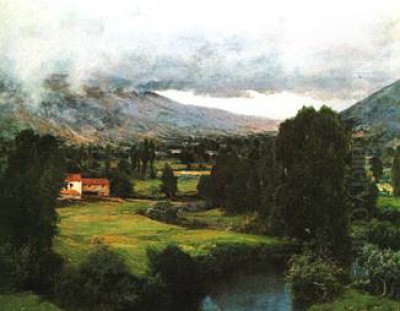
Manuel Salces y Gutierrez stands as a notable figure in the regional art history of Cantabria, Spain. Active during the late nineteenth and early twentieth centuries, he dedicated his artistic endeavors primarily to landscape painting, capturing the essence of his native region with a style rooted in Realism. Born in 1861, Salces y Gutierrez navigated an era of profound artistic transformation in Europe, yet he largely remained committed to a descriptive and faithful representation of the world around him. His work, while perhaps not achieving the widespread fame of some of his more avant-garde contemporaries, offers a valuable window into the artistic currents of provincial Spain and the enduring appeal of realist landscape traditions.
Early Life and Artistic Formation
Details regarding Manuel Salces y Gutierrez's specific artistic training and early influences remain somewhat scarce in widely accessible records. However, it is known he was born in 1861, a period when artistic education in Spain was still heavily influenced by academic traditions. Aspiring artists often sought training at local art schools or, if resources permitted, at the prestigious Real Academia de Bellas Artes de San Fernando in Madrid. This institution was a cornerstone of Spanish art education, emphasizing drawing, classical principles, and the study of Old Masters.
Whether Salces y Gutierrez formally attended the Madrid Academia or received his primary instruction within Cantabria, his artistic output clearly demonstrates a solid grounding in representational techniques. His development as an artist coincided with the flourishing of Realism across Europe, a movement that had taken firm root in Spain. This artistic philosophy, which prioritized the depiction of ordinary subjects and everyday life without idealization, would become a defining characteristic of his work. His deep connection to Cantabria suggests that the region itself, with its diverse scenery, served as a primary teacher and an inexhaustible source of inspiration.
The Cantabrian Artistic Milieu
Cantabria, a region in northern Spain known for its dramatic coastline, verdant mountains like the Picos de Europa, and picturesque rural villages, provided a rich tapestry of subjects for artists. During the late 19th and early 20th centuries, a distinct regional school of painting began to emerge, with artists focusing on capturing the unique character and atmosphere of their homeland. Salces y Gutierrez was an integral part of this Cantabrian artistic milieu.
He was a contemporary of other significant Cantabrian painters, most notably Agustín Riancho (1841-1929) and Casimiro Sainz (1853-1898). Riancho, often considered one of the preeminent Cantabrian landscape painters of his generation, was known for his poetic and often melancholic depictions of the region's forests and mountains. Sainz, whose career was tragically short, also focused on Cantabrian landscapes, often imbued with a romantic sensibility. The presence of such dedicated landscape artists undoubtedly fostered a supportive and stimulating environment for painters like Salces y Gutierrez, encouraging a shared focus on the local scenery. This regional concentration allowed for a deep exploration of place, contributing to a distinct Cantabrian identity within the broader Spanish art scene.
Salces y Gutierrez's Artistic Style and Themes
Manuel Salces y Gutierrez's artistic style is best characterized as a form of descriptive Realism. His paintings are noted for their straightforwardness and fidelity to the visual facts of the landscapes he depicted. He eschewed overt romanticism or dramatic embellishment, preferring a more objective and meticulous approach. His brushwork, while competent, was generally not a feature that drew attention to itself; rather, it served the primary purpose of accurately rendering form, light, and texture.
The primary theme throughout his oeuvre was the Cantabrian landscape. He painted coastal scenes, capturing the interplay of sea, sky, and rugged cliffs. Mountain vistas, rural pathways, and quiet village scenes also featured prominently in his work. His paintings often convey a sense of tranquility and an appreciation for the unspoiled beauty of nature. While the provided information suggests some "modernist attempts" in his work, these appear to have been tentative explorations rather than a fundamental shift in his artistic vision. His core commitment remained to the realist tradition, focusing on a clear and intelligible representation of his surroundings. This adherence to a more traditional style, while ensuring a certain clarity, also positioned him as somewhat conservative in an era marked by rapid artistic innovation.
Representative Works
While specific titles of Manuel Salces y Gutierrez's most famous works are not always prominently featured in international art historical surveys, his body of work is characterized by consistent themes and a recognizable style. His representative pieces would undoubtedly include numerous depictions of the Cantabrian countryside. One can imagine canvases titled, for instance, "Coastal View near Santander," "A Path in the Cantabrian Hills," or "Winter Landscape in the Picos."
These works would typically showcase his skill in rendering the specific atmospheric conditions of northern Spain – the soft, diffused light, the rich greens of the vegetation, and the often-moody skies. His paintings served as visual documents of the region, capturing its unique topography and the quiet dignity of its rural life. The "simple, descriptive" quality noted by critics points to an art that valued honesty and directness over subjective interpretation or stylistic flourish. His contribution lies in this faithful chronicling of his native land, providing a visual legacy of Cantabria as it existed during his lifetime.
Exhibitions and Recognition
Manuel Salces y Gutierrez actively participated in the artistic life of his time, exhibiting his works in various venues. He is known to have shown his paintings at exhibitions organized by the Santander Bank, a significant local institution that likely played a role in supporting regional artists. Furthermore, his work was presented at the Ateneo de Santander, a cultural society that would have been a central hub for intellectual and artistic exchange in the city.
His participation extended beyond Cantabria, as evidenced by exhibitions at what was likely the Real Academia de Bellas Artes de San Fernando in Madrid, or related Salons in the capital. Exhibiting in Madrid was crucial for any Spanish artist seeking broader recognition, as it provided a platform to reach a national audience and engage with the country's leading critics and artists. While the provided information does not detail the critical reception of his work at these exhibitions, his consistent presence suggests a degree of acceptance and respect within the Spanish art establishment of his day. He was recognized as a competent and dedicated painter of his region.
Contemporaries and the Broader Spanish Art Scene
To fully appreciate Manuel Salces y Gutierrez's position, it is essential to consider him within the context of the broader Spanish art scene of the late 19th and early 20th centuries. This was a period of immense talent and stylistic diversity. The foundational figure for much of Spanish landscape Realism was Carlos de Haes (1826-1898), a Belgian-born painter who became a highly influential professor at the Real Academia de Bellas Artes de San Fernando. De Haes advocated for direct observation of nature and plein air painting, influencing a generation of artists.
Among Salces y Gutierrez's direct contemporaries in landscape painting was Aureliano de Beruete (1845-1912), a prominent intellectual and artist who, while rooted in Realism, gradually incorporated Impressionist techniques into his depictions of the Castilian landscape. In contrast to Salces' more regional focus, Beruete gained national acclaim.
The era also saw the rise of artists who embraced more progressive styles. Joaquín Sorolla (1863-1923), a Valencian painter, became internationally famous for his vibrant, sun-drenched beach scenes, masterfully capturing light in a style often termed "Luminism." Darío de Regoyos (1857-1913), one of the few Spanish artists to fully embrace Impressionism and Pointillism, offered a distinctly modern vision of the Spanish landscape, often focusing on the "España Negra" (Black Spain) theme.
In Catalonia, the Modernisme movement flourished, with artists like Santiago Rusiñol (1861-1931) and Ramón Casas (1866-1932). Rusiñol was known for his Symbolist-influenced landscapes, particularly his depictions of gardens, while Casas excelled in portraiture and genre scenes that captured the sophisticated urban life of Barcelona.
Other major figures included Ignacio Zuloaga (1870-1945), a Basque painter whose powerful, often somber, depictions of traditional Spanish life and characters gained international renown, and José Gutiérrez Solana (1886-1945), whose expressive and sometimes grotesque portrayals of Spanish customs and undercurrents offered a darker, more critical vision. Solana, also active in Cantabria at times, shared a realist grounding with Salces but pushed it towards a more personal and intense expressionism.
Painters like Francisco Pradilla Ortiz (1848-1921) excelled in historical scenes, while Enrique Simonet (1866-1927) was known for his large-scale academic works, including historical and social realist subjects. The legacy of earlier masters like Mariano Fortuny (1838-1874), with his brilliant technique and Orientalist themes, also cast a long shadow. This rich and varied artistic environment highlights the diverse paths available to Spanish artists. Salces y Gutierrez chose a path of dedicated regional Realism.
The Transition to Modernism and Salces' Position
The late 19th and early 20th centuries were a crucible for artistic change. Impressionism had already revolutionized French painting and its influence, though sometimes delayed or modified, was felt across Europe. Post-Impressionism, Symbolism, Fauvism, and Cubism followed, each challenging established artistic conventions. In Spain, while Madrid remained a bastion of academicism for a considerable time, cities like Barcelona became more receptive to modern currents.
Manuel Salces y Gutierrez, active through these transformative decades, appears to have remained largely anchored to the realist principles he had mastered. The mention of his "modernist attempts" being "not always successful" or representing "small adjustments" suggests a cautious engagement, if any, with the more radical innovations of his time. This is not uncommon for artists trained in a strong academic or realist tradition who find it difficult or undesirable to fully embrace rapidly changing artistic paradigms.
His position can be seen as that of a dedicated craftsman committed to a particular way of seeing and representing the world. While artists like Picasso (born 1881, a generation younger but overlapping in active years) were deconstructing form, Salces y Gutierrez continued to find value in the faithful depiction of Cantabrian nature. This does not diminish his work but rather situates it within a specific artistic current that, while perhaps less revolutionary, maintained its appeal and relevance, particularly at a regional level. He represented a continuity of tradition in a world increasingly defined by rupture and innovation.
Legacy and Critical Reception
The legacy of Manuel Salces y Gutierrez is primarily enshrined within the art history of Cantabria. He is remembered as a diligent and skilled painter who devoted his career to capturing the landscapes of his native region. His works serve as valuable historical and artistic documents, offering insights into the Cantabrian environment and the realist landscape tradition in Spain at the turn of the century.
Critically, his work is often characterized by its "simple, descriptive" nature. This can be interpreted both positively, highlighting its honesty and clarity, and negatively, suggesting a lack of imaginative depth or stylistic innovation when compared to more dynamic contemporaries. His adherence to a more traditional, "conservative" style likely limited his impact on the broader national and international art scenes, which were increasingly captivated by the avant-garde.
However, within his regional context, Salces y Gutierrez played a role in establishing and continuing a tradition of Cantabrian landscape painting. Alongside figures like Riancho and Sainz, he helped to define a regional artistic identity. His paintings would have been appreciated by local audiences for their familiar subjects and their skillful, if unassuming, execution. He contributed to a visual understanding and appreciation of Cantabria's natural beauty.
Conclusion
Manuel Salces y Gutierrez (1861 – c. 1932, though his exact death year can vary in sources) was a Spanish painter from Cantabria who carved out a niche as a dedicated landscape artist. Working within a realist framework, he meticulously documented the coastlines, mountains, and rural scenes of his beloved region. While his style remained largely traditional, avoiding the major modernist upheavals of his era, his work possesses a quiet integrity and offers a sincere vision of northern Spain.
He was a contemporary of a vibrant generation of Spanish artists, including regional peers like Agustín Riancho and Casimiro Sainz, national figures in landscape like Carlos de Haes and Aureliano de Beruete, and innovators such as Joaquín Sorolla, Darío de Regoyos, Santiago Rusiñol, and Ignacio Zuloaga. While perhaps not achieving their level of fame or influence, Salces y Gutierrez made a consistent and valuable contribution to the artistic heritage of Cantabria. His paintings remain a testament to the enduring appeal of realist landscape art and the deep connection an artist can forge with their native land. His work invites us to appreciate the subtle beauty of a specific place, rendered with honesty and skill.