Mason Chamberlin the Elder (1727-1787) stands as a significant, if sometimes overlooked, figure in the burgeoning landscape of 18th-century British art. A dedicated portraitist, he was not only a skilled practitioner of his craft but also a foundational member of the Royal Academy of Arts, an institution that would come to define British artistic identity for generations. His career, spanning several decades of dynamic change in British society and art, offers a window into the tastes, aspirations, and intellectual currents of his time. While perhaps not possessing the dazzling flamboyance of some of his contemporaries, Chamberlin's work is characterized by a sober honesty, a meticulous attention to detail, and a consistent ability to capture the character of his sitters.
Early Life and Artistic Apprenticeship
Born in London in 1727, Mason Chamberlin's early life saw him initially engaged in commerce, working in a counting house at a London Exchange. This background in the world of trade and finance was not uncommon for artists of the period, many of whom came from artisanal or middle-class backgrounds. However, the call of art proved stronger. Chamberlin transitioned to the study of painting, a decision that would place him under the tutelage of Francis Hayman (c. 1708–1776).
Hayman was a pivotal figure in mid-18th-century British art. Known for his robust Rococo style, historical paintings, and, importantly, his "conversation pieces" – informal group portraits that depicted families or friends in relaxed, everyday settings. Hayman's studio was a veritable training ground for a generation of artists, and his influence on Chamberlin would have been considerable. It was likely here that Chamberlin honed his foundational skills in drawing, composition, and the handling of oil paint, absorbing Hayman's narrative tendencies and his ability to render figures with a degree of naturalism, albeit often infused with a Rococo lightness. This period of study was crucial in developing the mature portraiture skills for which Chamberlin would become known.
Rise to Prominence and the Society of Arts
By the early 1760s, Chamberlin was establishing himself as a capable painter. A notable early recognition came in 1764 when he was awarded the second premium, a significant prize of fifty guineas, by the Society for the Encouragement of Arts, Manufactures and Commerce (now the Royal Society of Arts). This award was for an historical painting, a genre then considered the highest form of art. The specific subject of this prize-winning history painting is not always clearly recorded, but the accolade itself indicates his ambition and competence beyond mere face-painting.
Despite this success in historical painting, Chamberlin's primary focus and the bulk of his professional output would be in portraiture. This was a pragmatic choice as much as an artistic one. The demand for portraits in 18th-century Britain was immense, fueled by a growing affluent middle class eager to emulate the aristocracy in commissioning likenesses of themselves and their families. London, as the burgeoning capital of an expanding empire, was the epicenter of this demand. Chamberlin, with his solid technique and ability to produce dignified and recognizable likenesses, was well-positioned to cater to this market.
A Founding Member of the Royal Academy
The year 1768 marked a watershed moment in British art history: the foundation of the Royal Academy of Arts in London, with Sir Joshua Reynolds (1723–1792) as its first President. Mason Chamberlin was among the thirty-four or so initial founding members, a testament to his established reputation and the esteem in which he was held by his peers. Other founding members included luminaries such as Thomas Gainsborough (1727–1788), Benjamin West (1738–1820), Angelica Kauffman (1741–1807), Francesco Bartolozzi (1727–1815), Paul Sandby (1731–1809), and his former master, Francis Hayman.
Membership in the Royal Academy provided artists with prestige, exhibition opportunities, and a framework for artistic education. Chamberlin became a regular exhibitor at the Academy's annual exhibitions, contributing around fifty portraits between 1769 and his death in 1786. These exhibitions were major social and cultural events, drawing large crowds and generating considerable press coverage and critical discussion. For an artist like Chamberlin, they were vital for maintaining visibility and securing commissions. His consistent participation underscores his commitment to the institution and his active role within the London art world.
Artistic Style: Realism and Refinement
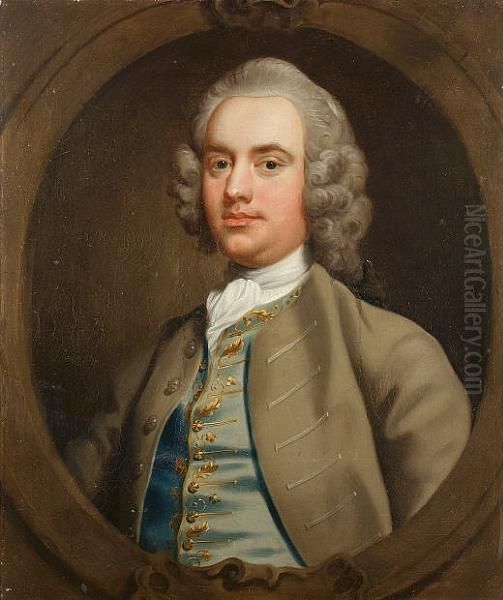
Mason Chamberlin's artistic style evolved from the Rococo influences of his training under Hayman towards a more sober and direct form of realism. While his early works might show a lighter touch and a greater concern for decorative effect, his mature portraits are characterized by their solid construction, careful delineation of features, and meticulous rendering of costume and accessories. He was less inclined towards the "Grand Manner" popularized by Reynolds, which often involved ennobling sitters through classical allusions and dramatic poses, nor did he possess the feathery, almost ethereal brushwork of Gainsborough.
Instead, Chamberlin's strength lay in his straightforwardness and his ability to convey a sense of the sitter's personality without excessive flattery or idealization. His portraits are often described as "honest" or "sincere." He paid close attention to the textures of fabrics – the sheen of silk, the richness of velvet, the crispness of lace – details that would have appealed to his often mercantile or professional clientele, who valued such markers of status and prosperity. The faces in his portraits are typically well-modelled, with a clear understanding of anatomy and a subtle use of light and shadow to convey form. While perhaps not as psychologically penetrating as some of his contemporaries, his likenesses were considered strong and true.
Notable Sitters and Representative Works
Chamberlin's clientele included members of the burgeoning middle class, professionals, and figures from the world of science and letters. One of his most enduringly famous works is his portrait of Benjamin Franklin (1762). This iconic image, painted while Franklin was in London as an agent for the Pennsylvania Assembly, depicts the statesman and inventor in a thoughtful pose, seated at a desk with books and papers, a lightning rod visible outside the window – a clear allusion to his scientific experiments. The portrait was commissioned by Colonel Philip Ludwell III of Virginia and was later engraved by Edward Fisher in 1763, which greatly increased its dissemination and fame. Several versions and copies exist, with one prominent version housed in the Philadelphia Museum of Art. This portrait is celebrated for its directness and its insightful capture of Franklin's intellectual gravitas.
Another significant work is his portrait of Dr. William Hunter (1721–1783), the eminent Scottish anatomist and physician. Hunter was also a founding member of the Royal Academy and its first Professor of Anatomy. Chamberlin's portrait of Hunter, now in the collection of the Royal Academy of Arts, London, shows him lecturing, possibly pointing to an anatomical illustration. It’s a dignified portrayal that reflects Hunter's professional standing and intellectual pursuits.
Other representative works include:
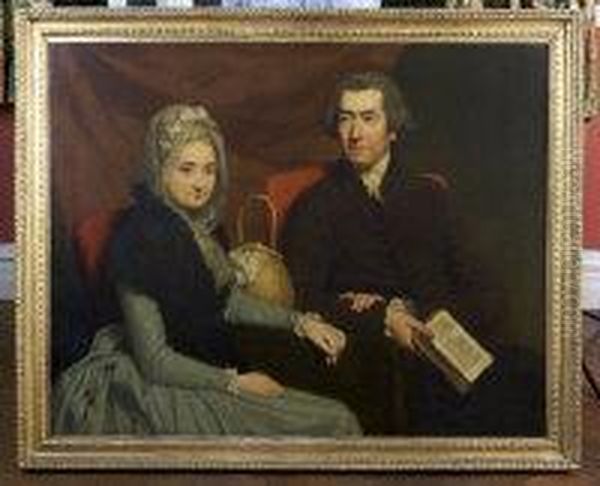
A Lady and Gentleman (1761, Yale Center for British Art, New Haven): This double portrait, likely a marriage portrait, showcases Chamberlin's skill in composing group figures and his attention to contemporary fashion and domestic setting. It reflects the influence of the conversation piece tradition.
A Naval Officer and his Son (National Maritime Museum, Greenwich): This work demonstrates his ability to capture familial relationships and the attributes of a specific profession, in this case, the Royal Navy, which was central to Britain's growing global power.
Many of his exhibited works at the Royal Academy were simply titled Portrait of a Gentleman or Portrait of a Lady, often exhibited anonymously or with generic titles, a common practice at the time unless the sitter was a public figure. This anonymity sometimes makes tracing specific sitters challenging for art historians today.
His sitters were often drawn from the commercial and professional classes of London, individuals who were shaping the economic and intellectual life of the city. This contrasts with artists like Reynolds or Gainsborough, who also painted royalty and high aristocracy more frequently.
The 18th-Century British Art Scene: Context and Contemporaries
Chamberlin worked during a transformative period for British art. The early 18th century had been dominated by foreign-born artists like Sir Godfrey Kneller (1646–1723) and, to a lesser extent, Sir Peter Lely (1618–1680) in the preceding century. However, by the mid-1700s, a distinctly British school of painting was emerging. William Hogarth (1697–1764) was a towering figure in this development, championing native talent and creating uniquely British forms of art like his "modern moral subjects."
Portraiture was the dominant genre, and the competition was fierce. Besides the giants Reynolds and Gainsborough, Chamberlin's contemporaries included:
Allan Ramsay (1713–1784): A Scottish painter known for his elegant and sensitive portraits, particularly of women. He was a principal rival to Reynolds.
George Romney (1734–1802): Immensely popular in his day, Romney's style was more fluid and classical than Chamberlin's, and he was particularly famed for his portraits of Emma Hamilton.
Joseph Wright of Derby (1734–1797): Known for his dramatic use of chiaroscuro and his depictions of scientific experiments and industrial scenes, though he also painted fine portraits.
Johann Zoffany (1733–1810): A German-born painter who excelled in theatrical conversation pieces and portraits of the Royal Family.
Nathaniel Dance-Holland (1735–1811): Another founding RA member, known for his history paintings and portraits, including a famous one of Captain James Cook.
Tilly Kettle (c. 1735–1786): One of the first prominent British painters to work in India.
John Singleton Copley (1738–1815): An American artist who settled in London in 1774, bringing a sharp, linear realism to British portraiture and history painting.
In this crowded and talented field, Chamberlin carved out a niche for himself through his reliable craftsmanship and his connections within institutions like the Royal Academy. His relationship with his former master, Francis Hayman, would have remained significant, as Hayman was also an influential figure in the London art world, serving as Librarian of the Royal Academy.
Minor "Controversies" and Points of Clarification
Like many artists of earlier centuries, some details of Chamberlin's life are subject to minor ambiguities.
Birth Year Confusion: There has occasionally been confusion regarding his birth year, with some older sources citing 1722. However, 1727 is now the generally accepted date for Mason Chamberlin the Elder, the portraitist. This confusion may have arisen in part due to his son, Mason Chamberlin the Younger (active c. 1786–1826), who was a landscape painter. It's crucial to distinguish between the father, the RA founder and portraitist, and the son.
Anonymous Works: As mentioned, many of Chamberlin's works exhibited at the Royal Academy were listed anonymously or with generic titles like "Portrait of a Lady." While this was common practice, it sometimes makes the specific identification of sitters and the full extent of his oeuvre more challenging for modern scholars. This was not a "controversy" in the modern sense but a reflection of exhibition practices of the time, perhaps also indicating a desire by some sitters for privacy or a focus on the artistic merit rather than the sitter's fame.
It is important to note that some information circulating online sometimes mistakenly attributes views on cultural theory, indigenous studies, or scientific debates (such as the age of the Earth) to the 18th-century painter Mason Chamberlin. These views belong to a different, modern academic, likely Professor J. Edward Chamberlin. The 18th-century artist Mason Chamberlin was focused on his career as a portrait painter within the artistic and social context of his time.
Later Career, Death, and Legacy
Mason Chamberlin continued to paint and exhibit regularly until shortly before his death. He passed away in London on January 26, 1787, at his home in Stuart Street, Spitalfields, and was buried in the church of St Mary Abbots, Kensington. His son, Mason Chamberlin the Younger, followed him into the arts as a landscape painter, exhibiting at the Royal Academy from 1786.
Chamberlin's legacy is that of a competent, respected, and diligent portrait painter who played a significant role in the institutionalization of British art through his founding membership of the Royal Academy. While he may not have achieved the posthumous superstar status of Reynolds or Gainsborough, his contributions were vital. His portraits provide valuable records of the faces and fashions of his era, particularly of the professional and mercantile classes that were increasingly shaping British society. His work reflects the prevailing tastes for verisimilitude and dignified representation.
His paintings are held in various public collections, including the Royal Academy of Arts in London, the Yale Center for British Art in New Haven, Connecticut, the National Maritime Museum in Greenwich, and the Philadelphia Museum of Art. His works also appear on the art market, though less frequently than those of his more famous contemporaries. For instance, a version of his Benjamin Franklin portrait reportedly fetched around £30,000 at auction, indicating a solid market appreciation for his key works. An unspecified work from RA 1768 was noted at a Christie's auction in London in 1964, though the price is not readily available.
Conclusion: A Solid Contributor to the British School
Mason Chamberlin the Elder was a quintessential artist of his time: a skilled craftsman who adapted to the demands of the market, a respected professional who contributed to the establishment of Britain's foremost artistic institution, and a painter whose works offer a sober and insightful glimpse into 18th-century British life. His portraits, characterized by their honesty and meticulous detail, particularly his depiction of Benjamin Franklin, secure his place in the annals of British art history. He stands as a testament to the depth and breadth of talent that constituted the burgeoning British school of painting, a solid pillar supporting the more celebrated names of his generation. His career underscores the importance of portraiture in 18th-century society and the vital role of the Royal Academy in shaping the course of British art.