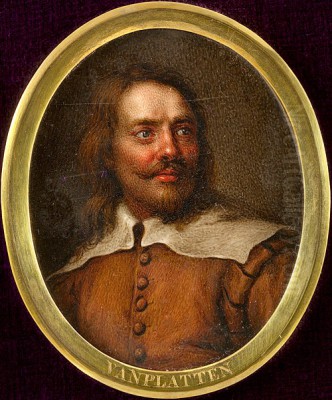
Matthieu Van Plattenberg, a notable figure in the rich tapestry of 17th-century European art, carved a distinct niche for himself as a painter of dramatic seascapes and turbulent marine narratives. Born in the bustling artistic hub of Antwerp, his career would see him traverse Europe, absorbing influences and leaving his mark in Italy and France, where he eventually settled and became known as Matthieu de Plattemontagne or simply Monsù Montagna to his Italian admirers. His oeuvre, characterized by its dynamic compositions and evocative portrayal of nature's power, offers a compelling window into the maritime consciousness of the Baroque era.
Early Life and Artistic Genesis in Antwerp
Born in Antwerp around 1606 (though some sources suggest 1607 or 1608), Matthieu Van Plattenberg emerged during a period when the city, despite political and economic shifts, still resonated with artistic vibrancy. Antwerp was a crucible of talent, home to masters like Peter Paul Rubens and Anthony van Dyck, and it fostered a strong tradition in various genres, including landscape and marine painting. It was in this environment that Van Plattenberg received his foundational artistic training.
A pivotal figure in his early development was Andries van Eertvelt (1590–1652), a prominent Antwerp marine painter. Van Eertvelt was one of the earliest Flemish specialists in seascapes, known for his depictions of naval battles, storms, and ships in various conditions. Under his tutelage, Van Plattenberg would have learned the rudiments of composing marine scenes, capturing the movement of water, the intricacies of ship rigging, and the dramatic play of light and shadow on the waves. Van Eertvelt's own style, often characterized by somewhat agitated waters and a narrative focus, likely provided a strong starting point for Plattenberg's later explorations of tempestuous seas. The master-pupil relationship was common, and van Eertvelt's studio would have been a place of learning not just technique but also the business of art.
The artistic scene in Antwerp was competitive but also collaborative. Young artists often learned by copying established masters or by working on specific elements within larger studio productions. While details of Plattenberg's earliest independent works are scarce, his grounding in the Antwerp school, with its emphasis on robust forms and dynamic energy, would remain a consistent thread throughout his career, even as he encountered and assimilated other European artistic currents.
The Italian Sojourn: Florence and Beyond
Around 1627, or shortly thereafter, Van Plattenberg, like many Northern European artists of his generation, embarked on a journey to Italy. This pilgrimage was considered almost essential for ambitious artists seeking to study classical antiquity and the masterpieces of the Italian Renaissance and contemporary Baroque. He is documented as having traveled with his master, Andries van Eertvelt, at least for part of this journey, indicating a continued association or perhaps a shared venture.
His Italian travels took him to several key artistic centers. He is recorded in Genoa, a major maritime republic with a rich artistic tradition, and Venice, another city whose identity was inextricably linked to the sea. However, it was in Florence that Van Plattenberg seems to have spent a significant and formative period. In the Tuscan capital, he found a receptive audience for his skills.
During his time in Florence, Van Plattenberg collaborated closely with Jan Asselijn (c. 1610–1652), a Dutch painter also known by his Bentvueghel nickname "Crabetje" (Little Crab) due to a deformed hand. Asselijn was a versatile artist, known for his Italianate landscapes, battle scenes, and animal paintings. Their collaboration in Florence focused on producing sea pieces, particularly storm scenes and calmer marine views, which were reportedly highly esteemed by Florentine patrons. This partnership suggests a synergy of talents, perhaps with each artist contributing their specific strengths to joint works, a common practice at the time. The intellectual and artistic climate of Florence, with its rich Medicean heritage and ongoing patronage, would have provided both stimulus and opportunity.
The experience in Italy was transformative for many Northern artists. They were exposed to a different light, a different palette, and different artistic priorities. While Plattenberg remained a specialist in marine subjects, his Italian experience likely refined his sense of composition and perhaps introduced a greater monumentality or classical balance to his work, even amidst the depiction of chaos. He was known in Italy as "Monsù Montagna," an Italianization of his name that also played on the "mountain" (montagna) element, perhaps a nod to the dramatic, towering waves he often depicted.
Parisian Acclaim: The Transformation to Plattemontagne
After his productive years in Italy, Matthieu Van Plattenberg moved to Paris, likely around the 1630s. This move marked a significant new chapter in his life and career. In the French capital, he chose to further adapt his identity to his new surroundings, Gallicizing his name to Matthieu de Plattemontagne. Sometimes he signed his works simply as "Montagne." This assimilation was a practical step for an artist seeking to establish himself in a foreign court and artistic milieu.
Paris, under Louis XIII and later Louis XIV, was rapidly becoming the dominant cultural capital of Europe. The French art scene was increasingly centralized around the court and, later, the Académie Royale de Peinture et de Sculpture (founded in 1648). Plattemontagne achieved considerable success in Paris. He became a member of the prestigious Académie Royale in 1648, the year of its founding, which was a significant mark of distinction and recognition by his peers.
His reputation in Paris was built upon his specialized skill in depicting seascapes, particularly stormy ones. These works appealed to a taste for the dramatic and the sublime, themes that were gaining currency in Baroque art. He was not only a painter but also an accomplished etcher, producing prints that further disseminated his compositions. His son, Nicolas de Plattemontagne (1631–1706), born in Paris, also became a respected painter and a prominent member of the Académie Royale, focusing more on religious and mythological subjects as well as portraiture, in a style closer to the classicism of Philippe de Champaigne. The success of both father and son attests to their integration and esteem within the Parisian art world. Matthieu Van Plattenberg, or Plattemontagne as he was known in France, remained in Paris for the rest of his life, dying there in 1660 or, according to some sources, 1666.
Artistic Style and Thematic Concerns
Matthieu Van Plattenberg's artistic style is firmly rooted in the Baroque tradition, characterized by dynamism, emotional intensity, and a flair for the dramatic. His primary thematic concern was the sea, in all its moods, but he was particularly drawn to its more violent and awe-inspiring aspects.
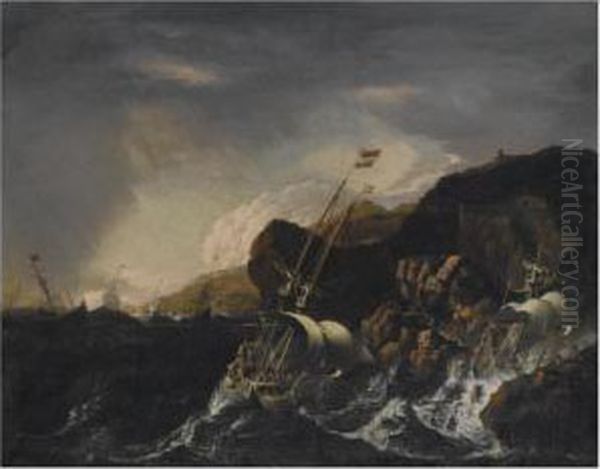
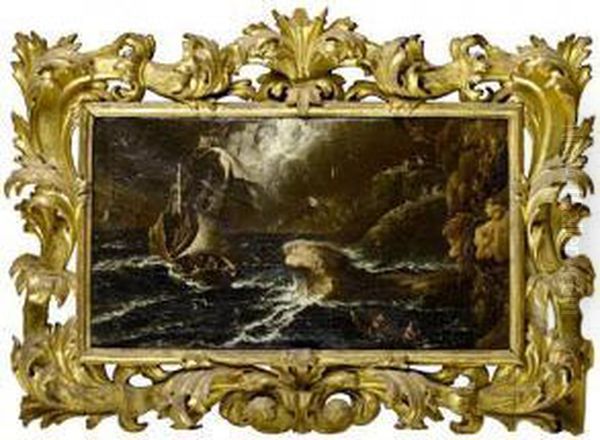
His storm scenes are powerful evocations of nature's fury. He excelled in depicting towering waves, often rendered with vigorous, impastoed brushstrokes that convey the texture and force of the water. Ships are shown tossed precariously, their masts broken, sails shredded, as tiny figures of sailors struggle against the overwhelming elements. This theme of humanity's struggle against the untamable power of nature was a popular one in the 17th century, an age of maritime exploration, trade, and warfare, where the sea was both a source of wealth and a constant peril.
Compositionally, Plattenberg often employed dramatic diagonals to heighten the sense of movement and instability. Dark, ominous clouds dominate the skies, rent by flashes of lightning or illuminated by a struggling moon, creating strong chiaroscuro effects that enhance the drama. The palette is often somber, dominated by blues, grays, greens, and browns, appropriate for the stormy subjects, but with carefully placed highlights on the foaming crests of waves or the distressed timbers of a ship.
While storms were his forte, he also painted calmer seascapes, ship portraits, and coastal views. In these, a more serene atmosphere prevails, but his keen observation of maritime details – the construction of ships, the play of light on water, the formation of clouds – remains evident. His works show a high degree of finish, suggesting careful execution and attention to detail, even within the most turbulent scenes. The human element, though often small in scale compared to the vastness of the sea and sky, is crucial, providing a focal point for the narrative and the emotional impact of the painting. Sometimes, a distant lighthouse or a fortified coastal town appears, symbolizing hope, refuge, or the interface between human civilization and the wildness of the ocean.
His style can be seen as a bridge between the more narrative and somewhat archaic approach of early Flemish marine painters like his teacher Andries van Eertvelt, and the developing trends towards greater naturalism or dramatic romanticism in seascape painting. He shared with contemporaries like the Flemish Bonaventura Peeters the Elder (1614-1652) a taste for shipwrecks and dramatic coastal scenes. While Dutch marine painters like Jan Porcellis (c. 1584–1632) and Simon de Vlieger (c. 1601–1653) were moving towards a more tonal and atmospheric depiction of the sea, Plattenberg often retained a stronger narrative and dramatic impetus, which found favor with patrons who appreciated vivid storytelling and visual spectacle.
Representative Works: Capturing Maritime Drama
Among Matthieu Van Plattenberg's known works, several stand out as exemplars of his style and thematic preoccupations. While a comprehensive catalogue raisonné might be elusive, paintings attributed to him consistently showcase his mastery of marine subjects.
One of his significant works is titled Fortuna di Mare (Sea Fortune, or The Fortune of the Sea). This painting, or versions of it, depicts ships battling a fierce storm near a rocky coastline. The title itself evokes the unpredictable nature of maritime ventures, where fortune could be won or lost at the mercy of the waves. Such scenes often carried allegorical weight, symbolizing the vicissitudes of human life. In Fortuna di Mare, Plattenberg would typically employ his characteristic dramatic lighting, with dark, turbulent skies and churning, white-capped waves threatening to engulf the vessels. The detailed rendering of the ships, their rigging strained and sails torn, alongside the desperate efforts of the crew, would create a scene of high tension and pathos. One version of this subject is noted as a collaboration with Adrien Manglard (1695-1760), a French painter of landscapes and seascapes, though Manglard's later dates suggest this might refer to a different version, a copy, or a misattribution in some records, as Plattenberg died when Manglard was very young or not yet born. It's more likely that if a collaboration occurred on such a theme, it was with a contemporary active during Plattenberg's lifetime.
Numerous paintings titled Ships in a Storm, Stormy Sea, Sailing Ship in a Storm, or Marine par gros temps (Seascape in Heavy Weather) are attributed to him. One such Sailing Ship in a Storm is held in the collection of the Galleria Corsini in Florence, a testament to his activity and recognition in Italy. These works invariably feature ships in distress, highlighting the artist's skill in rendering the chaotic energy of the sea. The compositions often include dramatic rock formations or a dimly lit coastline, adding to the sense of peril. The human figures, though small, are crucial in conveying the narrative of struggle and survival. The lighting is typically theatrical, with shafts of light breaking through storm clouds to illuminate parts of the scene, emphasizing the drama.
The consistent theme across these representative works is the sublime power of the ocean and the vulnerability of human endeavors in the face of it. Plattenberg's ability to capture this elemental conflict with such vigor and technical skill secured his reputation as a specialist in this demanding genre. His paintings served not only as decorative pieces but also as mementos of maritime life, reminders of its dangers, and perhaps as objects for contemplation on broader themes of fate and resilience.
Contemporaries, Collaborations, and Artistic Circle
Matthieu Van Plattenberg's career unfolded within a vibrant network of artists, both in his native Flanders and in his adopted homes in Italy and France. His interactions with these contemporaries shaped his development and positioned him within the broader artistic currents of the 17th century.
His primary teacher, Andries van Eertvelt, was a foundational influence. Van Eertvelt himself had pupils and followers, creating a lineage of Flemish marine painters. Among those associated with van Eertvelt's circle, besides Plattenberg, were artists like Gaspar van Eyck (1613–1674), Hendrik van Minderhout (1632–1696), and Sebastian Castro (fl. c. 1633–1656). Plattenberg is documented to have had close contact with Gaspar van Eyck, who also specialized in marine paintings, often depicting Mediterranean port scenes. Such connections fostered an environment of shared knowledge and stylistic exchange, even if each artist developed a personal idiom.
In Italy, his collaboration with the Dutch painter Jan Asselijn ("Crabetje") in Florence was particularly significant. Asselijn was part of the "Bentvueghels" (Birds of a Feather), a society of mostly Dutch and Flemish artists active in Rome, known for their bohemian lifestyle and mutual support. While Plattenberg's primary base in Italy seems to have been Florence rather than Rome, his association with Asselijn connects him to this broader community of Northern artists working south of the Alps. These artists often brought their Northern realism and genre specializations to Italian settings, creating a unique fusion. Other Northern artists active in Italy during this period, such as Pieter van Laer ("Il Bamboccio"), who specialized in Roman street scenes, contributed to this rich cultural exchange.
Upon moving to Paris, Plattenberg entered a different artistic ecosystem. His acceptance into the Académie Royale de Peinture et de Sculpture in 1648 placed him among the elite of the French art world. This institution included prominent French artists like Charles Le Brun and Eustache Le Sueur, though Plattenberg's specialization in seascapes set him apart. His son, Nicolas de Plattemontagne, would become even more integrated into this French academic tradition. The mention of a collaboration with Adrien Manglard on a Fortuna di Mare is intriguing, though chronologically challenging as noted. Manglard, active later, was himself a renowned marine painter who taught Claude-Joseph Vernet, indicating the enduring appeal of seascape painting in France. If such a link exists, it might be through a later version or a workshop connection. More contemporary to Plattenberg in France, Claude Lorrain (1600-1682), though primarily a landscape painter, created idealized port scenes and coastal views that shared some thematic ground with marine painting, often suffused with a poetic, classical light that contrasted with Plattenberg's more dramatic tempests.
The art markets of Antwerp, Florence, and Paris each had their own characteristics and demands. Plattenberg's ability to adapt and find patronage in these diverse centers speaks to his skill and perhaps his business acumen. His interactions were not just artistic but also professional, navigating guilds, academies, and patron networks.
The Wider Context: 17th-Century Marine Painting
Matthieu Van Plattenberg worked during the golden age of marine painting, a genre that flourished particularly in the Netherlands and Flanders, but also found appreciation across Europe. The 17th century was an era of intense maritime activity: global trade expanded, naval power became crucial for emerging nation-states, and voyages of exploration captured the public imagination. This societal preoccupation with the sea naturally translated into artistic demand.
In the Dutch Republic, artists like Jan Porcellis, Simon de Vlieger, Jan van Goyen (for his river and estuary scenes), and later Willem van de Velde the Elder and Younger, and Ludolf Bakhuizen, developed marine painting to unprecedented levels of naturalism and atmospheric subtlety. Dutch seascapes often celebrated naval prowess, depicted bustling harbors, or captured the nuanced effects of light and weather on water. While storm scenes were part of their repertoire, there was also a strong tradition of "tonal" seascapes emphasizing calm and atmospheric unity.
Flemish marine painting, while sharing some characteristics with the Dutch, often leaned towards more dramatic and colorful depictions. Artists like Andries van Eertvelt, Bonaventura Peeters the Elder, and his brother Jan Peeters I, often painted historical naval battles, exotic Mediterranean ports with galleys and xebecs, and, like Plattenberg, highly dramatic shipwrecks and storms. There was perhaps a greater influence from the more flamboyant Baroque style prevalent in Catholic Flanders, as exemplified by Rubens.
In Italy, while landscape painting had a rich tradition, specialized marine painting by local artists was less prominent than in the North, creating an opening for specialists like Plattenberg and Asselijn. Italian patrons, however, appreciated the skill of these Northern visitors. In France, the genre would gain more traction through artists like Claude Lorrain (with his idealized coastal scenes) and later, significantly, Claude-Joseph Vernet in the 18th century, who specialized in dramatic seascapes and port views, partly influenced by the tradition Plattenberg had contributed to.
Plattenberg's work, therefore, fits into this broader European phenomenon. His Flemish training provided the dramatic impetus, his Italian experience likely refined his compositions, and his Parisian career saw him contribute to the growing appreciation for marine art in France. He specialized in the "storm and shipwreck" subgenre, which appealed to the Baroque fascination with strong emotions, the sublime power of nature, and human drama.
Legacy and Posthumous Reputation
Matthieu Van Plattenberg, or Plattemontagne, established a solid reputation during his lifetime as a skilled marine painter and etcher, particularly valued for his dramatic storm scenes. His acceptance into the French Académie Royale and the presence of his works in collections like the Galleria Corsini in Florence attest to this contemporary esteem.
After his death, his name continued to appear in inventories and auction records, indicating that his paintings remained in circulation and were valued by collectors. However, like many artists who were successful in their time but did not achieve the towering fame of a Rubens or a Rembrandt, his visibility in general art historical narratives may have somewhat diminished over the centuries. Specialists in Baroque art and marine painting, however, have continued to recognize his contribution.
His influence can be seen in the context of the development of marine painting. He was part of a generation that solidified the genre, moving it beyond purely illustrative functions towards more expressive and emotionally charged depictions. His focus on the turbulent sea contributed to the iconography of the sublime, which would become a major theme in later Romantic art. While he may not have founded a large "school" of followers in the traditional sense, his work would have been known to other artists specializing in seascapes, particularly in Paris. His son, Nicolas de Plattemontagne, carried on the family's artistic name, though in different genres, contributing to the French school of painting.
Today, works by Matthieu Van Plattenberg appear periodically on the art market, often commanding respectable prices, especially for well-preserved and characteristic storm scenes. Museums with collections of Flemish or French Baroque painting may hold examples of his work. Art historians value him for his technical skill, his dramatic compositions, and his role as a Northern artist who successfully navigated and contributed to the art scenes of Italy and France. He remains a significant, if perhaps not household, name in the specialized field of 17th-century marine art. His paintings continue to engage viewers with their vivid portrayal of humanity's enduring and often perilous relationship with the sea.
Conclusion: An Enduring Vision of the Sea's Might
Matthieu Van Plattenberg, from his beginnings in Antwerp to his established career in Paris as Plattemontagne, and his formative years in Italy as Monsù Montagna, stands as a compelling figure in 17th-century art. He dedicated his considerable talents to capturing the wild, untamed essence of the sea, specializing in dramatic storms that showcased both nature's formidable power and humanity's resilience or vulnerability. His work, characterized by dynamic compositions, vigorous brushwork, and a keen sense of theatricality, found appreciation across Europe.
As a student of Andries van Eertvelt, a collaborator with Jan Asselijn, and a member of the prestigious French Académie Royale, Plattenberg was an active participant in the rich artistic exchanges of his time. He contributed to the flourishing genre of marine painting, bringing a distinctly Flemish energy to his depictions, which he then honed through Italian experiences and adapted for a discerning Parisian audience. While the sea could offer fortune, as suggested by titles like Fortuna di Mare, Plattenberg's canvases more often reminded viewers of its capacity for destructive fury, making his art a powerful reflection of the Baroque era's fascination with drama, emotion, and the sublime forces that shape human destiny. His legacy endures in the powerful imagery of his surviving works, which continue to evoke the timeless struggle between humankind and the vast, indomitable ocean.