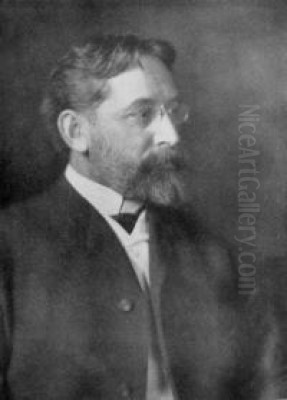
Oliver Dennett Grover stands as a significant, if sometimes overlooked, figure in American art history, particularly within the vibrant artistic milieu of Chicago during the late 19th and early 20th centuries. An accomplished painter and influential educator, Grover's career spanned a period of dynamic change in the art world, and his work reflects a thoughtful engagement with both academic traditions and the burgeoning influence of Impressionism. His contributions as a portraitist, landscape painter, muralist, and teacher cemented his place as a respected artist of his generation.
Formative Years and European Training
Born on January 29, 1861, in Earlville, Illinois, Oliver Dennett Grover's artistic inclinations emerged early. His family, recognizing his talent, supported his pursuit of formal art education. Like many aspiring American artists of his time, Grover understood that a European sojourn was essential for honing his skills and gaining exposure to the masterworks and contemporary trends shaping the art world. His journey was not merely a tour but a dedicated period of rigorous study.
His initial significant training took place in Munich, Germany, at the Royal Academy. There, he studied under Frank Duveneck, an influential American painter who had himself trained in Munich and was known for his vigorous brushwork and dark, rich palette, often associated with the Munich School's realism. Duveneck's teaching emphasized direct observation and a painterly approach, which undoubtedly left an impression on the young Grover. The "Duveneck Boys," as his students were known, formed a notable group of American artists who absorbed these methods.
Following his time in Munich, Grover, like many of his contemporaries such as John Singer Sargent and William Merritt Chase, gravitated towards Paris, the undisputed center of the art world in the late 19th century. In Paris, he enrolled at the prestigious Académie Julian, a private art school that attracted students from around the globe, offering an alternative to the more rigid École des Beaux-Arts. At Académie Julian, Grover studied under esteemed academic painters Gustave Boulanger and Jules Joseph Lefebvre. Both Boulanger and Lefebvre were masters of the academic tradition, emphasizing strong draftsmanship, meticulous finish, and often classical or historical subject matter. This training provided Grover with a solid foundation in figure drawing and composition, skills that would serve him well throughout his diverse career.
Grover's European experience was further enriched by time spent in Florence, Italy. The cradle of the Renaissance, Florence offered unparalleled opportunities to study the works of masters like Michelangelo, Leonardo da Vinci, and Raphael. This immersion in the classical tradition would have deepened his understanding of form, anatomy, and the grand manner of painting, influences that can be subtly detected in the structure and ambition of some of his later works, particularly his murals. He also spent time painting in Venice, a city that captivated countless artists with its unique light and picturesque canals, including predecessors like J.M.W. Turner and contemporaries like James McNeill Whistler and John Singer Sargent.
Return to America and the Chicago Art Scene
Upon returning to the United States in 1885, Oliver Dennett Grover chose Chicago as his home base. The city was rapidly transforming into a major cultural and economic hub, and its art scene was burgeoning. Grover quickly established himself as a prominent figure. He became deeply involved with the Art Institute of Chicago, not only as an exhibiting artist but also as an influential instructor. He began teaching there in 1887, a role he would maintain for several years, shaping a new generation of Midwestern artists.
His presence in Chicago coincided with a period of great artistic energy. The city was preparing for the World's Columbian Exposition of 1893, a monumental event that would showcase American artistic and industrial achievement to the world. Grover was actively involved in the Exposition, contributing to the artistic fervor and gaining wider recognition. This fair was a pivotal moment for American art, bringing together artists from across the nation and exposing the public to diverse styles, including the increasingly popular Impressionism. Artists like Childe Hassam, Mary Cassatt, and Frank Weston Benson were among those whose works reflected Impressionist influences and were gaining prominence.
Grover's studio became a known entity in Chicago, and he received commissions for portraits, landscapes, and genre scenes. He was a founding member of the Society of Western Artists and the Chicago Society of Artists, organizations that played crucial roles in promoting art and providing exhibition opportunities for artists in the region. His engagement with these groups underscored his commitment to fostering a vibrant local art community. He was a contemporary of other notable Chicago artists such as the sculptor Lorado Taft, who also played a significant role in the city's cultural development, and painters like Ralph Clarkson and Charles Francis Browne.
Artistic Style and Thematic Concerns
Oliver Dennett Grover's artistic style is characterized by its versatility and its graceful synthesis of different influences. His early training in Munich and Paris instilled in him a strong command of academic principles: accurate drawing, balanced composition, and a respect for traditional subject matter. This foundation is evident in the solidity of his figures and the careful construction of his scenes.
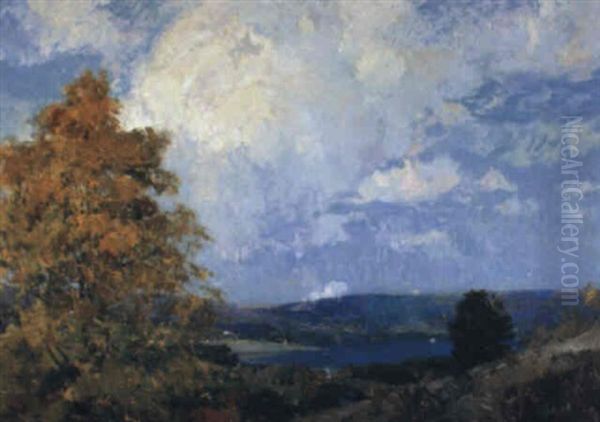
However, Grover was not immune to the allure of Impressionism, which had revolutionized painting in Europe and was making significant inroads in America. While he never fully abandoned his academic underpinnings, he increasingly incorporated Impressionistic techniques into his work, particularly in his landscapes and outdoor scenes. This is seen in his brighter palette, his attention to the effects of light and atmosphere, and his more broken brushwork, designed to capture fleeting moments and sensory experiences. His Venetian scenes, for example, often shimmer with reflected light, reminiscent of the work of Claude Monet or Pierre-Auguste Renoir in their treatment of water and light, though Grover generally maintained a greater sense of form and structure.
Portraiture was a significant aspect of Grover's oeuvre. He possessed a keen ability to capture not only a physical likeness but also the personality and character of his sitters. His portraits are often distinguished by their dignified compositions and sensitive rendering of flesh tones and textures. He painted prominent citizens, family members, and fellow artists, contributing to the rich tradition of American portraiture exemplified by artists like Thomas Eakins and the aforementioned Sargent.
Landscapes also held a strong appeal for Grover. He painted scenes from his travels in Europe, particularly Italy, as well as the American landscape. Works like "A June Morning, Lake Orta" showcase his ability to convey the tranquility and beauty of nature, employing a lighter palette and softer focus characteristic of Impressionist-inspired landscape painting. He was adept at capturing the specific mood and atmosphere of a place, whether it was the sun-drenched Italian countryside or the more subdued light of the American Midwest.
Beyond easel painting, Grover also undertook significant mural commissions. Murals were an important form of public art during this period, often adorning libraries, courthouses, and other civic buildings. His work in this genre allowed him to engage with allegorical and historical themes on a grand scale, drawing upon his classical training and compositional skills.
Notable Works and Masterpieces
Several works stand out in Oliver Dennett Grover's career, illustrating his diverse talents and stylistic evolution.
"The Thycaen" (1891, Art Institute of Chicago) is one of his most celebrated early works. It depicts a young woman in classical attire, reclining gracefully and holding a thyrsus, a staff associated with Dionysus. The painting showcases Grover's academic training in its meticulous rendering of form, the smooth finish, and the classical subject matter. It won the prestigious Yerkes Prize at the Art Institute of Chicago's annual exhibition, a significant early recognition of his talent. The work demonstrates his mastery of figurative painting and his ability to imbue a classical theme with a sense of quiet elegance.
His Venetian scenes, such as "The Riva Schiavoni, Venice" and "The Rialto Market," capture the unique atmosphere of the city. These paintings often feature a brighter palette and more visible brushwork than his earlier academic pieces, reflecting the influence of Impressionism. He skillfully depicts the interplay of light on water, the bustling activity of the canals, and the distinctive architecture of Venice. These works invite comparison with those of other American artists captivated by Venice, such as Maurice Prendergast, though Grover's approach tends to be more representational.
"A June Morning, Lake Orta" (c. 1913) is a beautiful example of his landscape painting, showcasing a more overtly Impressionistic style. The soft light, gentle colors, and serene atmosphere convey a sense of peace and natural beauty. The brushwork is looser, capturing the shimmering quality of the water and the lushness of the foliage. This work reflects a mature artist confidently blending his technical skill with a poetic sensibility.
The murals for the James Blackstone Memorial Library in Branford, Connecticut, represent a significant achievement in public art for Grover. Completed in the late 1890s, these murals depict allegorical figures and scenes related to knowledge, literature, and the arts. They required considerable skill in composition, figure drawing, and the handling of large-scale narratives, demonstrating the breadth of his artistic capabilities. These murals align with the "American Renaissance" movement, which saw a flourishing of mural painting in public buildings, with artists like Edwin Blashfield and Kenyon Cox being leading figures.
Other notable works include numerous portraits of prominent Chicagoans and sensitive depictions of family members, which further attest to his skill in capturing human character. His genre scenes often depicted everyday life with a quiet dignity and charm.
Grover as an Educator and His Influence
Oliver Dennett Grover's role as an educator at the Art Institute of Chicago was highly significant. For many years, starting in 1887 and continuing intermittently, he taught painting and drawing, influencing a generation of artists emerging from the Midwest. His own comprehensive training in both Munich and Paris equipped him to offer students a broad perspective on artistic techniques and philosophies.
It is likely that his teaching emphasized the foundational skills of drawing and composition, which he had mastered under his academic teachers, while also encouraging students to observe nature directly and explore the expressive possibilities of color and light, reflecting his own engagement with Impressionism. He would have been able to share firsthand knowledge of European art centers and contemporary trends, providing invaluable insights for students who might not have had the opportunity to travel abroad themselves.
The Art Institute of Chicago was, and remains, one of the most important art schools in the United States. Grover's long association with it places him among a distinguished faculty that helped to shape American art in the late 19th and early 20th centuries. While it is difficult to trace direct stylistic lineage to specific famous pupils without more detailed records, his impact would have been felt through the general raising of artistic standards and the dissemination of sound artistic principles. He contributed to an environment that nurtured artists like Pauline Palmer, who also became a prominent figure in the Chicago art scene.
His commitment to teaching demonstrates a dedication to the broader artistic community, extending beyond his personal creative output. This dual role as a practicing artist and an educator was common among many successful artists of the period, including William Merritt Chase, who was also a highly influential teacher.
Connections and Contemporaries
Oliver Dennett Grover operated within a rich network of artistic relationships and influences. His teachers—Frank Duveneck, Gustave Boulanger, and Jules Joseph Lefebvre—provided him with distinct yet complementary approaches to art-making. Duveneck's bold realism and painterly style contrasted with the refined academicism of Boulanger and Lefebvre, giving Grover a versatile toolkit.
In America, he was a contemporary of the leading figures of American Impressionism, such as Childe Hassam, Frank Weston Benson, and Edmund C. Tarbell, who formed part of "The Ten American Painters." While Grover's style was perhaps more conservative than some of these artists, he shared their interest in capturing light and atmosphere, particularly in his landscapes.
His relationship with the Chicago art scene was central. He exhibited alongside and collaborated with other key Chicago artists. Figures like Lorado Taft, a sculptor and writer, were instrumental in promoting the arts in Chicago, and Grover would have been part of this cultural vanguard. He would have also been aware of and likely interacted with other painters active in Chicago, such as Ralph Clarkson, another prominent portraitist and teacher, and Charles Francis Browne, known for his landscapes.
The World's Columbian Exposition of 1893 provided a major platform for interaction among American artists. Grover's participation placed him in the company of many of the nation's leading painters and sculptors, fostering a sense of national artistic identity. The art exhibitions at the fair were extensive, featuring works by international stars like Anders Zorn and American expatriates like John Singer Sargent and James McNeill Whistler, whose sophisticated aesthetics influenced many American artists.
Grover also maintained connections with the broader American art world through his memberships in organizations like the National Academy of Design, to which he was elected an Associate in 1913. This recognition signified his standing among his national peers.
Anecdotes and Personal Glimpses
While detailed personal anecdotes about Oliver Dennett Grover are not as widely circulated as those of some of his more flamboyant contemporaries, his career itself speaks to a dedicated and serious artist. His decision to return to Chicago after his European studies, rather than remaining in Paris or settling in New York, suggests a commitment to developing the artistic culture of his home region.
His long tenure as a teacher at the Art Institute of Chicago points to a patient and generous character, willing to share his knowledge with aspiring artists. The consistent quality of his work across different genres—portraiture, landscape, mural—indicates a disciplined work ethic and a persistent pursuit of excellence.
One can imagine the discussions and camaraderie among artists in Chicago during that period, particularly in the lead-up to the World's Columbian Exposition. Grover would have been part of these exciting times, contributing to the planning and execution of artistic projects for the fair. The very act of establishing a successful artistic career in a city like Chicago, which was still forging its cultural identity, would have required considerable enterprise and resilience.
His travels, particularly to Italy, were clearly a source of great inspiration, as evidenced by the numerous paintings of Venetian and other Italian scenes. These trips were not mere holidays but working expeditions, where he filled sketchbooks and canvases with observations that would later be developed into finished paintings in his studio. This dedication to firsthand experience and plein air sketching, even when later refined in the studio, connects him to the Impressionist ethos.
Later Years, Death, and Artistic Legacy
Oliver Dennett Grover continued to paint and exhibit throughout his life, maintaining a respected position in the American art world. He received various awards and honors for his work, including the First Yerkes Prize and the Young Fortnightly Prize from the Art Institute of Chicago, and a silver medal at the Louisiana Purchase Exposition in St. Louis in 1904. These accolades affirmed his critical reception during his lifetime.
His style, while evolving, remained rooted in a strong sense of draftsmanship and a balanced approach to composition, even as he embraced the brighter palettes and atmospheric concerns of Impressionism. He did not push into the more radical modernist movements that began to emerge in the early 20th century, such as Cubism or Fauvism, but rather continued to refine his personal synthesis of academic and Impressionist sensibilities. This places him firmly within the generation of American artists who navigated the transition from 19th-century realism to the early stirrings of modern art.
Oliver Dennett Grover passed away in Chicago, Illinois, on February 14, 1927. He left behind a substantial body of work that attests to his skill, versatility, and dedication to his craft.
His legacy is perhaps most strongly felt in Chicago, where he was a key figure in the development of the city's art scene. His paintings are held in the collections of the Art Institute of Chicago, the Union League Club of Chicago, and other museums and private collections. His murals in the Blackstone Memorial Library remain an important example of public art from that era.
While he may not be as widely known today as some of his East Coast contemporaries like Childe Hassam or John Singer Sargent, Oliver Dennett Grover's contributions are significant. He represents a vital strand of American art that flourished outside the major New York art hub, demonstrating the depth and breadth of artistic talent across the nation. He successfully bridged the gap between the rigorous demands of academic training and the fresh, light-filled perspectives of Impressionism, creating art that was both technically accomplished and aesthetically pleasing.
Historical Evaluation and Conclusion
In the broader narrative of American art, Oliver Dennett Grover is recognized as a skilled and versatile painter who made significant contributions as an artist and educator, particularly in the Midwest. His work reflects the dominant artistic currents of his time, showing a mastery of academic techniques learned in Europe, combined with a sensitive adoption of Impressionist principles. He was part of a generation of American artists who, after training abroad, returned to the United States to help build a distinctly American artistic culture.
His portraits are valued for their psychological insight and technical proficiency. His landscapes, especially those inspired by his travels in Italy and his observations of the American scene, are admired for their lyrical beauty and skillful handling of light and atmosphere. His mural work demonstrates his ability to handle complex compositions and allegorical themes on a grand scale.
While the tides of art history have sometimes favored more avant-garde figures, there is a renewed appreciation for artists like Grover who maintained a high level of craftsmanship and aesthetic quality within more traditional frameworks, while still engaging with contemporary developments. He played an important role in establishing Chicago as a significant art center and in educating future generations of artists.
Oliver Dennett Grover's art offers a window into the American cultural landscape at the turn of the 20th century—a period of optimism, growth, and increasing artistic sophistication. His dedication to his craft, his ability to synthesize diverse influences, and his commitment to his community ensure his enduring place in the annals of American art. His paintings continue to be appreciated for their beauty, skill, and the quiet dignity they convey, reflecting an artist who was both a master of his tradition and a sensitive observer of the world around him.