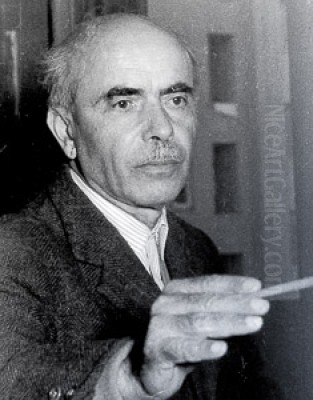
Oreste Albertini stands as a noteworthy figure in the landscape of Italian art, an artist whose career bridged the late 19th century and extended well into the transformative decades of the 20th century. Born in 1887 and passing away in 1980, Albertini's life witnessed profound shifts in artistic paradigms, yet he remained largely dedicated to a mode of painting rooted in observation, realism, and a deep appreciation for the Italian scene, both natural and architectural. While perhaps not as globally recognized as some of his avant-garde contemporaries, his body of work offers a valuable window into a persistent and cherished tradition within Italian painting.
His artistic journey unfolded during a period of immense artistic ferment in Italy and across Europe. The late 19th century saw the lingering influences of movements like the Macchiaioli, who had revolutionized Italian painting with their plein-air techniques and commitment to capturing immediate reality. As Albertini began his career, Italy was also experiencing the rise of Divisionism and Symbolism, soon to be followed by the explosive energy of Futurism. Albertini, however, appears to have carved a niche for himself within a more traditional, yet no less skilled, representational approach.
Early Life and Artistic Formation
Born in Italy in 1887, Oreste Albertini's formative years would have coincided with a period where academic training still held considerable sway, even as new artistic currents were challenging established norms. Information regarding his specific artistic education is not extensively documented in readily available sources, but it is reasonable to assume he would have undergone training that emphasized draftsmanship, perspective, and the study of Old Masters, which was standard in Italian art academies of the time.
The artistic environment in Italy during the late 19th and early 20th centuries was rich and varied. Painters like Giovanni Fattori, Silvestro Lega, and Telemaco Signorini, key figures of the Macchiaioli movement, had already left an indelible mark with their innovative approach to light and form. Their commitment to capturing the essence of Italian life and landscape undoubtedly created a fertile ground for subsequent generations of realist painters. It is plausible that Albertini, in his youth, would have been exposed to their work and the principles they espoused.
Furthermore, the broader European context included the powerful influence of French Realism, championed by artists such as Gustave Courbet and Jean-François Millet, whose unvarnished depictions of rural life and landscape resonated across the continent. The subsequent wave of Naturalism, with figures like Jules Bastien-Lepage, further pushed the boundaries of verisimilitude in art. These currents, emphasizing direct observation and a truthful portrayal of the world, likely informed the artistic milieu in which Albertini developed.
Artistic Style and Thematic Concerns
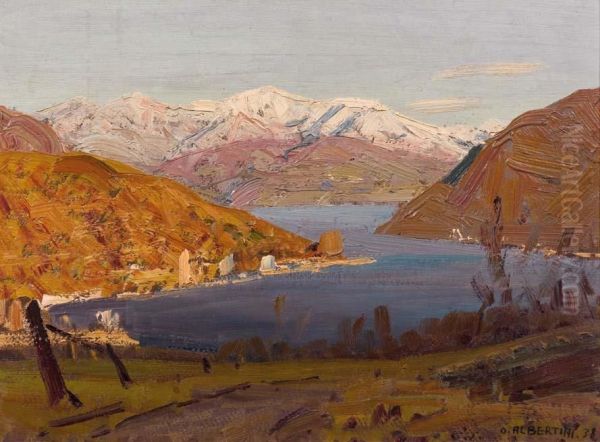
Oreste Albertini's artistic style is primarily characterized by its adherence to Realism and Naturalism. His paintings, predominantly oil on canvas, demonstrate a keen observational skill and a meticulous attention to detail. He focused on capturing the tangible world around him, whether it was the play of light on ancient stonework, the subtle hues of a rural landscape, or the quiet dignity of figures within their environment.
His works often exhibit a strong sense of place, grounding his subjects firmly in the Italian context. This is evident in his architectural paintings, where buildings are rendered with an understanding of their structure and historical character, as well as in his landscapes, which convey the specific atmospheric qualities of the Italian countryside. The "delicate and emotive style" noted in some descriptions suggests that his realism was not merely a cold transcription of reality but was imbued with a sensitivity and an ability to evoke mood.
Light and shadow play a crucial role in his compositions, a hallmark of realist painting. Albertini seems to have been adept at using chiaroscuro not just for modeling form but also for creating atmosphere and highlighting focal points within his scenes. His color palette, while not extensively detailed in general descriptions, would likely have been true to nature, reflecting the earthy tones of the Italian landscape and the varied materials of its architecture.
While he may not have been an innovator in the vein of the Futurists like Umberto Boccioni or Giacomo Balla, who were his contemporaries and sought to radically break from past traditions, Albertini's commitment to representational art provided a continuity with long-standing pictorial values. His focus on landscape, architecture, and occasionally figures, places him within a lineage of Italian painters who found inexhaustible inspiration in their native land.
Notable Works: A Closer Look
Several works by Oreste Albertini have been documented, particularly through their appearance in auction records, providing glimpses into his artistic output and thematic preoccupations. These pieces, dated across several decades, showcase his consistent style and preferred subjects.
One of Albertini's most frequently cited works is Torre del Mangano. The information indicates it was painted in 1887 in Pavia and later, in 1953, moved to Besanzo. The initial date of 1887 is particularly interesting as it would mean Albertini painted this significant work in the year of his birth, which is highly improbable. It is more likely that 1887 refers to the subject or an earlier iteration by another artist, or there's a conflation of dates. However, if we consider Albertini's birth year as 1887, a work dated "1887-1953" might imply a long period of ownership, or perhaps the 1953 date refers to a specific event related to the painting or even a later work depicting the same subject. Assuming the painting is indeed by Oreste Albertini and reflects his mature style, it would likely be a depiction of the actual Torre del Mangano, a known landmark.
A painting of such a subject would allow Albertini to explore architectural forms, the texture of aged stone, and the interplay of light and shadow on the tower's surfaces. Italian artists have long been fascinated by their country's rich architectural heritage, and a depiction of a prominent tower would fit well within this tradition. Artists like Antonio Fontanesi, though from an earlier generation, also showed a profound sensitivity to architectural elements within landscapes. The dimensions given (33x41.5 cm) suggest a moderately sized easel painting, suitable for detailed rendering.
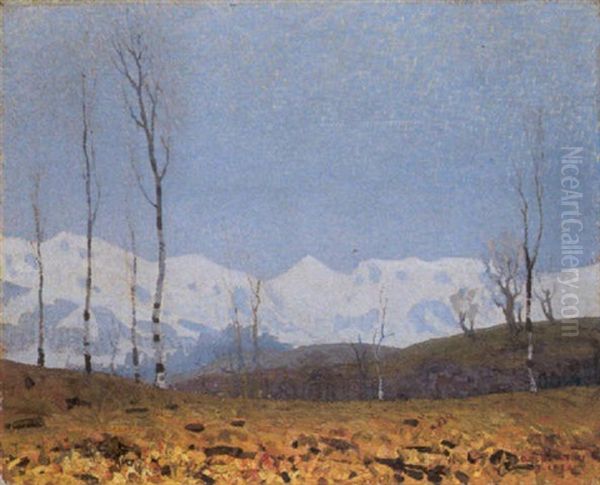
Dated 1938, Paesaggio con alberi (Landscape with Trees) clearly indicates Albertini's engagement with landscape painting. At 60x49 cm, it is a reasonably sized canvas. This work, created in the late 1930s, would have been produced at a time when various modernist movements had already taken hold across Europe. However, Albertini's choice of a traditional landscape theme suggests his continued adherence to representational art.
One can imagine this painting capturing a specific Italian scene, perhaps a quiet rural vista or a more rugged terrain, with trees as the central motif. The treatment of foliage, the quality of light filtering through branches, and the overall composition would be key elements. Italian landscape painting has a rich history, from the idealized landscapes of the Renaissance to the more immediate and naturalistic depictions of the 19th century. Albertini's work would contribute to this ongoing tradition, likely emphasizing the natural beauty and specific character of the Italian environment. His style would likely involve careful observation of botanical details and atmospheric effects, akin to the dedication seen in the works of landscape specialists.
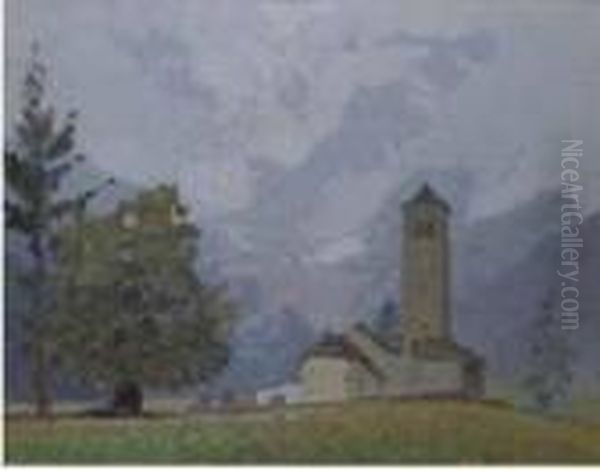
Chiesetta di montagna (Little Mountain Church), dated 1953 and with dimensions of 33x41.5 cm (identical to one listing for Torre del Mangano, suggesting a possible pairing or series), points to another favored theme: the integration of architecture within a natural, often rustic, setting. Small churches and chapels are ubiquitous in the Italian landscape, particularly in mountainous regions, and they offer poignant subjects for artists.
This painting would likely depict a quaint, perhaps isolated, church nestled in a mountainous backdrop. Albertini would have had the opportunity to contrast the man-made structure with the grandeur or ruggedness of the natural environment. The theme evokes a sense of tranquility, spirituality, and the enduring presence of faith in remote communities. The challenges of depicting mountainous terrain, with its unique light and atmospheric conditions, would also be addressed. One might think of the alpine scenes by Giovanni Segantini, a Divisionist, though Albertini's approach would be stylistically different, favoring realism over Segantini's luminous, fragmented brushwork.
Il Gruppo delle Odle
Also dated 1953, Il Gruppo delle Odle (The Odle Group), sized at 24.3x29.8 cm, clearly refers to a specific mountain range in the Dolomites. This indicates Albertini's interest in majestic alpine scenery. The Odle Group is renowned for its dramatic peaks and breathtaking beauty, providing a powerful subject for any landscape painter.
A painting of this subject would require Albertini to capture the monumental scale of the mountains, the texture of rock formations, and the distinctive light of high altitudes. The smaller dimensions of this piece might suggest a study or a more intimate portrayal, perhaps focusing on a particular aspect of the range or a specific atmospheric condition. The tradition of alpine painting was strong in regions bordering the Alps, and Albertini's work would connect with this genre, emphasizing the sublime power of nature.
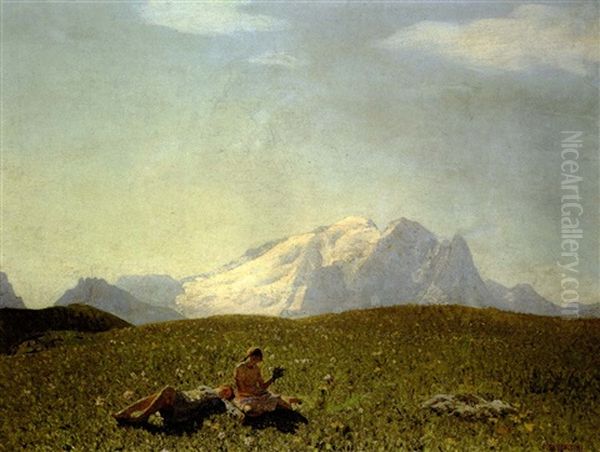
Fanciulli sul prato (Children on the Meadow), dated 1942 and sized at 79x100 cm, introduces a figural element into a landscape setting. This larger canvas suggests a more ambitious composition. The subject of children in a natural environment often evokes themes of innocence, play, and the simple joys of rural life.
This work would have allowed Albertini to combine his skills in landscape painting with figure depiction. The interaction of the children, their poses, and their integration into the meadow setting would be central to the painting's narrative and emotional impact. Such genre scenes were popular in the 19th and early 20th centuries, with artists like Francesco Paolo Michetti capturing the vibrant life of the Italian peasantry, though often with a more dynamic and earthy realism than Albertini's "delicate and emotive" style might suggest. Albertini's version might lean towards a more idyllic or contemplative portrayal. The year 1942 places this work during World War II, and it's interesting to consider whether the painting offered an escape into a more peaceful, timeless vision of childhood and nature amidst a period of global conflict.
The Italian Artistic Milieu During Albertini's Career
Oreste Albertini's long career, spanning from the late 19th century to 1980, meant he was a contemporary to a vast array of artistic developments in Italy. When he was beginning, the echoes of the Macchiaioli (Giovanni Fattori, Silvestro Lega, Telemaco Signorini) were still strong, with their emphasis on "macchia" (patches of color) and plein-air painting to capture the immediate truth of light and subject. Their influence fostered a strong tradition of realism in Italian art.
Simultaneously, Italy saw the rise of Divisionism (Scapigliatura's later development) at the turn of the century, with artists like Giovanni Segantini, Gaetano Previati, and Giuseppe Pellizza da Volpedo. They used dabs of pure color to create luminous effects, often imbuing their subjects—whether landscapes or social themes—with symbolic meaning. While Albertini's style seems distinct from Divisionism, he would have been aware of its prominence.
The early 20th century was dominated by the explosive arrival of Futurism, led by Filippo Tommaso Marinetti, with artists like Umberto Boccioni, Giacomo Balla, Carlo Carrà, and Luigi Russolo. Futurism celebrated speed, technology, and a radical break from the past, diametrically opposed to the more traditional representational art Albertini practiced.
Between the wars, Italy experienced the "Return to Order" (Ritorno all'ordine), a broader European trend that saw many artists move away from avant-garde experimentation towards more classical and traditional forms of representation. Movements like Novecento Italiano, championed by Margherita Sarfatti and artists such as Mario Sironi and Achille Funi, sought to revive Italian artistic traditions with a modern sensibility. While Albertini's consistent realism might align with the spirit of valuing craftsmanship and representation, Novecento often had a more monumental and sometimes classicized or stylized quality.
Post-World War II, Italian art saw renewed experimentation with abstraction (Arte Informale, exemplified by Alberto Burri and Lucio Fontana) and later, movements like Arte Povera. Throughout all these shifts, however, there remained artists dedicated to figurative and landscape painting. Albertini's continued production of works like Chiesetta di montagna and Il Gruppo delle Odle in 1953 shows his steadfast commitment to his chosen path, even as the art world around him was constantly reinventing itself. His work can be seen as part of a persistent undercurrent of realism that provided an alternative to the dominant avant-garde narratives. Other painters like Giorgio Morandi, while highly individual, also focused on representational subjects with intense dedication, though Morandi's metaphysical still lifes are stylistically very different from Albertini's landscapes.
Albertini's Place and Legacy
Oreste Albertini may not be a household name in the grand narrative of art history, which often prioritizes radical innovators and movement leaders. However, his work holds value for several reasons. Firstly, it represents a consistent dedication to realist principles and skilled craftsmanship over many decades, offering a counterpoint to the more tumultuous changes in 20th-century art. His paintings provide a visual record of Italian landscapes, architecture, and, to some extent, life, filtered through a sensitive artistic temperament.
The fact that his works appear in auctions indicates a continued, if modest, market interest and appreciation among collectors who value traditional representational painting. Artists like Albertini contribute to the rich tapestry of art history by maintaining and evolving established genres. They cater to a fundamental human desire to see the world reflected and interpreted through an artistic lens that values verisimilitude and beauty in the everyday.
His focus on specific Italian locales, such as the Torre del Mangano or the Odle Mountains, also contributes to a regional artistic identity. Such works resonate with those familiar with these places and offer others a glimpse into the diverse beauty of Italy. He can be situated within a broad school of Italian landscape and architectural painters who found endless inspiration in their homeland, a lineage that includes artists from various periods who, despite stylistic differences, shared a common love for depicting the Italian scene. Consider, for example, the veduta painters of the 18th century like Canaletto or Bernardo Bellotto, whose detailed cityscapes, while different in intent and style, share with Albertini a commitment to capturing specific locations.
While the provided information does not indicate significant involvement in major artistic groups or manifestos, Albertini's quiet dedication to his craft speaks for itself. His paintings, with their "delicate and emotive style" and "attention to detail," offer a form of visual poetry, celebrating the enduring appeal of the Italian landscape and its man-made landmarks.
Distinguishing from Other Albertinis
It is important to note that the name "Albertini" is not uncommon, and the initial information provided in the prompt seemed to conflate Oreste Albertini the painter with other individuals. For instance, references to Luigi Albertini, a journalist and anti-fascist politician, or a Francesco Albertini with purported supernatural inclinations, or an Oreste Albertini involved in the Italian Federalist Movement, pertain to different people. The focus here is solely on Oreste Albertini, the artist active from the late 19th to the mid/late 20th century, whose documented works are paintings like Torre del Mangano and Paesaggio con alberi. Similarly, the great Renaissance humanist, architect, and art theorist Leon Battista Alberti is an entirely different historical figure, active centuries before Oreste Albertini the painter.
There is also no substantial evidence to suggest that Oreste Albertini, the painter, was significantly active in sculpture. His documented artistic output lies firmly within the realm of painting.
Conclusion: An Enduring Vision
Oreste Albertini (1887-1980) was an Italian painter who dedicated his long career to the art of realistic representation, focusing primarily on landscapes, architectural scenes, and occasional figural compositions. His work, characterized by careful observation, attention to detail, and a sensitive, emotive quality, provides a valuable contribution to the tradition of Italian representational painting that persisted alongside and often in contrast to the major avant-garde movements of the 20th century.
His paintings, such as Torre del Mangano, Paesaggio con alberi, Chiesetta di montagna, Il Gruppo delle Odle, and Fanciulli sul prato, showcase his skill in capturing the essence of Italian locales and the nuances of light and atmosphere. While not a radical innovator, Albertini's steadfast commitment to his artistic vision ensured the continuation of a pictorial tradition that values craftsmanship and the depiction of the tangible world. His art offers a window onto the enduring beauty of Italy, seen through the eyes of a dedicated and skilled observer. In a rapidly changing art world, Oreste Albertini's work stands as a testament to the lasting appeal of realism and the timeless allure of the Italian landscape.