Karl Otto Kasimir von Thoren: A Master of Animal and Aristocratic Life
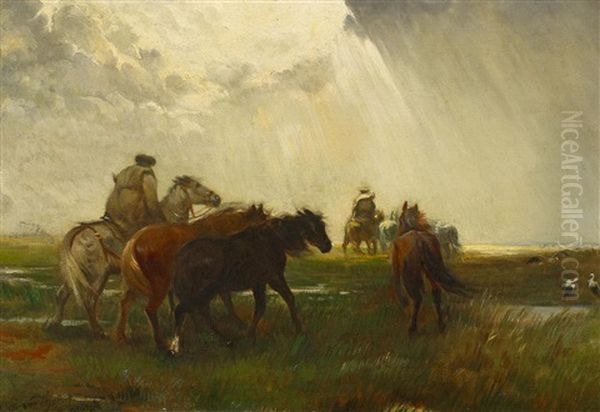
Karl Otto Kasimir von Thoren stands as a significant, if sometimes overlooked, figure in 19th-century European art. An Austrian painter of considerable skill, he navigated the worlds of military service, aristocratic portraiture, and the evocative depiction of animal life with a distinctive flair. His canvases, rich in detail and imbued with a keen observational power, offer a window into the pastoral landscapes and societal echelons of his time. Born in Vienna and ultimately passing in Paris, Thoren's life and career spanned a period of immense artistic and social change, yet his work largely remained rooted in a tradition that valued realism, narrative, and technical proficiency.
Early Life and Foray into Military Service
Born in the imperial capital of Vienna on July 21, 1828, Karl Otto Kasimir von Thoren's early life was set against the backdrop of the Austrian Empire, a hub of culture and tradition. The "von" in his name suggests a connection to the nobility or a family of established standing, which often provided access to education and societal connections beneficial for an aspiring artist. However, before fully dedicating himself to the arts, Thoren embarked on a military career.
In 1846, he became an officer, a path not uncommon for young men of his social standing. This military experience was not merely a brief interlude; it included active service. Notably, Thoren participated in the Hungarian campaign of 1848. This period of military involvement, with its demands for discipline, observation, and direct experience of varied terrains and the robust life of cavalry and campaigns, likely honed skills that would later serve him well in his artistic endeavors, particularly in his dynamic portrayals of horses and outdoor scenes. The exposure to the landscapes of Hungary, especially the Puszta, would also leave a lasting impression, becoming a recurring theme in his oeuvre.
Artistic Formation in Brussels and Emerging Style
Following his military service, Thoren's path turned decisively towards art. While details of his earliest artistic training are not extensively documented, a significant period of his development occurred in Brussels. The Belgian capital, during the mid-19th century, was a vibrant artistic center, benefiting from its unique position between French and Dutch artistic traditions. It fostered a strong school of Realism, and its Royal Academy of Fine Arts was a respected institution.
Thoren's time in Brussels, where he both studied and worked, would have exposed him to a rich artistic milieu. Belgian art of this era saw accomplished animal painters like Eugène Joseph Verboeckhoven, known for his meticulously rendered livestock and pastoral scenes. While direct tutelage under a specific master in Brussels isn't clearly recorded, the environment itself, with artists like Hendrik Leys, who focused on historical genre scenes with a strong realist bent, or Alfred Stevens, known for his elegant portrayals of contemporary women, would have provided a stimulating atmosphere. The influence of the French Barbizon School, with painters like Constant Troyon who excelled in animal and landscape painting, was also palpable across Europe, and Brussels would not have been an exception. It's plausible that Thoren absorbed these influences, refining his technique and developing his preference for animal subjects and naturalistic landscapes.
The Animalier and Landscape Painter
It was in the realm of animal painting, or "animalier" art, that Karl Otto Kasimir von Thoren truly distinguished himself. His depictions of horses, cattle, and other animals were characterized by anatomical accuracy, a sense of movement, and an empathy for his subjects. He didn't merely paint animals as static figures; he captured their spirit, their power, and their place within their environment. This was a period when animal painting was gaining considerable respect, moving beyond mere agricultural illustration to become a recognized genre in its own right, championed by artists like the French painter Rosa Bonheur, whose monumental work The Horse Fair (1852-55) had achieved international acclaim.
Thoren's military background, particularly his experience with cavalry, undoubtedly provided him with an intimate understanding of equine anatomy and movement. His horses are not idealized creatures but robust, living beings, whether depicted in a royal procession, pulling a carriage, or roaming free on the plains. This focus on realism aligned with broader artistic trends of the mid-19th century, which saw a move away from Romantic idealization towards a more direct observation of the world.
His landscapes, often serving as settings for his animal subjects, were rendered with similar attention to detail and atmosphere. The Hungarian Puszta, a vast, flat grassland, became a signature subject. These paintings evoke a sense of open space, the harsh beauty of the plains, and the traditional lives of the herdsmen and their animals. Works like In der Puszta (1863) exemplify this aspect of his art, showcasing his ability to capture the unique light and character of this distinctive European landscape. He shared this interest in specific, characterful landscapes with artists of the Barbizon School, such as Théodore Rousseau and Jean-Baptiste-Camille Corot, though Thoren's focus remained more on the figures and animals within the landscape.
Portraiture and Aristocratic Commissions
Beyond his celebrated animal and landscape scenes, Thoren was also an accomplished portrait painter. His skills in this genre naturally led to commissions from aristocratic and royal patrons, who sought artists capable of capturing not only a likeness but also the status and dignity of the sitter. His ability to integrate sitters with their prized animals, particularly horses, made him a sought-after artist for equestrian portraits.
One of his most notable works in this vein is the Equestrian Portrait of the Belgian Royal Family, dated to 1863. This painting reportedly depicts King Leopold I of Belgium (reigned 1831-1865) and Queen Marie Henriette (Marie Henriette of Austria, who married the future Leopold II in 1853 and was thus Duchess of Brabant at this time). Such a commission underscores Thoren's standing and his acceptance within high society. Royal portraiture was a prestigious field, dominated by artists like Franz Xaver Winterhalter, who painted many of Europe's crowned heads. Thoren's contribution to this genre, particularly with its dynamic equestrian element, showcased his versatile talents. The painting, set against the backdrop of the Château de Laeken in Brussels, combines formal portraiture with his expertise in animal depiction and landscape.
The creation of such works required not only artistic skill but also diplomatic finesse, navigating the expectations and protocols of royal courts. These portraits served as important statements of power, lineage, and cultural refinement, and Thoren's ability to fulfill these complex requirements speaks to his professionalism and the esteem in which he was held.
Notable Works: A Closer Look
Several key works help to define Karl Otto Kasimir von Thoren's artistic legacy. Each demonstrates different facets of his skill and thematic interests.
Equestrian Portrait of the Belgian Royal Family (1863): This significant piece, as mentioned, is a prime example of his royal portraiture. The composition likely involved careful arrangement to convey both the individual likenesses and the collective dignity of the royal figures. The horses would have been rendered with Thoren's characteristic accuracy and vitality, serving not just as mounts but as symbols of status and power. The choice of the Château de Laeken as a backdrop roots the figures in a specific, recognizable Belgian royal setting. The painting's history, including its passage through the Koller auction house in Zurich and its later association with the Union Kuenstlerhaus in Prague, indicates its recognized value and importance.
In der Puszta (1863): This oil painting, measuring 50 x 74 cm, captures the essence of the Hungarian plains. It likely features herdsmen, possibly with cattle or horses, embodying the traditional way of life in this unique region. Thoren's treatment would emphasize the vastness of the landscape, the quality of light, and the hardy nature of both the people and animals who inhabited it. The Puszta was a subject that offered scope for depicting dramatic skies, expansive horizons, and the robust character of its denizens, appealing to a 19th-century taste for scenes that combined realism with a touch of the exotic or pastoral. The sale of this work by the auction house Van Ham Alte Kunst further attests to its market presence.
U vody (At the Water, 1866): This title suggests a scene of animals, perhaps cattle or horses, at a watering place – a common and popular theme in animal painting. Such scenes allowed artists to depict animals in natural, relaxed poses, interacting with each other and their environment. The year 1866 places this work firmly within his mature period. Its sale at auction in 2019 for approximately 3600 Euros indicates a continued appreciation for his work among collectors. The depiction of water would also have offered Thoren an opportunity to showcase his skill in rendering reflections and the interplay of light on different surfaces.
These works, among others, highlight Thoren's consistent engagement with themes of animal life, landscape, and human interaction with the natural world, often through the lens of aristocratic or rural society.
The Artistic Milieu: Vienna, Brussels, and Paris
Thoren's career unfolded across several major European artistic centers, each with its own distinct character. His Viennese origins placed him in a city with a rich imperial tradition, where artists like Hans Makart would later dominate the Ringstrasse era with opulent historical and allegorical paintings. While Thoren's style was generally more subdued and naturalistic than Makart's flamboyant historicism, Vienna provided a foundational cultural context.
His formative years in Brussels, as discussed, exposed him to a blend of influences. The city was a significant center for Realism and for high-quality animal and genre painting. Artists like Joseph Stevens, brother of Alfred Stevens and also an accomplished animal painter, were part of this Belgian scene.
Later in his career, Thoren spent considerable time in Paris, which was, by the latter half of the 19th century, the undisputed capital of the Western art world. Paris was a crucible of artistic innovation, home to the official Salons, which were crucial for an artist's reputation and commercial success, but also to emerging avant-garde movements. While Thoren's work did not align with the radicalism of Impressionism, which was taking root during his later years with artists like Claude Monet, Edgar Degas (who himself was a master of depicting horses in motion), and Pierre-Auguste Renoir, he would have been aware of these developments. His presence in Paris suggests an ambition to engage with this central art market. He likely exhibited at the Paris Salon, a common aspiration for artists seeking international recognition. The city also offered a sophisticated clientele and a network of dealers and fellow artists. His style, with its polished realism and appealing subject matter, would have found an audience there, even amidst the ferment of newer artistic ideas. The influence of established French animal painters like Constant Troyon or the legacy of earlier masters like Théodore Géricault, whose dramatic portrayals of horses were iconic, would have been part of the Parisian artistic atmosphere.
Later Life and Legacy
Karl Otto Kasimir von Thoren continued to paint throughout his life, maintaining a reputation for his specialized subjects. He passed away in Paris on July 15, 1889, just shy of his 61st birthday. His death occurred during a transformative period in art history, as Post-Impressionism was beginning to emerge with artists like Vincent van Gogh and Paul Gauguin, pushing the boundaries of expression far beyond the realist traditions Thoren largely upheld.
Thoren's legacy lies in his skilled contribution to 19th-century animal painting, landscape, and portraiture. He was not a radical innovator in the vein of the Impressionists, but rather a master craftsman working within established, yet still highly valued, genres. His paintings are prized for their meticulous detail, their sympathetic portrayal of animals, and their evocation of specific environments, from the royal parks of Brussels to the expansive plains of Hungary.
His work is represented in various collections and continues to appear at art auctions, demonstrating an enduring interest. He occupies a niche as a specialist, particularly admired by those who appreciate traditional equine art and depictions of 19th-century rural and aristocratic life. While perhaps not as widely known today as some of his more revolutionary contemporaries, Karl Otto Kasimir von Thoren remains an important representative of a significant strand of 19th-century European painting, one that valued keen observation, technical skill, and the depiction of the world with clarity and empathy. His paintings offer a glimpse into a world where the relationship between humans, animals, and the landscape was central to both daily life and artistic representation. His contemporaries in Austria might have included artists like August von Pettenkofen, also known for his scenes of Hungarian life, or landscape painters of the Austrian school who focused on the Alpine scenery, providing a different but related national artistic context.
Conclusion: An Enduring Appeal
Karl Otto Kasimir von Thoren's art continues to resonate through its honest depiction and technical assurance. From the disciplined life of a military officer to the esteemed position of a court-favored painter, his journey was one of dedication to his craft. His canvases, whether capturing the spirited energy of a horse, the serene expanse of the Puszta, or the dignified presence of royalty, speak of a deep connection to his subjects. In an era of burgeoning industrialization and societal upheaval, Thoren’s work often harked back to more pastoral or traditionally ordered worlds, finding beauty and significance in the animal kingdom and the enduring landscapes they inhabited. He remains a testament to the lasting power of realist painting and a valuable chronicler of the 19th-century European scene, holding his own among a generation of skilled painters who documented and interpreted their world with precision and artistry. His contributions to animal and portrait painting ensure his place in the annals of art history.