Paul De Castro, a painter whose life and career spanned a period of profound artistic transformation, remains a figure worthy of deeper exploration within the vibrant tapestry of early 20th-century European art. Born in 1882 and passing away in 1939, De Castro's artistic journey coincided with the twilight of Impressionism, the explosive arrival of Fauvism and Cubism, and the flourishing of the diverse international community of artists known as the École de Paris (School of Paris). While perhaps not achieving the household-name status of some of his contemporaries, De Castro carved out a distinct niche, capturing the essence of his time with a sensitive eye and an expressive brush. His work, often characterized by intimate cityscapes, evocative landscapes, and thoughtful portraits, offers a valuable window into the artistic currents and the lived experience of his era.
Early Influences and Artistic Awakening
The late 19th century, the period of Paul De Castro's formative years, was an electrifying time for the visual arts in France. The Impressionist revolution, spearheaded by artists like Claude Monet, Camille Pissarro, and Pierre-Auguste Renoir, had irrevocably altered the course of painting, emphasizing light, color, and fleeting moments captured en plein air. Following them, the Post-Impressionists, a diverse group including Paul Cézanne, Vincent van Gogh, Paul Gauguin, and Georges Seurat, pushed the boundaries further, exploring structure, emotion, symbolism, and scientific color theory.
It was into this dynamic environment that De Castro emerged. While specific details of his early training may not be as extensively documented as those of more prominent figures, it is evident that he absorbed these prevailing influences. The emphasis on direct observation, the liberation of color from purely descriptive purposes, and the growing interest in subjective expression would have been part of the artistic air he breathed. The legacy of Cézanne, with his methodical construction of form and space, and Van Gogh, with his emotionally charged brushwork and vibrant palette, undoubtedly left an imprint on many aspiring artists of De Castro's generation.
Navigating the Parisian Art Scene: Fauvism and the École de Paris
As Paul De Castro matured as an artist in the early 1900s, Paris was the undisputed epicenter of the art world. New movements were emerging with bewildering rapidity. Fauvism, which exploded onto the scene at the 1905 Salon d'Automne, championed pure, unadulterated color and bold, non-naturalistic forms. Artists like Henri Matisse, André Derain, and Maurice de Vlaminck shocked and exhilarated audiences with their "wild" use of pigment. While De Castro may not be classified as a core member of the Fauvist group, the movement's daring approach to color likely resonated with him and can be seen as an undercurrent in his own developing palette, encouraging a more expressive and less representational use of hues.
More significantly, De Castro became associated with the École de Paris. This was not a formal school or a unified movement with a manifesto, but rather a term describing the remarkable concentration of artists, many of them émigrés, who flocked to Paris, particularly to the neighborhoods of Montmartre and later Montparnasse, from the early 20th century until World War II. This vibrant community included figures from across Europe and beyond, such as Amedeo Modigliani from Italy, Chaïm Soutine and Marc Chagall from Russia, Moïse Kisling from Poland, Jules Pascin from Bulgaria (via Vienna and Munich), and Tsuguharu Foujita from Japan.
The École de Paris was characterized by its stylistic diversity, its internationalism, and often a shared sense of bohemianism and a quest for individual expression. Artists within this milieu explored various forms of modernism, from lingering Post-Impressionist sensibilities to Cubist-influenced figuration, Expressionism, and unique personal styles. De Castro found his place within this eclectic environment, contributing his own distinct voice to the chorus of modern art. His work often reflects the School of Paris's interest in figuration, albeit filtered through a modern lens, and a focus on capturing the human element and the atmosphere of contemporary life.
Themes and Subjects: The Urban Landscape and Human Presence
Paul De Castro's oeuvre demonstrates a keen interest in the world around him, particularly the urban environment of Paris. His street scenes are not merely topographical records but are imbued with a sense of atmosphere and the rhythm of daily life. He was adept at capturing the play of light on buildings, the bustle of pedestrians, and the unique character of different Parisian quartiers. These works often possess a certain intimacy, drawing the viewer into the scene rather than presenting a grand, detached panorama. One can imagine him sketching in the streets, absorbing the nuances of the city that was a muse to so many artists.
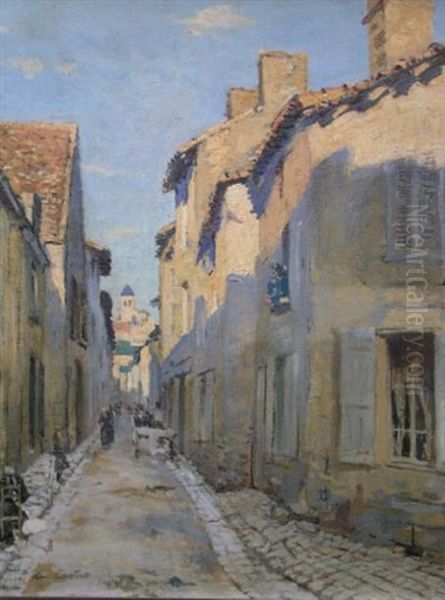
His painting "Ruelle animée" (Animated Alleyway) is a prime example of this focus. The title itself suggests an interest in the vitality of urban spaces, even the more modest or hidden ones. Such works often feature a lively interplay of figures, architecture, and light, rendered with an expressive handling of paint that conveys both the visual information and the emotional tone of the scene. In this, his work might share a certain affinity with other painters of Parisian life, such as Maurice Utrillo, who was renowned for his depictions of Montmartre, though De Castro's style often carried a different chromatic sensibility.
Beyond the city, De Castro also turned his attention to landscapes, likely painted during excursions outside Paris or travels further afield. These landscapes often showcase his ability to capture the specific light and color of a region, whether it be the softer light of northern France or the more intense luminosity of the south, a region that had famously captivated Van Gogh and Cézanne before him, and continued to attract artists like Pierre Bonnard and Henri Matisse.
Portraits and figure studies also form a part of De Castro's body of work. In these, he often sought to convey the personality and inner life of his subjects, moving beyond mere likeness to explore character. This aligns with a broader trend in early 20th-century portraiture, where artists like Modigliani, with his elegantly elongated figures, or Soutine, with his intensely expressive and psychologically charged portraits, were redefining the genre.
Artistic Style: Expressive Color and Lyrical Brushwork
Paul De Castro's style is generally characterized by a vibrant and expressive use of color, often applied with a visible, energetic brushstroke. He was not afraid to depart from strict naturalism in his color choices, instead using color to build form, create mood, and enhance the emotional impact of his compositions. This places him firmly within the post-Impressionist tradition, where color became a more autonomous and expressive element of painting.
His brushwork, often fluid and dynamic, contributes to the sense of life and movement in his paintings. There is a certain lyricism to his application of paint, avoiding a tight, overly finished appearance in favor of a more spontaneous and direct engagement with the medium. This approach allowed him to capture the fleeting qualities of light and atmosphere, a concern he shared with the Impressionists, but translated into a more modern, subjective idiom.
While he engaged with the modern artistic currents of his time, De Castro's work generally remained rooted in figuration. He did not venture into pure abstraction in the way that artists like Wassily Kandinsky or Piet Mondrian did. Instead, his modernism lay in his expressive interpretation of the visible world, his bold use of color, and his dynamic compositions. His paintings often achieve a harmonious balance between representation and painterly expression, where the subject matter is clearly discernible, yet the artist's hand and emotional response are equally evident.
Comparisons can be drawn to other artists of the École de Paris who navigated a similar path between tradition and modernity. For instance, artists like Moïse Kisling or Kees van Dongen (who had strong Fauvist roots) also combined vibrant color with figurative subjects, each developing a highly personal style. De Castro's work, while perhaps more subdued than the sometimes flamboyant canvases of Van Dongen, shares that commitment to expressive color and a modern sensibility grounded in observable reality.
Representative Works and Their Characteristics
While a comprehensive catalogue raisonné of Paul De Castro's work might be a subject for specialized art historical research, "Ruelle animée" stands out as a representative example of his urban scenes. In such a work, one would expect to see his characteristic approach: a composition that draws the eye into the depth of the alley, figures suggested with lively brushstrokes rather than precise detail, and a palette that captures the specific light conditions – perhaps the cool shadows of a narrow street contrasted with patches of sunlight, or the diffuse glow of an overcast Parisian day. The "animated" quality would come from the implied movement of people and the overall vibrancy of the paint application.
His landscapes would likely exhibit a similar approach, with color used to define the forms of trees, hills, and skies, and brushwork conveying the texture of foliage or the expanse of the terrain. The mood could range from serene and contemplative to more dynamic and windswept, depending on the scene and De Castro's interpretation. One might see echoes of the structural concerns of Cézanne in the way he renders forms, or the heightened emotionalism of Van Gogh in his use of color and energetic lines, all synthesized into his own visual language.
In his portraits, De Castro would have focused on capturing not just a physical resemblance but also the psychological presence of the sitter. The brushwork might be more controlled in some areas, such as the face, to convey subtle expressions, while the treatment of clothing or the background could be looser and more expressive. The use of color would play a crucial role in setting the mood and highlighting aspects of the subject's personality. These works would contribute to the rich tradition of portraiture within the École de Paris, where artists often painted each other and members of their bohemian circle.
It is important to note the confusion that sometimes arises with artists sharing similar names. For instance, the provided information initially mixed up Paul De Castro (1882-1939) with other individuals, including Sergio de Castro (1922-2012), an Argentinian-French painter and musician of a later generation known for his abstract and figurative works, including still lifes and stained glass. Works like "Feuilles et fleurs" (2007) or "La Grande table-colonne" (1954) belong to Sergio de Castro, not the Paul De Castro who is the subject of this discussion, as they were created well after Paul De Castro's death in 1939. Similarly, references to geometric abstractionism or Brazilian Neo-Realism pertain to other artists, not the French Paul De Castro (1882-1939) whose career was centered in Paris and aligned with Post-Impressionist and École de Paris tendencies.
The Broader Context: Art in a Time of Change
To fully appreciate Paul De Castro's contribution, it is essential to consider the tumultuous and exhilarating period in which he worked. The early 20th century witnessed not only artistic revolutions but also profound social, political, and technological changes. World War I (1914-1918) cast a long shadow over Europe, deeply affecting the lives and outlooks of many artists. The interwar period, despite economic challenges, was a time of intense creative ferment in Paris.
De Castro's commitment to capturing the life of the city and the character of its inhabitants can be seen as a form of bearing witness to his time. His paintings offer glimpses into a world that was rapidly modernizing, yet still retained many of its traditional charms and human-scale interactions. In this, his work complements that of photographers like Eugène Atget, who documented "Old Paris," or painters like Édouard Vuillard and Pierre Bonnard, who, though associated with the earlier Nabi movement, continued to create intimate scenes of domestic life and urban views well into the 20th century.
The diversity of the École de Paris itself reflected the changing demographics and cultural exchanges of the era. Artists brought with them traditions and perspectives from their home countries, enriching the artistic dialogue in Paris. De Castro, as a French artist working within this international milieu, would have been part of this cross-pollination of ideas and styles. His work, while rooted in French artistic traditions, also partakes of the broader modernist spirit that characterized the School of Paris.
Legacy and Historical Assessment
Paul De Castro may not be as widely celebrated as some of the towering figures of modern art, but his work holds a legitimate place in the history of early 20th-century painting. He was a skilled and sensitive artist who contributed to the rich visual culture of his time, particularly within the context of the École de Paris. His paintings offer a personal and expressive vision of the world, characterized by a pleasing use of color, lively brushwork, and an ability to capture atmosphere and mood.
His street scenes, landscapes, and portraits provide valuable insights into the subjects that preoccupied artists of his generation and the stylistic means they employed to interpret them. He successfully navigated the currents of Post-Impressionism and the emerging modernisms of the early 20th century, developing a style that was both individual and reflective of its time. Artists like De Castro, who may not have been radical innovators but were talented practitioners and interpreters of prevailing artistic ideas, form the essential fabric of any art historical period. They help to flesh out our understanding of an era, providing a broader and more nuanced picture than can be obtained by focusing solely on a few famous names.
Further research into his exhibition history, critical reception during his lifetime, and the current whereabouts of his major works would undoubtedly enrich our understanding of his career and significance. For now, based on available information and representative works like "Ruelle animée," Paul De Castro emerges as an artist who merits appreciation for his skillful and evocative depictions of Parisian life and the broader world he observed, rendered with a modern sensibility and a distinctive artistic voice. His paintings serve as a quiet but eloquent testament to the enduring power of art to capture the spirit of a time and place.
In conclusion, Paul De Castro (1882-1939) was an artist who, working in the vibrant heart of Paris, absorbed the lessons of Post-Impressionism and contributed to the diverse artistic landscape of the École de Paris. His paintings, characterized by expressive color, lyrical brushwork, and a focus on urban scenes, landscapes, and human subjects, offer an intimate and engaging perspective on the early 20th century. He remains a noteworthy figure for those interested in the rich tapestry of French modern art, a painter who captured the world around him with sensitivity and skill, leaving behind a body of work that continues to resonate with its quiet charm and painterly intelligence.