Philips de Momper the Elder stands as a notable, if sometimes overlooked, figure in the rich tapestry of Flemish Baroque painting. Active primarily in Antwerp during the late sixteenth and early seventeenth centuries, he was a dedicated landscape painter who navigated the stylistic shifts from late Mannerism towards a more naturalistic and evocative depiction of the natural world. Born into an extensive and influential artistic dynasty, his work contributed to the flourishing Antwerp school, a vibrant center of artistic production and innovation in Europe. His career, though perhaps not as globally renowned as some of his direct contemporaries, offers valuable insights into the collaborative artistic environment of the time and the evolving aesthetics of landscape art.
An Artistic Heritage: The de Momper Dynasty
The de Momper family was a significant force in the Antwerp art scene for several generations. Philips de Momper the Elder was the son of Bartholomeus de Momper, who was not only a painter but also an art dealer and print publisher. This familial immersion in the multifaceted art world undoubtedly provided Philips with an early and comprehensive education in both the creation and commerce of art. The most celebrated member of this dynasty was Joos de Momper II (1564-1635), a highly prolific and influential landscape painter. While the exact familial relationship in the provided information has some ambiguities, art historical consensus generally places Philips de Momper (often referred to as Philips de Momper I or the Younger, c. 1598–1634) as the son of the famous Joos de Momper II. This connection would have placed him directly within one of the most active and successful landscape painting workshops in Antwerp.
This workshop environment, typical of the era, was a hub of learning and production. Apprentices and family members often contributed to the master's output, learning the trade through direct participation. Philips would have been trained in the established techniques and stylistic conventions of his father's workshop, which specialized in imaginative mountain landscapes, winter scenes, and panoramic vistas. The de Momper workshop was known for its efficient production methods, often involving collaboration where different artists specialized in particular elements, such as figures, animals, or specific landscape features.
Other members of the de Momper family also pursued artistic careers, including Philips's brother, Frans de Momper (1603-1660), who also became a landscape painter, though with a style that evolved somewhat differently. The legacy of the de Momper name was thus carried forward by several individuals, each contributing to the broad genre of landscape painting that was exceptionally popular in the Low Countries.
Early Career and Guild Affiliation
Following his formative training, likely within his father Joos de Momper II's studio, Philips de Momper the Elder embarked on his independent career. A crucial step for any professional artist in Antwerp was membership in the Guild of Saint Luke. This venerable institution regulated the art trade, set standards for craftsmanship, and provided a framework for the training of apprentices. Philips de Momper the Elder is recorded as becoming a master in the Antwerp Guild of Saint Luke in the guild year 1622-1623. This official recognition marked his status as an independent artist qualified to take on his own commissions and apprentices.
His involvement with the Guild did not end with mere membership. At some point, he also held the esteemed position of dean of the Guild. This role would have involved administrative responsibilities, upholding the guild's statutes, and representing the interests of its members. Serving as dean was a mark of respect and standing within the artistic community, indicating that Philips was a recognized and respected figure among his peers. His active period as a painter is generally considered to be from the early 1620s until his death, which is recorded as occurring in 1634 in Antwerp.
Artistic Style: Bridging Mannerism and Naturalism
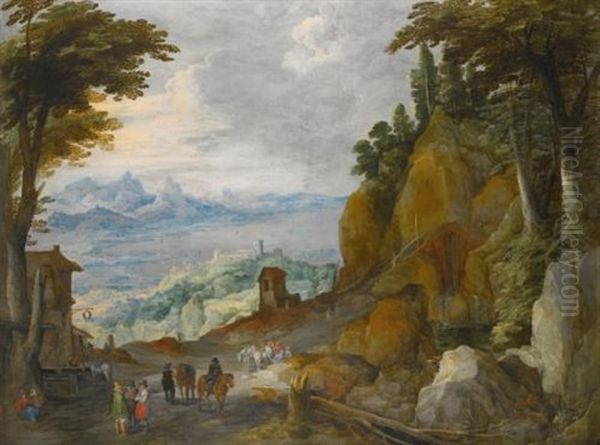
Philips de Momper the Elder's artistic output consisted primarily of landscapes. His style reflects the broader trends in Flemish landscape painting of his time, which was undergoing a significant transition. He inherited the late Mannerist tendencies prevalent in the work of artists like his father, Joos de Momper II, and earlier masters such as Gillis van Coninxloo. These Mannerist landscapes often featured dramatic, fantastical mountain ranges, elevated viewpoints, and a conventionalized color scheme—typically a progression from brownish foregrounds, through greenish middle grounds, to bluish backgrounds, designed to create a sense of atmospheric perspective.
However, Philips's work also shows an increasing inclination towards a more naturalistic and realistic representation of the environment, a trend heavily influenced by the groundbreaking work of Pieter Bruegel the Elder a generation earlier. Bruegel’s keen observation of nature and peasant life had a profound and lasting impact on landscape painting in the Low Countries. Philips de Momper sought to combine the imaginative scope of Mannerist tradition with a greater fidelity to observed reality. His paintings often feature expansive vistas, rugged mountains, and wooded scenes, populated with small figures that animate the landscape and provide a sense of scale.
His brushwork could be bold and his colors vivid, contributing to a lively and expressive quality in his paintings. While some art historians have occasionally described his forms as somewhat "stiff" or "formalized," this can also be seen as a characteristic of the transitional period in which he worked, where established conventions were gradually giving way to new modes of representation. His compositions often employed a high viewpoint, allowing for a sweeping panoramic effect, a hallmark of the "world landscape" tradition pioneered by Joachim Patinir and further developed by Bruegel.
The Italian Influence: A Sojourn in Rome
Travel to Italy, particularly Rome, was a rite of passage for many Northern European artists during the Renaissance and Baroque periods. The allure of classical antiquity and the works of Italian Renaissance masters drew artists southward, seeking inspiration and refinement of their skills. Philips de Momper the Elder is believed to have undertaken such a journey. During his time in Italy, possibly in the early 1620s before becoming a master in Antwerp, he is thought to have spent time in Rome.
This period in Rome was likely formative. He would have encountered a vibrant international community of artists and been exposed to a wide range of influences. One significant connection from this period was with Jan Brueghel the Younger (1601-1678), son of the renowned Jan Brueghel the Elder (the "Velvet Brueghel"). Reports suggest that Philips traveled with Jan Brueghel the Younger in Rome. This association is noteworthy, as the Brueghel family was at the forefront of developing detailed, jewel-like landscapes and flower paintings. Exposure to the Brueghels' meticulous technique and their approach to landscape, which often blended Flemish traditions with Italianate elements, would have been invaluable.
While in Rome, Philips may also have been influenced by the works of other landscape painters active there, such as the German artist Adam Elsheimer, known for his poetic small-scale landscapes with innovative light effects, and the Flemish expatriate Paul Bril, who had a long and successful career in Rome painting landscapes that often incorporated ancient ruins and a softer, more Italianate light. The frescoes in churches like San Vitale, with their early Christian mosaics and later decorative schemes, might also have offered artistic stimuli, although direct influence on his landscape style is harder to pinpoint.
Collaborations: The Antwerp Tradition
Collaboration between artists specializing in different genres was a common and distinctive feature of Antwerp painting in the 17th century. Landscape painters frequently teamed up with figure painters (staffage painters) to populate their scenes, as the latter often had greater skill in rendering human and animal forms. Philips de Momper the Elder participated in this collaborative culture.
One of the most significant collaborations would have been within his own family workshop. It is documented that sons often painted figures or specific parts of landscapes for their fathers. If Philips worked in Joos de Momper II's studio, he might have contributed figures or other elements to his father's numerous canvases. This was a practical way to increase workshop output and train younger artists.
Beyond the family, Philips is known to have collaborated with other artists. His association with Jan Brueghel the Younger in Italy suggests a close working relationship, and it's plausible they collaborated on paintings, with one perhaps providing the landscape and the other the figures or specific details.
He was also involved in decorative painting projects. One such project mentioned is a collaboration with the architect and sculptor Cornelis Floris de Vriendt (though Floris died in 1575, so this might refer to a project involving Floris's designs or a member of his workshop, or perhaps a different Cornelis). If the collaboration was with Floris himself, it would place Philips's activity much earlier or indicate a misunderstanding in the source. However, participation in larger decorative schemes, such as murals for civic or private buildings, was not uncommon for versatile artists. For instance, he is noted to have worked on decorative paintings for the Arcadia Society in Antwerp, possibly alongside other artists like Adam van Noort (one of Rubens's teachers) and Tobias Verhaecht (another prominent landscape painter and Rubens's first teacher, who also specialized in mountain scenes). Tobias Vercruyssen is also mentioned as a collaborator, likely in similar decorative ventures.
These collaborations highlight the interconnectedness of the Antwerp art world, where artists with different specializations pooled their talents. This practice not only enhanced the quality and appeal of the artworks but also fostered a dynamic exchange of ideas and techniques. Other notable Antwerp contemporaries who frequently engaged in collaborations included Peter Paul Rubens himself, who often had landscapes in his paintings executed by specialists like Jan Wildens, and Jan Brueghel the Elder, who famously collaborated with Rubens on paintings such as "The Garden of Eden."
Representative Works and Thematic Focus
Identifying specific, securely attributed works by Philips de Momper the Elder can sometimes be challenging due to the workshop practices of the time and the sheer volume of landscapes produced by the de Momper family. Signatures were not always consistently applied, and stylistic similarities can make attributions difficult. However, his oeuvre is generally characterized by mountainous and wooded landscapes.
One of his representative works often cited is a Mountain Landscape dated to around 1623, which is now in a private collection. Such works typically showcase his characteristic blend of imaginative topography with an emerging naturalism. These mountain scenes often feature winding paths, distant castles or villages, and small figures of travelers or peasants, which add narrative interest and emphasize the grandeur of nature.
His repertoire would have also included winter landscapes, a popular theme in Flemish art, allowing for explorations of light, atmosphere, and the depiction of snow and ice. Forest interiors, with dense foliage and filtered light, were another common subject. The influence of Pieter Bruegel the Elder's iconic series of the "Months," which included masterful depictions of different seasons and landscapes, resonated through generations of Flemish landscape painters, including Philips de Momper.
The murals for the Arcadia Society in Antwerp, though likely no longer extant or identifiable, point to his involvement in larger-scale decorative projects. Such commissions often required artists to adapt their style to architectural settings and specific thematic programs, showcasing their versatility.
Patronage and Reception
Philips de Momper the Elder's landscapes found favor with collectors. The provided information notes that his works were collected by Antwerp's political elite. This indicates a level of success and recognition within his own time. Antwerp, despite political and economic challenges in the late 16th and early 17th centuries, remained a wealthy city with a discerning clientele for art. Merchants, nobles, and civic leaders adorned their homes with paintings, and landscapes were a particularly popular genre, offering an escape into idealized or exotic natural settings.
The demand for landscapes was fueled by a growing appreciation for nature itself, as well as by the desire for artworks that were both decorative and evocative. The de Momper workshop, with its efficient production, was well-positioned to meet this demand. The popularity of their style, characterized by dramatic scenery and often a sense of expansive space, appealed to contemporary tastes. Artists like David Teniers the Younger, though of a slightly later generation, also found immense success with landscape and genre scenes, indicating the sustained market for such works.
The Broader Context: The Antwerp School
Philips de Momper the Elder operated within the vibrant ecosystem of the Antwerp School of painting. During the 17th century, Antwerp was a leading artistic center in Europe, rivaled perhaps only by Rome and later Amsterdam. This period saw the towering presence of Peter Paul Rubens, whose dynamic Baroque style had an international impact. Anthony van Dyck, Rubens's most gifted pupil, achieved fame as a portraitist, while Jacob Jordaens produced robust genre scenes and mythological paintings.
Within this environment, landscape painting carved out its own significant niche. Artists like Jan Brueghel the Elder, Jan Wildens, Lucas van Uden, Abraham Govaerts, and Alexander Keirincx specialized in various types of landscapes, from meticulous "paradise landscapes" to expansive river views and intimate forest scenes. Philips de Momper's work fits into this tradition, contributing to the diversity and richness of Flemish landscape art. The exchange of ideas was constant, with artists influencing one another through direct contact, shared apprentices, and the circulation of prints after their paintings.
Anecdotes and Later Life
One specific historical anecdote sheds light on the practical, business side of the art world and family matters. In 1662, a Philips de Momper (this date is problematic if our Philips died in 1634, suggesting it might be a different family member or a confusion in the source material regarding the specific Philips) acted as the son and heir of Frans de Momper. This Philips authorized a ship's captain to retrieve all paintings stored with a certain Dirck Ulbrecht in Hamburg, with the intent to sell them. This incident, regardless of which Philips it refers to, illustrates the international nature of the art trade, with paintings being shipped and stored in different cities, and the role artists or their heirs played in managing artistic estates. If this refers to our Philips de Momper the Elder, it would require a significant revision of his death date, pushing it much later, which contradicts the 1634 date generally accepted for Joos II's son. It is more likely this anecdote refers to a different Philips de Momper or there's a conflation of identities or dates in the source. Assuming the 1634 death date for Philips, son of Joos II, this anecdote would not apply to him.
The death date of Philips de Momper the Elder (son of Joos II) is generally cited as 1634 in Antwerp. The provided information contains a conflicting death year of 1675, and another of 1642, which creates ambiguity. However, based on his entry into the guild in 1622/23 and his known period of activity, a death in 1634 seems most consistent for the son of Joos de Momper II.
Legacy and Historical Position
Philips de Momper the Elder occupies a position as a skilled practitioner within a prominent artistic family, contributing to the evolution of Flemish landscape painting. His work embodies the transition from the imaginative, often fantastical, landscapes of late Mannerism to a more naturalistic and empirically observed approach to depicting the world. While perhaps not an innovator on the scale of Pieter Bruegel the Elder or Rubens, his paintings reflect the high standards of craftsmanship and artistic vitality of the Antwerp school.
He played a role in popularizing landscape as an independent genre and in developing its various sub-types, such as mountain landscapes and winter scenes. His engagement with Italian art, particularly through his travels and association with artists like Jan Brueghel the Younger, demonstrates the cross-cultural currents that enriched Flemish painting. The collaborative nature of his practice further underscores the interconnectedness of the Antwerp artistic community.
His influence, along with that of his father Joos de Momper II and other contemporaries like Paul Bril and Tobias Verhaecht, helped to shape the direction of landscape painting in the Low Countries. Later generations of artists, including those of the Dutch Golden Age, built upon the foundations laid by these Flemish masters, further developing naturalism and atmospheric effects in landscape art. Figures like Jacob van Ruisdael and Meindert Hobbema in the Dutch Republic, for example, pushed landscape painting to new heights of realism and emotional depth, but the groundwork was laid by earlier generations, including the de Momper family.
In conclusion, Philips de Momper the Elder was a dedicated and proficient landscape painter who made a solid contribution to the Flemish artistic tradition. As a member of an important artistic dynasty, a master in the Guild of Saint Luke, and a collaborator with notable contemporaries, he was an active participant in the vibrant art world of 17th-century Antwerp. His works, characterized by their expansive views and transitional style, offer a window into the evolving aesthetics of landscape painting during a pivotal period in European art history.