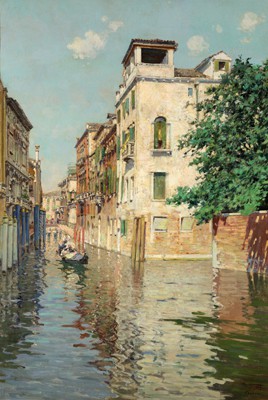
Raffaele Tafuri (1857-1929) stands as a notable figure in the vibrant tapestry of late 19th and early 20th-century Italian art. Primarily a painter, he dedicated his artistic endeavors to capturing the ephemeral beauty and unique atmosphere of Venice, his lifelong home. His work is generally classified within the Italian Post-Impressionist movement, a period characterized by a departure from the strict observational naturalism of Impressionism towards more subjective and expressive interpretations of reality. Tafuri's legacy, though perhaps not as globally renowned as some of his contemporaries, offers a valuable insight into the artistic currents of his time, particularly within the rich tradition of Venetian painting.
This exploration will delve into the life and work of Raffaele Tafuri the painter, examining his artistic style, his contributions to the Venetian School, and his place among his peers. It will also, by necessity of the information available, touch upon broader intellectual and art-historical discussions associated with the Tafuri name, which sometimes encompass figures and works beyond the painter himself, reflecting a complex web of art, architecture, and critical theory that emerged from Italy in the subsequent decades.
The Life and Artistic Milieu of Raffaele Tafuri (1857-1929)
Born in 1857, Raffaele Tafuri came of age during a period of significant artistic transition in Italy and across Europe. The unification of Italy (the Risorgimento) had concluded, fostering a new national consciousness that also found expression in the arts. In Venice, the legacy of past masters like Titian, Veronese, and Tintoretto, and later Canaletto and Guardi, provided a formidable backdrop against which new generations of artists sought to define themselves. The city itself, with its unique interplay of light, water, and architecture, remained an inexhaustible source of inspiration.
Tafuri would have likely received his academic training at the Accademia di Belle Arti di Venezia, a venerable institution that had nurtured countless artists. During the latter half of the 19th century, the Academy, like many others in Europe, was grappling with the balance between traditional academicism and the burgeoning modern art movements. Impressionism, originating in France, had begun to send ripples across the continent, encouraging artists to paint en plein air and to focus on capturing fleeting moments and the subjective experience of light and color.
While Italy developed its own responses to these trends, such as the Macchiaioli movement which predated Impressionism with its emphasis on "macchie" (patches or spots) of color, by Tafuri's active period, Post-Impressionist sensibilities were taking hold. This meant artists were not merely recording visual phenomena but were imbuing their work with greater emotional depth, symbolic content, or a focus on formal structure. For Tafuri, this translated into a sensitive and nuanced approach to his beloved Venetian landscapes.
Artistic Style: Capturing the Venetian Soul
Raffaele Tafuri's artistic style is characterized by a delicate yet assured brushwork and a rich, harmonious color palette. He was particularly adept at rendering the subtle shifts in light and atmosphere that define Venice – the hazy dawns, the shimmering reflections on the canals, the warm glow of sunset on ancient facades. His paintings often evoke a sense of poetic realism, where the fidelity to the scene is infused with a personal, almost lyrical, sensibility.
His approach can be seen as a continuation of the Venetian tradition of colorito, where color and light are paramount in creating form and mood, as opposed to the Florentine emphasis on disegno (drawing and design). However, Tafuri filtered this tradition through the lens of late 19th-century modernism. His brushstrokes, while not as broken or abstract as some of his more radical contemporaries, often display a visible texture and a concern for the painterly surface, hallmarks of Post-Impressionist tendencies. He shared this interest in capturing the essence of Venice with contemporaries like Guglielmo Ciardi and his children Beppe Ciardi and Emma Ciardi, as well as Ettore Tito and Luigi Nono (the painter).
Tafuri's subjects were predominantly the iconic vistas and intimate corners of Venice: the bustling Grand Canal, quiet side canals with their moored gondolas, lively market scenes, and architectural studies. He demonstrated a keen observational skill, capturing not just the physical appearance of the city but also its unique rhythm and character. His works often feature a masterful play of light and shadow, creating depth and volume, and imbuing his scenes with a sense of immediacy and life. Artists like Giacomo Favretto, known for his lively genre scenes of Venetian life, were also part of this vibrant artistic environment, and it is noted that Tafuri collaborated with Favretto and Guglielmo Cardi (likely Guglielmo Ciardi) in 1896, suggesting a shared artistic dialogue.
Representative Works of Raffaele Tafuri (Painter)
While a comprehensive catalogue of Raffaele Tafuri's paintings is not readily available in all sources, his oeuvre is understood through the consistent themes and stylistic qualities present in his known works. Titles often reflect his Venetian focus, such as:
Venetian Canal Scene: A typical subject, allowing for exploration of water, reflections, and architectural details.
Market Day in Venice: Capturing the vibrancy and human element of the city.
Gondolas on the Grand Canal: An iconic Venetian motif, offering opportunities to depict movement and the interplay of light on water.
Quiet Courtyard, Venice: Showcasing his ability to find beauty in the less monumental aspects of the city.
Sunset over the Lagoon: Demonstrating his skill in rendering atmospheric effects and color gradations.
These works, and others like them, would have showcased his post-impressionistic handling of paint, with attention to capturing the specific light conditions of Venice. His paintings were not merely topographical records but interpretations filtered through his artistic sensibility, aiming to convey the mood and essence of the scene. He sought to balance the truth of observation with the expressive potential of his medium, a path trodden by many Post-Impressionists like Paul Cézanne in France, who sought underlying structure, or Vincent van Gogh, who emphasized emotional expression through color and brushwork.
The Broader Intellectual Landscape: The Tafuri Name in Architectural History
It is important to note that the name "Tafuri" also resonates very strongly in a different, though related, field: architectural history and theory, primarily through the work of Manfredo Tafuri (1935-1994). While distinct from Raffaele Tafuri the painter, the prominence of Manfredo Tafuri means that discussions involving the "Tafuri" name in art and architectural discourse often lead to his influential, and sometimes controversial, body of work. To provide a comprehensive picture of the intellectual currents associated with the name, as suggested by some overlapping source materials, it is pertinent to touch upon these contributions.
Manfredo Tafuri was a highly influential architectural historian whose work profoundly impacted the study of architecture from the Renaissance to the modern period. His approach was often Marxist-inflected, critically examining the relationship between architecture, ideology, power, and capitalist development.
Key Theoretical Works Associated with Manfredo Tafuri
Several seminal texts define Manfredo Tafuri's intellectual legacy:
_Teorie e storia dell'architettura_ (Theories and History of Architecture, 1968): This early work laid the groundwork for his critical approach, challenging prevailing formalist and stylistic interpretations of architectural history. He argued for an "operative criticism," one that actively engages with contemporary architectural practice, but later grew skeptical of its efficacy.
_Progetto e utopia: Architettura e sviluppo capitalistico_ (Architecture and Utopia: Design and Capitalist Development, first published in a shorter version in Contropiano in 1969, book form 1973): Perhaps his most famous work internationally, this book offered a powerful critique of modern architecture and urbanism. Tafuri argued that the utopian aspirations of the Modern Movement were ultimately co-opted and neutralized by capitalist development, serving its needs rather than transforming society. He analyzed how avant-garde movements, despite their radical intentions, often ended up providing new forms and languages for the very system they sought to critique.
_La Sfera e il Labirinto: Avanguardie e architettura da Piranesi agli anni '70_ (The Sphere and the Labyrinth: Avant-Gardes and Architecture from Piranesi to the 1970s, 1980): Here, Tafuri explored the complex and often contradictory nature of avant-garde architectural movements. He examined figures like Giovanni Battista Piranesi, whose imaginative and often disquieting depictions of Roman ruins he saw as a precursor to modern anxieties, and traced the trajectory of avant-garde impulses through to the late 20th century, often highlighting their internal crises and their relationship with ideology.
_Venezia e il Rinascimento_ (Venice and the Renaissance, 1985): This book demonstrated his deep engagement with Renaissance Venice, analyzing its urban development, architecture, and the ideologies that shaped them. He explored how the city's unique political and economic structure influenced its architectural expression, focusing on architects like Jacopo Sansovino and Andrea Palladio.
_Ricerca del Rinascimento: Principi, città, architetti_ (Interpreting the Renaissance: Princes, Cities, Architects, his final work, published posthumously in English in 2006): This volume synthesized much of his thinking on the Renaissance, examining the complex interplay between patrons, architects, and the socio-political context. He delved into the works of architects like Brunelleschi, Alberti, and Bramante, offering nuanced readings of their contributions.
_Storia dell'architettura italiana 1944-1985_ (History of Italian Architecture 1944-1985): This work provided a detailed account of post-war Italian architecture, a period of intense reconstruction, debate, and architectural innovation, featuring architects like Carlo Scarpa, Aldo Rossi, and Franco Albini.
These writings illustrate a critical mind grappling with the role of architecture in society, its historical development, and its often-fraught relationship with political and economic forces. His work was characterized by dense prose, a vast erudition, and a polemical edge that challenged many established orthodoxies in architectural history.
Exhibitions, Activities, and the "Historical Project"
The intellectual endeavors associated with Manfredo Tafuri also extended to significant involvement in exhibitions and a broader "historical project" (progetto storico). This project aimed to re-examine architectural history through a critical lens, moving beyond mere stylistic analysis to uncover the deeper socio-political and ideological underpinnings of architectural production.
Key activities and involvements include:
1972 "Italy: The New Domestic Landscape" Exhibition (MoMA, New York): Manfredo Tafuri contributed significantly to the planning and catalogue of this landmark exhibition. It showcased innovative Italian design and architecture, but also reflected a critical awareness of consumer culture and social issues, themes central to Tafuri's own concerns. The exhibition was a pivotal moment for Italian design on the international stage and featured works and ideas from designers like Ettore Sottsass, Gae Aulenti, and Joe Colombo.
1976 Venice Biennale – "Europa-America, centro storico-suburbio": Tafuri was involved in organizing this section of the Biennale, which provoked considerable debate about modernism, urbanism, and the relationship between historical centers and suburban expansion. It pushed architects and historians to clarify their positions on these critical issues.
1960 Milan "Industrial Art Observatory" Exhibition: As a curator, he participated in exhibitions that engaged with modernism, reflecting an early interest in the relationship between art, design, and industrial production.
Critique of the 1985 Venice Architecture Biennale: Tafuri critically assessed this Biennale, particularly its impact on Venice, arguing that its push for rapid modernization could undermine the city's essential character. This reflects his ongoing concern for the integrity of historical urban environments.
His "historical project" was not just an academic exercise but an attempt to make history relevant to contemporary architectural and urban dilemmas. He believed that a rigorous, critical understanding of the past was essential for navigating the complexities of the present. This often put him at odds with architects who sought direct, unproblematic inspiration from history, as he was deeply skeptical of simplistic or nostalgic appropriations of historical forms.
Anecdotes and Formative Influences (Manfredo Tafuri)
Biographical details concerning Manfredo Tafuri shed light on the development of his critical perspective:
Childhood and WWII: Born in Rome in 1935, his early childhood was marked by the Second World War. Experiences during this period, including the need for his family to hide his Jewish grandmother, and the general atmosphere of upheaval, likely contributed to a sense of historical contingency and the impact of broad societal forces on individual lives. His early education included learning Hebrew from his grandmother.
Early Philosophical Interests: As a young man, he was exposed to French existentialist philosophy, particularly the works of Jean-Paul Sartre and Franz Kafka, through radio programs. These authors, with their themes of alienation, absurdity, and the search for meaning in a complex world, resonated deeply with him and influenced his worldview. He pursued these interests with fellow students, engaging in intensive reading and discussion.
Shift from Architecture to History: Though initially trained in architecture, he became disillusioned with what he perceived as the conservatism of some of his professors and gravitated towards architectural history and theory. This shift allowed him to develop the critical and analytical tools that would define his scholarship.
Health Issues: In later life, he suffered from heart and lung problems, which some have linked to the privations and stresses of his youth during the Nazi occupation of Rome.
Final Wishes: His decision to be buried in Rome, rather than Venice (a city he studied extensively), and the simple inscription "Architectural Historian" on his tombstone, speak to his profound dedication to his chosen field and his Roman roots.
These biographical elements paint a picture of an individual shaped by tumultuous historical events and profound intellectual curiosity, leading to a career dedicated to critically interrogating the discipline of architecture.
The Evolution of Artistic and Theoretical Styles
Returning to Raffaele Tafuri the painter (1857-1929), his artistic evolution would have been situated within the broader shifts from late Romanticism and Academic Realism towards Impressionism and Post-Impressionism in Venice. His style, characterized by its sensitivity to light and atmosphere, suggests an engagement with the plein-air practices and subjective color interpretations that were becoming current. He would have navigated the legacy of Venetian masters of light and color like Giovanni Bellini and Giorgione, through to the 18th-century vedutisti like Canaletto and Francesco Guardi, and more immediate predecessors like Ippolito Caffi. His contemporaries in Venice included not only Favretto and the Ciardi family but also artists like Pietro Fragiacomo, known for his melancholic lagoon scenes, and Luigi Querena. The broader Italian scene featured Divisionists like Giovanni Segantini and Gaetano Previati, who were exploring optical theories of color in a different, more systematic manner.
In contrast, the "stylistic evolution" associated with Manfredo Tafuri (1935-1994) was intellectual and theoretical. It moved from an early engagement with "operative criticism" – the idea that historical study could directly inform and guide contemporary design – towards a more pessimistic, or at least skeptical, stance. He increasingly emphasized the ways in which architecture was constrained by, and often complicit with, larger socio-economic and political structures, particularly capitalism. His critique of modernism and the avant-garde focused on their perceived failure to achieve genuine social transformation, arguing that their formal innovations were often absorbed and instrumentalized by the dominant culture. This intellectual journey involved a deep engagement with Marxist thought, the Frankfurt School (e.g., Theodor Adorno, Walter Benjamin), and structuralist and post-structuralist ideas.
Legacy and Re-evaluation of Raffaele Tafuri (Painter)
Raffaele Tafuri the painter, like many artists of his generation who did not become leading figures of major international movements, may not have achieved widespread fame during his lifetime. However, the subsequent re-evaluation of Post-Impressionist art in its various regional manifestations has led to a greater appreciation for artists like him. He is recognized as a significant representative of the Venetian School of his period, contributing to its ongoing tradition of landscape and cityscape painting.
His work is valued for its technical skill, its evocative portrayal of Venice, and its embodiment of a particular moment in the evolution of Italian art. His paintings offer a window onto the city as it was at the turn of the 20th century, filtered through a Post-Impressionist sensibility that balanced observation with personal expression. He stands alongside other Italian painters of the era, such as Telemaco Signorini of the Macchiaioli, or the aforementioned Divisionists, who each sought new ways to represent the world around them. His dedication to capturing the unique light and atmosphere of Venice places him firmly within a long line of artists captivated by the city, from Vittore Carpaccio in the Renaissance to modern painters.
Positioning in Art History
Raffaele Tafuri the painter (1857-1929) is positioned within Italian Post-Impressionism, specifically as a practitioner of the Venetian School. His art contributes to the narrative of how Venetian painters responded to the broader European trends of modern art while remaining connected to their rich local traditions. He was part of a generation that included artists who explored light, color, and atmosphere with a new subjectivity, moving beyond the purely academic or the strictly mimetic. His contemporaries in the broader Italian art scene included figures like Medardo Rosso, a sculptor whose work shared Impressionistic concerns with light and form, and painters who, like Tafuri, focused on regional landscapes and daily life, such as Antonio Mancini with his vibrant portraits.
The evaluation of Manfredo Tafuri (1935-1994) in art and architectural history is, by contrast, that of a major, if sometimes polarizing, critical voice. He is considered one of the most important architectural historians of the 20th century. His work fundamentally challenged traditional approaches to architectural history and forced a re-examination of the relationship between architecture, ideology, and society. His influence extended far beyond Italy, shaping architectural theory and criticism internationally. While some critics found his analyses overly deterministic or pessimistic, his rigorous scholarship and provocative arguments undeniably reshaped the field. His legacy is evident in the continued debate over the issues he raised concerning modernism, the avant-garde, the role of the architect, and the critical potential of architectural history.
Conclusion: The Enduring Allure of Venice and Critical Thought
Raffaele Tafuri, the painter of Venice (1857-1929), offers us a legacy of beautifully rendered scenes, imbued with the light and atmosphere of his beloved city. His Post-Impressionist style captured both the timeless allure and the everyday life of Venice, contributing to the rich artistic heritage of the region. He worked within a vibrant community of artists, including Giacomo Favretto and Guglielmo Ciardi, who similarly sought to interpret the unique character of Venice for a modern audience. His paintings remain a testament to his skill and his deep connection to place, appreciated by those who value the nuanced interplay of color, light, and painterly expression. His work finds its place alongside other European painters of the era who were exploring similar paths, from the French Impressionists like Claude Monet and Camille Pissarro, whose influence was pervasive, to more localized schools across the continent.
The broader intellectual currents associated with the Tafuri name, particularly through the extensive and influential work of architectural historian Manfredo Tafuri, highlight a different kind of engagement with art, architecture, and history. This body of work, with its critical examination of architecture's role in society, its relationship with power, and its utopian aspirations, has profoundly shaped modern architectural discourse. While distinct from the painterly concerns of Raffaele Tafuri, it underscores the multifaceted ways in which Italian intellectuals and artists have contributed to our understanding of culture and history.
Ultimately, whether through the evocative canvases of Raffaele Tafuri the painter or the incisive critical texts associated with the Tafuri name in architectural history, we gain a richer, more complex understanding of Italian artistic and intellectual life across a transformative period. The painter invites us to see and feel the beauty of a specific place and time, while the historian challenges us to think critically about the forces that shape our built environment and its representations. Both, in their own ways, contribute to the enduring dialogue about art, history, and human experience.