Ralph Todd (1856-1932) stands as a notable figure within the British art scene of the late 19th and early 20th centuries, particularly associated with the Newlyn School of painters. His dedication to capturing the maritime life and landscapes of Cornwall, rendered with a keen observational eye and a robust technique, secured him a place among the respected artists of his generation. This exploration delves into his life, artistic development, significant works, and his position within the vibrant artistic milieu of his time.
Origins and Artistic Awakening
Ralph Todd was born in London, England, in 1856. His artistic inclinations may have been nurtured from a young age, as his father, Robert Todd (1820-1895), was also a painter, known for his landscapes and coastal scenes. This familial connection to the art world likely provided early exposure and encouragement for the young Ralph. The precise details of his earliest education are not extensively documented, but it is clear that he pursued formal art training to hone his natural talents.
His pursuit of artistic excellence led him to some of the most prestigious art training centers of the era. Todd enrolled in the Royal Academy Schools in London, a traditional bastion of British art education. However, like many ambitious young artists of his generation, he sought further instruction and exposure to different artistic philosophies on the continent. He traveled to Antwerp, Belgium, where he studied under Charles Verlat, a prominent figure in Belgian academic and realist painting, known for his historical scenes and animal subjects.
Following his time in Antwerp, Todd made his way to Paris, the undisputed capital of the art world in the 19th century. There, he continued his studies at the Académie Julian, a progressive institution that attracted students from across the globe. Crucially, he also studied under the celebrated portraitist Carolus-Duran, whose atelier was a magnet for aspiring painters, including the famed John Singer Sargent. This period in Paris would have exposed Todd to the burgeoning Impressionist movement and the prevailing academic realism, shaping his technical skills and artistic outlook.
The Call of Newlyn and Artistic Development
The late 19th century saw the rise of artists' colonies, where painters gathered in picturesque rural or coastal locations, drawn by the quality of light, affordable living, and the camaraderie of like-minded individuals. One of the most significant of these in Britain was the Newlyn School, established in the fishing village of Newlyn in Cornwall. Artists were attracted by the dramatic coastal scenery, the authentic life of the fishing community, and the unique silvery light of the region.
Ralph Todd was among the early wave of artists who settled in Newlyn, arriving around 1883 or 1884. He became an integral part of this vibrant community, which included luminaries such as Stanhope Forbes, often considered the "father" of the Newlyn School, and Walter Langley, one of its earliest pioneers. Other prominent members included Frank Bramley, Norman Garstin, Elizabeth Forbes (née Armstrong), Thomas Cooper Gotch, and Henry Scott Tuke.
The Newlyn painters were largely influenced by French plein-air painting (painting outdoors) and the social realism of artists like Jules Bastien-Lepage. They sought to depict the everyday lives of the local fishing communities with honesty and empathy, often focusing on themes of labor, loss, and resilience. Todd embraced these ideals, and his work from this period reflects a deep engagement with the local environment and its people.
Artistic Style and Thematic Concerns
Ralph Todd's artistic style is characterized by its robust realism, strong draughtsmanship, and an atmospheric rendering of light and color. He primarily worked in oils and watercolors, demonstrating proficiency in both mediums. His subject matter was predominantly focused on maritime themes: fishing boats, harbor scenes, coastal landscapes, and the figures of fishermen and their families.
His paintings often convey the ruggedness and inherent dangers of life at sea, as well as moments of quiet domesticity ashore. He had a particular skill for capturing the textures of weathered wood, taut ropes, and wind-filled sails, alongside the expressive faces of his subjects. His palette, while grounded in naturalistic tones, could also achieve a remarkable luminosity, reflecting the distinctive Cornish light.
Unlike some of his Newlyn contemporaries who leaned more heavily into anecdotal or sentimental narratives, Todd's work often maintained a more direct, observational quality. His compositions are generally well-structured, balancing figurative elements with the broader landscape or seascape to create a cohesive and engaging scene. He was adept at conveying movement, whether it be the heave of the sea or the bustling activity of a quayside.
Notable Works and Exhibitions
Throughout his career, Ralph Todd was a regular exhibitor at major London institutions, a testament to the quality and appeal of his work. He showed frequently at the Royal Academy, the Royal Society of British Artists (RBA), where he was elected a member, and the Royal Institute of Oil Painters (ROI), also becoming a member of this society. His works were also seen at the Grosvenor Gallery and other prominent venues.
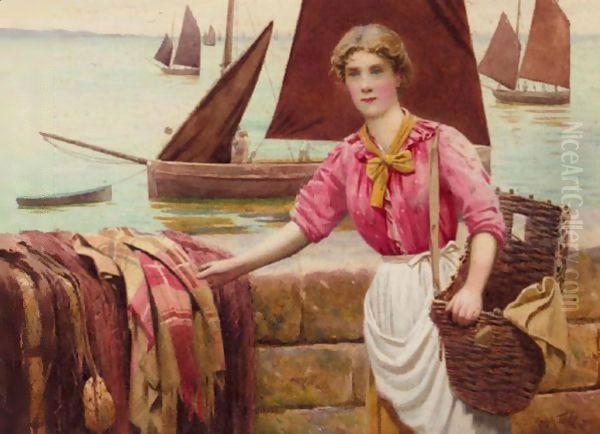
Among his recognized paintings, several stand out for their characteristic themes and execution. "The Prodigal Daughter" (exhibited RA 1889) is a poignant genre scene, typical of the Newlyn School's interest in narrative and emotional depth. "A Healthy Haul" captures the vigor and success of fishermen returning with their catch, showcasing his ability to depict lively action.
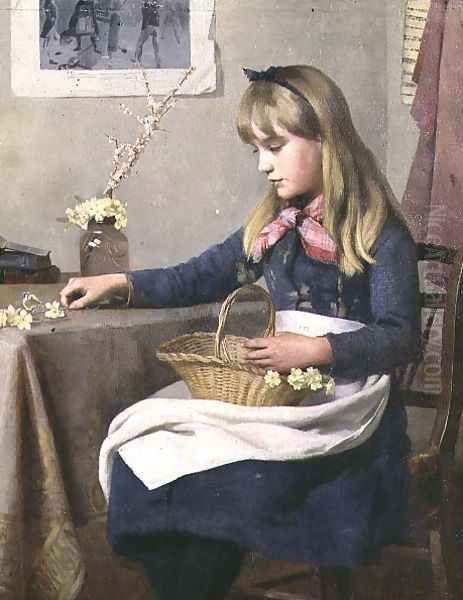
Other notable titles include "Primrose Day," which likely depicted a scene related to the annual commemoration of Benjamin Disraeli, and "The Fisherman's Daughter," a subject that allowed for both portraiture and a connection to the maritime theme. "An Old Salt" would have been a character study, a popular genre that allowed artists to explore the weathered faces and personalities of seasoned seafarers. His watercolor works, often depicting coastal views and harbor scenes, were also highly regarded for their freshness and technical skill.
The specific work "The Anchor is Weighed" (exhibited RA 1890) is a fine example of his maritime expertise, depicting the activity and anticipation aboard a fishing vessel preparing to set sail. Such paintings not only showcased his artistic skill but also served as valuable records of a way of life that was integral to coastal communities like Newlyn.
Contemporaries and the Wider Artistic Milieu
Ralph Todd's career unfolded during a period of significant artistic change and dynamism. In Britain, the Victorian academic tradition was being challenged by new movements and ideas. The Newlyn School itself represented a shift towards greater realism and plein-air practice, influenced by continental trends.
His direct contemporaries within the Newlyn School, such as Stanhope Forbes, Walter Langley, Frank Bramley, and Norman Garstin, formed his immediate artistic circle. They shared a common artistic purpose, often painting similar subjects and influencing each other's development. Elizabeth Forbes, a highly talented painter and wife of Stanhope Forbes, was another key figure in this community, known for her sensitive portrayals of children and rural life.
Beyond Newlyn, Todd's contemporaries included artists associated with other movements. The Glasgow Boys in Scotland, including James Guthrie and John Lavery, were pursuing similar interests in realism and plein-air painting. In London, artists like George Clausen and Henry Herbert La Thangue were also exploring rural themes with a naturalist approach, sometimes referred to as British Impressionism.
The broader art world also included figures like James McNeill Whistler, whose aestheticism and tonal harmonies offered a different path from the social realism of Newlyn, and John Singer Sargent, whose dazzling brushwork and society portraits set a high bar for technical brilliance. While Todd's focus remained on his chosen maritime and genre subjects, he would have been aware of these diverse artistic currents. His training under Carolus-Duran in Paris placed him in a lineage that also produced Sargent, highlighting the interconnectedness of the art world.
The influence of French artists like Jules Bastien-Lepage and Jean-François Millet was pervasive among realist painters of this generation, and Todd's work shows an affinity with their commitment to depicting ordinary people and their labor with dignity.
Later Years, Relocation, and Continued Practice
While Newlyn was a formative and significant base for Ralph Todd, he, like some other artists, eventually moved from the immediate vicinity of the village. He later resided in St. Keverne and then Helston, both also in Cornwall, allowing him to remain connected to the coastal environment that so inspired his art. This move did not signify a departure from his artistic concerns; he continued to paint and exhibit, maintaining his focus on maritime subjects and the Cornish landscape.
His membership in prestigious societies like the Royal Society of British Artists (RBA) and the Royal Institute of Oil Painters (ROI) indicates his continued standing within the professional art world. These affiliations provided regular venues for exhibiting his work and engaging with fellow artists.
The art world was evolving rapidly in the early 20th century with the advent of Post-Impressionism, Fauvism, Cubism, and other modernist movements. While Todd's style remained rooted in the realist traditions he had mastered, his dedication to his chosen themes and his consistent output ensured his continued relevance, particularly for audiences who appreciated skilled representational art.
Verification of Life Dates
The generally accepted and documented life dates for Ralph Todd are his birth in 1856 and his death in 1932. These dates are corroborated by numerous art historical resources, auction records, and biographical dictionaries of artists. He passed away in Helston, Cornwall, the region that had been his home and primary source of inspiration for much of his adult life. His lifespan placed him firmly within the late Victorian and Edwardian eras, and into the early interwar period, witnessing significant shifts in British society and art.
Anecdotes and Personal Glimpses
Specific, detailed anecdotes about Ralph Todd's personal life or eccentricities are not as widely circulated as those of some of his more flamboyant contemporaries. This often suggests an individual more focused on his work and a quieter existence within the artistic community. However, his long association with the Newlyn School and his continued residence in Cornwall point to a deep affection for the region and its people.
Being part of the Newlyn community would have involved shared experiences, critiques, and social interactions. Artists often gathered in local inns or studios to discuss their work and the latest artistic developments. The very nature of plein-air painting, often undertaken in challenging weather conditions, fostered a sense of camaraderie and shared purpose. Todd's consistent production and exhibition record suggest a disciplined and dedicated professional.
His choice to study in Antwerp and Paris indicates an ambitious and adventurous spirit in his youth, willing to seek out the best instruction available. The decision to then settle in a relatively remote fishing village like Newlyn, rather than pursuing a career solely in the metropolitan art centers, speaks to a genuine connection with the subjects he chose to paint.
Social Activities and Influence
Ralph Todd's primary social and professional activities revolved around the art societies to which he belonged. Membership in the Royal Society of British Artists (RBA) and the Royal Institute of Oil Painters (ROI) was significant. These societies not only provided exhibition opportunities but also fostered a sense of community among professional artists. They held regular meetings, social events, and played a role in shaping the contemporary art scene through their exhibitions and advocacy.
As a member of the Newlyn School, Todd contributed to one of the most important regional art movements in British art history. The collective success and recognition of the Newlyn painters helped to decentralize the British art world to some extent, demonstrating that significant art could be produced outside of London. Their focus on the lives of ordinary working people also brought a new dimension to British genre painting.
While perhaps not as overtly influential as a teacher or a polemicist like some other artists, Todd's influence would have been felt through the consistent quality of his work and his commitment to the ideals of the Newlyn School. His paintings, exhibited widely, would have contributed to the public's appreciation of maritime art and the Cornish landscape. Younger artists visiting or settling in Cornwall would have been aware of his work and that of his Newlyn colleagues, contributing to the ongoing artistic legacy of the region. Artists like Laura Knight and Alfred Munnings, who later became associated with Cornwall, followed in the tradition of artists drawn to its unique character, a path forged by pioneers like Todd.
Legacy and Conclusion
Ralph Todd passed away in 1932, leaving behind a substantial body of work that captures the essence of Cornish maritime life in the late 19th and early 20th centuries. He was a skilled and dedicated painter, a respected member of the Newlyn School, and a consistent contributor to the major art exhibitions of his day.
His legacy lies in his contribution to British realism and plein-air painting. His works serve as both artistic achievements and valuable historical documents, offering insights into the fishing communities of Cornwall and the challenging lives of those who depended on the sea. While perhaps not achieving the same level of international fame as some of his contemporaries like Sargent or Whistler, or even the foremost leaders of the Newlyn School like Stanhope Forbes, Todd's paintings are appreciated for their honesty, technical competence, and atmospheric quality.
His works are held in various public and private collections, and they continue to appear at auction, where they are sought after by collectors of British traditional art and maritime paintings. Ralph Todd remains an important figure for understanding the breadth and depth of the Newlyn School and the wider currents of British art during a period of profound transformation. His dedication to his craft and his chosen subjects ensures his enduring place in the annals of British art history.