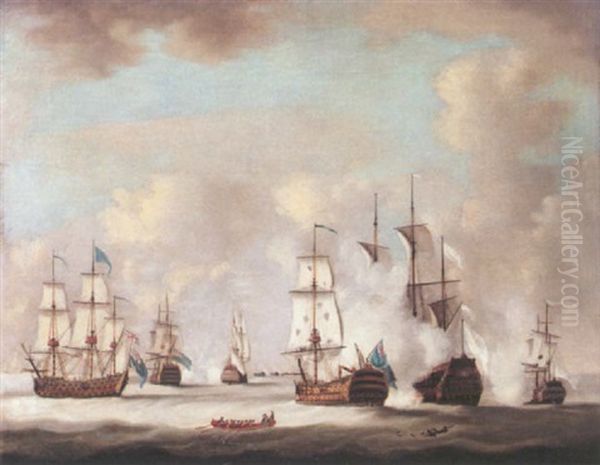
Richard Paton (1717-1791) stands as a significant, if sometimes overlooked, figure in the rich tradition of British marine painting. Flourishing in an era when Great Britain's maritime power was ascending to unprecedented heights, Paton carved a niche for himself as a vivid chronicler of naval warfare. His canvases, often depicting the dramatic intensity of sea battles, captured the public imagination and contributed to the burgeoning national pride associated with the Royal Navy. Though largely self-taught, his work demonstrates a keen eye for detail, a flair for dramatic composition, and an intimate understanding of seafaring life, making him a noteworthy artist of the 18th century.
Humble Beginnings and a Fateful Encounter
Born in London in 1717, Richard Paton's early life was marked by poverty. Unlike many of his contemporaries who benefited from formal apprenticeships or academic training, Paton's artistic journey was one of remarkable self-reliance. The precise details of his early education, if any, are scarce, but it is widely accepted that he was primarily an autodidact. This lack of formal instruction, while perhaps contributing to certain perceived unevenness in his output by later critics, also allowed for a rawness and directness in his vision that set him apart.
A pivotal moment in Paton's life, and indeed his career, is said to have occurred on Tower Hill. According to a popular anecdote, the young Paton was found in a state of destitution, possibly begging, by Admiral Sir Charles Knowles (c. 1704–1777). Knowles, a distinguished naval officer who later became Governor of Jamaica, recognized some spark or potential in the young man. Instead of a mere charitable handout, Knowles offered Paton a position aboard his ship, reportedly as an assistant to the ship's painter or in a similar capacity that would allow him to be close to the maritime world.
This act of patronage was transformative. Life at sea provided Paton with an unparalleled education. He was immersed in the daily routines, the technical intricacies of sailing vessels, and, crucially, the visceral reality of naval operations. This firsthand experience would become the bedrock of his artistic practice, lending an authenticity to his depictions of ships and seascapes that could not be easily replicated by studio-bound artists. He learned the language of the sea, the anatomy of warships, and the dynamic interplay of wind, water, and sail.
The Artistic Landscape of 18th-Century Britain
To fully appreciate Paton's contribution, it's essential to understand the context of marine painting in 18th-century Britain. The genre had gained immense popularity, fueled by the nation's expanding global trade, colonial ambitions, and frequent naval conflicts. Paintings of ships and sea battles were not merely decorative; they were potent symbols of national identity, commercial success, and military prowess. The legacy of Dutch Golden Age marine painters, particularly Willem van de Velde the Elder (1611–1693) and his son Willem van de Velde the Younger (1633–1707), who had moved to England in the 1670s and worked for the Crown, cast a long shadow. Their meticulous accuracy and dramatic compositions set a high standard.
By Paton's time, a native school of British marine painters was emerging. Artists like Peter Monamy (1681–1749) were among the first to build upon the Van de Velde tradition. Paton's slightly older contemporary, Charles Brooking (1723–1759), was another exceptionally talented marine artist whose promising career was cut short by an early death. Brooking's delicate rendering of light and atmosphere, and his accurate depiction of shipping, were highly influential. Samuel Scott (c. 1702–1772), often called the "Canaletto of London" for his Thames views, also produced significant naval scenes. Later in the century, artists like Dominic Serres the Elder (1719–1793), a Gascon by birth who settled in England, became a dominant figure, eventually being appointed Marine Painter to King George III. Nicholas Pocock (1740–1821), who began his career as a seaman, and Thomas Luny (1759–1837) would continue this tradition into the early 19th century. Paton operated within this vibrant and competitive artistic milieu.
Paton's Artistic Development and Style
Having gained invaluable experience at sea under Admiral Knowles, Richard Paton began to establish himself as a professional artist. He started exhibiting his works with the Society of Artists in London from 1758. This was a significant step, providing him with a public platform and bringing his work to the attention of potential patrons and critics. His participation in these exhibitions continued for many years, and he later also exhibited at the prestigious Royal Academy of Arts from 1776. Some records suggest his Royal Academy exhibitions continued until 1800, though this extends beyond his death in 1791 and may refer to posthumous showings or a slight discrepancy in records; exhibitions until 1780 are more consistently cited during his active years.
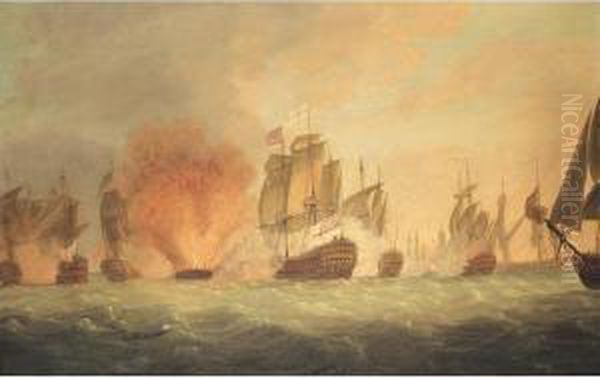
Paton's style is characterized by a robust, dramatic realism. He excelled in depicting the chaos and energy of naval engagements. His canvases often feature billowing smoke from cannon fire, splintered masts, and ships maneuvering in close quarters. He had a particular talent for capturing nocturnal scenes, with moonlight glinting off the water and the flash of explosions illuminating the darkness. This focus on dramatic lighting effects added a theatrical intensity to his work. His rendering of skies, whether stormy or clear, often played a significant role in setting the mood of his compositions. He was also noted for his depictions of ships in distress or the dramatic moment of a vessel sinking, conveying the perils of naval warfare.
While he may not have possessed the refined elegance of a formally trained academician, Paton's strength lay in his directness and his ability to convey the narrative of a battle. His understanding of ship construction and rigging, honed during his time at sea, ensured a high degree of accuracy in his portrayals. This technical veracity was highly valued by patrons, many of whom were naval officers or individuals with a vested interest in maritime affairs. His works were not just art; they were historical documents, visual records of Britain's naval history.
Key Themes and Celebrated Works
Richard Paton's oeuvre is dominated by depictions of contemporary naval battles, particularly those from the Seven Years' War (1756–1763) and the American Revolutionary War (1775–1783). These conflicts provided him with a wealth of dramatic subject matter. His paintings served to commemorate British victories, celebrate naval heroes, and inform the public about the realities of war at sea.
Among his notable works is "The Battle of Barfleur, 1692." Although depicting an event that occurred before his birth, this painting, likely an early commission or a subject chosen for its historical significance, demonstrates his engagement with earlier naval history. The Battle of Barfleur was a crucial victory for the Anglo-Dutch fleet over the French, and its depiction would have resonated with patriotic sentiment.
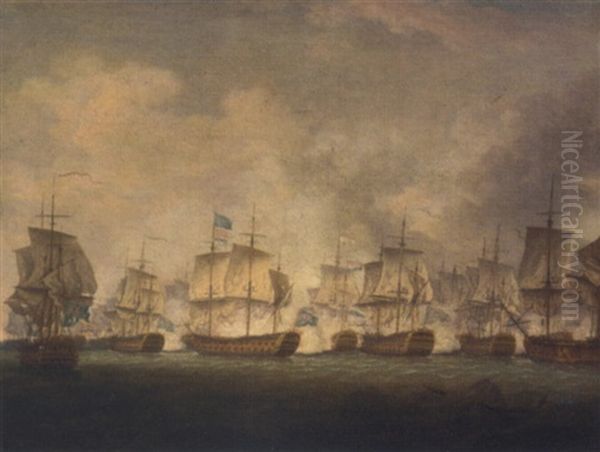
Another significant historical event he painted was the "Battle of Cape Passaro, 1718." This was a major naval engagement where the British fleet under Sir George Byng decisively defeated a Spanish fleet off the coast of Sicily. Paton's rendition, painted decades after the event, would have aimed to capture the scale and strategic importance of this victory, showcasing his ability to reconstruct historical battles with drama and accuracy.
Perhaps one of his most famous series of paintings depicts the "Battle of Quiberon Bay, 1759." This was a decisive British naval victory during the Seven Years' War, where Admiral Sir Edward Hawke defeated a French fleet in treacherous conditions. Paton's portrayals of this battle are celebrated for their dynamism and their ability to convey the ferocity of the fighting amidst a storm. These works highlight his skill in rendering tumultuous seas and dramatic weather effects, underscoring the dangers faced by sailors.
"The Daring Capture of the Prudent and Bienfaisant at Louisbourg, 1758" is another important work. It illustrates a specific, audacious incident during the siege of Louisbourg in the Seven Years' War, where British sailors rowed into the harbor under heavy fire to capture two French ships of the line. Paton's depiction would have emphasized the bravery and skill of the British seamen, contributing to the heroic narrative of the Royal Navy.
Later in his career, Paton painted scenes from the American Revolutionary War. "The Battle of Flamborough Head, 1779," is a particularly noteworthy example. This engagement involved the British warship HMS Serapis, commanded by Captain Richard Pearson, fighting against a Franco-American squadron led by John Paul Jones aboard the Bonhomme Richard. Paton's depiction of this fierce and bloody nocturnal battle, often showing the ships locked in close combat illuminated by moonlight and gunfire, captured the brutal reality of the conflict.
He also depicted other significant actions, such as the "Capture of Port Louis, Cuba," further cementing his reputation as a painter of contemporary naval history. His works were not limited to grand fleet actions; he also painted smaller engagements, ship portraits, and general maritime scenes, though battle pieces remained his forte.
Technique, Reception, and Legacy
Richard Paton primarily worked in oils on canvas. His technique, while perhaps not as polished as some of his academically trained contemporaries like Dominic Serres or later masters such as J.M.W. Turner (1775-1851) who would revolutionize marine painting, was effective in conveying the drama and detail he sought. His compositions are often complex, with multiple vessels engaged in intricate maneuvers. He paid close attention to the architectural details of the ships, their rigging, and the effects of cannon fire on their hulls and masts. His use of light, particularly in his night scenes, was a hallmark of his style, creating strong chiaroscuro effects that heightened the drama.
During his lifetime, Paton achieved considerable recognition. His works were popular, and many were engraved by leading printmakers of the day, such as Pierre-Charles Canot and James Fittler. These engravings played a crucial role in disseminating his images to a wider public, enhancing his reputation and ensuring that his depictions of naval battles became iconic. Artists like Robert Dodd (1748–1815), another prominent marine painter, also benefited from the burgeoning print market for naval scenes.
However, critical opinion on Paton's work has sometimes been mixed. Some critics, particularly in later periods, have pointed to a certain "naivety" or unevenness in his execution, possibly a consequence of his lack of formal training. His figures, for instance, are not always rendered with the anatomical precision of a trained figure painter. Yet, this perceived lack of academic polish can also be seen as a strength. His focus was less on classical ideals of beauty and more on the raw, unvarnished truth of naval warfare. His paintings possess an immediacy and a sense of authentic experience that resonates with viewers.
His contemporary, Dominic Serres, often achieved a greater degree of atmospheric subtlety and compositional elegance. However, Paton's work often conveyed a more visceral sense of the battle itself. He was less concerned with the picturesque qualities of the sea, as perhaps Charles Brooking was, and more with its role as a theatre of conflict. His contribution lies in his dedication to chronicling the naval history of his time with vigor and a commitment to factual representation, as he understood it.
Later Life and Enduring Influence
Richard Paton continued to paint and exhibit throughout much of his life. He resided in London, and his connection with the maritime world remained strong. His firsthand experiences, coupled with diligent research into the details of specific engagements, allowed him to produce a substantial body of work that serves as a valuable historical record. He passed away in London on March 7, 1791, at the age of 74.
His legacy is that of a dedicated and skilled marine painter who captured a pivotal era in British naval history. While he may not always be ranked in the very first tier of British artists alongside giants like Thomas Gainsborough (1727-1788) or Sir Joshua Reynolds (1723-1792) in terms of overall artistic innovation or breadth, within the specialized field of marine painting, his contribution is undeniable. His works are held in numerous public collections, including the National Maritime Museum in Greenwich, London, where they are valued both for their artistic merit and their historical importance.
Paton's paintings continue to be studied by naval historians and art enthusiasts alike. They offer a window into the world of 18th-century naval warfare, rendered by an artist who possessed both a passion for his subject and a significant degree of experiential knowledge. He successfully bridged the gap between reportage and art, creating images that were both informative and dramatically compelling. In the lineage of British marine art, which includes figures from the Van de Veldes to later artists like Clarkson Stanfield (1793-1867) and E.W. Cooke (1811-1880), Richard Paton holds a secure and respected place as a self-made master of the naval battle scene.
Conclusion
Richard Paton's journey from impoverished beginnings to a respected position in the London art world is a testament to his talent and determination. As a largely self-taught artist, he overcame significant obstacles to become one of the foremost marine painters of his generation. His close association with the Royal Navy, initiated by Admiral Sir Charles Knowles, provided him with the authentic experiences that infused his work with a sense of realism and drama.
His depictions of key naval battles from the Seven Years' War and the American Revolutionary War are not only artistically significant but also serve as invaluable historical documents. Through his vivid portrayals of cannon fire, storm-tossed seas, and dueling warships, Paton captured the spirit of a nation increasingly defined by its maritime power. While his style may have differed from the more polished academic approaches of some contemporaries, its directness and energy conveyed the brutal realities and heroic endeavors of naval conflict. His works, widely disseminated through engravings, helped shape public perception of the Royal Navy and its role in Britain's global ascendancy. Richard Paton remains an important figure for anyone interested in 18th-century British art, maritime history, and the enduring power of the sea as a subject for artistic expression.