Sebastian Wegmayr (1776-1857) stands as a distinguished figure in the annals of Austrian art, particularly celebrated for his exquisite contributions to flower still life painting. Active during a vibrant period of artistic development in Vienna, Wegmayr not only produced a remarkable body of work characterized by its meticulous detail and refined aesthetics but also played a crucial role as an educator, shaping a generation of artists at the prestigious Vienna Academy of Fine Arts. His career coincided with the Biedermeier era, a period in Central European art and culture that emphasized domesticity, sentiment, and a deep appreciation for the natural world, all of which found eloquent expression in Wegmayr's canvases.
The Artistic Milieu of Early 19th Century Vienna
Vienna in the late 18th and early 19th centuries was a burgeoning cultural metropolis, the heart of the Habsburg Empire. Despite the political upheavals of the Napoleonic Wars, the city fostered a rich artistic environment. The Academy of Fine Arts Vienna (Akademie der bildenden Künste Wien) was a central institution, promoting classical ideals while also adapting to new artistic currents. It was within this stimulating atmosphere that Sebastian Wegmayr embarked on his artistic journey, an environment that valued technical skill, precision, and an intimate observation of nature.
The Biedermeier period, roughly spanning from 1815 (the Congress of Vienna) to 1848 (the March Revolution), particularly influenced the arts. It was a time characterized by a turn towards the private sphere, an appreciation for simplicity, and a focus on the tangible beauty of everyday life and nature. Still life painting, especially floral compositions, became exceedingly popular, adorning the homes of the increasingly affluent middle class. These works were not merely decorative; they often carried subtle symbolic meanings and reflected a scientific interest in botany, coupled with a romantic sensibility.
Influential Mentors and Early Training
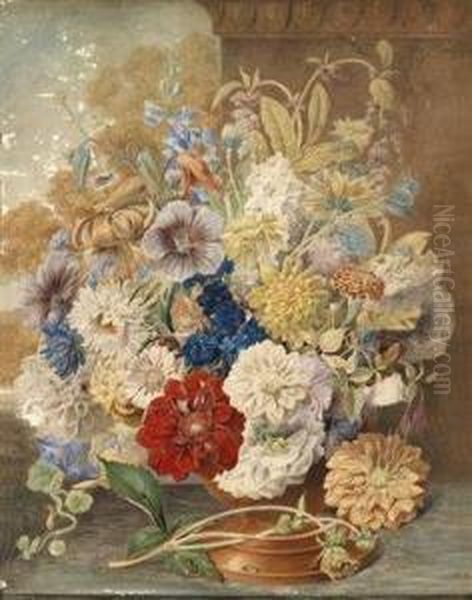
The foundation of any great artist often lies in the tutelage they receive. For Sebastian Wegmayr, two prominent figures in Viennese art played significant roles in his development: Johann Baptist Drechsler (1756-1811) and, according to some sources, Franz Xaver Petter (1791-1866), who was also a contemporary and later a colleague. Drechsler, in particular, was a pivotal figure in the establishment of the Viennese school of flower painting.
Johann Baptist Drechsler was the first professor of flower painting at the Vienna Academy, a position created in 1807, highlighting the genre's growing importance. Drechsler himself was influenced by the rich tradition of Dutch Golden Age flower painting, known for its opulent arrangements, meticulous detail, and symbolic depth. Artists like Jan van Huysum and Rachel Ruysch had set a standard centuries earlier that continued to inspire. Drechsler adapted these traditions to the Viennese context, emphasizing botanical accuracy and elegant compositions. Wegmayr would have absorbed these principles, learning the importance of precise rendering, the skillful use of color, and the art of creating harmonious arrangements.
Franz Xaver Petter, though younger than Wegmayr, also became a leading exponent of the Viennese flower painting tradition. If Petter was indeed a teacher to Wegmayr in some capacity, it would likely have been in a peer-learning or collaborative context as their careers overlapped significantly. More commonly, they are seen as contemporaries who both contributed to the genre's prominence. Petter, like Drechsler and Wegmayr, was associated with the Academy and produced works celebrated for their vibrant colors and lifelike depictions of flowers and fruit.
A Distinguished Academic Career
Sebastian Wegmayr's association with the Vienna Academy of Fine Arts was long and impactful. He was appointed Professor of Flower Painting in 1812, a position he held with distinction until 1850. This nearly four-decade tenure allowed him to exert considerable influence on the development of still life painting in Vienna. His role involved instructing students in the specialized techniques required for depicting flowers, fruits, and other elements of still life with accuracy and artistic flair.
As a professor, Wegmayr would have emphasized the importance of direct observation from nature, a hallmark of the Biedermeier approach. Students were encouraged to study botanical specimens closely, understanding their structure, texture, and color. The curriculum likely involved drawing from live plants, learning about color theory, and mastering the techniques of oil painting to achieve the desired effects of translucency, softness, and vibrancy characteristic of floral subjects. His professorship ensured the continuation and refinement of the flower painting tradition established by Drechsler.
The Academy during this period was a hub for artistic talent. Beyond still life, figures like Ferdinand Georg Waldmüller (1793-1865), renowned for his portraits, genre scenes, and landscapes, also taught at the Academy, contributing to its reputation. While Waldmüller's focus was different, his commitment to realism and meticulous observation resonated with the prevailing Biedermeier spirit that Wegmayr's work also embodied.
Shaping a Generation: Wegmayr's Students
A significant part of Sebastian Wegmayr's legacy lies in the artists he mentored. His long tenure as a professor allowed him to guide numerous students, some of whom went on to become notable painters in their own right, carrying forward the traditions of Viennese still life. Among his most recognized pupils were Josef Lauer and Anton Hartinger.
Josef Lauer (1818-1881) became a highly respected still life painter, known for his lush and detailed compositions of flowers and fruits. Lauer's works often exhibit the same precision and vibrant coloring that characterized Wegmayr's style, but he also developed his own distinct approach, sometimes incorporating more elaborate settings or a slightly softer atmospheric quality. Lauer was one of the artists who successfully continued the Biedermeier tradition into the later 19th century, adapting it to evolving tastes. He was also known for being one of the first to integrate floral still lifes into landscape settings.
Anton Hartinger (1806-1890) was another prominent student of Wegmayr. Hartinger was not only a painter but also a skilled chromolithographer, and he produced influential botanical illustrations. His paintings of flowers are celebrated for their botanical accuracy and delicate beauty. Like Lauer, Hartinger's work demonstrates the thorough grounding he received from Wegmayr in the art of floral depiction. His contributions extended to scientific illustration, showcasing the intersection of art and botany that was so prevalent in the era. One of his known works is "Blumenstilleben mit Schmetterling und Maikäfer" (Flower Still Life with Butterfly and Cockchafer), dated around 1860.
The success of students like Lauer and Hartinger attests to Wegmayr's effectiveness as a teacher and his commitment to nurturing new talent within the specialized field of flower painting.
The Essence of Biedermeier Still Life in Wegmayr's Art
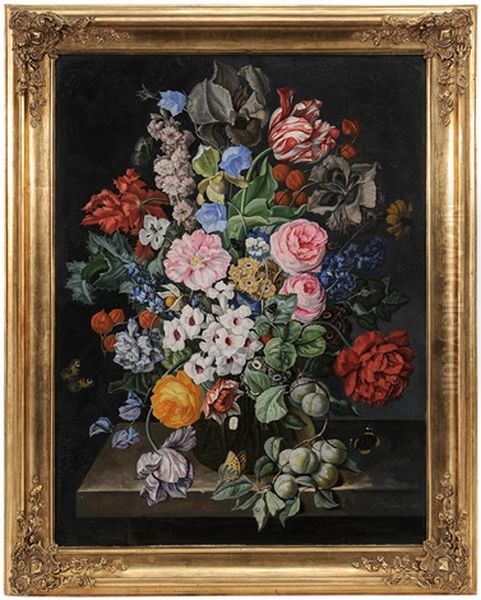
Sebastian Wegmayr's artistic style is quintessentially Biedermeier. His works are characterized by a profound attention to detail, a smooth, almost invisible brushstroke, and a desire to capture the natural world with utmost fidelity. The Biedermeier aesthetic valued realism, but it was a realism imbued with a sense of order, tranquility, and often a subtle sentimentality.
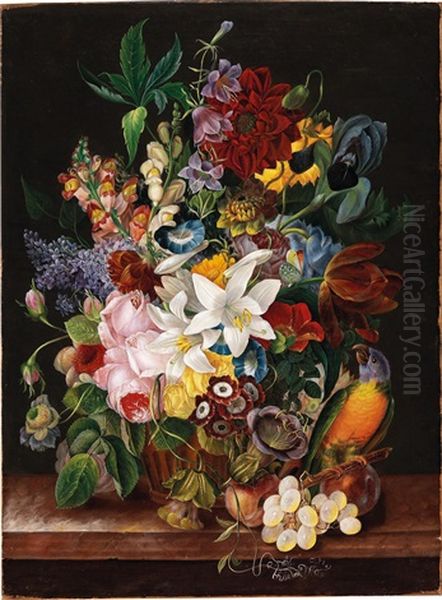
In Wegmayr's floral compositions, each petal, leaf, and stem is rendered with painstaking care. He masterfully depicted the varied textures of flowers, from the velvety softness of a rose petal to the delicate translucency of a poppy. His understanding of light was crucial, using it to model forms, highlight textures, and create a sense of depth and vibrancy. Colors are typically rich and true to life, arranged in harmonious combinations that are both visually pleasing and botanically accurate.
Compositions are generally balanced and elegant, often featuring a selection of flowers arranged in a vase or basket, sometimes accompanied by fruits, insects, or dewdrops that add to the illusion of reality. These arrangements, while appearing natural, were carefully constructed to create a pleasing aesthetic effect. The backgrounds are usually simple and unobtrusive, ensuring that the focus remains squarely on the floral subject. This clarity and precision were highly valued by the Biedermeier audience, who appreciated art that reflected the beauty and order of the natural world.
Meticulous Detail and Naturalism
The hallmark of Sebastian Wegmayr's paintings is their extraordinary level of detail and commitment to naturalism. This was not merely a technical exercise but an expression of a deep appreciation for the intricacies of nature. In an era that saw significant advancements in the natural sciences, including botany, there was a heightened interest in accurate depictions of flora and fauna. Wegmayr's work catered to this interest, providing viewers with images that were both aesthetically beautiful and botanically informative.
His paintings often feature a diverse array of flower species, each identifiable and rendered with specific characteristics. One can almost feel the delicate weight of a lily or the crispness of a tulip petal. This verisimilitude was achieved through careful observation and a highly refined painting technique. The inclusion of insects like butterflies, bees, or ladybugs, and sometimes even a bird's nest, further enhanced the naturalistic effect, suggesting a snapshot of a living ecosystem. These elements also carried symbolic weight – butterflies, for instance, often symbolized resurrection or the soul, while dewdrops could signify transience.
This dedication to detail aligns with the broader Biedermeier appreciation for craftsmanship and the tangible world. Wegmayr's art invited close inspection, rewarding the viewer with a wealth of finely observed details that spoke of the artist's patience and skill. His contemporaries, such as Josef Nigg (1782-1863), another prominent Viennese flower painter, shared this commitment to meticulous rendering, contributing to a distinct Viennese style within the broader European still life tradition.
Notable Compositions and Representative Works
While a comprehensive catalogue of Sebastian Wegmayr's oeuvre might be extensive, certain works and types of compositions are particularly representative of his style and contributions. His paintings typically feature lush bouquets in vases, often set against a neutral background, allowing the vibrant colors and intricate forms of the flowers to take center stage.
One specific work mentioned is a painting of "Lilies" from 1857. Lilies, with their elegant forms and symbolic associations (often purity or majesty), were a popular subject for floral painters. A late work like this would demonstrate the culmination of his decades of experience, showcasing his mature style, characterized by flawless technique and a sophisticated sense of composition. The depiction would undoubtedly highlight the waxy texture of the petals, the delicate structure of the stamens, and the subtle play of light across the blooms.
Another cited work is "Apfelortsen" (Apple Trees or, more likely, a still life featuring specific apple varieties). This indicates that Wegmayr's expertise was not limited to flowers but extended to fruits as well. Fruit still lifes were equally popular during the Biedermeier period, celebrating nature's bounty and often carrying symbolic meanings related to abundance, fertility, or the seasons. Wegmayr would have applied the same meticulous approach to rendering the textures, colors, and forms of apples, perhaps showing them with leaves, blossoms, or alongside other fruits and objects.
Beyond these specific mentions, his body of work would have included numerous compositions featuring roses, tulips, carnations, peonies, and other popular garden flowers of the time, often combined to create rich and varied bouquets. These paintings served as enduring records of floral beauty, capturing the ephemeral nature of blooms in a permanent art form.
The Vienna School of Flower Painting: A Flourishing Tradition
Sebastian Wegmayr was a key figure within what can be termed the Vienna School of Flower Painting, a vibrant tradition that flourished particularly during the Biedermeier period. This "school" was not a formal institution but rather a group of artists, often connected through the Academy of Fine Arts, who specialized in floral still lifes and shared certain stylistic characteristics, primarily a commitment to detailed realism, botanical accuracy, and elegant composition.
Johann Baptist Drechsler is often considered the founder of this 19th-century Viennese tradition. His appointment as professor of flower painting at the Academy legitimized the genre and provided a formal training ground. Wegmayr, as his successor, consolidated and continued this legacy. Other important artists associated with this school include Franz Xaver Petter, Josef Nigg, Johann Knapp (1778-1833), and Wegmayr's own students like Josef Lauer and Anton Hartinger.
Franz Xaver Petter, in particular, produced a significant body of work that is often compared to Wegmayr's. His paintings, such as "Still Life with Goldfinch" (1856) or "Two Flower Still Lifes" (1830), exhibit a similar mastery of detail and vibrant color. His "Blumenstillleben mit Früchten und Schmetterlingen" (Flower Still Life with Fruits and Butterflies) from 1812 shows his early talent. Petter's compositions sometimes incorporated more dynamic arrangements or dramatic lighting, but the core principles of Biedermeier naturalism remained.
Josef Nigg was another highly skilled porcelain painter who also created exquisite flower paintings on canvas. His work on porcelain for the Vienna Porcelain Manufactory further disseminated the appreciation for detailed floral depictions. Johann Knapp, a contemporary of Drechsler and Wegmayr, was also known for his large-scale floral pieces and his work documenting the plants in the gardens of Schönbrunn Palace.
These artists, while each possessing individual nuances, collectively created a distinct Viennese identity for flower painting, characterized by its refinement, precision, and intimate connection with the natural world. Their works were highly sought after by patrons, reflecting the cultural values of the Biedermeier era.
Broader Artistic Context: Still Life Traditions in Europe
The Viennese tradition of flower painting, to which Wegmayr so significantly contributed, did not exist in isolation. It was part of a long and rich history of still life painting in Europe. The Dutch Golden Age of the 17th century is widely regarded as the zenith of early still life, particularly flower painting. Artists like Ambrosius Bosschaert the Elder, Balthasar van der Ast, Jan Davidsz. de Heem, Rachel Ruysch, and Jan van Huysum created opulent and incredibly detailed floral arrangements, often laden with complex symbolism. These works set a benchmark for technical skill and compositional ingenuity that influenced generations of artists across Europe.
In France, artists like Jean-Baptiste-Siméon Chardin in the 18th century brought a different sensibility to still life, focusing on humble domestic objects with a profound sense of quietude and masterful handling of paint. While not primarily a flower painter, Chardin's dedication to observing and rendering everyday objects resonated with the later Biedermeier emphasis on the tangible world. Later French artists like Henri Fantin-Latour (though active after Wegmayr's peak) would continue the tradition of exquisite flower painting, demonstrating the genre's enduring appeal.
The Biedermeier flower painters, including Wegmayr, inherited aspects of the Dutch precision and love for detail, but their work generally eschewed the overt opulence and complex allegories of some Baroque pieces. Instead, Biedermeier still lifes often conveyed a more direct, almost scientific, appreciation of nature's beauty, combined with a sense of domestic tranquility and sentiment. The influence of botanical illustration, which was flourishing due to scientific exploration and horticultural developments, also played a role in shaping the emphasis on accuracy.
Other notable female artists who excelled in floral painting include the German Biedermeier painter Therese Concordia Maron (née Mengs), though earlier, and later figures like Berthe Morisot who, while an Impressionist, also painted beautiful floral still lifes. The tradition was widespread, with regional variations, but the Viennese school carved its own niche with its characteristic blend of meticulousness and charm.
The Biedermeier Era and its Aesthetic Imperatives
To fully appreciate Sebastian Wegmayr's art, one must understand the cultural and aesthetic imperatives of the Biedermeier era. This period, nestled between the Napoleonic Wars and the Revolutions of 1848, was marked by political conservatism and a retreat into the private, domestic sphere. The middle class was growing in influence and sought art that reflected their values: comfort, family, piety, and an appreciation for nature and the simple pleasures of life.
Biedermeier art is characterized by its realism, meticulous attention to detail, and often a sentimental or idyllic quality. In portraiture, artists like Friedrich von Amerling (1803-1887) captured the likenesses of the Viennese bourgeoisie with elegance and precision. Genre scenes, popularized by artists such as Peter Fendi (1796-1842) and later Carl Spitzweg (1808-1885) in Germany, depicted charming vignettes of everyday life. Landscape painting also flourished, with artists like Adalbert Stifter (1805-1868), who was also a renowned writer, capturing the serene beauty of the Austrian countryside.
Still life painting, especially of flowers and fruit, fit perfectly within this aesthetic. Flowers brought nature indoors, symbolizing beauty, transience, and domestic harmony. Wegmayr's paintings, with their clarity, precision, and celebration of natural beauty, were ideally suited to the tastes of Biedermeier patrons. They were not grand historical or mythological scenes, but intimate portrayals of nature's perfection, offering a sense of peace and order in a world that was undergoing significant social and political changes beneath the surface. The emphasis on craftsmanship and tangible reality in Biedermeier art found its apotheosis in the finely wrought floral compositions of Wegmayr and his contemporaries.
Enduring Influence and Legacy
Sebastian Wegmayr's influence extended primarily through his long and dedicated career as a professor at the Vienna Academy of Fine Arts. By training students like Josef Lauer and Anton Hartinger, he ensured the continuation of the high standards of Viennese flower painting well into the 19th century. His commitment to botanical accuracy, combined with a refined aesthetic sensibility, helped to define the character of the Vienna School of Flower Painting during the Biedermeier period.
While the Biedermeier style eventually gave way to new artistic movements like Realism, Impressionism, and Historicism in the latter half of the 19th century, the appreciation for detailed still life painting persisted. The skills and traditions fostered by Wegmayr and his colleagues laid a foundation for later artists, even as styles evolved. His work, and that of the Biedermeier era in general, experienced a renewed appreciation in the 20th and 21st centuries, valued for its technical mastery, its charming depiction of a bygone era, and its quiet celebration of beauty.
Art historians recognize Wegmayr as an important representative of his time and genre. His paintings are held in various Austrian collections and appear in art markets, attesting to their enduring appeal. While he may not have achieved the international fame of some of his Dutch Golden Age predecessors or later Impressionist masters who painted flowers, within the context of Austrian art and the specific domain of Biedermeier still life, Sebastian Wegmayr remains a significant and respected figure.
Sebastian Wegmayr in Art History
In the broader narrative of art history, Sebastian Wegmayr is firmly placed within the Biedermeier movement and recognized as a leading exponent of the Viennese flower painting tradition. His work exemplifies the period's aesthetic values: meticulous realism, an intimate appreciation of nature, and a focus on domestic-scale beauty. He is often discussed alongside his contemporaries like Franz Xaver Petter and Josef Nigg as one of the artists who brought this genre to a high level of refinement in Vienna.
His role as an educator is a critical aspect of his historical importance. The Vienna Academy of Fine Arts was a crucible for artistic talent, and professors like Wegmayr played a vital role in shaping the skills and artistic philosophies of succeeding generations. The continuity of the flower painting tradition, as seen in the work of his students, speaks to the quality and impact of his teaching.
While Biedermeier art was once somewhat overlooked by art historians focused on grander or more revolutionary movements, there has been a growing scholarly interest in the period. This reassessment has highlighted the unique cultural contributions of Biedermeier artists and the ways in which their work reflected the social and intellectual currents of their time. Wegmayr's paintings, with their blend of scientific observation and artistic sensitivity, offer valuable insights into the 19th-century Viennese worldview. They stand as testaments to a period that found profound beauty in the careful observation of the natural world.
Conclusion: The Quiet Brilliance of a Floral Master
Sebastian Wegmayr dedicated his artistic life to the depiction of flowers and fruits, achieving a level of excellence that earned him a distinguished professorship and a lasting place in the history of Austrian art. His paintings, characterized by their exquisite detail, vibrant colors, and harmonious compositions, are perfect embodiments of the Biedermeier spirit. They reflect a world that valued precision, craftsmanship, and the quiet beauty of nature.
Through his own prolific output and his influential role as a teacher at the Vienna Academy of Fine Arts, Wegmayr helped to shape and sustain a remarkable tradition of flower painting. He and his contemporaries, including masters like Johann Baptist Drechsler, Franz Xaver Petter, Josef Nigg, and his own accomplished students Josef Lauer and Anton Hartinger, created a legacy of floral art that continues to charm and impress. Sebastian Wegmayr's work remains a testament to the enduring appeal of still life and the quiet brilliance of an artist who found his universe in the delicate forms and vibrant hues of a flower.