Vladimir Orlovsky: A Luminary of Ukrainian and Russian Landscape Painting
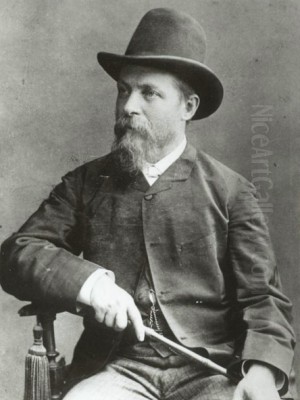
Vladimir Donatovich Orlovsky stands as a significant figure in the annals of late 19th and early 20th-century Eastern European art. A Ukrainian-born artist of noble descent, he carved a distinguished career as a landscape painter, academician, and an influential teacher. His canvases, celebrated for their realistic depiction, panoramic scope, and lyrical beauty, captured the essence of the Ukrainian, Crimean, and Finnish countrysides, earning him acclaim during his lifetime and a lasting place in art history. Orlovsky's journey from a promising student in Kyiv to a revered professor at the Imperial Academy of Arts in St. Petersburg is a testament to his dedication, talent, and profound connection to the natural world.
Early Life and Artistic Awakening in Kyiv
Vladimir Donatovich Orlovsky was born on February 1, 1842, in Kyiv, then part of the Russian Empire, into a Ukrainian noble family with landowning heritage. This background likely afforded him certain privileges in pursuing an education, yet his path was ultimately defined by his innate artistic talent. His initial formal education took place at Kyiv's Second High School (Gymnasium), where his aptitude for drawing and painting began to surface. It was here that the foundational seeds of his artistic inclinations were sown, nurtured by an environment that, even in a provincial capital, was experiencing a burgeoning cultural identity.
The mid-19th century in Kyiv was a period of growing national consciousness, and the arts were beginning to reflect this. While the dominant artistic trends were still heavily influenced by the Imperial Academy in St. Petersburg, local artists were increasingly looking to their native landscapes and traditions for inspiration. It is plausible that the young Orlovsky was exposed to the works of earlier Ukrainian artists or the burgeoning interest in ethnographic studies, which often included visual documentation of rural life and scenery. This early immersion in his native environment would prove to be a lifelong source of inspiration.
The St. Petersburg Academy and Formative Influences
Recognizing his potential, Orlovsky moved to the imperial capital, St. Petersburg, to further his artistic training. In 1861, he enrolled in the prestigious Imperial Academy of Arts, the preeminent art institution in the Russian Empire. This was a critical step, placing him at the center of Russian artistic life and exposing him to rigorous academic training. At the Academy, he studied under the tutelage of Alexei Bogolyubov (1824-1896), a highly respected landscape and marine painter. Bogolyubov, himself a product of the Academy and later a professor there, was known for his realistic depictions of nature and his connection to the Barbizon School's principles, having spent considerable time in France.
Bogolyubov's influence on Orlovsky was undoubtedly significant. He would have instilled in his student a respect for direct observation of nature, meticulous technique, and the importance of capturing light and atmosphere. The Academy at this time was a crucible of talent. While Orlovsky was honing his skills, other artists who would become luminaries of Russian art were also active, either as students, teachers, or exhibiting artists. Figures like Ivan Shishkin (1832-1898), known for his majestic forest landscapes, and Ivan Kramskoi (1837-1887), a leading figure of the Peredvizhniki (Wanderers) movement, were shaping the artistic landscape. Though Orlovsky's path would lean more towards academic realism than the often critical realism of some Peredvizhniki, the prevailing atmosphere of artistic inquiry and the push towards national themes would have been palpable.
Orlovsky's talent quickly gained recognition. In 1863, he was awarded the Grand Silver Medal by the Academy for his achievements, a significant honor for a young artist. He continued to excel, and by 1868, he earned the title of First-Class Artist for a series of Crimean landscapes. This accolade was not merely a title; it came with a coveted government scholarship, enabling him to travel abroad for further study and artistic development.
European Sojourns and Artistic Development
Between 1869 and 1872, Orlovsky embarked on an extensive study tour of Europe, a common practice for promising artists sponsored by the Academy. He traveled and worked in France, Switzerland, Germany, and Italy. This period was crucial for broadening his artistic horizons and exposing him to contemporary European art movements and the masterpieces of the past. In Paris, he would have encountered the works of the Barbizon School painters like Jean-Baptiste-Camille Corot (1796-1875), Théodore Rousseau (1812-1867), and Jean-François Millet (1814-1875), whose emphasis on plein-air painting and realistic, yet poetic, depictions of rural life and landscape were revolutionizing art.
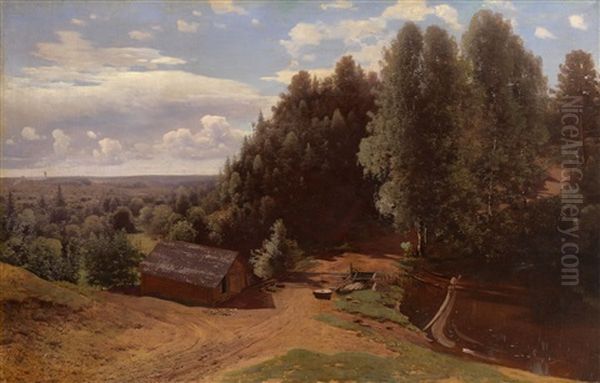
The experience of painting outdoors, directly from nature, in diverse European landscapes – from the Swiss Alps to the Italian countryside – would have refined his technique and deepened his understanding of light, color, and atmospheric effects. He produced numerous sketches and paintings during these travels, absorbing the lessons of European art while retaining his own developing vision. The Düsseldorf School of painting in Germany, with artists like Andreas Achenbach (1815-1910) and Oswald Achenbach (1827-1905), known for their detailed and often dramatic landscapes, might also have offered points of comparison or influence. This European sojourn equipped Orlovsky with a sophisticated technical arsenal and a broader perspective, which he would later synthesize with his innate connection to his homeland's scenery.
The Emergence of a Distinctive Style: Panoramic Realism
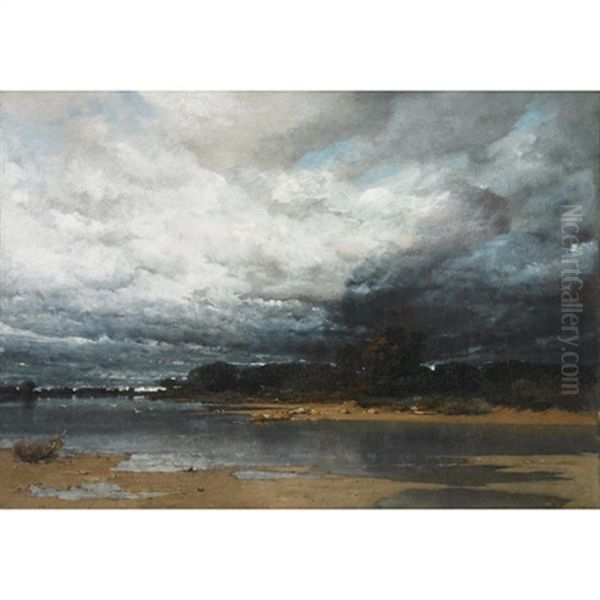
Upon his return to the Russian Empire, Orlovsky's artistic style had matured. He became renowned for his realistic landscapes, which often possessed a panoramic quality, offering expansive views that stretched from a detailed foreground to a distant horizon, sometimes encompassing miles of terrain. His works were characterized by meticulous attention to detail, a clear and luminous palette, and a sense of tranquil grandeur. While firmly rooted in the academic tradition of realism, his paintings often carried a subtle romantic sensibility, imbuing the depicted scenes with a lyrical and sometimes idyllic atmosphere.
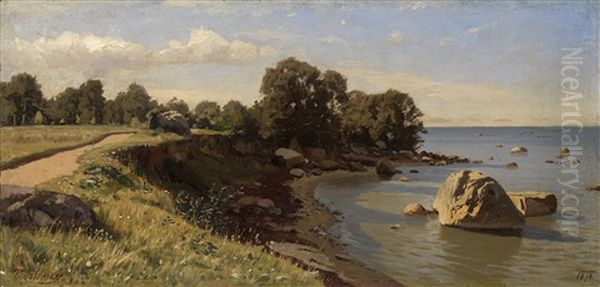
Orlovsky was a pioneer of the panoramic landscape in Ukrainian art. He excelled at capturing the vastness of the Ukrainian steppes, the lushness of its forests, and the picturesque charm of its villages. His paintings were not merely topographical records; they conveyed a deep affection for the land and its people. He was an active proponent of plein-air painting, believing in the importance of working directly from nature to capture its authentic character. This practice allowed him to render the subtle nuances of light and shadow, the changing seasons, and the specific atmospheric conditions of the locations he painted. His depictions of Ukrainian, Crimean, and later, Finnish landscapes, showcased his versatility and his ability to adapt his technique to different environments.
His contemporaries, such as Isaac Levitan (1860-1900), would later develop the "mood landscape," emphasizing emotional resonance. While Orlovsky's work also evoked feeling, it was often through a more objective, though highly skilled and sensitive, representation of the visible world. He shared with artists like Alexei Savrasov (1830-1897) a deep love for the native landscape, though Savrasov's work often carried a more melancholic tone.
Masterworks and Thematic Concerns
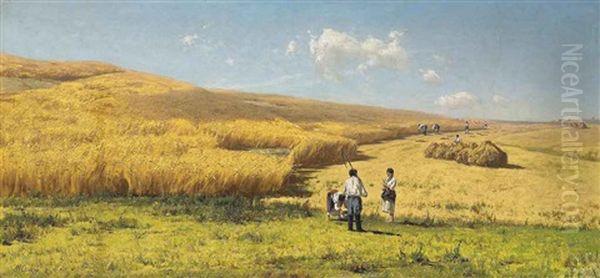
One of Orlovsky's most celebrated paintings is "Harvest" (Zhatva). This work exemplifies his ability to combine detailed realism with a sense of narrative and human presence within the landscape. The painting depicts workers engaged in the toil of reaping grain in the vast Ukrainian fields, under a wide, luminous sky. The composition is masterful, leading the viewer's eye across the scene, highlighting the rhythmic activity of the figures and the golden expanse of the ripe crops. "Harvest" is not just a depiction of agricultural labor; it is a celebration of the fertility of the Ukrainian land and the enduring connection between its people and their environment. It showcases his keen observation of rural life and his sympathy for the peasant experience, a theme also explored by many Peredvizhniki artists like Vasily Perov (1834-1882) and Grigory Myasoyedov (1834-1911), albeit often with a more critical social commentary.
Beyond grand harvest scenes, Orlovsky painted a wide array of subjects. His Crimean landscapes, for which he first gained significant recognition, captured the dramatic beauty of the peninsula's coastline, its mountains, and its unique flora. He depicted tranquil river scenes, dense forests, quiet village outskirts, and the changing moods of nature through different times of day and seasons. His works often featured carefully rendered details of trees, water, and cloud formations, demonstrating his profound understanding of natural forms. The human element, when present, was typically integrated harmoniously into the landscape, suggesting a peaceful coexistence. His paintings were sought after by collectors and earned him the admiration of figures such as Tsar Alexander III, who personally acquired some of his works.
Academic Career and Pedagogical Impact
Orlovsky's artistic achievements were matched by a distinguished academic career. In 1874, he was appointed an Academician by the Imperial Academy of Arts in St. Petersburg, a prestigious recognition of his standing in the art world. His connection to the Academy deepened further when, in 1878, he was made a professor and appointed as the head of the landscape painting department. This was a position of considerable influence, allowing him to shape the training of a new generation of landscape painters.
As a professor, Orlovsky would have emphasized the principles he himself practiced: rigorous drawing, careful observation of nature, mastery of technique, and an appreciation for the beauty of the native landscape. He was known to be an inspiring teacher, and his studio attracted many aspiring artists. His pedagogical approach likely balanced the structured curriculum of the Academy with encouragement for students to develop their own individual responses to nature. Among Ukrainian artists, figures like Mykola Pymonenko (1862-1912), known for his genre scenes often set in idyllic Ukrainian landscapes, and Serhiy Svitoslavsky (1857-1931), a dedicated landscape painter, were his contemporaries and part of a broader movement to depict Ukrainian life and nature. Orlovsky's success and academic position would have served as an inspiration and a benchmark for them.
Later in his career, he also became associated with the Kyiv Art School, contributing to the development of art education in his native Ukraine. His influence extended beyond his direct students, as his widely exhibited and reproduced works helped to popularize landscape painting and foster a greater appreciation for the beauty of the region. He played a role in bridging the academic traditions of St. Petersburg with the burgeoning artistic scene in Kyiv.
Personal Life: Triumphs and Tribulations
While Orlovsky's professional life was marked by significant achievements and recognition, his personal life, according to some accounts, was more tumultuous and contained elements of eccentricity and sorrow. It is reported that he was married twice, both times to French women, and both marriages were touched by tragedy or unusual circumstances. One story suggests that his first wife led him to believe she was pregnant multiple times, only for him to discover that the children presented as his own were, in fact, adopted from an orphanage. This alleged deception would undoubtedly have caused considerable personal distress.
His second marriage was reportedly to an animal tamer or zoo attendant, with whom he had two children. These biographical details, if accurate, paint a picture of a personal life far removed from the serene and ordered beauty of his landscapes. He was described by some as having an eccentric personality, perhaps not conventionally attractive to women but possessing a strong charisma that drew people to him.
Later in life, Orlovsky faced significant hardships. There are accounts suggesting that he lost his official residence and salary, possibly due to changing circumstances at the Academy or personal issues. This period was reportedly marked by financial difficulties and a struggle with alcoholism, leading him to move to a poorer district. These personal struggles stand in stark contrast to the idyllic and often sunlit scenes he committed to canvas, hinting at a complex inner world.
Later Years and Enduring Legacy
In 1897, Orlovsky reportedly contracted typhoid fever and, upon recovery, moved from St. Petersburg back to his native Kyiv. The reasons for this move could have been health-related, a desire to be closer to his roots, or a response to his changing professional circumstances. He did not, however, remain in Kyiv for the rest of his life. His final years were spent in Genoa, Italy, a country he had visited during his earlier European travels. The mild climate and picturesque scenery of the Italian Riviera may have offered solace in his declining years. Vladimir Donatovich Orlovsky passed away in Genoa in 1914, at the age of 72, on the cusp of a world that would be irrevocably changed by war and revolution.
Despite the personal challenges he may have faced, Orlovsky's artistic legacy is secure. He is regarded as one of the founders of the Ukrainian school of realist landscape painting and an important representative of late 19th-century Russian academic art. His works are held in numerous prestigious museum collections, including the National Art Museum of Ukraine in Kyiv, the Tretyakov Gallery in Moscow, and other museums across Ukraine and Russia, as well as in private collections.
His paintings continue to be admired for their technical brilliance, their faithful yet poetic rendering of nature, and their celebration of the Ukrainian and Russian landscapes. He successfully synthesized the rigorous training of the Imperial Academy with a personal vision deeply rooted in his native land. Artists like Arkhip Kuindzhi (1842-1910), a contemporary known for his dramatic and innovative use of light, also explored the Ukrainian landscape, though with a very different, more romantic and almost mystical sensibility. Orlovsky's approach was more grounded in observable reality, yet no less captivating.
Orlovsky in the Context of His Contemporaries
Vladimir Orlovsky's career unfolded during a dynamic period in Russian and Ukrainian art. He was a contemporary of the Peredvizhniki (Wanderers), a group of realist artists who broke away from the strictures of the Imperial Academy to create art that was more accessible and relevant to the broader public, often focusing on social issues and the lives of ordinary people. While Orlovsky remained more closely aligned with the Academy throughout his career, his dedication to depicting the native landscape and, in works like "Harvest," the life of its people, shared some common ground with the Peredvizhniki's focus on national themes.
His teacher, Alexei Bogolyubov, was instrumental in the formation of the Peredvizhniki society. Other prominent members included Ilya Repin (1844-1930), a master of historical painting and portraiture, and Vasily Surikov (1848-1916), known for his large-scale historical canvases. While Orlovsky's primary focus was landscape, the prevailing artistic discourse, heavily influenced by these figures, emphasized realism and national identity.
In Ukraine, artists like Kyriak Kostandi (1852-1921), who was associated with the Peredvizhniki and the South Russian school of painters in Odessa, also contributed to the development of realist landscape painting. The legacy of Taras Shevchenko (1814-1861), the great Ukrainian poet and artist, also loomed large, championing Ukrainian culture and identity. Orlovsky's contribution was to elevate landscape painting within this context, creating works that were both academically sound and deeply expressive of his connection to his homeland.
Conclusion: Orlovsky's Place in Art History
Vladimir Donatovich Orlovsky was an artist of considerable talent and dedication, whose work significantly enriched the tradition of landscape painting in both Ukraine and Russia. His ability to capture the grandeur and subtle beauty of nature, combined with his technical mastery, earned him a prominent place among his contemporaries. From the sun-drenched fields of Ukraine to the rugged coasts of Crimea and the serene forests of Finland, his canvases offer a timeless vision of the natural world.
As a professor at the Imperial Academy of Arts, he influenced a generation of artists, passing on the tenets of academic realism while fostering an appreciation for direct observation and plein-air painting. His works remain a testament to an era when landscape painting was not merely a depiction of scenery, but a profound expression of national identity, a celebration of the homeland, and a source of aesthetic and spiritual contemplation. Despite the personal adversities he may have encountered, his artistic output remained consistently high in quality, leaving behind a legacy that continues to be valued and studied. Vladimir Orlovsky's paintings endure as luminous windows onto the landscapes he loved, securing his position as a master of his genre.