William Henry Knight (1823-1863) was a British artist whose career, though relatively brief, left a distinct mark on the Victorian art scene. He is primarily celebrated for his charming and intimate depictions of domestic scenes and, in particular, his sensitive portrayals of children. His work offers a window into the everyday lives, joys, and minor dramas of mid-19th century British households, rendered with a truthfulness and naturalism that appealed greatly to his contemporaries.
Early Life and Artistic Awakening
The consensus among art historical records indicates that William Henry Knight was born in Newbury, Berkshire, in 1823. His early life saw him employed in a solicitor's office, a path that seemed far removed from the world of art. However, Knight possessed an innate talent for drawing and painting. This burgeoning ability did not go unnoticed. Encouragement, notably from the Society of British Artists, played a crucial role in his decision to pursue art professionally.
This pivotal moment led him to London, the vibrant heart of the British art world. In the capital, he embarked on formal artistic studies, though sources suggest he was also largely self-taught, honing his skills through diligent practice. To support himself during these formative years, Knight undertook work creating crayon portraits, a common means for aspiring artists to earn a livelihood while developing their more ambitious oil painting techniques. One piece of information suggests a birth in Bournemouth on September 26, 1823, and that his father ran a school there; while Newbury is more widely cited, this alternative detail adds a layer to his early biography, though it requires careful consideration alongside more established facts. There is also a significantly conflicting record suggesting a South African birth in 1866, which seems highly improbable given his documented exhibition record and death in 1863, and likely refers to a different individual.
Artistic Focus: The World of Home and Children
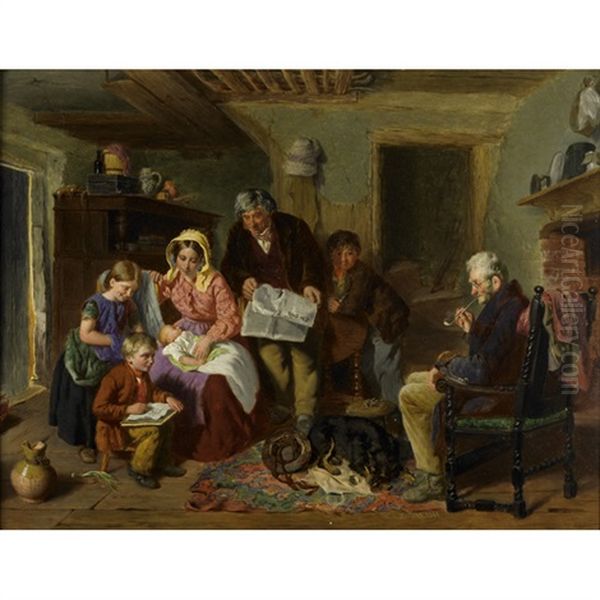
Knight quickly found his niche in genre painting, specifically focusing on scenes of domestic life. His canvases are often populated by children engaged in play, learning, or experiencing the small, significant moments of childhood. These were not grand historical or mythological subjects, but rather the quiet, relatable narratives of family existence. This focus resonated with Victorian sensibilities, which placed a high value on home, family, and the innocence of youth.
His paintings are typically characterized by their relatively small scale, which lends them an intimate quality. Knight's style was praised for its truthfulness and naturalism. He avoided overt sentimentality, instead capturing genuine expressions and interactions. His attention to detail in rendering figures, clothing, and domestic interiors contributed to the realism of his work. Artists like Thomas Webster (1800-1886) also excelled in similar charming depictions of children and village life, creating a popular sub-genre that Knight contributed to significantly. The works of the Cranbrook Colony artists, such as Frederick Daniel Hardy (1827-1911) and George Bernard O'Neill (1828-1917), who meticulously painted domestic interiors and family groups, also share thematic similarities with Knight's output.
Notable Works and Their Reception
Several of William Henry Knight's paintings achieved considerable recognition during his lifetime and continue to be appreciated. Among his most famous works are "The Lost Change" (sometimes referred to as "The Lost Coin"), painted in 1849. This piece, depicting a moment of childhood concern or discovery, was reportedly sold for a significant sum, around £200, at auction, underscoring its contemporary appeal and market value.
Another well-regarded painting is "The Trump Card," executed in 1860. This work, likely portraying a scene of a card game, again highlights his ability to capture narrative and emotion within a domestic setting. It, too, commanded a good price at auction, selling for £126. These sales figures indicate that Knight's work was commercially successful and sought after by Victorian art collectors.
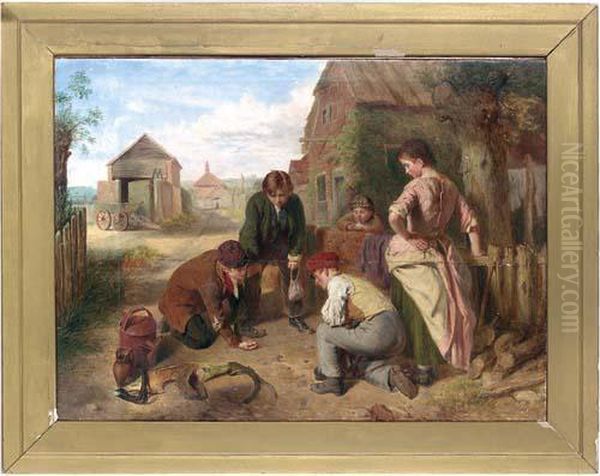
"Early Attempts," a scene painting from 1861 measuring 23 by 27 inches, further exemplifies his thematic concerns. "The Game of Marbles," also dated 1861 and measuring 40 x 50.5 cm, now in a private collection, is another testament to his focus on childhood activities. These titles themselves evoke the everyday, relatable scenarios that Knight so skillfully brought to life on canvas. His approach can be seen as part of a broader tradition of genre painting that had been popularized in Britain by artists like Sir David Wilkie (1785-1841) earlier in the century, whose scenes of Scottish peasant life were immensely influential.
Exhibitions and Professional Standing
William Henry Knight was an active participant in the London art scene, regularly submitting his works to major exhibitions. Between 1844 and his death in 1863, he exhibited an impressive 29 works at the prestigious Royal Academy of Arts. This consistent presence at the RA indicates a level of acceptance and recognition from the leading art institution of the day.
He also showed 17 works at the British Institution, another important venue for artists to display and sell their paintings. Furthermore, he exhibited eight pieces at the Society of British Artists on Suffolk Street, the very society that had initially encouraged his artistic pursuits. This consistent exhibition record across multiple significant venues demonstrates his productivity and his engagement with the contemporary art world. His success in these forums was crucial for an artist like Knight, who did not come from an established artistic dynasty like, for example, the Landseer family (Sir Edwin Landseer being a dominant figure).
The Victorian Context: Genre Painting and Its Appeal
Knight's work flourished within a Victorian art market that had a strong appetite for genre painting. The burgeoning middle class, with its emphasis on domestic virtue and family life, provided a ready audience for art that reflected these values. Unlike the grand history paintings favored by earlier generations or the academic elite, genre scenes offered narratives that were accessible, relatable, and often imbued with a gentle moral or sentimental lesson.
Artists like William Powell Frith (1819-1909), with his sprawling, detailed panoramas of modern life such as "Derby Day" or "The Railway Station," represented one end of the genre spectrum, capturing large-scale public life. Knight, on the other hand, focused on the more private, intimate sphere of the home. His work shares an affinity with that of painters like Augustus Egg (1816-1863), whose narrative paintings often explored domestic dramas, albeit sometimes with a more overt moralizing tone, as seen in his triptych "Past and Present." Richard Redgrave (1804-1888) also contributed to social commentary through his genre scenes.
The depiction of children was a particularly popular sub-genre. The Victorian era saw a shift in the perception of childhood, with a greater emphasis on its innocence and distinctness from adulthood. Artists like Sophie Gengembre Anderson (1823-1903), a contemporary of Knight, also specialized in idyllic and detailed portrayals of children and women. Even prominent Pre-Raphaelite painters like Sir John Everett Millais (1829-1896) later in his career produced highly popular paintings featuring children, such as "Bubbles."
Artistic Style and Technique
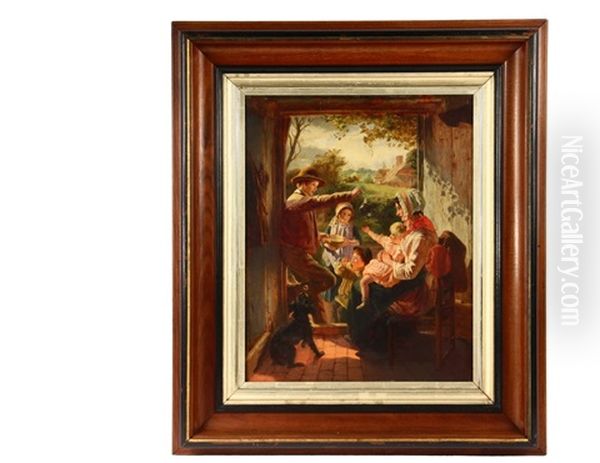
William Henry Knight's artistic style was characterized by its meticulous detail and smooth finish, typical of much Victorian academic painting. He worked primarily in oils, building up his compositions with careful drawing and subtle gradations of color. His figures are solidly rendered, and he paid close attention to the textures of fabrics, the play of light on surfaces, and the specific details of domestic interiors, which all contributed to the verisimilitude of his scenes.
While oil painting was his primary medium for exhibition pieces, it's noted that he initially supported himself with crayon portraits. Some sources also mention a watercolor technique involving loose pencil or pen drawing overlaid with clear color washes. This suggests a versatility in his approach, though his reputation rests firmly on his oil paintings of genre subjects. The intimate scale of many of his works invited close viewing, allowing the audience to appreciate the fine execution and the subtle narratives embedded within them. This careful, detailed approach differed significantly from the broader, more atmospheric effects sought by landscape painters like J.M.W. Turner (1775-1851) or the naturalistic observations of John Constable (1776-1837), who represented different, though equally important, facets of British art.
Clarifying Identities: William Henry Knight vs. Others
It is important to distinguish William Henry Knight (1823-1863) from other artists with similar names to avoid confusion. For instance, there was another William Knight, a watercolorist born in 1857, and William Henry Hunt (1790-1864), a celebrated watercolorist known for his detailed still lifes of fruit and flowers, and rustic figures.
A significant point of confusion in some aggregated information pertains to artistic associations. The provided source material mentions friendships and studies with artists like Alfred Sisley, Auguste Renoir, Frédéric Bazille, and Claude Monet, and a friendship with George Beaumont. These connections, however, are characteristic of Daniel Ridgway Knight (1839-1924), an American artist who worked extensively in France and was indeed associated with the Impressionists. William Henry Knight, being British and dying in 1863 before Impressionism fully emerged as a movement, and primarily working in London, would not have had these specific Parisian associations. This highlights the importance of careful attribution in art historical research. While William Henry Knight would have been aware of and exhibited alongside many British contemporaries, his direct artistic circle and influences would have been rooted in the British art scene of the 1840s and 1850s.
Legacy and Art Historical Assessment
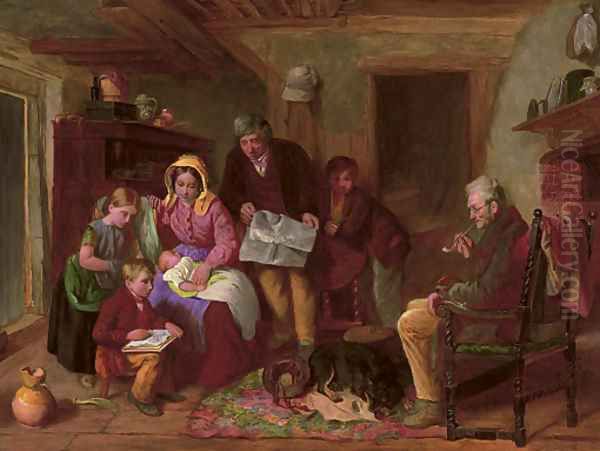
William Henry Knight's career was cut short by his relatively early death in 1863 at the age of 40. In his two decades of professional activity, he established himself as a skilled and popular painter of domestic genre scenes. His work was well-received by the public and sold for respectable prices, indicating a successful, if not stellar, career.
In the broader sweep of art history, Knight is considered a competent and charming minor master of the Victorian era. He did not revolutionize painting or spearhead a new artistic movement in the way that, for example, the Pre-Raphaelite Brotherhood (including Dante Gabriel Rossetti, William Holman Hunt, and Millais) sought to do. Instead, his contribution lies in his heartfelt and skillfully executed depictions of a particular aspect of Victorian life. His paintings provide valuable social documents, offering insights into the material culture, pastimes, and emotional tenor of mid-19th century family life, particularly the world of children.
His works continue to appear at auction and are held in various public and private collections. They are appreciated for their narrative charm, technical proficiency, and their nostalgic evocation of a bygone era. While perhaps not an artist of the absolute first rank like some of his more famous contemporaries, William Henry Knight carved out a specific niche for himself and produced a body of work that remains appealing and historically significant within the context of Victorian genre painting. His focus on the small, everyday moments, rendered with sincerity and skill, ensures his place as a noteworthy chronicler of his time. The enduring appeal of his subjects speaks to a universal appreciation for the warmth and intimacy of family life, a theme he explored with dedication and artistry.