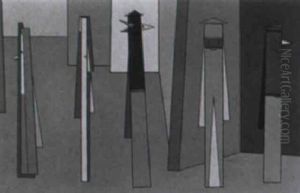
Attilio Salemme was an Italian-American painter known for his abstract compositions and unique approach to form and color. Born in 1911 in Italy, Salemme immigrated to the United States where he would eventually establish his career as an artist. Despite a relatively short life — he died in 1955 at the age of 44 — Salemme made significant contributions to the American art scene of the mid-20th century.
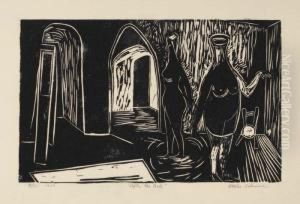
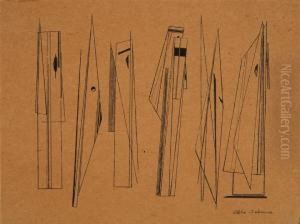
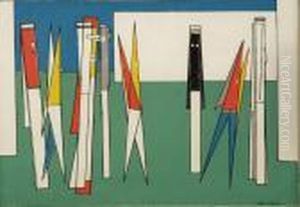
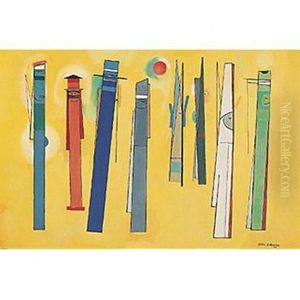
His early work was influenced by the European avant-garde, particularly by movements such as Cubism and Futurism. However, as his style developed, Salemme began to move away from these influences, seeking a more personal and idiosyncratic form of expression. His paintings often featured enigmatic and abstracted figures, set against vibrant, color-saturated backgrounds that defied traditional perspective.
During his lifetime, Salemme exhibited his work in various galleries and museums, although he never achieved the same level of fame as some of his contemporaries. Nevertheless, his paintings were well received by critics who appreciated his innovative use of color and form. Salemme's work was also noted for its emotional intensity and the sense of mystery that pervades much of his imagery.
Tragically, Salemme's career was cut short when he died unexpectedly in 1955. His death was a loss to the art world, as he was at the prime of his creative life and continuing to evolve as an artist. Posthumously, his work has been revisited and has gained recognition for its contribution to the development of abstract art in America. Exhibitions of his work continue to introduce Salemme to new generations of art enthusiasts and collectors, cementing his legacy as an important figure in the history of American modernism.