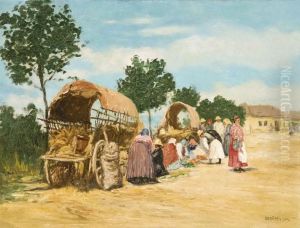
Béla Erdőssy was a Hungarian painter and graphic artist born in 1891 in Zombor, which was part of the Austro-Hungarian Empire at the time of his birth and is now in Serbia. He was known for his landscapes, still lifes, portraits, and figure paintings. Erdőssy's work reflects a variety of influences, including elements of Post-Impressionism and Expressionism, and he is often associated with the Nagybánya artists' colony, which played a crucial role in the development of Hungarian modern art.
Erdőssy studied at the Hungarian Royal Drawing School, now known as the Hungarian University of Fine Arts, under the guidance of notable artists such as István Réti and János Thorma, who were important figures in Hungarian art at the turn of the century. The Nagybánya colony, where these mentors were influential, was known for its open-air painting practice, a characteristic that would become evident in Erdőssy's approach to landscapes.
After his formal education, Erdőssy traveled to Paris, which was a common practice among artists of the era seeking to immerse themselves in the avant-garde movements of the time. His time in Paris likely exposed him to the works of the French Impressionists and Post-Impressionists, which would have influenced his artistic development. Upon returning to Hungary, Erdőssy continued to paint and exhibit his works, contributing to the Hungarian art scene.
Throughout his career, Erdőssy exhibited in various group exhibitions and had several solo shows. His work often depicted the rural landscapes of Hungary, capturing the essence of the countryside with a vibrant palette and dynamic brushwork. Despite his achievements, Erdőssy remains a lesser-known figure outside of Hungary, and his work is primarily appreciated by a domestic audience and scholars of Hungarian art history.
Béla Erdőssy passed away in 1955. His legacy remains in the collections of Hungarian museums and in the history of the Nagybánya artists' colony, which continues to be celebrated for its role in shaping Hungarian modernism and for nurturing artists like Erdőssy, who contributed to the rich tapestry of Hungarian cultural heritage.