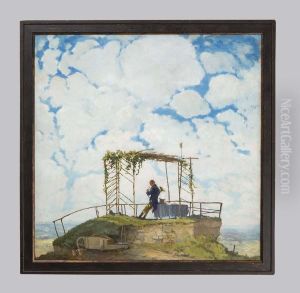
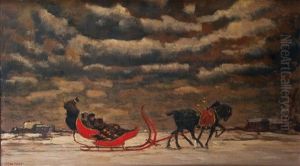
Max Frey, an artist whose career spanned the first half of the 20th century, remains a notable figure in European art history for his unique contributions to painting and graphic design. Born in 1902, Frey's early life was marked by the tumultuous backdrop of pre-World War I Europe, a factor that would later influence his artistic themes and styles. Despite the scarcity of detailed records about his personal life and educational background, it is known that Frey was deeply involved in the artistic movements of his time, exploring and contributing to various styles and forms.
His work, often characterized by a blend of surrealism and expressionism, showcases a profound depth of emotion and a keen eye for the complexities of the human condition. Frey was adept at using both color and form to evoke a sense of mystery and introspection, making his art resonate with a wide audience. Throughout the 1920s and 1930s, he became increasingly involved in graphic design, applying his artistic sensibilities to posters, book covers, and advertisements. This period saw Frey integrating modernist principles into his work, simplifying forms and employing vibrant colors to communicate effectively with the viewer.
Despite the challenges posed by World War II, Frey continued to produce art, although his work from this period reflects the darker tones and existential concerns of the time. After the war, he returned to more introspective themes, exploring the nature of human existence and the subconscious. His late works are often seen as a culmination of his life's artistic journey, synthesizing his earlier explorations into a coherent whole.
Max Frey's death in 1955 marked the end of a career that had significant influence on the European art scene. His legacy is preserved in the collections of various European museums and galleries, where his work continues to be studied and admired. Frey's ability to navigate through different artistic movements while maintaining a distinctive voice has made him a subject of interest for art historians and a source of inspiration for contemporary artists.