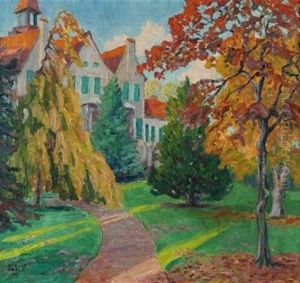
Rudolf Greve was a German portrait and landscape painter born in Hamburg on May 27, 1863. His artistic journey began at a young age, leading him to study at the Academy of Fine Arts in Munich, where he was influenced by the works of the old masters. Greve's style was deeply rooted in the traditions of academic painting, but he also absorbed and reflected the changes happening in the art world during his lifetime, particularly the move towards Impressionism and Post-Impressionism. Despite these influences, Greve's work retained a distinctive character, marked by a nuanced understanding of light and shadow, and a profound ability to capture the essence of his subjects.
After completing his studies in Munich, Greve traveled extensively in Europe, drawing inspiration from the diverse landscapes and cultures he encountered. His travels took him to Italy, France, and the Netherlands, among other places, where he studied the works of the Renaissance and Baroque masters, further enriching his artistic vocabulary. Upon returning to Germany, Greve settled in Hamburg where he quickly established himself as a prominent portrait painter, sought after by the elite of society. His portraits are celebrated for their psychological depth and the skillful depiction of his sitters' personalities.
Greve's landscapes, on the other hand, reveal his profound connection to nature and his fascination with the effects of light. These works range from serene depictions of the German countryside to more dramatic and moody scenes, reflecting the varied moods of nature. Throughout his career, Greve exhibited his work widely, gaining recognition and accolades both in Germany and abroad. His contributions to German art were recognized with several awards and honors during his lifetime.
Despite his success, Rudolf Greve remained a somewhat private figure, dedicated to his art and teaching. He was also involved in the artistic community in Hamburg, contributing to the development of the local art scene. Greve's legacy is preserved in the collections of various German museums, and his works continue to be admired for their technical mastery and emotional depth. Rudolf Greve passed away in Hamburg on June 12, 1927, leaving behind a body of work that continues to be celebrated for its contribution to the German art history of the late 19th and early 20th centuries.