The annals of art history are replete with figures whose lives are shrouded in mystery, their identities known only through the distinctive style and recurrent motifs of their surviving works. Among these is the artist, or perhaps group of artists, known as the Master of the Parrot. This intriguing name, a "notname" or "name of convenience," was bestowed by the eminent art historian Max J. Friedländer in 1948. It designates a painter, or more likely a workshop, active primarily in Antwerp, though possibly also Bruges, during the first half of the 16th century, a period of immense artistic ferment and transition in the Southern Netherlands.
The works attributed to the Master of the Parrot are predominantly religious in theme, often featuring the Madonna and Child, and are characterized by an elegant, somewhat Italianate style adapted for the burgeoning middle-class market. A distinctive, almost signature element in many of these paintings is the inclusion of a parrot, an exotic bird that, by the 16th century, had become a symbol of various concepts, including eloquence, the Annunciation, and even Marian purity. The quest to unmask this artist reveals much about the art production, patronage, and intellectual currents of Renaissance Flanders.
The Artistic Crucible of 16th-Century Antwerp and Bruges
To understand the Master of the Parrot, one must first appreciate the vibrant artistic environment from which these works emerged. In the early 16th century, Antwerp was rapidly eclipsing Bruges as the economic and artistic powerhouse of Northern Europe. Its bustling port facilitated international trade, bringing not only wealth but also new ideas, exotic goods, and diverse cultural influences. This cosmopolitan atmosphere fostered a dynamic art market, catering to a wide range of patrons, from the church and nobility to the increasingly affluent merchant class.
Bruges, while past its absolute zenith, still maintained a significant artistic tradition, with established workshops continuing to produce high-quality paintings. The artistic landscape of both cities was marked by a fascinating interplay between enduring Late Gothic traditions and the burgeoning influence of the Italian Renaissance. Artists like Jan Gossaert (also known as Mabuse), who had traveled to Italy, were instrumental in introducing classical motifs and idealized human forms to the North. Others, such as Quentin Matsys (or Quinten Massys), often considered the first great painter of the Antwerp school, skillfully blended traditional Netherlandish realism with Renaissance sensibilities, particularly in portraiture and religious scenes.
This period also saw the rise of specialized genres and a more market-oriented approach to art production. Workshops often employed numerous assistants, each potentially specializing in different aspects of a painting, such as figures, landscapes, or still life elements. This collaborative environment makes the attribution of specific works to a single hand exceptionally challenging, a factor that undoubtedly contributes to the anonymity of figures like the Master of the Parrot. Other notable artists active in this milieu included Joos van Cleve, known for his devotional paintings and portraits, and Bernard van Orley, a Brussels-based artist who also absorbed Italian influences and was a prominent designer of tapestries and stained glass.
Stylistic Hallmarks and Thematic Concerns
The oeuvre attributed to the Master of the Parrot, though diverse, exhibits several recurring stylistic and thematic characteristics. The paintings are generally small to medium in scale, suitable for private devotion or domestic display. Figures are often depicted with a refined, somewhat elongated elegance, their features smooth and idealized. Draperies are rendered with a soft, flowing quality, though sometimes with a slightly mannered complexity.
A key feature is the assimilation of Italian Renaissance elements, particularly in the composition and the depiction of the human form. However, this Italianism is filtered through a distinctly Northern sensibility, retaining a meticulous attention to detail in textures, fabrics, and accessories, a hallmark of the Flemish tradition inherited from masters like Jan van Eyck and Rogier van der Weyden. The color palettes are often rich and luminous, with a preference for jewel-like tones.
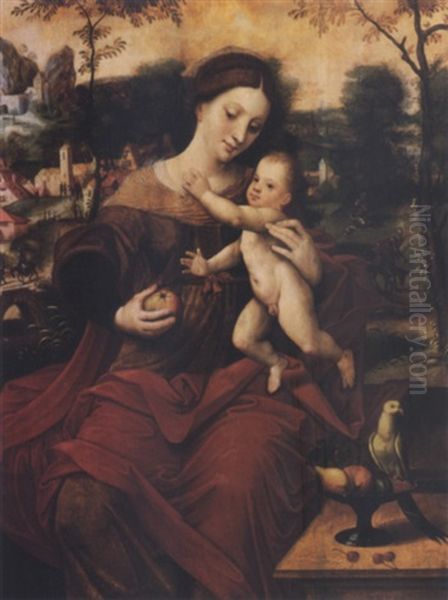
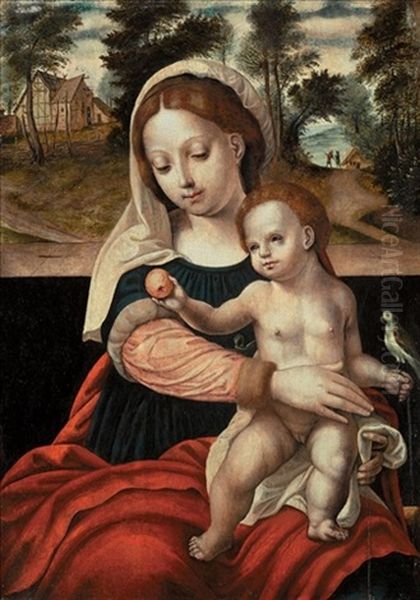
Thematically, the Virgin and Child is the most frequent subject. These depictions often emphasize the tender, human relationship between mother and infant. The inclusion of a parrot in these scenes is particularly noteworthy. In Christian iconography, the parrot was sometimes associated with the Virgin Mary. Its ability to "speak" was likened to the Word of God, and its cry "Ave" was linked to the Archangel Gabriel's salutation at the Annunciation. Furthermore, as parrots were exotic and expensive, their inclusion could also signify the wealth and status of the patron, or allude to Paradise and the purity of the Virgin.
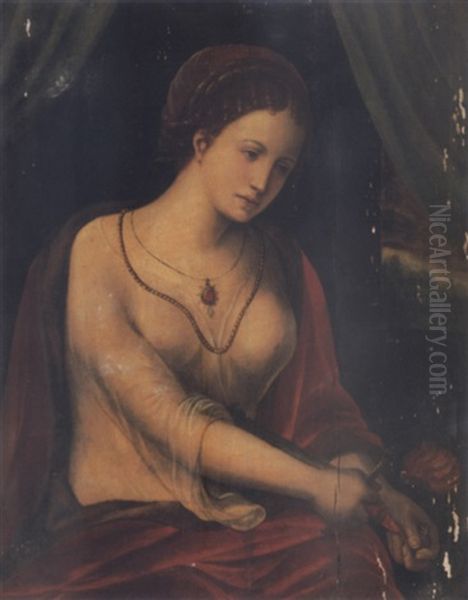
Other religious subjects, such as depictions of female saints like Mary Magdalene or Lucretia, also appear in the Master of the Parrot's attributed body of work. These figures are often portrayed with a fashionable, courtly elegance, appealing to the tastes of the contemporary elite. The settings, whether interiors or landscape backgrounds, often incorporate architectural elements or vistas that blend Northern and Italianate features.
The Parrot Motif: A Symbol of Multiple Meanings
The parrot, the eponymous bird that gives this master his name, was more than just a decorative element in 16th-century art. Its symbolism was rich and varied, drawing from classical, Christian, and contemporary cultural sources. In ancient Rome, parrots were prized pets, associated with luxury and exoticism. Pliny the Elder noted their ability to mimic human speech.
In the Christian context, as mentioned, the parrot could symbolize the Virgin Mary, particularly her immaculate conception, as it was believed by some that the parrot was a clean bird. Its association with the "Ave" of the Annunciation made it a Marian emblem. The parrot's vibrant green plumage could also link it to themes of spring, renewal, and hope, all relevant to Christian salvation.
Beyond religious connotations, the parrot in the 16th century was a status symbol. Imported from Africa, India, and the New World, these birds were expensive and rare, their presence in a painting indicating the owner's worldliness and wealth. They represented the expanding horizons of European exploration and trade. The bird's ability to mimic speech also lent itself to interpretations of eloquence or, conversely, mindless repetition, depending on the context. For the Master of the Parrot, the consistent inclusion of this bird suggests it held particular significance, either for the artist, the workshop's brand, or the patrons they served. It became a recognizable trademark, setting their works apart in a competitive market.
The Quest for Identity: A Collective or an Individual?
The true identity of the Master of the Parrot remains one of art history's intriguing puzzles. Friedländer grouped a cohesive body of work around this notname, but whether these paintings are the product of a single artist or a workshop with a consistent style is still debated. The variations in quality and handling within the attributed oeuvre might suggest the latter – a principal master overseeing assistants who executed different parts of paintings or entire versions of popular compositions.
Several art historians have proposed potential candidates or affiliations. The style shows affinities with the work of artists active in Antwerp, such as the circle of Quentin Matsys or Joos van Cleve. The Italianate leanings also point to an artist who was receptive to the new artistic currents flowing from the South, perhaps through prints, imported artworks, or even direct contact with artists who had traveled.
One of the most compelling, though by no means universally accepted, hypotheses links the Master of the Parrot to the workshop or circle of Pieter Coecke van Aelst (1502-1550). Coecke was a highly influential and versatile artist, active as a painter, tapestry designer, architect, and publisher. He ran a large and productive workshop in Antwerp and later in Brussels, and his work played a crucial role in disseminating Renaissance forms and ideas in the Netherlands.
Pieter Coecke van Aelst: A Potential Candidate?
Pieter Coecke van Aelst was born in Aalst in 1502. According to Karel van Mander, the early Netherlandish art historian, Coecke studied under Bernard van Orley in Brussels. By 1527, he was enrolled as a master in the Antwerp Guild of Saint Luke, indicating his established status as an independent artist. He later served as dean of the guild, a testament to his standing within the artistic community.
Coecke was a man of broad intellectual interests and entrepreneurial spirit. He traveled to Italy, absorbing firsthand the principles of Renaissance art and architecture. Around 1533, he journeyed to Constantinople (Istanbul), possibly with the aim of securing tapestry commissions from the Ottoman Sultan Suleiman the Magnificent. Though this venture was reportedly unsuccessful, the journey resulted in a series of remarkable drawings depicting Turkish customs and costumes, which were later published as woodcuts by his widow, Mayken Verhulst (herself an accomplished artist, particularly in miniature painting and watercolor).
Coecke's artistic output was prodigious and varied. He designed significant tapestry series, including the "Story of Saint Paul" and the "Seven Deadly Sins." His paintings, such as "The Last Supper" (of which many workshop versions exist), demonstrate his engagement with Italian compositional models, particularly those of Leonardo da Vinci. He was also a key figure in architectural publishing, translating and issuing Flemish editions of Sebastiano Serlio's influential treatises on architecture, thereby making Italian Renaissance architectural theory accessible to Northern craftsmen.
The argument for connecting the Master of the Parrot to Coecke's circle rests on several points. Firstly, the period of activity aligns. Secondly, Coecke's workshop was known for producing a large volume of paintings for the open market, often featuring popular religious subjects rendered in an accessible, Italianizing style – characteristics shared by the Master of the Parrot's works. Thirdly, Coecke's known interest in exotic subjects (as evidenced by his Turkish drawings) might extend to the inclusion of elements like parrots. However, direct stylistic links that definitively prove Coecke himself or a specific member of his workshop was the Master of the Parrot are still debated. Coecke's documented style, while sharing a general Renaissance leaning, can differ in specific handling from many works attributed to the Master of the Parrot. It is plausible that the Master of the Parrot was an independent contemporary influenced by Coecke, or perhaps a distinct entity within Coecke's large and diverse workshop.
It is also important to note that Coecke's father-in-law was Jan van Dornicke (also known as the Master of 1518), another Antwerp painter with a productive workshop. Coecke took over this workshop after van Dornicke's death, inheriting its patterns and possibly its personnel, further complicating the attribution of works from this period.
Contemporaries and the Wider Artistic Milieu
The Master of the Parrot did not operate in a vacuum. The artistic scene in Antwerp and Bruges was rich with talent, and artists frequently influenced one another, collaborated, or competed. Besides Matsys, Joos van Cleve, Bernard van Orley, and Pieter Coecke van Aelst, other significant figures shaped the artistic landscape.
Joachim Patinir, active in Antwerp, is considered a pioneer of landscape painting as an independent genre. His panoramic vistas, often with religious figures diminutively placed within them, created a new way of seeing the world. While the Master of the Parrot's landscapes are generally more conventional, the growing importance of landscape was a feature of the era.
Ambrosius Benson, an Italian-born painter who became a citizen of Bruges, produced a large number of religious paintings and portraits, often characterized by strong colors and somewhat melancholic figures. His success in Bruges demonstrates the continued vitality of that city's art market. Similarly, Adriaen Isenbrandt, also active in Bruges, worked in a style influenced by Gerard David and produced many devotional works for the open market, sometimes showing parallels in sentiment and composition to the Master of the Parrot.
The influence of German artists was also felt. The prints of Albrecht Dürer, who visited Antwerp in 1520-1521, were widely circulated and had a profound impact on Netherlandish artists through their technical mastery and innovative compositions. Hans Holbein the Younger, though primarily active in Basel and later England, represented the pinnacle of Northern Renaissance portraiture, and his meticulous realism and psychological insight set a standard. While direct links between the Master of the Parrot and these German masters are not explicitly documented, the general artistic climate was one of cross-pollination of ideas.
The broader Italian Renaissance, with giants like Leonardo da Vinci, Raphael, and Michelangelo, exerted its influence primarily through prints, drawings, and the experiences of Northern artists who traveled south, like Gossaert and Coecke. Their innovations in composition, anatomy, and the depiction of emotion gradually permeated Netherlandish art.
Representative Works Attributed to the Master of the Parrot
While a definitive catalogue raisonné is elusive due to the anonymity, several works are consistently attributed to the Master of the Parrot or his immediate circle, showcasing the typical features of this group:
1. Madonna and Child with a Parrot: Numerous versions of this composition exist, varying in details of pose, costume, and background. Typically, the Virgin is shown half-length, tenderly holding the Christ Child, who often interacts with a parrot. One notable example is in the Museo del Prado, Madrid. Another, showing the Child holding a parrot which pecks at an apple (symbolizing salvation from original sin), is found in various collections. These works epitomize the Master's blend of devotional intimacy and elegant presentation.
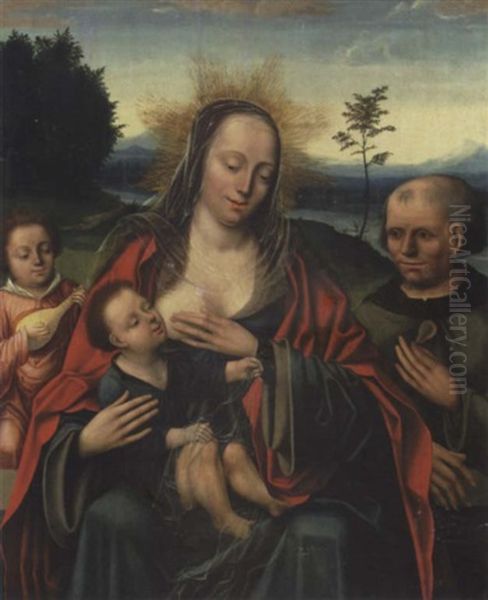
2. The Holy Family with a Parrot: Expanding on the Madonna and Child theme, these compositions include Saint Joseph and sometimes the infant Saint John the Baptist. The parrot often remains a prominent feature. The inclusion of Joseph adds a dimension of domesticity and paternal care.
3. Lucretia: The subject of the Roman heroine Lucretia, who chose suicide over dishonor, was popular during the Renaissance as an exemplar of virtue. Depictions attributed to the Master of the Parrot show her in a typically elegant, slightly melancholic pose, often half-nude and holding the dagger. An example is housed in the John G. Johnson Collection at the Philadelphia Museum of Art.
4. Salome with the Head of John the Baptist: This dramatic Old Testament subject, often imbued with an erotic charge, was also tackled by artists in this circle. Salome is usually depicted as a beautiful young woman, fashionably dressed, presenting the severed head on a platter.
5. Madonna and Child Enthroned with Angels and a Parrot: More elaborate compositions sometimes feature the Virgin and Child enthroned, flanked by music-making angels, with the parrot still present. These works demonstrate a greater ambition in terms of scale and complexity.
The repetition of successful compositions with minor variations was a common workshop practice, allowing for efficient production to meet market demand. This makes it difficult to distinguish the hand of the "master" from that of his assistants.
The Enduring Anonymity and Art Historical Significance
The anonymity of the Master of the Parrot is characteristic of a period when the modern concept of the artist as a unique, named genius was still evolving. While some artists, like Dürer or Matsys, achieved individual fame, many highly skilled painters worked within the guild and workshop system without necessarily seeking personal renown in the way later artists would. Signatures were not consistently used, and the "brand" of a successful workshop often superseded the identity of individual craftsmen within it.
Despite the unresolved questions surrounding his identity, the Master of the Parrot holds a significant place in the study of 16th-century Flemish art. The body of work attributed to him provides valuable insight into:
Art Market Dynamics: The paintings demonstrate the type of art favored by the growing middle class and the production strategies of workshops catering to this demand.
Stylistic Transition: The works illustrate the gradual assimilation of Italian Renaissance ideals into the Netherlandish tradition, creating a distinctive hybrid style.
Iconography: The recurrent use of the parrot and other symbolic elements sheds light on the religious and cultural preoccupations of the era.
Workshop Practices: The variations within the oeuvre offer clues about collaborative art production in the 16th century.
The Master of the Parrot, whether a single individual or a collective of artists working under a unified stylistic banner, contributed to the rich tapestry of art produced in Antwerp and Bruges during a pivotal moment of cultural and artistic transformation. The elegant figures, harmonious compositions, and, of course, the ever-present parrot, continue to charm and intrigue viewers and scholars alike.
Conclusion: A Legacy in Brushstrokes
The Master of the Parrot remains an enigma, a name attached to a style rather than a documented life. The efforts of art historians like Friedländer have allowed us to group these charming and historically significant works, offering a window into the artistic tastes and production methods of early 16th-century Flanders. Whether the hand behind these paintings was that of Pieter Coecke van Aelst, an associate, a competitor, or an entirely separate workshop, the legacy endures in the delicate brushstrokes, the serene Madonnas, and the brightly plumed birds that give this master his intriguing appellation. The mystery itself adds to the allure, reminding us that art can transcend the individual identity of its creator, speaking to us across centuries through its beauty and its embedded cultural meanings. The quest to understand such anonymous masters continues to enrich our understanding of the complex and fascinating world of Renaissance art.