Abraham Teniers, a notable figure in the Flemish Baroque period, carved out his artistic career amidst a family of celebrated painters. Born in Antwerp in 1629 and passing away in the same city in 1670, his life and work offer a fascinating glimpse into the bustling art scene of 17th-century Flanders, particularly its penchant for genre painting. Though often viewed in the context of his more famous elder brother, David Teniers the Younger, Abraham developed his own distinct, albeit related, artistic voice, contributing to the rich tapestry of Flemish art with his depictions of everyday life, rural festivities, and intriguing allegorical scenes.
Early Life and Artistic Formation in Antwerp
Abraham Teniers was born into an artistic dynasty. His father was David Teniers the Elder (1582-1649), a painter of altarpieces, mythological subjects, and genre scenes, who himself had studied under influential masters including, purportedly, Adam Elsheimer in Rome and Peter Paul Rubens in Antwerp. Abraham's primary artistic education, however, came from both his father and, more significantly, his elder brother, David Teniers the Younger (1610-1690). This familial instruction was common practice at the time and ensured a continuity of style and technique, yet also presented the challenge for younger siblings to establish their own artistic identity.
Antwerp, during Abraham's formative years, was a vibrant artistic hub, still basking in the glow of the High Baroque period dominated by figures like Rubens and Anthony van Dyck. The city's Guild of Saint Luke, a powerful institution for artists and craftsmen, played a crucial role in regulating the profession and maintaining standards. Abraham Teniers became a master in the Antwerp Guild of Saint Luke in the guild year 1645-1646, a formal recognition of his skills and his entry into the professional world of painting. This membership allowed him to take on pupils and sell his works independently.
The Teniers Artistic Dynasty
The Teniers family was a significant force in Flemish art. David Teniers the Elder, while a capable artist, was somewhat overshadowed by his son, David the Younger. David the Younger achieved international fame, becoming court painter to Archduke Leopold Wilhelm, the governor of the Spanish Netherlands, and later to Don Juan of Austria. His prolific output, particularly his scenes of peasant life, taverns, and alchemists, set a benchmark for genre painting.
David the Younger's marriage to Anna Brueghel, daughter of Jan Brueghel the Elder and granddaughter of the legendary Pieter Bruegel the Elder, further cemented the Teniers family's connection to another great artistic lineage. This connection is pertinent as Pieter Bruegel the Elder was a foundational figure in the development of peasant genre scenes, a tradition that David Teniers the Younger, and subsequently Abraham, continued and adapted. The influence of the Brueghel dynasty, with its meticulous detail and lively narratives, can be seen as an undercurrent in the Teniers' work. Abraham's own son, David Teniers III (1638-1685, though this is David the Younger's son; Abraham's direct descendants are less documented as prominent artists, so this point from the source might be a slight confusion or refer to the broader family continuation), also became a painter, continuing the family tradition into another generation.
Abraham's Artistic Style and Influences
Abraham Teniers' style is deeply rooted in the Flemish Baroque tradition, characterized by a keen observation of reality, a lively palette, and dynamic compositions. His primary influence was undoubtedly his brother, David the Younger. Like David, Abraham specialized in genre scenes: depictions of peasants carousing in taverns, village festivals (kermesses), domestic interiors, and guardroom scenes. His works often share the same thematic concerns and a similar approach to figure drawing and composition as his elder brother.
However, art historians note subtle differences. While David the Younger's work is often praised for its refined technique, silvery tonalities, and masterful handling of light, Abraham's paintings are sometimes described as having a slightly less polished finish or a somewhat heavier touch in color and execution. This is not to diminish Abraham's skill; his works possess their own charm and demonstrate considerable ability in capturing the character and atmosphere of his chosen subjects. Indeed, the similarity in style has occasionally led to misattributions, with some of Abraham's works being mistaken for those of his more famous brother.
The broader context of Flemish genre painting also informed Abraham's work. Artists like Adriaen Brouwer (1605/6-1638), known for his raw and expressive depictions of peasant brawls and tavern life, had a profound impact on the genre. While Brouwer's style was often more visceral, the Teniers family, including Abraham, tended to present a somewhat more sanitized and often humorous view of peasant life, which appealed to a broader, more affluent clientele. Joos van Craesbeeck, a contemporary and follower of Brouwer, also contributed to this popular genre.
Abraham’s paintings are noted for their detailed rendering of figures, objects, and settings. He paid close attention to the textures of fabrics, the gleam of metal, and the rustic simplicity of peasant dwellings. His use of color could be vibrant, contributing to the lively atmosphere of his scenes, and he was adept at using light and shadow to create depth and drama, as seen in works like "Young Page."
Principal Themes and Subjects in Abraham's Oeuvre
Abraham Teniers' thematic repertoire was diverse, though centered on genre subjects. His paintings often explored the daily lives and leisure activities of the common people, a subject that gained immense popularity in the 17th century.
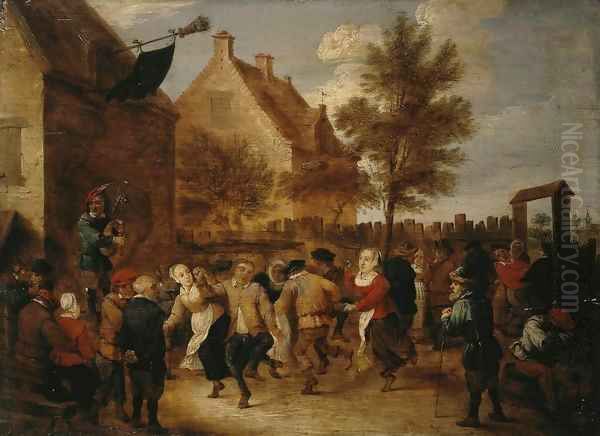
Rural and Tavern Scenes: A significant portion of Abraham's output consists of paintings depicting peasants merrymaking. These scenes, often set outdoors at village fairs or kermesses, or indoors in rustic taverns, are filled with animated figures eating, drinking, dancing, and conversing. Works like "Rural Feast" exemplify this aspect of his art, showcasing his ability to manage complex multi-figure compositions and imbue them with a sense of joyful energy. These paintings often carried moralizing undertones, subtly critiquing excess, but were primarily enjoyed for their lively and entertaining qualities.
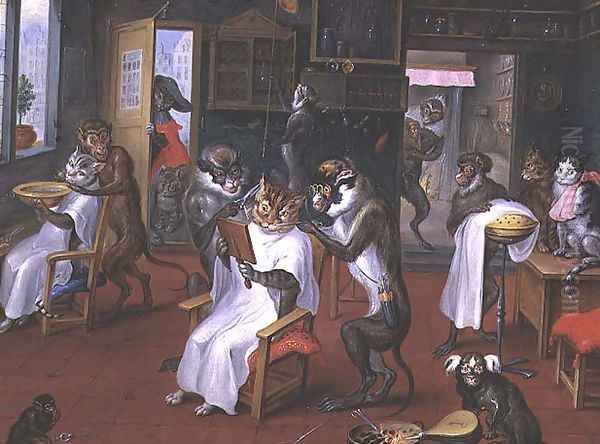
"Singeries" (Monkey Scenes): A particularly intriguing and humorous theme in Abraham's work, also popular with his brother David, was the "singerie" – scenes where monkeys are depicted dressed in human clothes and engaging in human activities. His painting "Barber Shop with Monkeys and Cats" is a prime example. In this work, monkeys play the roles of barbers and customers, while cats also feature in the scene. These satirical paintings often poked fun at human follies and vanities, using the monkeys as allegorical stand-ins for human society.
Allegorical and Mythological Scenes: While primarily a genre painter, Abraham, like his father and brother, also tackled allegorical and occasionally mythological or religious subjects. His "Abraham's Sacrifice of Isaac" (1654-1656) demonstrates his capability in handling more serious, narrative themes, drawing on biblical stories.
Depictions of Professionals: Abraham also painted scenes featuring alchemists, doctors, or scholars in their studies, themes also explored by David the Younger. These works often highlighted the contrast between true knowledge and charlatanism, or simply depicted the dedicated pursuit of learning and experimentation. One source mentions Abraham portraying himself as an alchemist, emphasizing the creative parallels between the artist and the alchemist, both engaged in transformative processes.
Guardroom Scenes: Another popular genre in the Netherlands at the time was the guardroom scene (cortegaardje), depicting soldiers at leisure in their quarters, often gambling, smoking, or cleaning their equipment. Abraham contributed to this genre, capturing the camaraderie and idleness of military life.
Notable Works and Their Characteristics
Several works stand out in Abraham Teniers' oeuvre, showcasing his skill and thematic interests:
"Barber Shop with Monkeys and Cats" (c. 1647): Currently housed in the Kunsthistorisches Museum in Vienna, this painting is a quintessential example of a singerie. The meticulous detail in the monkeys' attire and the humorous interactions between the animal characters highlight Abraham's wit and observational skills. The setting of a barber shop, a common place for social interaction, adds another layer to the satire.
"Abraham's Sacrifice of Isaac" (1654-1656): This religious painting demonstrates Abraham's versatility beyond genre scenes. The dramatic intensity of the biblical narrative would have required a different compositional and emotional approach compared to his light-hearted peasant scenes. Its existence underscores his training within a family that also produced religious art.
"Rural Feast": This title likely refers to a common theme rather than a single specific work, as many such scenes were produced. These paintings are characterized by a multitude of figures engaged in various activities, set within a detailed landscape or village square. They celebrate community and the simple pleasures of life, and are often rich in anecdotal detail. One version is noted as being in the Tretyakov Gallery, with others in various museums and private collections.
"Kitchen Scene": Mentioned for its use of red, white, and blue accents to create a lively atmosphere, this work would depict the interior of a peasant home, focusing on domestic activities. Such scenes allowed for the detailed rendering of still life elements – pots, pans, food items – alongside the human figures.
"Young Page": This painting is cited as an example of Abraham's effective use of light and shadow to create dramatic effect. The subject of a page suggests a connection to aristocratic or courtly life, perhaps reflecting the broader social environment in which the Teniers family operated.
Collaborations with Other Artists
Collaboration was a common practice in 17th-century Antwerp, allowing artists to combine their specialist skills. Abraham Teniers is known to have collaborated with other painters, most notably his brother David Teniers the Younger and Jan Brueghel the Younger (1601-1678).
With David Teniers the Younger: Given their close artistic relationship and shared studio environment, it is highly probable that Abraham and David collaborated on various works. The provided text mentions their joint work on illustrations for Torquato Tasso's epic poem "Gerusalemme Liberata," indicating a shared engagement with literary and historical themes.
With Jan Brueghel the Younger: Jan Brueghel the Younger, son of Jan Brueghel the Elder and brother-in-law to David Teniers the Younger, was a specialist in landscapes, flowers, and allegorical scenes. Abraham collaborated with him on several occasions.
In a painting depicting the "Temptation of St. Anthony," Jan Brueghel the Younger was responsible for painting the armor, while Abraham executed the figures, background, and surrounding objects. This division of labor played to each artist's strengths.
Another notable collaboration was the "Armorer’s Shop" (or "The Armourer's Shop," sometimes titled "Venus at the Forge of Vulcan") from around 1642. In this work, Abraham Teniers is credited with the overall scene and figures, while Jan Brueghel the Younger meticulously painted the intricate details of the armor and weaponry. Such collaborations resulted in rich, detailed compositions that appealed to collectors.
These collaborations highlight the interconnectedness of the Antwerp art world and the pragmatic approach artists took to producing high-quality, marketable works. The influence of Peter Paul Rubens, who frequently collaborated with specialists like Jan Brueghel the Elder, had set a precedent for such cooperative ventures.
Involvement in the "Theatrum Pictorium"
One of the most significant projects associated with the Teniers family, particularly David the Younger, was the "Theatrum Pictorium" (Theatre of Painting), published in 1660. This was an illustrated catalogue of 243 Italian paintings from the collection of Archduke Leopold Wilhelm. David Teniers the Younger, as the Archduke's court painter and keeper of his collection, supervised this ambitious undertaking. He painted small copies of the Italian masterpieces, which then served as models for a team of engravers.
Abraham Teniers played a role in this project, reportedly assisting with the creation of some of the engravings or preparatory works. The "Theatrum Pictorium" was the first illustrated catalogue of a major art collection and was instrumental in disseminating knowledge of Italian Renaissance and Baroque art (including works by masters like Titian, Giorgione, Paolo Veronese, Raphael, and many others) throughout Europe. Abraham's involvement, even if secondary to his brother's, connects him to this important art historical endeavor. The very concept of depicting art collections in paintings, known as "gallery paintings," was a genre pioneered by artists like Frans Francken the Younger and later popularized by David Teniers the Younger himself, often featuring the Archduke in his gallery. Gonzales Coques, another contemporary, was known for his small-scale group portraits, sometimes in gallery-like settings.
Social Commentary and Observation
Like many genre painters of his time, Abraham Teniers' works can be read as more than simple depictions of everyday life. They often contain elements of social observation and subtle commentary. The humorous "singeries" clearly satirized human behavior. His peasant scenes, while generally cheerful, also documented the customs, attire, and social interactions of the rural population.
The mention of Abraham occasionally depicting Black figures as servants or slaves reflects the realities of 17th-century European society, where individuals of African descent were present, often in subservient roles, due to colonial trade and expansion. These depictions, while potentially uncomfortable for modern viewers, are historical documents of the social structures and attitudes of the time.
An anecdote concerning David the Younger's son (David Teniers III) gifting an expensive watch to a court official to influence a decision regarding the Antwerp Royal Academy of Fine Arts (which David the Younger was instrumental in founding) illustrates the Teniers family's social connections and their efforts to navigate the corridors of power for the benefit of their artistic community and status. While not directly about Abraham, it paints a picture of the family's standing and influence.
Later Years, Demise, and Legacy
Abraham Teniers continued to work in Antwerp throughout his career. He passed away in 1670 at the relatively young age of 41. Despite his shorter lifespan compared to his brother, he left behind a respectable body of work that contributes to our understanding of Flemish genre painting.
In art historical terms, Abraham Teniers has often been overshadowed by his brother David. His works have generally commanded lower prices at auction and have received less scholarly attention. However, his paintings are appreciated for their charm, their skillful execution within the family tradition, and their value as documents of 17th-century Flemish life. His style, described as "gentle and fine," found favor with a public that appreciated less boisterous and more polished depictions of peasant life compared to, for example, the earthier works of Adriaen Brouwer.
His paintings are found in various museum collections, including the Kunsthistorisches Museum in Vienna and the Tretyakov Gallery in Moscow, as well as in numerous private collections. These works continue to be studied for their iconographic content, their relationship to the broader Teniers workshop, and their place within the development of genre painting.
Conclusion
Abraham Teniers was a talented and productive member of one of Flanders' most distinguished artistic families. Working in the shadow of his immensely successful brother, David Teniers the Younger, he nonetheless forged a career creating lively and engaging genre scenes that captured the spirit of his time. His depictions of peasant festivities, tavern interiors, and humorous monkey satires, along with his contributions to collaborative works and projects like the "Theatrum Pictorium," secure his place in the annals of Flemish Baroque art. While perhaps not an innovator on the scale of some of his contemporaries, Abraham Teniers skillfully perpetuated and enriched a popular artistic tradition, leaving behind a legacy of paintings that continue to delight and inform viewers about the multifaceted world of 17th-century Antwerp. His art serves as a testament to the enduring appeal of scenes from everyday life and the collective strength of an artistic dynasty.